Once I was a clever boy learning the arts of Oxford... is a quotation from the verses written by Bishop Richard Fleming (c.1385-1431) for his tomb in Lincoln Cathedral. Fleming, the founder of Lincoln College in Oxford, is the subject of my research for a D. Phil., and, like me, a son of the West Riding. I have remarked in the past that I have a deeply meaningful on-going relationship with a dead fifteenth century bishop... it was Fleming who, in effect, enabled me to come to Oxford and to learn its arts, and for that I am immensely grateful.


Thursday, 30 January 2025

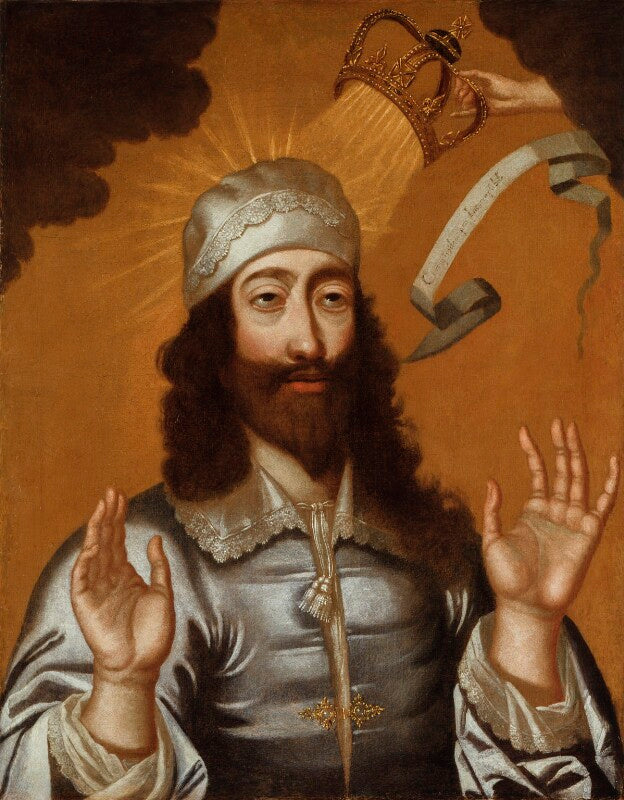
The Royal Martyr


Today is the anniversary of the regicide of King Charles I in 1649.

King Charles I NPG 4836


A devotional image of the Royal Martyr from the late seventeenth or early eighteenth century and now in the National Portrait Gallery
Image: NPG

Last year I posted about a number of links to sites concerning the cult and commemoration of the Royal Martyr and it seems appropriate to link to that again. The links can be seen by going to King Charles the Martyr


An additional example of a relic is linked to in another post from last year at Charles I King and Martyr


Wednesday, 29 January 2025

Heligoland


If you are someone to whom the name of Heligoland merely recalls the Shipping Forecast - it is indicativecof a certain kind of desperation when you listen to that as a landlubber - then a new video from The History Chap is quite an eye opener.

I knew something of the history of this British North Sea - or perhaps I should call it the German Ocean as it was often then termed - which was administered from 1814 until 1890 when it was ceded to the German Empirein return for Zanzibar and parts of Kenya and Uganda.

In many ways I regret this exchange. Heligoland could well have continued to develop into something like the Channel Islands or Gibraltar, combining local and British identities in an engaging cultural synthesis.

What was new to me was its role as a refuge for German liberal exiles, and of the writing there of at least one famous set of verses. In that respect it is similar to Victor Hugo’s exile in first Jersey and then Guernsey.


Identifying the Bosham home of King Harold II


GBNews reported yesterday the findings of an archaeological investigation at Bosham, on the shore of Chichester Harbour in West Sussex, which appears to have revealed conclusively the site of the house occupied for in the mid-eleventh century by Earl Harold Godwinson. According to the BayeuxTapestry, which depicts and names the house at Bosham, this was where the Earl spent time before his fateful journey to Normandy and his meeting with Duke William II. That resulted in his oath to support the claim of the Duke to succeed King Edward the Confessor as English monarch.

The identification of a late Anglo-Saxon aristocratic house would be very unusual in itself, but the fact that belonged to a figure as important as the future King Harold II makes this an extremely significant discovery indeed.


That is a press release from Newcastle University, the base for some of the academics who, together with others from Exeter, carried out the research, which adds more specific detail to the account at Archaeologists find ‘lost’ site depicted in the Bayeux Tapestry

Wikipedia has an account of Bosham, and the significant Anglo-Saxon work in the church at Bosham


Sunday, 26 January 2025

More on French Royalism


Coat of Arms of the Bourbon Restoration (1815-30).svg

Image: Wikipedia 

I have posted twice in recent days about commemorations in France of King Louis XVI, and of course once ventures onto the Internet the algorithm starts finding related videos.

Here then are a few more, starting with a Requiem Mass celebrated in Grenoble, which can be seen at Messe de requiem pour Louis XVI - Mardi 21 Janvier 2025 - Collégiale Saint André de Grenoble

The Count of Paris - King Jean IV - is shown attending a Mass at Saint-Germain l'Auxerroiswhich was the parish church for a couple of centuries for the Louvre, and he is briefly interviewed by the presenter, at Je vais à l’Hommage au roi Louis XVI et j'interview le comte de Paris ! 


There is an interview with the then Prince Jean from 2018, before the death of his father, which  can be seen at Interview Prince Jean d'Orléans, Comte de Paris - Complément d'Enquête


Finally there is his equivalent of a reigning monarch Christmas or New Year broadcast on which can be seen at Voeux de Noël 2024 | PRINCE JEAN D'ORLEANS, COMTE DE PARIS

Vive Le Roi !

Sta Maria Novella in Florence


Recently I came upon a video about the great Dominican church of Sta Maria Novella in Florence. It can be seen at Santa Maria Novella - Florence - Churches and Museums - Virtual Walk 

The Wikipedia account of the church is detailed and can be seen at Santa Maria Novella

Despite its Renaissance facade the building is late medieval Florentine gothic. Inside it is  decorated with many works by major artists of the early generations of later fourteenth and fifteenth century Florence. 

It was at this time that Sta Maria Novella was of great importance not just as the Dominican church in so important a centre as Florence, but as the administrative centre of the Catholic Church. From 1418-20 the newly elected Pope Martin V resided in a hastily constructed palace attached the north east of the church. This was a lengthy pause on his journey to Rome. This Papal building now serves as the provincial police academy. 

One of the people who either lived with the Pope or must have frequented the palace was Richard Fleming, who had been appointed as a Chamberlain to the new Pope immediately upon his election in 1417 at Constance. It was doubtless here that in 1420 Pope Martin “with wonderful piety”, as Fleming was to recall it later when he wrote his own epitaph, consecrated as a bishop on his appointment to the diocese of Lincoln. 

Amongst the paintings in the church is the famous fresco by Andrea di Bonaiuto da Firenze which is sometimes termed The Triumph of the Church but is more accurately The Allegory of the Active and Triumpthant Church and o the Dominican Order. This was painted in 1365-7. It must have been seen by Richard Fleming when he was in residence at Sta Maria Novella.

In addition to the figures mentioned in the main Wikipedia article it includes in the foreground a young man wearing the Garter of a Knight of the Order, and thought to be the earliest representation of the insignia. Given the date of the work the most likely candidate must be Lionel of Antwerp, first Duke of Clarence, who married a Visconti and died soon after in Italy in 1368.

Regular readers of this blog will recognise that part of the painting forms the masthead at the beginning.


Image:  Wikipedia

Friday, 24 January 2025

Robert Waterton


Last Friday was the six hundredth anniversary of the death at his manor house at Methley in the West Riding of Yorkshire of Robert Waterton. His splendid tomb, together with that of his second wife, remains as one of the great treasures of the church at Methley.

<span class=prefix>Sir</span> Robert Waterton
 
The tomb of Robert and Cicely Waterton in Methley Church 

Image: John Kirk on Find a Grave

Waterton, born sometime in the 1360s at Waterton in the north-west of Lincolnshire, was a member of a family whose lives and careers were shaped by service to the house of Lancaster. Although there is some uncertainty about the exact family relationships, and confusion in older works as to the number of Robert’s marriages, such that he has been identified as being both a father and a non-existent son, his life is otherwise well documented in the surviving records of the Crown and the Duchy of Lancaster. 

He seems to have been especially close to the future King Henry IV and in July 1399, together with two hundred foresters, met the returning Duke of Lancaster at Spurn Point, thus participating from the very beginning in the rising which rapidly unseated King Richard II.

Following the accession of King Henry IV Waterton as Steward of the Honour of Pontefract was probably one of the few people who knew with certainty the fate of the former king in Pontefract Castle. He was to be prominent in King Henry’s suppression of revolts against him. and a trusted and close counsellor, serving as Master of the Horse. His effigy suggests he cultivated his beard to resemble that of his master.

Although credited by Shakespeare as being a knight in “Richard II” he never received the accolade and was never more than an esquire, despite his wide ranging influence and responsibilities.Having had custody at Pontefract of the captive boy King James I of Scots he was to serve King Henry V as the custodian, at various times in the next decade in the same castle or his own house at Methley of numerous prisoners taken at Agincourt. These included the most prestigious of all Charles Duke of Orleans, the Duke of Bourbon, Arthur of Richmond, later Constable of France and Duke  of Brittany, and Marshal Boucicault, who died at Methley in 1421. Even though the King worried at times about their security he clearly trusted Waterton, and they maintained a correspondence that survives in part. The Waterton household appears to have been cultivated and affluent in these years, and based in Robert’s newly built Methley Hall. The social standing and cultured chivalric interests of his illustrious ‘guests’ must have made it an interesting community.

Waterton’s second wife, Cecily, was the sister of “my” Bishop Richard Fleming, whose earlier career Waterton clearly assisted. 

In many ways I feel Robert Waterton has been a constant companion to me since I was a schoolboy forming an interest in the later medieval period. It was therefore a privilege to advocate his inclusion, and to write the entry for him in the Oxford Dictionary of National Biography published in 2004.

If you have online access to the ONDB I would recommend you to read my article, although unfortunately it harder to be edited down from what I had originally submitted.

There is an excellent account of him also by Dr Sarah Rose which pay particular attention to his role as a custodian of French prisoners and also the child Richard Duke of York for King Henry V. That can be read at Robert Waterton and Henry V Summary The ... - Lancaster EPrints

Wikipedia has a biography of Waterton which is useful but it perpetuate the mistake but split him into two differentindividuals. It can be seen at Robert Waterton

The church at Methley deserves to be better known for its collection of tombs; in addition to that of Waterton and his wife that is that of their daughter and son-in-law Lord Welles, who by his second marriage was to become the stepfather of Lady Margaret Beaufort, as well as of the Savile family who have owned the estate since the late sixteenth century.

Robert Waterton is a quintessential example of a Lancastrian retainer from the time of John of Gaunt and King Henry IV. In succeeding generations his son-in-law. grandson and great grandson and at least one other relative died violent deaths in the service of the Lancastrian dynasty. Such was the bond of service the Lancastrians could command.

As the inscription on the tomb requests:

Pray for the soul of Robert Waterton & Cecily  his wife,
That God will take to his kingdom their poor & endless life


Commemorating King Louis XVI


Since I posted about the Solemn Requiem celebrated fo King Louis XVI on the anniversary of his death and linked to the video of the Mass I have found some other related videos that may be of interest. They represent both the Orleanist and the Legitimist traditions within French Royalism.

From the Orleanist side there is film of the Count of Paris - King Jean IV - attending a Mass on the anniversary at Le comte de Paris commémore le roi Louis XVI | 21 janvier 2025

His wife, the Countess of Paris, is seen in another video attending Mass elsewhere and being interviewed about King Louis XVI. That can be seen at La comtesse de Paris rend hommage au roi Louis XVI

Meanwhile on the Legitimist front there is a longer video covering a march by young French Royalists in Paris on, I assume, one evening before the anniversary, and on the Sunday beforehand a Mass at the Chapelle Expiatoire erected on the site of the original burial place of the murdered King and his Queen. This was attended by the Duke of Anjou - King Louis XX - and can be seen at Marche pour Louis XVI et commémoration du Roy Martyr en à la Chapelle Expiatoire and at Louik XX commémore Louis XVI à Paris - 19 janvier 2025

Another commemorative event in what is now the Place de la Concorde ( formerly the Place Louis XV, and then the Place de la Revolution ) where the King was killed is covered at Commémoration: 232 ans de la décapitation de Louis XVI - 21 janvier 2025

Now I would not go so far as to predict an imminent restoration, but the presence of so many young people for what many might dismiss ae a minority interest, is striking. Nevertheless given the mess the current government(s) and, indeed, present constitution has got France into the French could certainly do a lot worse than restoring the monarchy - though that would require deciding which of the two claimants to recognise as the undoubted King.

Vive Le Roi!


Wednesday, 22 January 2025

A thirteenth century ring from Fishlake in Yorkshire


Quite by chance I came upon an online article from 2023 on the BBC News website about the purchase for Doncaster Museum of a medieval ring found by a metal detector in 2020 at Fishlake, a village which lies a few miles north east of the city-

The striking gold ring dates, as his thought from the thirteenth century but its bezel is a first century Roman intaglio. The reuse of such stones was by no means uncommon in the medieval era. Around the stone is an inscription indicating that the ring was commissioned as a love token or friendship item. Photographs of the ring would suggest that it had been worn for a considerable time as the hope of the rain has become distorted. It is still a very impressive piece and when originally made would doubtless have resembled the type we are used to seeing in modern costume dramas set in the mediaeval centuries.


The ring is also featured on Detecting Finds at 

"Exciting find" goes on display


An article from the Yorkshire Post has additional images and can be viewed at Medieval ring fit for a king found by metal detectorist in Yorkshire village


Fishlake, as its name suggests, is in the formerly marshland area around the outfall of the rivers Don and Trent into the head of the Humber. Until it was drained in the early seventeenth century it had a distinctive and prosperous fenland-type economy, to which a series of impressive mediaeval parish churches, including that at Fishlake itself, still bear witness. Partly used as a hunting area known as Hatfield Chase it was used on occasion by royalty in the period. King Edward iII’s second son William was born at nearby Hatfield in 1336 when his parents were staying there for Christmas. He died very shortly afterwards and was buried in York Mister in February 1337. By the fifteenth century the Chase had become the property of the Dukes of York. With such royal and aristocratic connections, the discovery of such an impressive piece of jewelry should not perhaps be so surprising. Inevitably, its history is lost to us, and we can only speculate as to who commissioned and owned it or how it came to be lost.