Once I was a clever boy learning the arts of Oxford... is a quotation from the verses written by Bishop Richard Fleming (c.1385-1431) for his tomb in Lincoln Cathedral. Fleming, the founder of Lincoln College in Oxford, is the subject of my research for a D. Phil., and, like me, a son of the West Riding. I have remarked in the past that I have a deeply meaningful on-going relationship with a dead fifteenth century bishop... it was Fleming who, in effect, enabled me to come to Oxford and to learn its arts, and for that I am immensely grateful.


Showing posts with label Royal martyr. Show all posts

Thursday, 30 January 2025

The Royal Martyr


Today is the anniversary of the regicide of King Charles I in 1649.

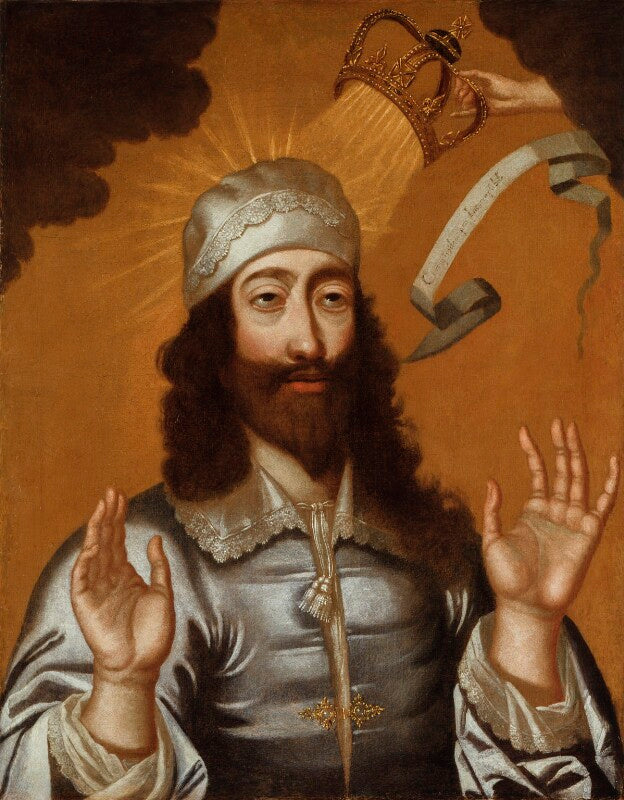
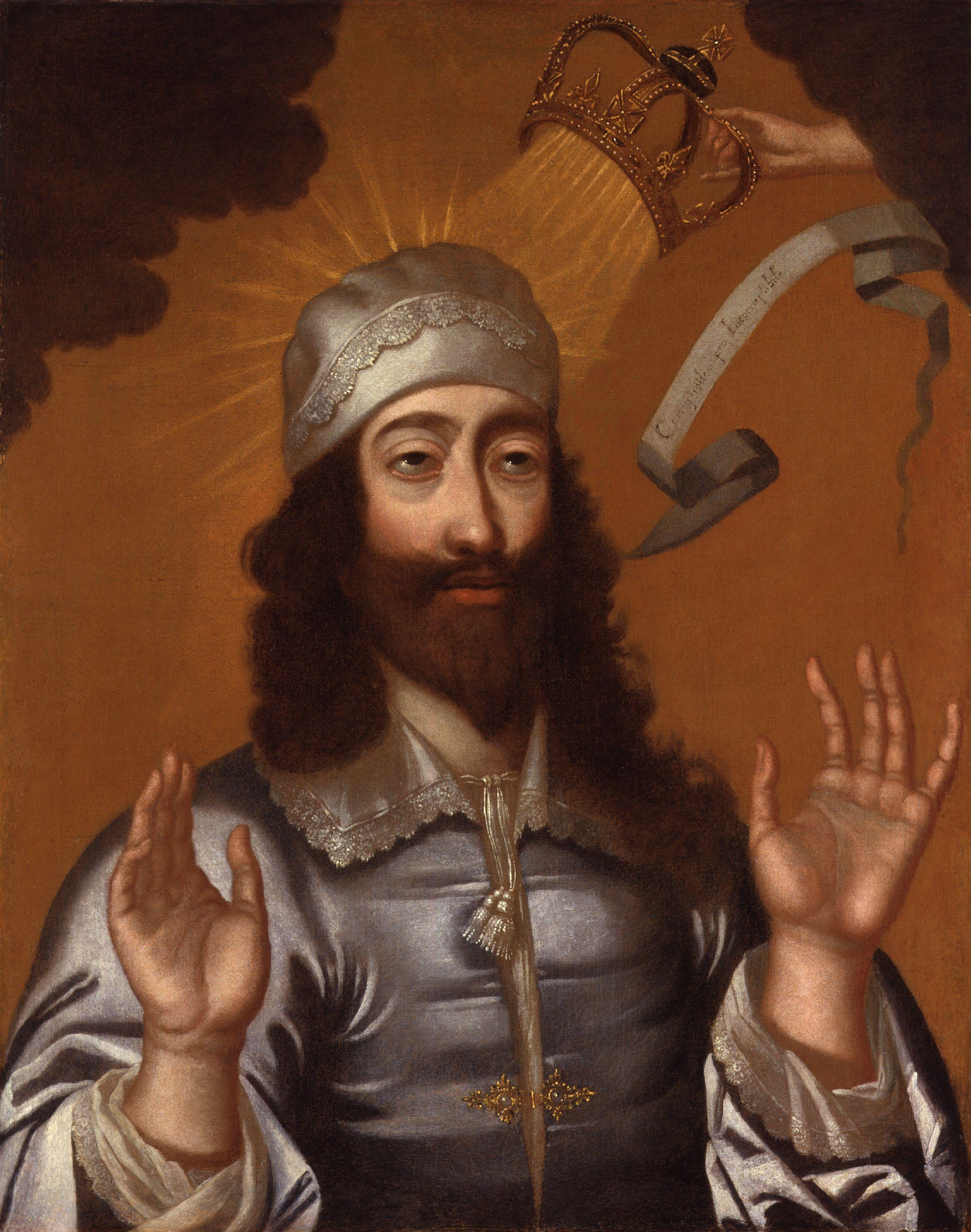
King Charles I NPG 4836


A devotional image of the Royal Martyr from the late seventeenth or early eighteenth century and now in the National Portrait Gallery
Image: NPG

Last year I posted about a number of links to sites concerning the cult and commemoration of the Royal Martyr and it seems appropriate to link to that again. The links can be seen by going to King Charles the Martyr


An additional example of a relic is linked to in another post from last year at Charles I King and Martyr


Wednesday, 30 January 2013

Commemorating the Royal Martyr


Today is the anniversary, the feast day if you will, of King Charles I.


Charles I (1600-1649)

King Charles I 
A portrait  after Van Dyck

Image:© National Maritime Museum, Greenwich, London

 Now it is I think fair to say, as I did on this day last year, that King Charles I frequently failed to display the political acumen necessary for the times and circumstances in which he lived. This was in part due to his nature and temperament, perhaps influenced, as I suggested recently in two posts, by a sense of mentally looking over his shoulder to the memory of his elder brother Henry. He was inclined to seek refuge in what he thought ought to happen rather than what was actually happening. It is also fair to say that his government faced entrenched problems as well as opposition that proved obdurate.

However that is not the point of commemorating him as King and Martyr.

File:King Charles I from NPG.jpg 

King Charles I - the Royal Martyr

A painting now in the National Portrait Gallery

Image:Wikipedia

It is not just respect and indeed awe at the way he approached his death, the martyrdom of a person, impressive and moving as that is in his case.

The King died as a martyr for the Church of England, and certainly for the most noble vision of it as a Catholically inclined national body. Had that vision not been preserved by the King's witness there would have been little chance of either the later seventeenth century flowering of Anglican devotion or of the impact of such ideas in generating the Oxford Movement  in the early nineteenth century. Today that vision seems to be the preserve of a minority, and a tradition valiantly upheld by the Society of King Charles the Martyr.  It is indeed appropriate that my old friends at Pusey House here in Oxford are marking the day with what they describe as a High Mass according to the Book of Common Prayer and veneration of a relic of the King.

The King died as a martyr for the Monarchy in that by refusing to compromise his rights and prerogatives in the negotiations in 1647-8 he avoided the destruction of its historic powers as an institution. The Restoration in 1660 was indeed that, the restoring of the traditional constitution, not of an enfeebled Crown.

The King died as a martyr for his people and the nation in that, as he pointed out at his trial, the people of England were not prosecuting him, but a radical military dictatorship who had seized power with Pride's Purge in 1648. Here again he reached out to the wider nation in defence of fundamental traditional rights - Subject and Sovereign might be clean different thing, but both were under threat from the clique who now sought to kill him.


The Death Mask of King Charles I
A painting at Turton Tower Lancashire

Image:BBC


My previous posts about this anniversary can be seen at The Royal Martyr , Post Mortem Patris Pro Filio and Col John Morris from 2011, and "Remember" from last year.

Monday, 30 January 2012

"Remember"


King Charles I's enigmatic command "Remember" to Bishop Juxon on the scaffold on this day in 1649 has become part of the collective memory of the events surrounding the King's death. Was it merely a reminder to carry out a last request or the more significant assumption of the role of royal martyr?

Remembrance is central to the cult of the Royal Martyr - the relics obtained of his hair and blood, as displayed in the recent exhibition at the British Museum, and as will be present at the SKCM's liturgy in the Banquesting House today, and the whole demeanor of the King who nothing mean or common did upon that memorable scene.

Image Detail

The iconography of the Royal Martyr

Image: Wikipedia

By his actions the King impressed remembrance of him upon the consciousness of his subjects, not just the fact of his judicial murder. This was his victory over his killers, a subtle undermining of his undoing. In that he followed in the footsteps of his grandmother Mary Queen of Scots ("In my death is my beginning"), and was to inspire King Louis XVI in similar circumstances in 1793.

As King he was clearly not the most skilled of politicians - one watches from a distance of three and a half centuries and observe him moving, if not inexorably, then certainly fatefully towards disaster and destruction; there is an urge to think "now you're not going to do that - oh, you just have..." Nor was he lucky as other were or are. One can see how he exasperated his friends and infuriated his opponants, and how his attempts to extricate himself from problems resulted in an impression of duplicity and untrustworthiness, particularly in the years 1640-42 and 1646-48.

http://mikespassingthoughts.files.wordpress.com/2011/04/king-charles-i-at-trial-2.jpg

King Charles I at the time of his trial
Portrait by Edward Bower

Image:mikespassingthoughts.wordpress.

Yet that was all washed away by the King's conduct at his trial, preparation for death and on the scaffold. By seeking to make him accountable to a court the Army and the Rump failed spectacularly. A discredited King, forced to compromise or rendered powerless, would have suited them and their plans to re-create a reformed state. By putting him on trial and killing him they gave King Charles the opportunity to stand alone against their use of force against the source of lawful authority. The man who suffered from a stammer lost his stammer in this supreme crisis and spoke for himself and his people. In his conduct and defence at Westminster, in his repeated questioning and denunciation of what they were claiming to do he vindicated his cause in words. On January 30th 1649 he vindicated his cause in his blood by his actions and behaviour. Here was political redemption of an individual and his cause, and, we may hope and trust, personal redemption for a devout man, who like everyone, King or commoner, was in need of salvation.

Killing the King may have been essential to achieve the "English revolution" (if such a thing ever existed or occurred), but by killing him the revolution was undermined and defeated - the traditional constitution could, and would, be restored.

My post from last year can be read at The Royal Martyr and there are two related posts about the events at Pontefract castle, where the garrison proclaimed King Charles II on the news of his father's death which can be read in Post Mortem Patris Pro Filio and Col John Morris.