Once I was a clever boy learning the arts of Oxford... is a quotation from the verses written by Bishop Richard Fleming (c.1385-1431) for his tomb in Lincoln Cathedral. Fleming, the founder of Lincoln College in Oxford, is the subject of my research for a D. Phil., and, like me, a son of the West Riding. I have remarked in the past that I have a deeply meaningful on-going relationship with a dead fifteenth century bishop... it was Fleming who, in effect, enabled me to come to Oxford and to learn its arts, and for that I am immensely grateful.


Showing posts with label King Louis XVI. Show all posts

Sunday, 26 January 2025

More on French Royalism


Coat of Arms of the Bourbon Restoration (1815-30).svg

Image: Wikipedia 

I have posted twice in recent days about commemorations in France of King Louis XVI, and of course once ventures onto the Internet the algorithm starts finding related videos.

Here then are a few more, starting with a Requiem Mass celebrated in Grenoble, which can be seen at Messe de requiem pour Louis XVI - Mardi 21 Janvier 2025 - Collégiale Saint André de Grenoble

The Count of Paris - King Jean IV - is shown attending a Mass at Saint-Germain l'Auxerroiswhich was the parish church for a couple of centuries for the Louvre, and he is briefly interviewed by the presenter, at Je vais à l’Hommage au roi Louis XVI et j'interview le comte de Paris ! 


There is an interview with the then Prince Jean from 2018, before the death of his father, which  can be seen at Interview Prince Jean d'Orléans, Comte de Paris - Complément d'Enquête


Finally there is his equivalent of a reigning monarch Christmas or New Year broadcast on which can be seen at Voeux de Noël 2024 | PRINCE JEAN D'ORLEANS, COMTE DE PARIS

Vive Le Roi !

Friday, 24 January 2025

Commemorating King Louis XVI


Since I posted about the Solemn Requiem celebrated fo King Louis XVI on the anniversary of his death and linked to the video of the Mass I have found some other related videos that may be of interest. They represent both the Orleanist and the Legitimist traditions within French Royalism.

From the Orleanist side there is film of the Count of Paris - King Jean IV - attending a Mass on the anniversary at Le comte de Paris commémore le roi Louis XVI | 21 janvier 2025

His wife, the Countess of Paris, is seen in another video attending Mass elsewhere and being interviewed about King Louis XVI. That can be seen at La comtesse de Paris rend hommage au roi Louis XVI

Meanwhile on the Legitimist front there is a longer video covering a march by young French Royalists in Paris on, I assume, one evening before the anniversary, and on the Sunday beforehand a Mass at the Chapelle Expiatoire erected on the site of the original burial place of the murdered King and his Queen. This was attended by the Duke of Anjou - King Louis XX - and can be seen at Marche pour Louis XVI et commémoration du Roy Martyr en à la Chapelle Expiatoire and at Louik XX commémore Louis XVI à Paris - 19 janvier 2025

Another commemorative event in what is now the Place de la Concorde ( formerly the Place Louis XV, and then the Place de la Revolution ) where the King was killed is covered at Commémoration: 232 ans de la décapitation de Louis XVI - 21 janvier 2025

Now I would not go so far as to predict an imminent restoration, but the presence of so many young people for what many might dismiss ae a minority interest, is striking. Nevertheless given the mess the current government(s) and, indeed, present constitution has got France into the French could certainly do a lot worse than restoring the monarchy - though that would require deciding which of the two claimants to recognise as the undoubted King.

Vive Le Roi!


Tuesday, 21 January 2025

Solemn Requiem Mass for King Louis XVI


YouTube has a video of the Solemn Requiem for King Louis XVI offered today at the church of Saint Eugène et Sainte Cécile in Paris on the 232nd anniversary of his judicial murder in 1793.  


Thursday, 21 January 2016

Requiems for King Louis XVI


Today is the anniversary of the guillotining of King Louis XVI in 1793.

Looking around on the internet I found that last year the Provost of the London Oratory celebrated a
Requiem Mass for King Louis XVI at Rye in Sussex as was reported by the Rye News as follows
www.ryenews.org.uk/news/requiem-mass-king-louis-xvi, with the comment that this may be the first Mass for King Louis XVI of France and Queen Marie Antoinette to be celebrated in St Mary's Rye. Very probably, but non ethe worse for that.

This year at Versailles itself on January 21st and 22nd in the Chapel Royal of the Palace there will be performances of the Requiems composed after the Bourbon Restoration by Cherubini in 1816 and by Plantard in 1823. Even if these are concerts rather than liturgical celebrations they an interesting sign in the current French climate. There is more about them at Requiem(s) for Louis XVI and Marie-Antoinette

These Versailles commemoration are included in the online list of Masses being offered for the repose of the soul of the King and the martyrs of the Revolution, which can be seen at Messes pour le repos de l'âme du Roi Martyr, Louis XVI. This is a not inconsiderable list, celebrated in cathedrals and churches across the length and breadth of France.


Wednesday, 21 January 2015

Je suis Louis


The violent events in Paris the other week and, more significantly in many ways,the reaction of the French political establishment and the media there and elsewhere have attracted considerable attention and comment.

Clearly such killings by terrorists are wrong and to be condemned - we certainly do not have a right to kill those we do not like or agree with. 

However being deliberately and provocatively offensive to others religious opinions is a dubious right to claim, and not easy to justify. Let's be honest - Charlie Hebdo is not Private Eye, and many of its cartoons were deeply offensive, indeed blasphemous, and I cannot imagine they would be published in this country in a magazine that would be available in newsagents. That they set out to offend Christians, Jews and Muslims alike does not mitigate this fact, rather it compounds it.

Not a few people have made these points in the media - on the blogs I read both Fr Blake (who reproduced some of Charlie Hebdo's deeply offensive covers) and Fr Hunwicke drew out these points in various posts.

Even the BBC pointed to French hypocrisy over freedom of speech when, in the name of freedom of speech the Hollande government proposes to prosecute the comedian Dieudonne M'Bala -in his own way as equally offensive as the magazine - for exercising his, er, freedom of speech...

The French, having avoided the various types of political and religious based terrorism that have affected the UK, Spain, the Netherlands, Germany and Italy in recent decades have been shaken out of their complacency - but only it would seem, to fall back into the assertion of republican values and secularism - to challenge that in any way is to be beyond the pale. Then they get so many European leaders to march through Paris - against terrorism, well and good, but also seemingly in support of an ironically narrow and bigoted version of "freedom of speech".

True freedom - if that is your cause - involves the right to say and write what you believe, but to offer respect to others different perspectives and to receive that respect in return. Freedom therefore requires self-restraint (i.e.good old fashioned good manners) and not to say you are curtailing someone else's right of free speech in the cause of free speech.
I am thinking these thoughts today especially as January 21st is the anniversary of the guillotining of King Louis XVI in 1793, the event which symbolises the repudiation of the Ancien Regime and its precursors.

So much of the contemporary French political ethos and discourse, founded on those shocking events over two centuries ago, seems to me sterile and stiffling, an insistant rejection of the past and its culture, an at times frantic denial of alternatives or of past crimes and failing by the revolutionary tradition. 

As a friend said to me the other day of the situation in France "Vive le Roi, a bas la republique"


** Having written this post I anm now given to understand that French monarchists have adopted a "Je suis Louis XVI" slogan for today.


Saturday, 23 August 2014

The birth of King Louis XVI


Today is the 260th anniversary of the birth at Versailles of the future King Louis XVI in 1754. He was the third son of Louis, Dauphin of France and Maria Josepha of Saxony, but the eldest one to survive childhood. His father died in 1765 and his mother in 1767, which brought him to prominance as Dauphin and heir, but at an early age. This was followed by his succession to the throne aged 19 in 1774.


File:Louis16-1775.jpg 

King Louis XVI at the age of 20

Image:Wikipedia

There is an online biography here, which gives some pointers both to his genuine mental abilities and also his profound shyness as a youth and young man, and also to the influence of tutors which may not have proved altogether helpful advice in the face of the mounting catastrophe he had to face after 1789.


The young King Louis XVI

Image:eponymousflower.blogspot

If in some ways he was perhaps a late developer  he was a man who was well intentioned, the promoter of humane values in his kingdom, and not opposed to reform. He was undoubtedly a good man, kind and caring for his family and for his subjects.

It is perhaps unclear how well he was prepared for his task, which was becoming ever more difficult with the need for reform, yet the system was too complex, with its inbuilt checks and balances, jealously defended by sectional and regional interests, to be other than tinkered with safely. The case for putting the Monarchy in the forefront of reform and seizing the advantage was a good one - attempted by his grandfather and his ministers in 1770, but then abandoned. Whether such a policy was possible is one question. Another is whether it could have actually worked in France in the ways that similar reforms were working in other European monarchies in the 1780s, including Austria, Spain and, indeed, after 1783, Britain.

King Louis XVI is sometimes derided for his hobby of making and repairing locks. However locks are complex mechanisms, requiring skill and attention. The King's tragedy, and that of his realm, was not that he could not solve or repair the complex mechanism of making the governance of the realm work, but that seemingly no-one could without smashing the whole to pieces.

With the often doubtful benefits of hindsight he has attracted criticism from both left for being incapable of seizing the initaitive for reform - or indeed for simply being King, and struggling to maintain his position - and from the right for irresolution and vacillation. Neither seem fair to a man placed in an uneviable position by events.


King Louis XVI receives the homage of the Knights of the Order of the Saint-Esprit after his coronation at reims in 1775

Image:forum.alexanderpalace.org 

Like King Charles I in England he attained full maturity and nobility in the way he faced his death.

A blood relic of the King has recently been analysed as can be seen from the article which can be viewed  here.


Saturday, 10 May 2014

Madame Élisabeth


Madame-elisabeth-2.jpg

 Madame Élisabeth

Image:Wikipedia

Today is not only the anniversary of the death in 1774 of King Louis XV, but also of the guillotining of his grandaughter Madame Élisabeth in 1794.
There is an illustrated online account of her life here, and one from the palace of Versailles website entitled Madame Elisabeth. There is another account of her, with good illustrations, here.

The interesting blog Tea at Trianon has a post from a few years ago The Death of Madame Elisabeth of France and the Digital library Project has the memoirs of her neice Madame Royale and of Cléry, King Louis XVI's valet which can be seen at The Ruin of a Princess.

Madame Élisabeth was clearly a determined and devout woman, noted for acts of charity. Probably the most opposed of her family to the revolution's challenge to the existing system, and who, devoted to her brother the King and his wife, stayed with them at the Tuilleries and in the Temple. By not feeling she may have sought to stiffen the King's resolve in the face of the revolutionary demands. By doing so she sacrificed her life. Whilst in the Temple she looked after Madame Royale after the Queen was removed to the Conciergerie, and knew nothing of her fate until her own death.

The cuase of her beatification was introduced in 1924.


Friday, 7 March 2014

Requiem for King Louis XVI in Paris


Rorate Caeli has a post with a really quite splendid, and beautiful, set of photographs of a Solemn Requiem Mass celebrated last year on 220th anniversary of his death for King Louis XVI in the church of St Eugene in the Archdiocese of Paris. 

The slide show from Flickr on the blog begins part way through the Mass, but if you play it through it comes to what is, I assume, the intended beginning, with pictures of a cataphalque bearing a crown and the riband of the Order of the Holy Ghost. The series continues through the traditional liturgy to the absolutions at the cataphalque and a group image of the altar party. It can be seen at  This is the Mass.

As I commented recently at the beginning of my post Commemorating King Louis XVI French Royalism displays a vitality of which few in this country seem to be aware.


Tuesday, 21 January 2014

Commemorating King Louis XVI


Today is the anniversary of the guillotining of King Louis XVI in 1793. French Royalism has had a somewhat chequered history ever since 1830, but it retains perhaps more vitality than many outside the country might credit it with. Last year the Radical Royalist blog had a post with a link to a list of the many Masses offered in France and elsewhere for the King on or close to the anniversary. It can be read here.


Fichier:LouisXVI-France1.jpg

King Louis XVI in 1786 
Portrait by A-F Callet

Image: fr.wikipedia.org


King Louis XVI faced an almost impossible task in governing a country with so many vested interests as Ancien Regime France. Most people saw the need for some kind of reform, from the King (and indeed his grandfather King Louis XV) downwards. The problem was that no-one in the establishment wanted their particular privileges removed or diminished and, once cracks appeared in the facade of the system, the Third Estate - which was hardly a unified set of interests  - could, and were, manipulated to more and more radical solutions by a section of the political intelligentsia.

Reform on the lines adopted by so many other eighteenth century monarchs, usually misnamed Enlightened despots - they were neither, but rather reformist monarchs formed in a traditional model of social organisation - was needed in France. The realm had become complacent and the system increasingly ossified; what had worked under King Louis XIV no longer worked as well under his great-great-great grandson. Trying to achieve such reforms as the revolutionaries attempted to do so rapidly in such sweeping changes was illusory and destabilising. Ironically Queen Marie Antoinette's brother the Emperor Joseph II pursued an often radical agenda in his reforing urge to change his domains, and there the conservative forces eventually put a brake on him. The Emperor in some of his rhetoric and actions looked at times very like the more moderate French revolutionaries. In other words the urge to reform was strong, but the issue was how who was in charge and how they responded to the situation facing them.

What was no doubt needed from King Louis XV and King Louis XVI was a commitment to reform they, it must, be admitted, did not possess to the extent that was needed, and able ministers who were backed by the Crown. 

What most certainly was not needed was the loss of control and the rapid and chaotic spread of revolutionary and millenarian ideas as happened from 1789, and the destructive mania that destroyed so much of value in the frequently vain quest for a new dispensation.

King Louis XVI might not in even different circumstances have been a great King, but he, and his family and realm, most certainly did not deserve the fate which overtook him and them, and which still scars the country. Like King Charles I in England or Bl. Charles of Austria he acquired a dignity in his fate which impressed contemporaries and should impress us now.


Wednesday, 16 October 2013

Queen Marie Antoinette


Today is the 220th anniversary of the death on the guillotine of Queen Marie Antoinette in 1793.


Queen Marie Antoinette in 1779

Portrait by Elisabeth Vigée-Lebrun

Image: Wikipedia

There is a good online narrative life of the Queen, which appears balanced and fair, and has a good selection of portraits, here. This deals with many of the allegations - usually complete calumnies - levied against her, both before 1789, and certainly after the collapse of the old order. For a variety of reasons she became an easy target for anti-Austrian, anti-Court propagandists, and for scurrilous gossip and speculation of the wildest and worst kind. The Queen's final years, and certainly the last thirteen months from September 1792, were a living nightmare, and her fate, and that of her husband and son, a lasting reproach to those who caused it and to those who defend the French Revolution.

Whatever her shortcoming and failings - and such as they were they were by no means untypical of her age, culture and context, and most of them appear to have been youthful indiscretions as a teenage Dauphine in the highly sensitive and gossip ridden world of Versailles - she was also a dutiful Queen, wife and mother. As the Ancien Regime unravelled after 1789 she, like the King and virtually everybody else, was unable to pick with any confidence a way through the shifting political waves - as their world fell about them the King and Queen were left increasingly vulnerable and defenceless to the onslaught - as Edmund Burke witnessed to his horror

The excellent blog Tea at Trianon concentrates of the life of the Queen and seeks to inform, as well as to correct the calumnies that have been persisted about her. I think the alleged remark about those asking for bread "Let them eat cake" is less often quoted these days - it was a line sometimes attributed  to Queen Marie-Therese, the wife of King Louis XIV, more than a century before Queen Marie-Antoinette's time. However it originated in a fictional piece by Rousseau, published in the mid-eighteenth century, and teh remark is delivered by an unnamed, and entirely fictional princess; this was published several year before the then Archduchess maria Antonia left Austria to marry the Dauphin Louis in 1770.

I believe the London Oratory has a tradition or custom of celebrating a Requiem Mass for the Queen on this day, and a definite cult of remembrance at least has flourished since the Bourbon Restoration, and the time of her and the King's reburial at St Denis.

The cult has led to memorabilia, books - good, bad and indifferent - films and myths; her terrible fate has become part of the conciousness of the western world.

I have visited the Chapelle Ardente in the Conciergerie in Paris on the site of the cell where she spent her last days which was created by King Louis XVIII, and also seen the striking mosaic in the apse of Sacré Cœur where together with King Louis XVI and King Louis XVII she is to be seen at prayer in the presence of Christ.

Of that more specific religious cult Nancy Mitford recounts the story of how with a companion she visited a house or collection devoted to the Queen's memory. When the visitors appeared a little critical of the Queen the curator responded forcefully that "La Reine etre une Sainte!" The Hon Nancy was wryly amused, but the King and Queen do deserve serious cosideration as Christian victims, rather as (part at least) of the Russian Orthodox Church have designated Emperor Nicholas Ii and his family as 'Passion bearers'

One of the more remarkable artifacts of the memorial cult was to be seen here in Oriel where a more than life-size terracotta bust of the Queen graced the rooms of a a now retired History Fellow, where it sat in the perpetually unlit hearth (there being no where else to place so large and grand an object) - undergraduates would surely get the message as to the attitude of their tutor to revolution.


Monday, 21 January 2013

The death and cult of King Louis XVI


Today is the 220th anniversary of the decapitation - the martyrdom - of King Louis XVI.

 Joseph Ducreux - Portrait of Louis XVI (1754-93) King of France, at the Temple


   King Louis XVI of France
A portrait done whilst he was imprisoned at the Temple by Joseph Ducreux

Image;art-ptints-on-demand.com


There is an account of the events of that terrible morning with descriptions and reminiscenses by some of those present which can be read here.

A fuller version of the extract from the memoirs of  the Abbe Edgeworth, the priest who accompanied the King to his death, can be read here.

The account of the King's death in The Times of January 25 1793 can be read here. It is prefaced by a very robust editorial, indicative of the British reaction to the French regicide.

In the latest version of this balanced online life of the King there is, towards the end, an account of the confirmation in 2012 of the survival of a relic of the King's blood in a gourd. It can be read here. There is more about the discovery in this article from the Daily Telegraph and in a piece from the BBC website here.

Prof. William Doyle has an interesting interpretive article in History Review about the significance or otherwise of the King's death in undermining the French monarchical ideal which can be read here.


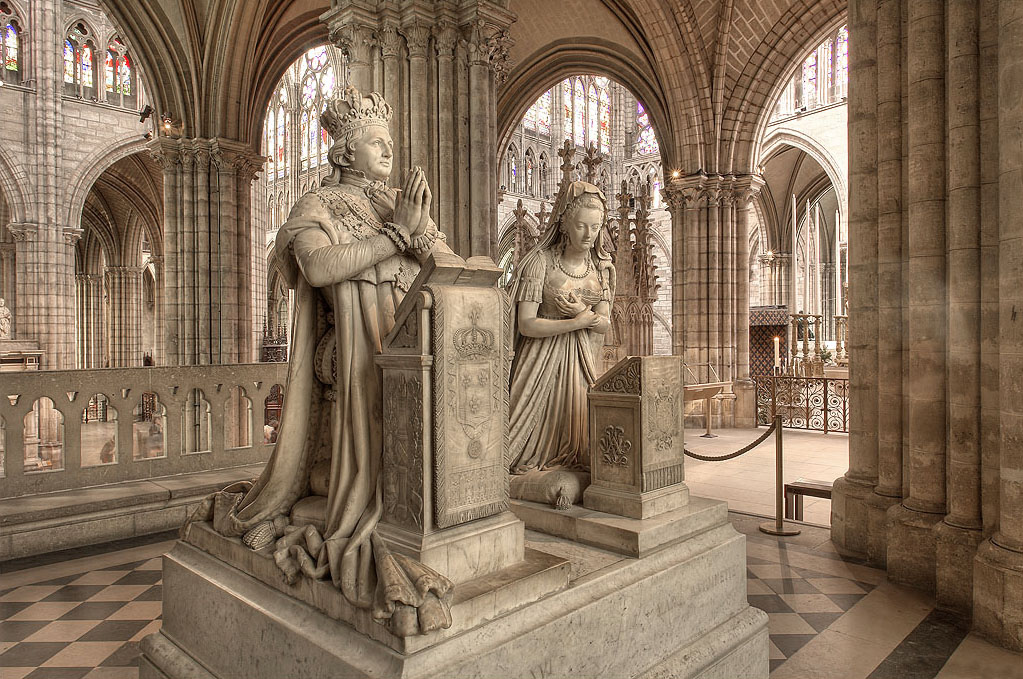
 File:Louis XVI et Marie-Antoinette.jpg 

 The memorial to King Louis XVI and Queen Marie Antoinette in St Denis which was erected after the Restoration of 1814-5 and their reburial in the Abbey in January 1815

Image: Wikipedia 

There is an illustrated online article about the Chapelle Expiatoire commissioned by King Louis XVIII in 1816 and completed under King Charles X in 1826 on the site of the King and Queen's original burial place here.


"Son of St Louis go up to Heaven" 

King Louis XVI Called to Immortality, Sustained by an Angel by François Joseph Bosio in the Chapelle Expiatoire

 Image: Wikipedia 

Although in 1820 the Church said that it was not possible to say that the King had been killed in defence of the Church rather than for political reasons his cult continued, and, following the political 
and constitutional disasters that affected the country after 1830, devotion to his memory and that of his Queen and son flourished in the later nineteenth century. I was struck on my visit in 1992 to  Sacré Cœur in Paris (built 1875-1914) to see in the mosaics of the sanctuary vault the figures of King Louis XVI, Queen Marie Antoinette and King Louis XVII:
Merson,Olivier. "L'hommage a la France", mosaic in the choir of the basilica of Sacre Coeur church financed by public contributions meant to atone for the occupation of France during the War of 1870/71 and the horrors of the Commune. Size of the mosaic: 475 sq. meters.
The Homage of France - King Louis XVI, Queen Marie Antoinette and King Louis XVII can be seen at the lower right of the picture.

Mosaic in Sacré Cœur

Image; lessing-photo.com


Today is one of the days on which I wear the fleur-de-lys badge I bought when in France in 2004 in my lapel as a mark of commmoration.

Vive le Roi!


95)

Saturday, 21 January 2012

" Son of St Louis ascend to Heaven"


Whether he had said "Son of St Louis ascend to Heaven" to King Louis XVI on the scaffold was something the Abbé Edgeworth could not recall afterwards such was his own fraught state, but it is one of those things which if it was not said ought to have been.

The phrase links the King to his illustrious and sainted ancestor and to the whole tradition of French sacral kingship which was being killed in the person of King Louis XVI on this day in 1793. Both in destroying the traditional institutions of governance and in destroying the man who was King the revolutionaries perpetrated a great act of injustice not only to a decent man who had sought to fulfill his obligations as monarch in an ever more difficult situation surrounded by mounting horrors - and therein lies his and his family's martyrdom - but also to the whole of the French people by depriving them of their corporate inheritance and means of self definition.

http://catherinedelors.com/blog/wp-content/uploads/Louis-16-adieux14.jpg

The farewell of King Louis XVI to his family in the Temple on the evening of January 20 1793

Image:catherine delours.blog

Whatever the need for genuine reform and renewal within the French system the onslaught on Throne and Altar, the deliberate seeking of the destruction of all that had been handed down - even to the ridiculous calendric reforms - went infinitely beyond what was required into a world of barbarism, insanity, and only partially rescued by a parvenu military dictatorship under the Corsican ogre. Bernard Fay concluded his biography of the King by saying that France has been morning ever since the moment the guillotine cut off his head. A powerful image which has remained with me. Once out of its bottle the genie of revolt and revolution and their vapid and spurious ideals has, alas, remained within the French political process - hence all the disorders since 1830 when the restored monarchy was overthrown.

To see this in action just observe the antics we shall find ourselves watching in the forthcoming "French Presidential Election." Admit it, you know I'm right.

My posts from last year can be read at King Louis XVI and The Orders worn by King Louis XVI.

I also commend to you this Prayer for the King of France.

Monday, 24 January 2011

The Orders worn by King Louis XVI


After writing my post last week about King Louis XVI it occurred to me that I could, and indeed should have said something about the Orders the King is wearing in the two portraits I included in my text.

In both paintings the King is wearing the premier Order of the French Crown, the Order of the Saint-Esprit (usually rendered in English as the Order of the Holy Ghost). It was founded in 1578 by KIng Henri III, and superceded the Order of St Michael, created by King Louis XI in 1469, as the most senior Order: thereafter Knights of the Saint-Esprit automatically received the Order of St Michael. There is a website about the Saint- Esprit here It has a few unfortunate mistranslations - such as rendering the 'Order of St Michael' as 'Michaelmas' produced by the automated system used - but is illustrated and informative.

There is another site which deals with all the French royal orders here.

In the portraits the King can clearly be seen wearing the sky blue moiree riband of the Order and the breast star with its motif of the Dove. The riband was the first to be prescribed in the statutes of an order, and is the origin of the term 'cordon bleu' as asign of honour. The Order specifically commemorated King Henri's accession to the thrones of Poland on Whitsunday 1573, and to that of France on Whitsunday 1574, and hence the use of the Dove as a symbol. It also served to recall the account of the Holy Dove bringing the Sainte-Ampoulle at the baptism of Clovis in 496, and the source of the Holy Oil used at the Sacre of the King at Rheims. The design of the breast star and badge of the Order was to be copied and adapted by nmany other orders in Spain, Sicily, Sweden and Great Britain with the badge of the Military Division of the Order of the Bath, with lions and unicorns replacing the fleur-de-lys.

Examples of the black mantles embroidered with flames worn by knights of the Order on ceremonial occasions can be seen in the Louvre. In Bernard Fay's biography
Louis XVI there is a reproduction of a painting of the knights paying homage to the King. It was in his reign, in 1778, that the bicentenary of the Order was celebrated and a commemorative medallion in silver produced by P.A.F. Tardieu.

H
File:Louis16-1775.jpg

King Louis XVI aged 20 in 1775

File:LouisXVI-France1.jpg

King Louis XVI in 1786

In both portraits the king is wearing on his jacket the badge of the Order of the Golden Fleece. I assume this is from the Austrian branch of the Order, through his marriage into the Habsburg dynasty. In the second
por
trait he is wearing with it the French Military Order of St Louis, founded in 1693. The red riband of that order was copied for the Napoloeonic and later Legion d'Honneur.

The chivalric orders of the monarchy were abolished by the revolution, but restored by King Louis XVIII. Amongst the recipients in those years were Britons such as King George IV and the Duke of Wellington. After 1830 the historic Orders were not retained under the Orleanist monarchy, although ocasionally worn and bestowed by the heirs of King Charles X.

In recent decades the Order has been revived, worn and bestowed by the Dukes of Anjou in respect of their claim through descent from King Philip V of Spain. In the photograph below, which shows him and his wife the present Duke of Anjou of that line, Louis Alphonse, who would claim to be
King Louis XX can be seen wearing the riband and star of the Order, as well as a collar of the Order of Malta.
Tke Their Royal Highnesses The Duke and Duche
In
Prince Louis Alphonse and Princess Maria Margarita, Duke and Duchess of Anjou

Friday, 21 January 2011

King Louis XVI


Today is the anniversary of the death on the guillotine of King Louis XVI in 1793.


File:Louis16-1775.jpg

King Louis XVI aged 20 in 1775

The course of his reign is well known, although revisionist historical work has not always filtered through to many popular perceptions of the causes and course of the terrible events which unfolded from 1789 onwards. Within the national tragedy inflicted upon France by the revolution there is also the personal tragedy of the King himself. Louis XVI's innate decency and moderation, not so say temperament, did not enable him to react as he might otherwise have to events. In many ways he was more suited to the role of King within the contemporary British model of George III rather than trying to resolve a system in need of a major overhaul, and pressures and politicians that did not, would not, wait.


File:LouisXVI-France1.jpg

King Louis XVI in 1786


Louis XVI and his family paid a terrible personal price for whatever failings there were in the Ancien Regime. France as a nation has paid a more terrible price for its rebellion against its historic roots and wellsprings. The sheer ingratitude expressed by so many of the French then and since to the institutions which had called into being - the Crown and the Church - is something I find shocking.

On January 21st 1815 the remains of the King and Queen were reinterred at St Denis, and in 1830 a memorial to the King and his Queen was erected nearby within the basilica.


The memorial to King Louis XVI and Queen Marie Antoinette,
sculptures by Edme Gaulle and Pierre Petitot in St Denis


Today is one on which I always seek to remember King Louis at Mass and to wear the fleur de lys badge I purchased when I was last in France. On a previous visit I was struck by the depiction of King Louis XVI and Queen Marie Antoinette kneeling, and in the presence of the Risen Christ, which decorates the apse of the Basilica of Sacre Coeur in Paris.