Once I was a clever boy learning the arts of Oxford... is a quotation from the verses written by Bishop Richard Fleming (c.1385-1431) for his tomb in Lincoln Cathedral. Fleming, the founder of Lincoln College in Oxford, is the subject of my research for a D. Phil., and, like me, a son of the West Riding. I have remarked in the past that I have a deeply meaningful on-going relationship with a dead fifteenth century bishop... it was Fleming who, in effect, enabled me to come to Oxford and to learn its arts, and for that I am immensely grateful.


Showing posts with label St Teresa of Avila. Show all posts

Thursday, 15 October 2015

St Teresa of Avila


Today is the feast day of that wonderful blend of profound and insightful mysticism with robust practical common sense, St Teresa of Avila.


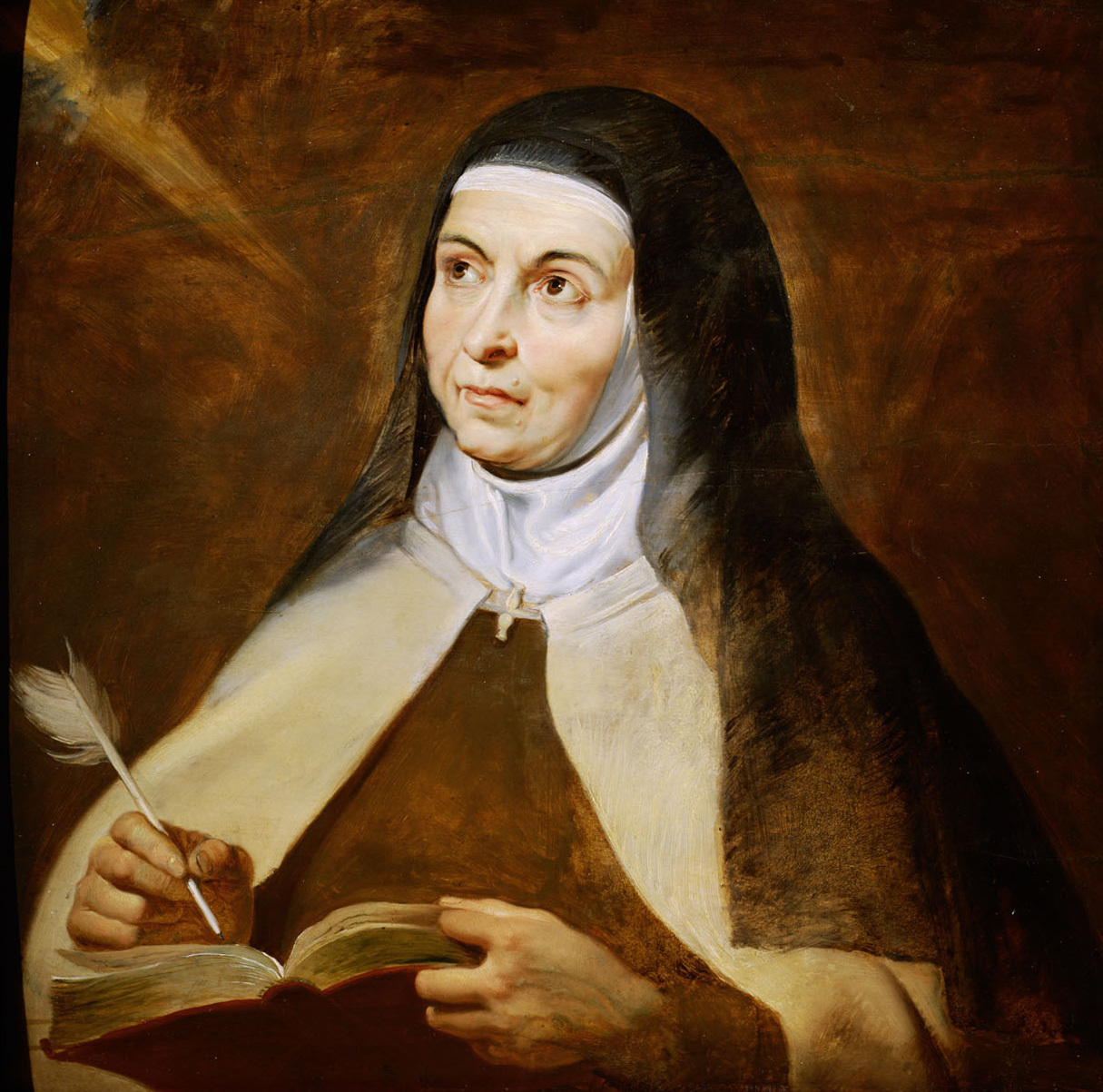
https://upload.wikimedia.org/wikipedia/commons/a/ae/Peter_Paul_Rubens_138.jpg 

St Teresa
A posthumous portrait by Peter Paul Rubens

Image: Wikipedia

This year is the fifth centenary of her birth in 1515 and so there is that added reason for celebrating today and giving thanks for the gift of her to the Church, for her reform of the Carmelites - no mean achievement by any standards to create a new community that has borne such fruit over the succeeding centuries - and for her writings. There have such directness and are a rich source for spiritual discernment as well as a record of living the Christian and monastic life in practice, and also a marvellous insight into life in Spain between 1515 and 1582.


https://blogger.googleusercontent.com/img/b/R29vZ2xl/AVvXsEh2gaitwKoEJM1l85BuG6BdBwv3WOqTEH4S4ieyIXaGhurcUa1fnVphjrXva7_gTzf_7lqPMlwOb3vX9wDPw4FlDIMHUo8mg0UdtFoG2HfVsbtXnETvW_1kUATd1Qean9tZ-SW7xUMHaqQ/s400/St+Teresa+of+Avila.png

St Teresa
 A more nearly contemporary portrait 
 
Image umblepie-northerterritory.blogspot.com 


May St Teresa pray for us 


Saturday, 28 March 2015

St Teresa 500


Today is the quincentenary of the birth of that very great saint Teresa of Avila.

http://upload.wikimedia.org/wikipedia/commons/a/ae/Peter_Paul_Rubens_138.jpg

St Teresa of Avila

A posthumous portrait by Peter Paul Rubens from 1615
Kunsthistorische Museum

Image: Wikimedia

I find her robust and practical common sense a very attractive feature - you feel she would have been fun to meet and talk to. Equally she impresses by her steelly determination to achieve what she set out to do. Her Autobiography and her account of her Foundations of Discalced Carmelites as well as her Letters make fascinating reading, full of incident and insight, a rich portrait of the world she inhabited. Most of us are not mystics - but maybe that should not, indeed ought not, stop us trying to be one - and St Teresa is awonderfully human companion on that journey of exploration. Indeed her travels through Castile can be seen as an image and allegory of her interior journey just as much as her Interior Castle is a tour of her own soul.

 
File:Teresa de Jesús.jpg 

St Teresa of Avila and her signature 

Copy of a contemporary painting of 1576 when she was 61 by Fray Juan de la Miseria
Carmelite Convent Seville

Image: Wikimedia 


May St Teresa continue to pray for us all


Friday, 2 May 2014

Celebrating St Joseph


Gegory Di Pippo at the New Liturgical Movement has built upon comments by Fr Hunwicke on his blog to produuce this interesting piece on the Calendar confusions and congestion around the observance of the feast of St Joseph the Worker yesterday. His post also discusses some other feast days that fall, or no longer fall, hereabouts. It can be read at Some Liturgical Notes on St Joseph the Worker (and a Few Dominican Saints)


Tuesday, 15 October 2013

St Teresa of Avila


Today has been the feast day of St Teresa of Avila, and this evening at our meeting of the lay Brothers of the Oratory Fr Jerome marked the occasion by going through just one of her letters to explore her personality and spirituality. In that one letter she engaged in humorous banter with her correspondent, passed on news of her latest foundation, retailed news of her own health, enquired after his and also gave several succinct and pertinent points about the life of prayer and how to foster and develop it - and all in a forthright, uncomplicated and very accessible way. This was in Fr Jerome's view quintessential St Teresa, and I am in entire agreement with his interpretation.

042_TeresaAvila.jpg - 34307 Bytes

St Teresa of Avila

Image:tradition in action

I have read both some of her letters and also some of her books. They all have a slightly breathless practicality and good humour that makes you want to read more, and whenever I do look at her works I do indeed intend to find the time to read more of her writings or books about her - but then, and I am sure she would understand, I get distracted and do not follow through with my intention. Maybe next Advent or Lent...?

You want to read more because St Teresa is so comfortably human and humane, full of practical common sense alongside sublime spiritual insights. Her humanity makes her seem to be a true companion, someone whom it would be good fun to meet, and yet also someone who in a few phrases can convey the deepest truths.

Her Autobiography, which clearly owes quite a bit to St Augustine's Confessions, despite her protestations of feminine inadequacy, is a wonderfully self-aware portrait.

As a historian I find such a self-portrait of a sixteenth century woman, or the bustling busy nun of the Letters, who can find time to scribble down The Interior Castle between the office, cooking and founding new Carmels on her travels along the bumpy, mountainous and flooded roads of the Spain of her day a quite fascinating historical source. You hear the authentic voice of a sixteenth century Spanish woman - the fact that she is a Saint and a Doctor of the Church is a huge bonus - but she is a vibrant and intriguing personality. 

As a result I am tempted to say that I tend to find her more immediately accessible as a flesh and blood human being than the equally great fellow Carmelite Doctor and namesake St Therese of Lisieux from the much more recent nineteenth century - the world of the Martin family in some way appears less immediately understandable than the more remote world of Philip II's Spain.


Wednesday, 22 February 2012

Lenten plans


I recently heard a sermon in which the visiting priest, from Opus Dei, challenged his hearers to make this the "best Lent yet." I always hope to do that, and took his idea as a pointer to what to aim for.

Last year I said I hoped or, indeed, intended to read in Lent some of the thought and spirituality of St Teresa of Avila - and failed to do so at all. Which, of course, told me something about myself. Last night, when we were having our Shrove Tuesday dinner, the Brothers of the Oratory decided amongst ourselves to read The Interior Castle as our Lenten book. So maybe this year St Teresa will get another chance to influence my formation. It is many years since I read The Interior Castle, so it will be a case of reacquainting myself with the text.

I have some other books in my sights for reading this Lent - theology merging with history rather than spirituality. I tend to use the former rather like layng down individual paving stones in the garden of my soul and letting the flowers of spirituality grow up around them - now there's a clever image I tell myself in a lack of humility...

Continuing the metaphor, I have marked down certain areas of my personality for some spiritual weeding and pruning - and I realise it is a pretty overgrown garden I am dealing with.

I think I have come up with a reasonably practicable regime to enable me to fast or abstain - and when that has worked in the past it has usually brought both spiritual and physical benefits - so losing some weight may well be an additional benefit.

A suitable restrained and spiritually profitable Lent to you all.


Thursday, 10 March 2011

Lent reading plan


Every Lent I mean to do more spiritual reading and more often than not that good intention goes the way of most good intentions...

This year I am more hopeful as we have agreed that the Brothers of the Oratory here in Oxford would aim to read the Pope's new book Jesus of Nazareth - Holy Week as part of our Lenten discipline.

On the basis of my other reading of his work, I am really looking forward to doing so.

Otherwise I would like to read some more of the work of St Teresa of Avila, and to learn more about her.


St Teresa of Ávila
by Peter Paul Rubens
Image: Wikipedia

A friend has lent me the biography by Marcelle Auclair, and I recently got a copy of the saint's letters, as well as E Allison Peers' introduction to the Spanish mystics, so I hope to become a little more knowlegeable over the next few weeks. I am attracted by St Teresa's sanctified common sense.

For other reading - and I rather doubt if it will happen in my case - I see from the Hermeneutic of Continuity that Fr Bryan Jerabek has updated the pages of his Lenten Reading Plans to give this year's dates. These reading plans are provided to assist people with their daily meditation. There are four plans with readings from the Fathers, Lives of the Saints, Newman/Faber, and St John Vianney. Last year I started on the Patristic series, and found it an excellent scheme, but once one misses a day or two it becomes well nigh impossible to catch up. However I may try to follow the series again.