Once I was a clever boy learning the arts of Oxford... is a quotation from the verses written by Bishop Richard Fleming (c.1385-1431) for his tomb in Lincoln Cathedral. Fleming, the founder of Lincoln College in Oxford, is the subject of my research for a D. Phil., and, like me, a son of the West Riding. I have remarked in the past that I have a deeply meaningful on-going relationship with a dead fifteenth century bishop... it was Fleming who, in effect, enabled me to come to Oxford and to learn its arts, and for that I am immensely grateful.


Showing posts with label St Stephen. Show all posts

Thursday, 26 December 2024

Celebrating St Stephen in the Ambrosian Rite


The New Liturgical Movement website marks St Stephen’s Day with an interesting article about the Gospel reading for the Mass for today in the Ambrosian Rite as used in Milan. It demonstrates very well the antiquity of the traditional lectionaries.  

It also includes a video from a parish under his patronage in Ticino, near Milan, of the opening of the Mass there on St Stephen’s Day in 2018 with the lighting of the faro. A splendid ceremony, very laudable, but not one to do without ecclesiastical approbation, or indeed, a fire extinguisher to hand ….

The article can be seen at The Ambrosian Gospel of St Stephen


St Stephen

 
Today is the Feast of St Stephen the Martyr.

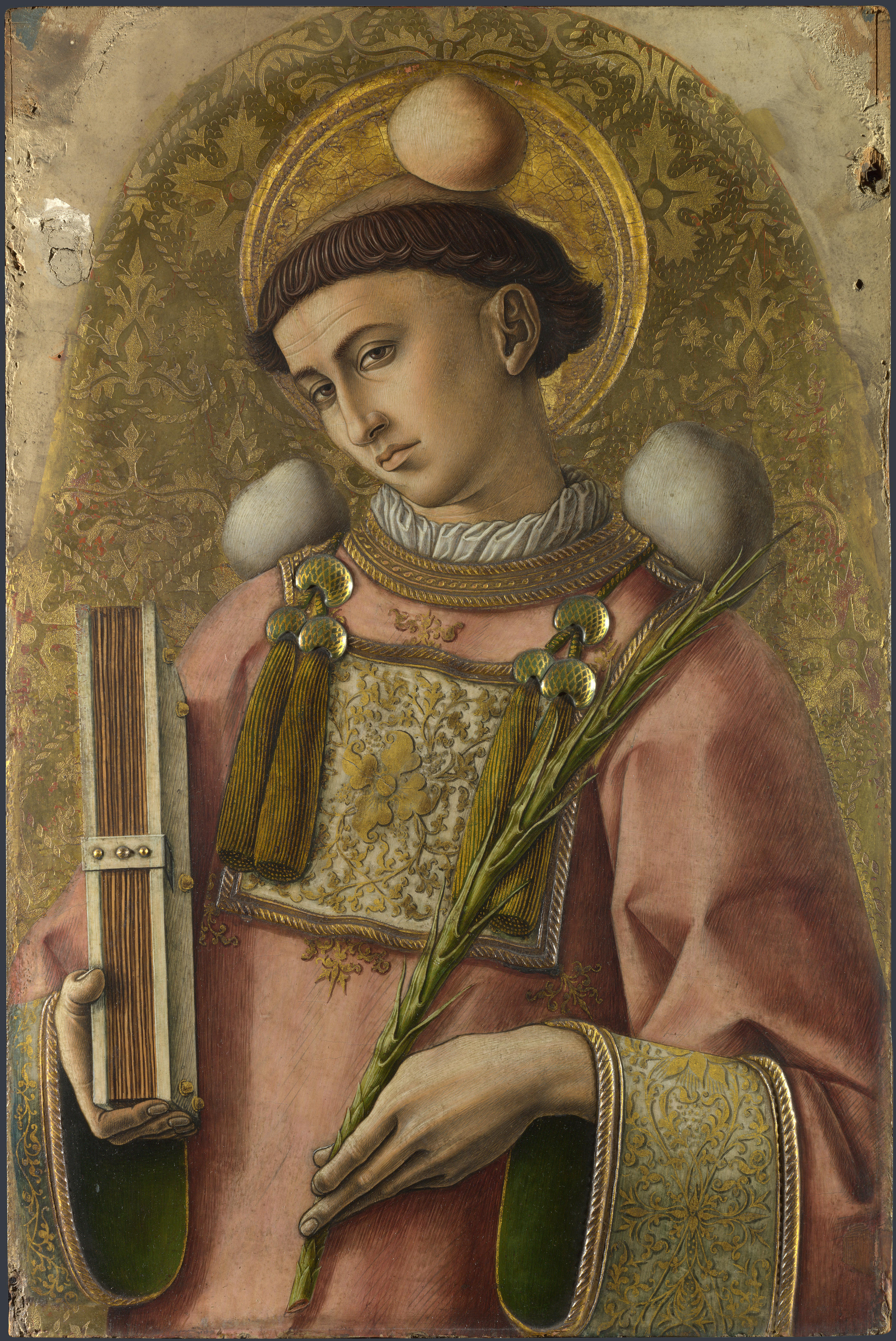
File:St-stephen.jpg

St Stephen from The Demidoff Altar by Carlo Crivelli. Painted in 1476 it is now in the National Gallery.

Image: Wikipedia 

Wikipedia recounts the life of St Stephen from the Acts of the Apostles and discusses his veneration in Saint Stephen

Ten years ago I wrote about St Stephen and linked several artists depictions of him and his martyrdom in St Stephen's Day

I would add to the notes about the painting of the diagonal ordination a link to the Catholic Encyclopaedia about the delivery of the instruments, in this case the chalice and paten for the deacon to prepare at Mass, which can be seen at Holy Orders


In my post there is also a reference to the sermon of St Fulgentius of Ruspe. This is quoted in the fourth, fifth and sixth lections at Matins in the Traditional Breviary as follows:

Yesterday we were celebrating the birth in time of our Eternal King; today we celebrate the victory, through suffering, of one of His soldiers. Yesterday our King was pleased to come forth from His royal palace of the Virgin's womb, clothed in a robe of flesh, to visit the world; today His soldier, laying aside the tabernacle of the body, entereth in triumph into the heavenly palaces. The One, preserving unchanged that glory of the Godhead which He had before the world was, girded Himself with the form of a servant, and entered the arena of this world to fight sin; the other taketh off the garments of this corruptible body, and entereth into the heavenly mansions, where he will reign for ever. The One cometh down, veiled in flesh; the other goeth up, clothed in a robe of glory, red with blood.

The One cometh down amid the jubilation of angels; the other goeth up amid the stoning of the Jews. Yesterday the holy angels were singing, Glory to God in the highest; today there is joy among them, for they receive Stephen into their company. Yesterday the Lord came forth from the Virgin's womb; today His soldier is delivered from the prison of the body. Yesterday Christ was for our sakes wrapped in swaddling bands; today He girdeth Stephen with a robe of immortality. Yesterday the new-born Christ lay in a narrow manger; today Stephen entereth victorious into the boundless heavens. The Lord came down alone that He might raise many up; our King humbled Himself that He might set His soldiers in high places.

Why brethren, it behoveth us to consider with what arms Stephen was able, amid all the cruelty of the Jews, to remain more than conqueror, and worthily to attain to so blessed a triumph. Stephen, in that struggle which brought him to the crown whereof his name is a prophecy, had for armour the love of God and man, and by it he remained victorious on all hands. The love of God strengthened him against the cruelty of the Jews; and the love of his neighbour made him pray even for his murderers. Through love he rebuked the wandering, that they might be corrected; through love he prayed for them that stoned him, that they might not be punished. By the might of his love he overcame Saul his cruel persecutor; and earned for a comrade in heaven, the very man who had done him to death upon earth.

Quotation from Divinum Officium

A damaged, but still charming, late medieval English depiction of St Stephen from the rood screen in the rural church at Hempstead in north Norfolk can be seen on Flickr Hempstead screen: St Stephen | St Andrew, Hempstead, Norfolk


Wikipedia has a separate article about an old English carol with a wildly implausible account of the saint’s death at Saint Stephen and Herod


JSTOR has an article about an old English and Irish custom, that of killing wrens ( the feathered variety, not the naval ones) to mark St Stephen’s Day. Much as I favour maintaining and reviving old customs I definitely think this one should be relegated to the past. The article can be read at Wren Folklore and St. Stephen's Day - JSTOR Daily


Saturday, 26 December 2015

St Stephen's martyrdom


Here are two of the images posted by John Dillon on the Medieval Religion discussion group of St Stephen's martyrdom to mark his feast day today:


Bernardo Daddi fresco of 1324 in Florence's basilica di Santa Croce


Beato Angelico  fresco cycle of circa 1448 in the Vatican's Cappella Niccolina


By clicking on the links you can view larger images of the paintings.


Friday, 26 December 2014

St Stephen's Day


St Stephen, whose feast falls today is, of course, venerated as the first martyr of the Church - apart that is from the claims to that dignity of the Holy Innocents and St John the Baptist. To mark his feast I am republishing a post from this day three years ago with a few emendations and additions.
http://cache2.artprintimages.com/p/LRG/13/1348/GUCS000Z/art-print/michael-pacher-the-stoning-of-st-stephen-from-the-altarpiece-of-st-stephen-circa-1470.jpg
The Stoning of St Stephen
From the St Stephen Altarpiece by Michael Pacher c.1470

Image: art.com

There are a series of readings and traditional devotions to him, as well as various depictions here.


St Stephen.
He is quite often shown in a standing pose but being bombarded with stones.
A rather effete depiction of a saint who was anything but that, being noticeably robust according to the Acts of the Apostles in Chapter 6 and Chapter 7.

The remainder of this post is adapted from a post from this day in 2005 on A Catholic Life.

"If you know what witness means, you understand why God brings St. Stephen, St. John, and the Holy Innocents to the crib in the cave as soon as Christ is born liturgically. To be a witness is to be a martyr. Holy Mother Church wishes us to realize that we were born in baptism to become Christ — He who was the world's outstanding Martyr" (Love Does Such Things by Rev. M. Raymond, O.C.S.O.)

We have only just celebrated the birth of our Lord and already the liturgy presents us with the feast of the first person to give his life for this Baby who has been born. Yesterday we wrapped Christ in swaddling clothes; today, he clothes Stephen with the garment of immortality. Yesterday, a narrow manger cradled the baby Christ; today, the infinite heaven has received Stephen in triumph (St. Fulgentius, Sermon 3)


This painting is a detail from The Ordination of St Stephen by Blessed Fra Angelico
(circa 1395-1455) in the Niccoline chapel in the Vatican.
Saint Peter is ordaining Stephen to the diaconate while Saint John the Beloved (whose feast is tomorrow), holding his Gospel, looks on.

The composition is remarkable: the three heads of Peter, John and Stephen form a triangle, a symbol of communion in the Three Divine Persons. Peter is handing over the chalice and paten which are very large. Fra Angelico makes the Most Holy Eucharist central; he paints what Saint Thomas Aquinas taught, i.e. that the unity of the Church is constituted and held together by participation in the adorable Body and Blood of Christ.

Source for the above excerpt: Vultus Christi

The Martyrdom of St Stephen.
A rather florid Baroque view.

Saint Stephen, martyr of Christ, ora pro nobis. Amen

Grant us, we beseech Thee, O Lord, so to imitate what we revere, that we may learn to love even our enemies: for we celebrate the heavenly Birthday of him who knew how to pray for his very persecutors to our Lord Jesus Christ, Thy Son: Who liveth and reigneth with Thee.

1962 Daily Missal

Images: A Catholic Life blog

The following year I posted another depiction of his death - again very much in the most dramatic Baroque style:

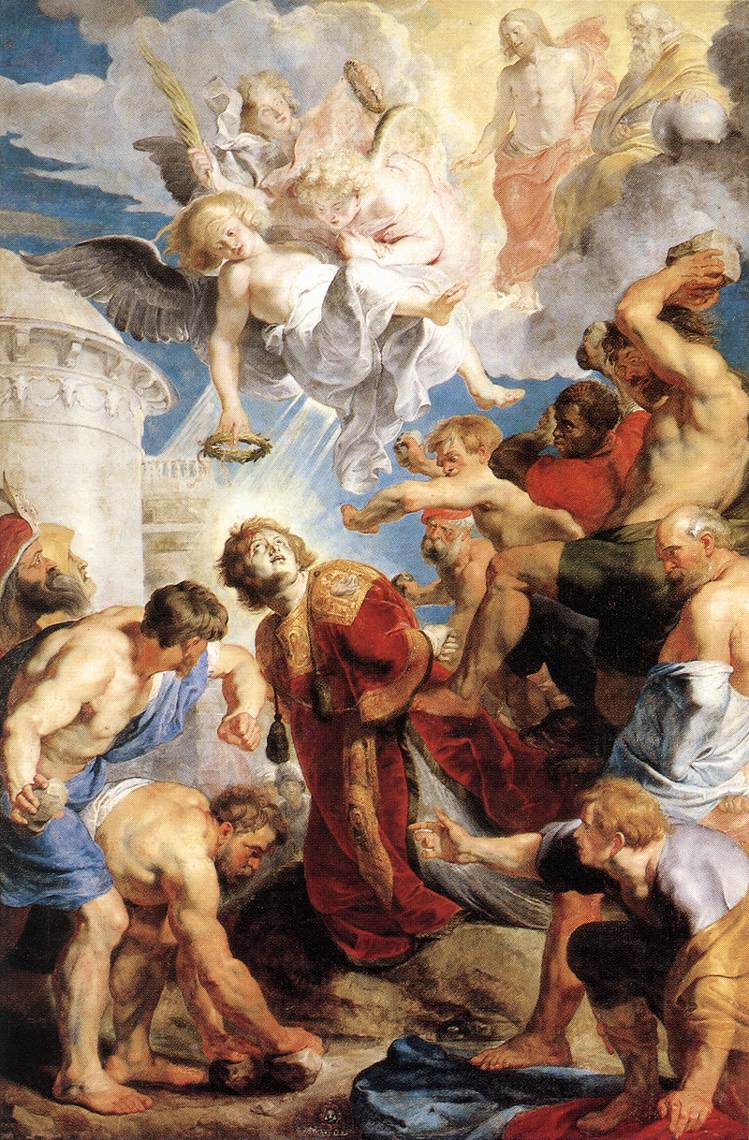
Fichier:Peter Paul Rubens - The Martyrdom of St Stephen - WGA20224.jpg

The Martyrdom of St Stephen

Sir Peter Paul Rubens
1616/17
Musee des Beaux Arts, Valenciennes

Image: fr.Wikipedia

That year I also posted St Stephen at Bourges about one of the greatest churches under his patronage.


Wednesday, 26 December 2012

St Stephen at Bourges


Despite his importance as the first Christian martyr St Stephen is not the patron of many cathedrals or other great churches. Amongst those which are under his patronage, apart from Vienna and the abbey at Caen - and the onetime chapel of the royal palace at Westminster - probably the most famous is Bourges, the seat of an archbishopric, and often described as one of the finest of all French cathedrals - it suffered less during the Wars of Religion and the French revolution than others. There is an illustrated online introduction to the cathedral here.

Not surprisingly one of the western portals depicts the story of the patron saint:


photo

 
The St Stephen Portal of Bourges of 1260-75 

The typanum reads from bottom left - the ordination of the first seven deacons, then, I assume, to the right Stephen's dispute with the Jews. In the middle register he is stoned, whilst Saul looks after the garments of the killers on the left, and Stephen's soul taken up to God in the top

Image: Stan Parry on Flickr


Inside the cathedral his martyrdom is depicted in medieval stained glass in the ambulatory. The window is partly medieval, partly nineteenth century restoration, as is explained in this schematic account of the window as whole, with hyperlinks to views of the panels.

Here are the two medieval panels showing the stoning and martyrdom:


Panels 17 and 18 from the St Stephen window

Image :medievalart.uk


St Stephen by Rubens


Today is the feast of St Stephen the protomartyr. I posted about him, his cult and some of his depictions in art, with appropriate links, last year in St Stephen.
.
This year here is another depiction of his death - again very much in the most dramatic Baroque style:

Fichier:Peter Paul Rubens - The Martyrdom of St Stephen - WGA20224.jpg

The Martyrdom of St Stephen

Peter Paul Rubens
1616/17
Musee des Beaux Arts, Valenciennes

Image: fr.wikipedia


Monday, 26 December 2011

St Stephen


St Stephen, whose feast falls to day is, of course venerated as the proto-martyr of the Church.
http://cache2.artprintimages.com/p/LRG/13/1348/GUCS000Z/art-print/michael-pacher-the-stoning-of-st-stephen-from-the-altarpiece-of-st-stephen-circa-1470.jpg
The Stoning of St Stephen
From the St Stephen Altarpiece by Michael Pacher c.1470

Image: art.com

There are a series of readings and traditional devotions to him, as well as various depictions here.


St Stephen.
He is quite often shown in a standing pose but being bombarded with stones.
A rather effete depiction of a saint who was anything but that, being noticeably robust according to the Acts of the Apostles in Chapter 6 and Chapter 7.

The remainder of this post is adapted from a post from this day in 2005 on A Catholic Life.

"If you know what witness means, you understand why God brings St. Stephen, St. John, and the Holy Innocents to the crib in the cave as soon as Christ is born liturgically. To be a witness is to be a martyr. Holy Mother Church wishes us to realize that we were born in baptism to become Christ — He who was the world's outstanding Martyr" (Love Does Such Things by Rev. M. Raymond, O.C.S.O.)

We have only just celebrated the birth of our Lord and already the liturgy presents us with the feast of the first person to give his life for this Baby who has been born. Yesterday we wrapped Christ in swaddling clothes; today, he clothes Stephen with the garment of immortality. Yesterday, a narrow manger cradled the baby Christ; today, the infinite heaven has received Stephen in triumph (St. Fulgentius, Sermon 3)


This painting is a detail from The Ordination of St Stephen by Blessed Fra Angelico
(circa 1395-1455) in the Niccoline chapel in the Vatican.
Saint Peter is ordaining Stephen to the diaconate while Saint John the Beloved (whose feast is tomorrow), holding his Gospel, looks on.
The composition is remarkable: the three heads of Peter, John and Stephen form a triangle, a symbol of communion in the Three Divine Persons. Peter is handing over the chalice and paten which are very large. Fra Angelico makes the Most Holy Eucharist central; he paints what Saint Thomas Aquinas taught, i.e. that the unity of the Church is constituted and held together by participation in the adorable Body and Blood of Christ.

Source for the above excerpt: Vultus Christi

The Martyrdom of St Stephen.
A rather florid Baroque view.

Saint Stephen, martyr of Christ, ora pro nobis. Amen

Grant us, we beseech Thee, O Lord, so to imitate what we revere, that we may learn to love even our enemies: for we celebrate the heavenly Birthday of him who knew how to pray for his very persecutors to our Lord Jesus Christ, Thy Son: Who liveth and reigneth with Thee.

1962 Daily Missal

Images: A Catholic Life blog