John Dillon posted as follows on the Medieval Religion discussion group for today's feast of St Michael:
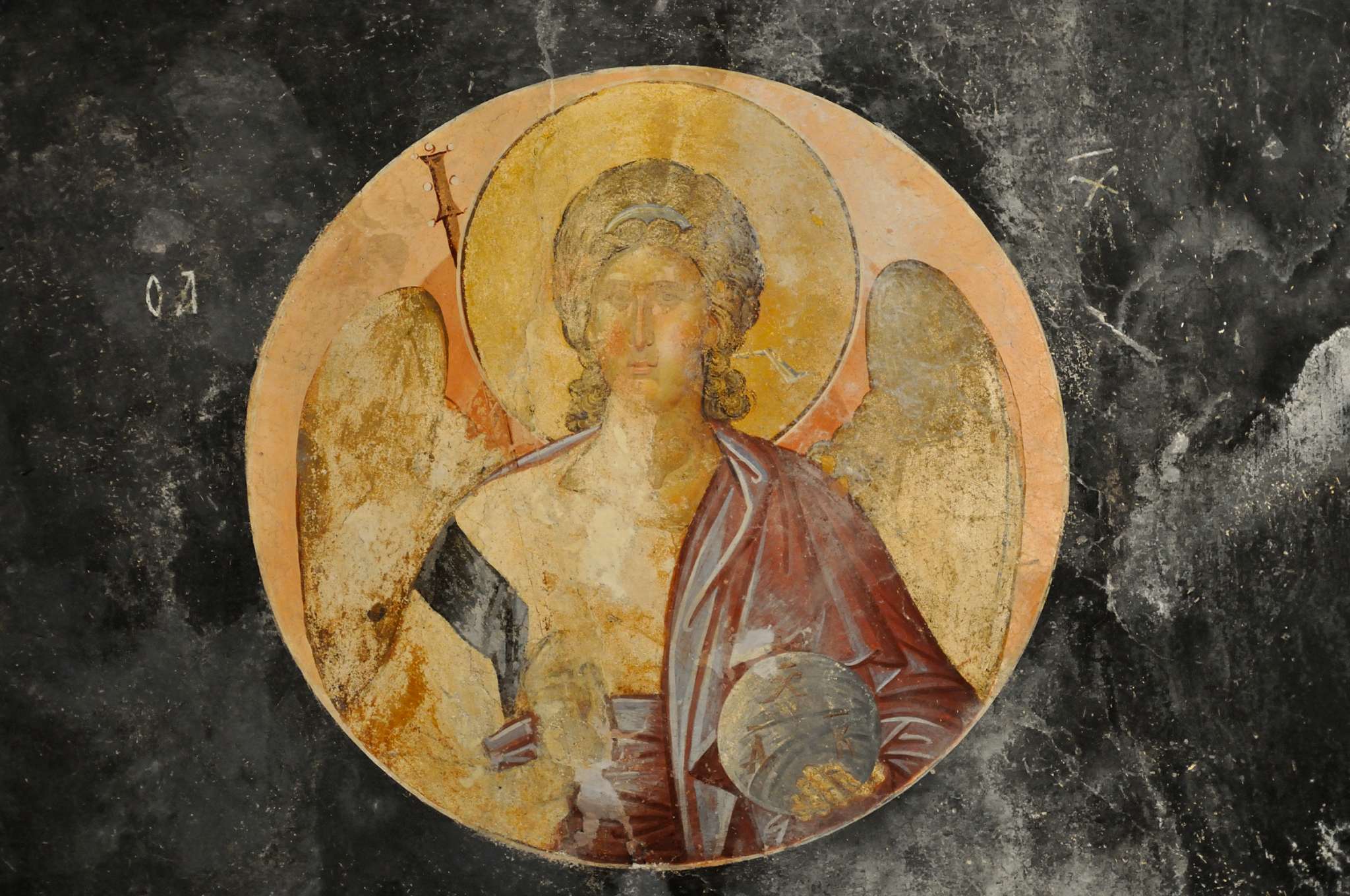
A few further period-pertinent images of St. Michael the Archangel (with some corresponding images of fellow archangels):
a) as portrayed in relief on an earlier sixth-century ivory panel (c. 525-550) from a dismembered diptych of Constantinopolitan origin in the British Museum, London:
http://tinyurl.com/nuv22op
b) as depicted (at right; at left, the Theotokos) in an enameled plaque in the central portion of the upper cover of the mid-tenth-century Limburger Staurothek (betw. 945 and 959; reliquary of the True Cross) in the Domschatz- und Diözesanmuseum in Limburg an der Lahn:
https://www.flickr.com/photos/28433765@N07/3767872473
In a corresponding plaque on the other side of the cover's central figure of the Pantocrator, Gabriel is at left and John the Forerunner is at right:
https://www.flickr.com/photos/28433765@N07/3767872589
The upper cover as a whole:
http://tinyurl.com/nqskjxl
c) as depicted in a later tenth- or earlier eleventh-century portable icon (fourteenth- and nineteenth-century reworking and restorations) in the treasury of the basilica cattedrale patriarcale di San Marco in Venice:
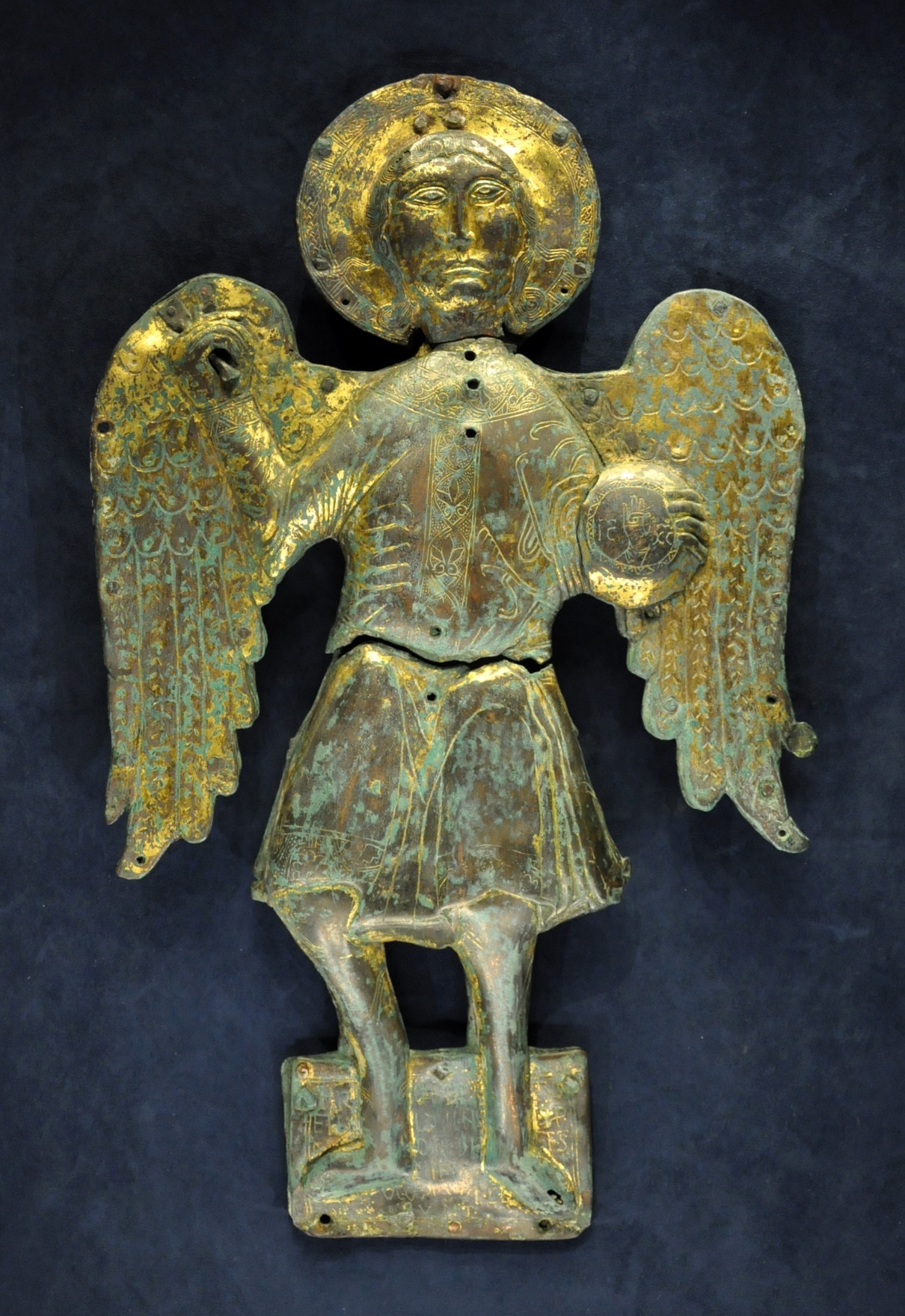
d) as portrayed in an earlier eleventh-century bronze gilt ex-voto in the Lapidarium e Museo devozionale di San Michele arcangelo at Monte Sant'Angelo (FG) in Apulia:
e) as depicted (at left) in an earlier eleventh-century vault mosaic (restored between 1953 and 1962) in the narthex of the church of the Theotokos in the monastery of Hosios Loukas near Distomo in Phokis:
http://tinyurl.com/pfxhxc4
Detail view (Michael):
http://tinyurl.com/ne5c6cy
The angel in the vault field opposite Michael is the archangel Gabriel. A detail view:
http://tinyurl.com/p2ajxuj
f) as depicted (at left, sharing a labarum with an Emperor Michael at right) on the reverse of an earlier eleventh-century histamenon (early 1040s) struck by either Emperor Michael IV or Emperor Michael V:
http://tinyurl.com/n9g9xe2
g) as depicted in an earlier to mid-eleventh-century fresco (1040s or 1050s) in the cathedral of St. Sophia in Kyiv / Kiev:
h) as depicted (at right) in the presentation illumination of a later eleventh-century copy of Constantinopolitan origin of the sermons of St. John Chrysostom (Paris, BnF, ms. Coislin 79, fol. 2b):
http://gallica.bnf.fr/ark:/12148/btv1b8470047d/f10.image
i) as depicted in the later eleventh-century apse fresco (between 1058 and 1073; restoration work in the 1980s) in the basilica di Sant'Angelo in Formis on Monte Tifata in today's Capua:
j) as depicted in a twelfth-century portable icon in the Holy Monastery of the God-trodden Mount Sinai, St. Catherine (South Sinai governorate), Egypt:
http://www.touregypt.net/images/touregypt/cart23.jpg
k) as depicted in a twelfth-century fresco (photographed before 1974) in the katholikon of the Antiphonitis monastery near Kalogrea (Girne [Kyrenia] dist.) in Turkish-dominated northern Cyprus:
Archangel Gabriel in another twelfth-century fresco (also photographed before 1974) in the same church:
Frescoes in this church, including that of Michael linked to above, have since been defaced, with others plundered outright.
l) as depicted in an early twelfth-century enamelled plaque (between 1102 and 1118) on the lower portion of the Pala d'oro in the basilica cattedrale patriarcale di San Marco in Venice:
m) as depicted (lower register at left; at right, the archangel Gabriel) in the mid-twelfth-century apse mosaics (betw. 1145 and 1148) in the basilica cattedrale della Trasfigurazione in Cefalù:
Detail view (Michael):
Detail view (Gabriel):
Not appearing in those views, and barely visible here, are the archangels Raphael (at far left) and Uriel (at far right):
n) as depicted in a mid-twelfth-century mosaic (between 1146 and 1151) on an intrados in the chiesa di Santa Maria dell'Ammiraglio (a.k.a. chiesa della Martorana) in Palermo:
http://tinyurl.com/ph2pzsm
A detail view in better light:
The archangel Gabriel on the same intrados:
o) as depicted (at upper left) in a mid-twelfth-century dome mosaic (between 1146 and 1151) in the chiesa di Santa Maria dell'Ammiraglio (a.k.a. chiesa della Martorana) in Palermo:
The other angels in this circle are the archangels Raphael (upper right), Uriel (lower right), and Gabriel (lower left).
p) as depicted (third from left, wearing a loros) in the mid- to slightly later twelfth-century mosaics in the Cappella Palatina in Palermo:
Detail view (Michael):
The other angels holding orbs are, from left to right, are Michael's fellow archangels Raphael, Gabriel, and Uriel.
Detail view (Raphael):
http://tinyurl.com/qykndf7
Detail view (Michael, Gabriel and, in part, Uriel):
q) as depicted in a later twelfth-century fresco (between 1176 and 1200) in St. George's Church, Staraya Ladoga in Russia:
http://tinyurl.com/5txqyse
r) as depicted (at centre left, flanking the BVM; at centre right, the archangel Gabriel) in the late twelfth-century frescoes (1180s) of the central apse in the basilica cattedrale di Santa Maria nuova in Monreale (image greatly expandable):
https://www.flickr.com/photos/iharsten/15496966194
In different light:
s) as depicted in a late twelfth-century fresco (1191) in the church of St. George at Kurbinovo (Resen municipality) in the Former Yugoslav Republic of Macedonia:
http://www.icon-art.info/hires.php?lng=en&type=1&id=3678
t) as depicted in a late twelfth-century fresco (1199; damaged in World War II) in the church of the Transfiguration of the Saviour on Nereditsa near Veliky Novgorod:
http://www.icon-art.info/masterpiece.php?lng=en&mst_id=4544
u) as depicted in a thirteenth-century Yaroslavl School icon in the State Tretyakov Gallery, Moscow:
http://tinyurl.com/6zqgqya
v) as portrayed in a later thirteenth-century marble capital (between 1250 and 1300) from Constantinople in the Metropolitan Museum of art, New York:
http://www.metmuseum.org/collection/the-collection-online/search/466108
http://tinyurl.com/nodftyw
w) as depicted in a later thirteenth-century fresco (between 1250 and 1300) in the rupestrian chiesa di Santa Lucia alle Malve in Matera:
http://tinyurl.com/nbb245h
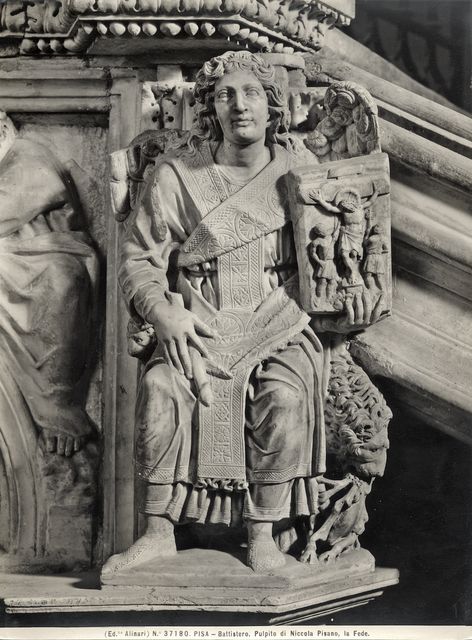
x) as portrayed (seated, holding an image of the Crucifixion) by Nicola Pisano in a statue placed just below the Last Judgment panel on his later thirteenth-century pulpit (1257-1260) in the baptistery of Pisa:
http://catalogo.fondazionezeri.unibo.it/foto/160000/142400/142128.jpg
y) as depicted in the later thirteenth-century frescoes (either ca. 1263-1270 or slightly later) of the monastery church of the Holy Trinity at Sopoćani (Raška dist.) in Serbia:
http://tinyurl.com/3u5euyk
http://tinyurl.com/3v5gemc
z) as depicted in a late thirteenth- or very early fourteenth-century Yaroslavl School icon in the State Tretyakov Gallery, Moscow:
http://www.icon-art.info/masterpiece.php?lng=en&mst_id=414
aa) as depicted in a late thirteenth- or earlier fourteenth-century fresco in the rupestrian chiesa di Santa Margherita in Melfi:
bb) as depicted in a fourteenth-century icon of Constantinopolitan origin in the Byzantine and Christian Museum, Athens:
http://tinyurl.com/oxevut9
cc) as depicted (at left, flanking the Theotokos; at right, the archangel Gabriel) in the earlier fourteenth-century frescoes (between c. 1311 and c. 1322) in the church of St. Nicholas Orphanos in Thessaloniki:
http://tinyurl.com/q7hc7aq
dd) as depicted in the earlier fourteenth-century frescoes (between 1313 and 1318; conservation work in 1968) by Michael Astrapas and Eutychios in the church of St. George in Staro Nagoričane in the Former Yugoslav Republic of Macedonia:
http://tinyurl.com/pgzkzgo
ee) as depicted in the earlier fourteenth-century frescoes (between c. 1314 and c. 1320) by Michael Astrapas and Eutychios in the church of St. Nikita at Čučer in today's Čučer-Sandevo in the Former Yugoslav Republic of Macedonia:
http://tinyurl.com/o55cpcm
ff) as depicted in an earlier fourteenth-century fresco (between 1315 and 1321) on an intrados in the parecclesion of the Chora church (Kariye Camii) in Istanbul:
gg) as depicted (at left, flanking the Theotokos; at right the archangel Gabriel) in an earlier fourteenth-century fresco (1330s) in the calotte of the apse in the church of the Hodegetria in the Patriarchate of Peć:
Detail view (Michael):
Detail view (Gabriel):
http://tinyurl.com/puepcn8
hh) as depicted in an earlier fourteenth-century fresco (1330s) in the diakonikon of the church of the Hodegetria in the Patriarchate of Peć:
http://tinyurl.com/yac98xz
The matching figure of the archangel Gabriel at the other end of the same wall is better preserved:
http://tinyurl.com/y9vdgrp
ii) as depicted (at right; at left, and slightly larger, the
despotes Jovan Oliver with a model of the church) in the mid-fourteenth-century frescoes (1340s) of the monastery church of St. Michael the Archangel at Lesnovo (Probištip municipality) in the Former Yugoslav Republic of Macedonia:
jj) as depicted in an earlier fifteenth-century Tver School icon in the State Tretyakov Gallery, Moscow:
http://www.icon-art.info/masterpiece.php?lng=en&mst_id=1464
kk) as depicted in an early fifteenth-century panel painting (ca. 1408; previously attributed to Andrej Rublev) from the iconostasis of the Dormition cathedral in Vladimir and now in the State Tretyakov Gallery, Moscow:
http://tinyurl.com/pzhykxo
The matching painting of the archangel Gabriel (also in the Tretyakov):
http://tinyurl.com/opkyabe
ll) as depicted by Andrej Rublev (attrib.) in an early fifteenth-century panel painting (early 1410s) from the Deesis range in the Dormition cathedral in Zvenigorod and now in the State Tretyakov Gallery, Moscow:
http://tinyurl.com/q3e6vcd
mm) as depicted by Dionisy and sons in the early sixteenth-century frescoes (1502) in the Virgin Nativity cathedral of the St. Ferapont Belozero (Ferapontov Belozersky) monastery at Ferapontovo in Russia's Vologda oblast:
http://www.dionisy.com/eng/museum/1028/1443/index.shtml
The corresponding depiction of the archangel Gabriel:
http://www.dionisy.com/eng/museum/1028/1444/index.shtml
The corresponding depiction of the archangel Uriel:
http://www.dionisy.com/eng/museum/1028/1448/index.shtml


![[St_Michael_La_Martorana_Palermo_2008-08-27.jpg]](https://blogger.googleusercontent.com/img/b/R29vZ2xl/AVvXsEhUYp6Op5iqaH2KqFKyf-BhpdWjvVJ3deT5tmsN2OuL781h4sMIiz2jBjWxJq6Y-Bf63gZ97W70nmurU-CZvm2ZNXX9RQhee-1UStXFY7-e57xKnkwQujpwQ57WqdGKjiDnxty9Qa3kT5i3/s640/St_Michael_La_Martorana_Palermo_2008-08-27.jpg)