Once I was a clever boy learning the arts of Oxford... is a quotation from the verses written by Bishop Richard Fleming (c.1385-1431) for his tomb in Lincoln Cathedral. Fleming, the founder of Lincoln College in Oxford, is the subject of my research for a D. Phil., and, like me, a son of the West Riding. I have remarked in the past that I have a deeply meaningful on-going relationship with a dead fifteenth century bishop... it was Fleming who, in effect, enabled me to come to Oxford and to learn its arts, and for that I am immensely grateful.


Showing posts with label Kingdom of Prussia. Show all posts

Tuesday, 3 November 2015

Thought for the day


"Those who seek to legitimate a claim to power in the present often have recourse to the idea of tradition. They decorate themselves with its cultural authority. But the encounter between the self-proclaimed inheritors of tradition and the historical record rarely takes place on equal terms."

Christopher Clark Iron Kingdom: The Rise and Downfall of Prussia 1600-1947, p.662

Wednesday, 27 May 2015

Iron Kingdom


I recently completed reading Christopher Clark's  excellent Iron Kingdom: The Rise and Downfall of Prussia 1600-1947


Image:Amazon


This really is a wonderful piece of historical scholarship, and a very readable book. It combines elegance and erudition, and richly illustrated with telling, and often entertaining, examples from the history of Prussia and the Prussians. Inevitably, and fittingly, the Hohenzollerns are centre stage for much of the historic drama that is unfolded before the reader's eyes.

It is thought provoking, and a book from which the reader learns a very great deal. It is the type of book to read, to have for refernce and to share with others.

A recurring theme is that of the contrasts and conflicts between a sense of identity inherent in the realm, the state and the nationalism of a unified Germany, even if led and dominated by Prussia. That these three concepts might not indeed be the same, however much they shared, is central to much of Clark's argument about what made Prussia what it was, and the extent to which their conflicting ends counteracted each other.


Political map of central Europe showing the 26 areas that became part of the united German Empire in 1891. Germany based in the northeast, dominates in size, occupying about 40% of the new empire.

Prussia within the German Empire

Image: Wikipedia


He also draws out the dilemma posed by the location of the Kingdom and the continuing question as to whether it should primarily look west or look east or look south. For much of its history it was the weaker in power relationships with its neighbours. 

The sudden move to the first rank came only in the 1860s, and that was more uncertain than is often depicted. Thus in 1860 The Times could write of Prussia that had hitherto failed to demonstrate true potential, and in the war of 1864 - the first Prussia had fought since 1815, bar policing measures in 1848-9 within the Confederation - its army was far less successful than that of the Austrians, who had fought in 1858-9 in northern Italy, against Denmark. Again in 1866 the defeat of Austria was perhaps more surprising than one is often led to believe in school text books.

This is above all a balanced and humane book, rich in human sympathy for both princes and paupers. The one Prussian Clark writes about whom he appears to dislike is Hindenburg - who has, I think, had a rather good press in Britain.

The last chapter, covering the period after 1918 makes for depressing reading, heartrending at times, and culminates in the idiocy of the 1947 abolition of Prussia by the Allies, on the basis that Prussia of itself was the cause of all the evils that had beset Germany. The problem and perception of the memory of Prussia, the remembrance of the realm, which runs through the book draws it to a conclusion as elegant as one could wish to find in such a work.


File:Royal Standard of the King of Prussia (1871–1918).svg

Royal Standard of the King of Prussia from 1871

Image: Wikimedia Commons


Sunday, 18 January 2015

Prussian Palaces


Today,January 18th was a significant date in teh calendar of the Kingdom of Prussia - it was on this day in 1701 that King Frederick I was crowned and on which in 1871 German Empire, presided over by the King of Prussia as German Emperor was proclaimed at Versailles.

As I am justa bout to sart reading Christopher Clark's acclaimed Iron Kingdom: The Rise and Downfall of Prussia 1600-1947 today seems a good day on which to post some pictures of Prussian palaces and royal residences.

I have posted previously about the rebuilding of the Royal Palace in Berlin in Rebuilding the Berlin Stadtschloss and in The reconstruction of the Royal Palace in Berlin

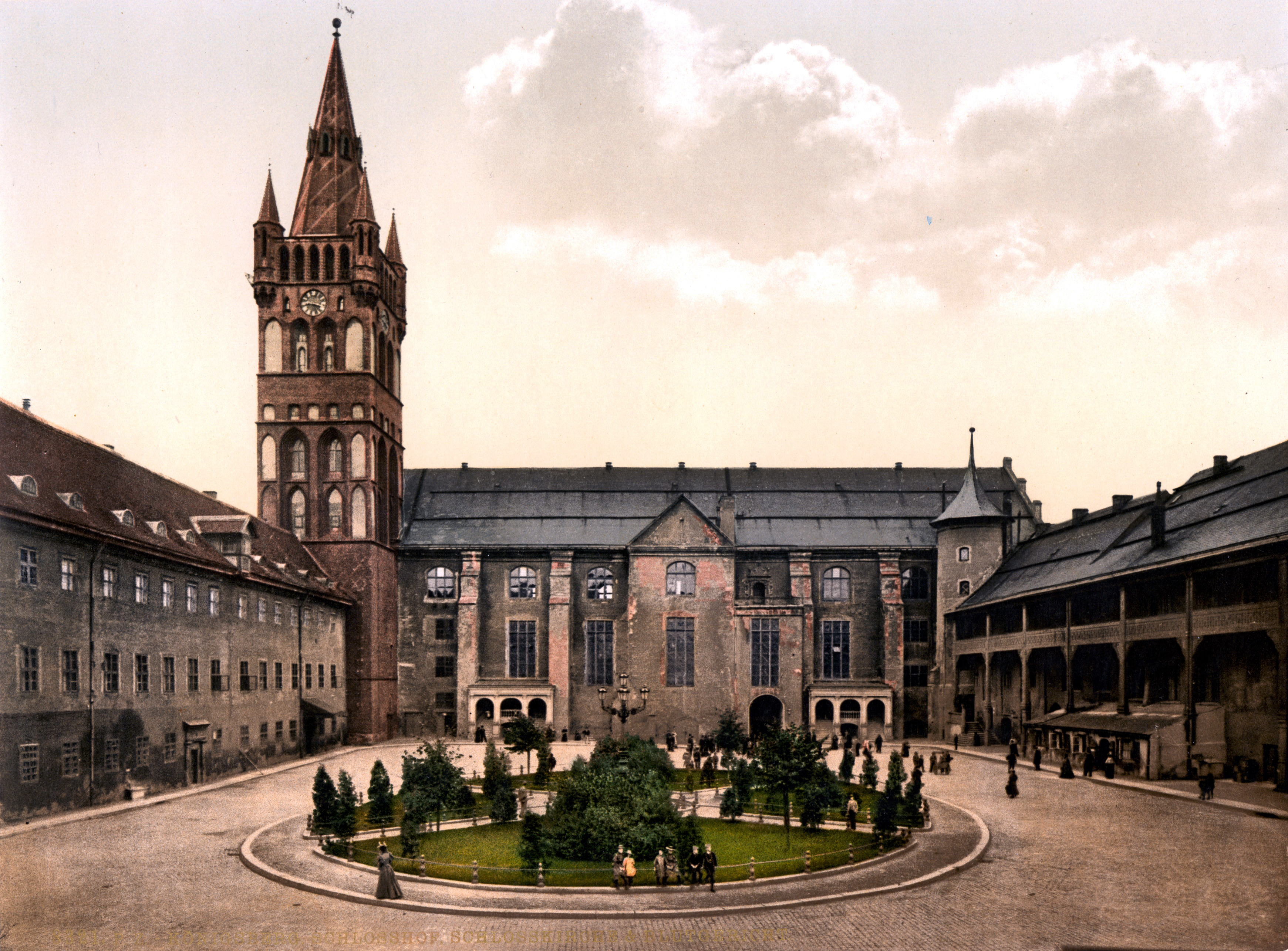
The coronation of 1701 took place in the church of the castle in Königsberg. The buildings were destroyed in the latter stages of the Second World War and afterwards, being finally blown up in 1986. Subsequently there has been talk of rebuilding it. The case for that is set out in a very interesting illustrated post, which includes aplan of the buildings, from a blogger in the city here.  There is an illustrated history of the buildings at the online piece Königsberg Castle

File:Königsberg Castle courtyard.jpg

The courtyard and church of Königsberg castle in the 1890s

Image:Wikimedia


Prior to World War II, Königsberg was a major German city in East Prussia. The...

The castle before the Second World War

Image:spiegel.de

As Kings the Hohenzollerns were in the eighteenth century prodigious builders in the Baroque and Rococco styles, despite the rather dour image we often have of Prussian court and social life.

The first of these palaces which survives intact is Charlottenburg, in the western part of Berlin. There is an illustrated account of the history and architecture of the building at Charlottenburg Palace.

http://berlin.citysegwaytours.com/blog/wp-content/uploads/2014/05/CharlottenburgPalace.jpg

Charlottenburg Palace

Image:berlin.citysegwaytours.com

Further to the west of the city a whole series of royal residences were created at Potsdam. Of these the oldest, of which there is an illustrated history at Potsdam City Palace, has recently been rebuilt following its final deliberate destruction by the East German authorities after wartime bombing. There is an illustrated post by Andrew Cusack about the plans from 2010 at Potsdam's City Palace to be Resurrected. Whether such a partial reconstruction of the interior is right is, of course, open to debate.I would prefer to see a full reconstruction.

There is more about the rebuilding at Reconstruction projects in Potsdam (City Palace, baroque Quartier) and the history of the building, its destruction and the begining of reconstruction work is covered in awell illustrated article at Rise and Fall of the City Palace

Potsdam City Palace

Potsdam City Palace in 1928
The dome is that of St Nicholas Church which is next to the Palace

Image:v-like-vintage.com

Inspired by King Louis XIV's palace at Marly King Frederick II created his own palace for relaxation, at Sanssouci in the park at Potsdam. This was an idyllic place situated above terraced vineyards where he couls escape the cares of state and military operations. The palace was built in 1747-7, towards the end of the War of the Austrian Succession. There is an account of it at Sanssouci. A fine set of photographs of the Palace can be seen here.


There are a fine series of photographs of the palace here.


Photo of Schloss Sanssouci Germany Stylish

 Sanssouci

Image:wallnyc.com


Following his next major European conflict, the Seven Years War , the King built the Neue Palais in Potsdam in the years after 1763. On top of the dome naked figures of his three female opponants - the Empress Maria Theresa, the Empress Elizabeth of Russia and Madame de Pompadour - are to be seen, holding up the King's crown.

Insider's Potsdam

The Neue Palais built by King Frederick II

Image:insidertour.com

There is an account of the building at the illustrated article New Palace Potsdam, which shows how it was built to entertain other royal guests and only used as a regular residence in the late nineteenth century. It survived the Second Wotld War relatively unscathed.


If the eighteenth century was the great age of Prussian palace building - and its achievements were spectacular - in the late nineteenth century the tradition continued with structures such as the Empress Frederick's Schloss Friedrichshof, built in the Taunus in her widowhood, and now a hotel, and her son Emperor Wilhelm II's Romanesque palace at Posen/Poznan, about which there is an illustrated article at Imperial Castle, Poznań. This was built in 1905-10.

1910 look of Palace

The Imperial Castle as originally built.
Following damage in the Second World War the tower was reduced in height

Image;info-poland.buffalo.edu


Tuesday, 18 October 2011

Prussian Coronation 1861


Today is the 150th anniversary of the Coronation of King William I and Queen Augusta of Prussia at Konigsberg in 1861. The King, who became German Emperor in 1871, was the last Prussian King to have a coronation - his son Frederick III was too ill and died after 99 days as Kaiser and King in 1888, although he envisaged two ceremonies, one as King and another as Deutsches Kaiser, and his son, William II, was dissuaded from holding the ceremony on the grounds of expense - Bismarck was not at all favourable to ceremonial, tending to see it as out of date. It is somewhat surprising, given William II's flamboyant style, that he did not insist on having a coronation.

This was the first coronation of which photographs survive, though I cannot find any online. I have seen one in a book by those eminent historians of photography Helmut and Alison Gernsheim, and there is a photograph of the Crown Princess on the day in Roger Fulford's Dearest Child. I remember seeing a series of paintings of the ceremonies reproduced some years ago in one of Sotheby's Art at Auction year reports.

I did find this picture, a painting by Adolf Menzel from 1861. The arrangement of the cathedral looks similar to that for the Norwegian coronation in 1906, with two facing thrones. The figures in red mantles are Knights of the Order of the Black Eagle:

Adolf Menzel, <I>Coronation of Wilhelm I in Königsberg in the Year 1861</i> (1861)

Original: Stiftung Preußische Schlöser und Gärten Berlin-Brandenburg, Schloß Sanssouci, Potsdam.
© Bildarchiv Preußischer Kulturbesitz

Tuesday, 7 June 2011

Commemorating Kaiser Wilhelm II


Following on from my post Kaiser Wilhelm II the other day I see that the excellent Australian blog Radical Royalist has two posts about the commemoration of the death of Emperor Wilhelm II and his former home at Doorn. They can be read at 70 years today since Kaiser Wilhelm II passed away... and at Huis Doorn: German Monarchists commemorate the Kaiser..., and thanks to the Mad Monarchist for highlighting them.

Saturday, 4 June 2011

Kaiser Wilhelm II


Today is the seventieth anniversary of the death in exile at Doorn of Wilhelm II, German Emperor and King of Prussia.

Anyone who reads about the personalities of his era cannot but be intrigued by him. Vilified and caricatured as he was - and his speeches and distinctive appearance were a gift to opponants - it is clear with hindsight that he was a much more complex and interesting figure than he once appeared. At times bombastic and vainglorious, at others insightful and far-sighted, a man who could be both bullying and selfless, he still arouses strong feelings. He may no longer be the hate figure he became in Britain  during the First World War, but one Bavarian friend was very keen to lay the blame for what happened on the Kaiser himself. Was that, I wondered, because my friend was proud of being Bavarian, and Wilhelm II incarnated  Prussia? I did n't ask, but I suspected it. Clearly for many Germans in 1918 Wilhelm and his Empire along with their other Kings, Grand Dukes and Dukes were easily made into scapegoats. The trouble, as we now know, was not with the old order, but with the fightening possibilities offered by the New Orders which succeeded it.


File:Kohner - Kaiser Wilhelm II.jpg


Wilhelm II 

by Max Koner 1890


This portrait , showing the young ruler at his most flamboyant, depicts him as King of Prussia rather than as German Emperor, with the Priussian crown as his side, and in the insignia of the Order of the Black Eagle 


The Kaiser in exile in 1933


Another German friend made the point that Kaiser Wilhelm's English ancestry meant that for some of his subjects he was not fully German, and it is clear that  his love-hate relationship with his mother and her country was a major factor in both his own life and in his actions as sovereign. 


Continuing interest in him by German monarchists is covered in this article about pilgrimages to his last resting place at Doorn


His life has something of the qualities of classical tragedy - birth and rank, genuine gifts, the effect of historical cirumstance, and a character full of conflicting impulses, gave him a central role in the great drama that erupted in the Great War. His own part in that is receiving significant new attention from historians.

My own sense is that despite his high profile actions and ambitions he did not realise the extent to which the modern state as it had come to function had taken on a life of its own which was increasingly resistant to interventions by the head of state or other figures. Like his fellow monarchs in 1914 he found things, as he himself commented in later years, got away from him. The concert of Europe no longer worked as a family reunion to sort out local difficulties. Nationalisms of all varieties were calling the new and strident tune. The Kaiser and his fellow rulers were drawn into that - how could they not be - but the pressures were too often to drag them down. 

The anniversary has prompted me to start reading Giles MacDonagh's biography of the Emperor  The Last Kaiser: William the Impetuous, which was published in 2000. From an initial skimming and what I have read it appears a well-balanced and humane biography, well researched and eminently readable. I will comment further when I have finished reading it. I also have some links to archive film of his life which I will publish.

Monday, 24 January 2011

Another Royal engagement


The Mad Monarchist recently had this post about the engagement of Prince Georg Friedrich, the head of the House of Hohenzollern:
Finally, to end on a happy note, there is another royal engagement to mention. This time it is HIH Prince Georg Friedrich of Prussia, head of the House of Hohenzollern and heir to the German Kaisers. The Prince (how much nicer it would be to say Kaiser Friedrich IV) announced yesterday that he is engaged to marry HSH Princess Sophie von Isenburg. The Princess grew up in Hesse and Freiburg im Breisgau, studied in Berlin in the area of business administration and is currently working at a consulting firm for a nonprofit organization in Berlin. Not wasting as much time as his fellow royals in Monaco or Britain, the Prussian prince plans to marry later this year in Potsdam and will coordinate the event with the 950th anniversary of the House of Hohenzollern. The Mad Monarchistcongratulates the happy couple and wishes them a long and prosperous union. Hoech der Kaiser!

Tuesday, 18 January 2011

Order of the Black Eagle of Prussia


Regular readers will know that I have an interest in Orders of Chivalry and today is an opportunity to write about one of them - the Order of the Black Eagle of Prussia. Established on January 17th 1701 by King Frederick I, the day before his coronation at Königsberg as the first King in Prussia (the title was changed to King of Prussia by his gransdson in 1772), and it is the premier Order of the Prussian monarchy. As such it was the equivalent of the Orders of the Garter or the Thistle, and like other Orders established before the late eighteenth century comprised only one class.


King Frederick I

He is wearing the collar of the Order of the Black Eagle


There is a good, illustrated, article about the Order here, with links to biographies of recipients. The article does not mention the fact that the orange colour of the riband was a tribute by the King to his mother Louise Henriette of Orange-Nassau. The star of the Order was used on the headgear of Prussian regiments. The Black Eagle itself is derived from the arms of the kingdom.


Black Eagle Order star.jpg

Order of the Black Eagle
Breast star with the motto Suum Cuique ("To each according to his merits") around the central medallion.

I have not so far read Karin Friedrich and Sara Smart (eds.) The Cultivation of Monarchy and the Rise of Berlin: Brandenburg-Prussia 1700 ( Ashgate, 2010) which is a study of the establishment of the new Prussian kingdom by Frederick I. It includes an article on the statutes of the Order.


Wilhelm II, German Emperor and King of Prussia
The riband and star of the Order can be clearly seen

Photo: Mad Monarchist