Once I was a clever boy learning the arts of Oxford... is a quotation from the verses written by Bishop Richard Fleming (c.1385-1431) for his tomb in Lincoln Cathedral. Fleming, the founder of Lincoln College in Oxford, is the subject of my research for a D. Phil., and, like me, a son of the West Riding. I have remarked in the past that I have a deeply meaningful on-going relationship with a dead fifteenth century bishop... it was Fleming who, in effect, enabled me to come to Oxford and to learn its arts, and for that I am immensely grateful.


Showing posts with label King of Spain. Show all posts

Friday, 20 June 2014

Spanish Monarchy - theories, symbols and ceremonies


I was already planning this post before I saw on Rorate Caeli the slightly waspish post from New Catholic A Message from the King to the People of Spain Mensaje del Rey al Pueblo de España.
By contrast the online version of the Catholic Herald has amorepositive assessment in Spain’s uncontroversial new king is good news for the Church, and the paper also reprints  an article from the US website First Things about evidence of a significant revival in Church life in Spain by Filip Mazurczak which can be read here.

 The absence of a formal religious element to the oath taking - a silver crucifix, from the collection of the Congress of Deputies was also on display alonside the regalia - or of a Mass of thanksgiving, as there was in 1975 - reflects , I imagine, the current constitution and is perhaps also an unfortunate legacy of the Zapatero government. That point is to some extent addressed in Mazurczak's article.

Spain's newly-crowned King Felipe VI and his wife Spain's Queen Letizia  (AP)

 King Felipe VI and  Queen Letizia 

Image: Catholic Herald/AP

The Spanish Royal family have shown continuing support for the practice of the Catholic faith, with their presence at Papal visits to the kingdom, with the pilgrimage to Santiago on July 25th, at the Mass for the victims of the rail disaster there the other year, with weddings theat are publically Catholic, and with a regular appearance outside the cathedral in Palma de Mallorca on Easter Day after Mass, very like the British Royal family at Sandringham at Christmas.

Despite its Catholic heritage and title the Spanish monarchy never had a Divine right tradition like Stuart England or France. For all its imagined absolutism - and most absolute monarchies turn out upon examination to have been very far from absolute - the Spanish crown represents a complex series of interrelated powers and limitations, exercised in varying ways over the centuries.

If Castile showed a more centralised monarchic tradition from the middle ages, the lands of the Crown of Aragon - in effect a federation - had a strong tradition of limited monarchy, expressed most famously in the coronation formula which stressed the near equality of King and nobles and its closing formula with its implicit, if not explicit, right of resistance of "if not, not", and where the Justiciar could veto royal enactments.

These traditions can be seen in the present constitution, including its devolved regional assemblies  - including swearing to the Viscayan privileges of the Basque region at Guernica - and expressed in the differing titles used by the new King as heir in different parts of the country not only Prince of Asturias, but distinct ones as heir to Aragon, and for its other territories of Catalonia, Valencia and Majorca, and for Navarre.

Even King Philip II was not as absolute as popular opinion might still think. He not only cut back on court ceremonial derived from his Burgundian ancestors in terms of outward display, but, as is pointed by a quotation in Henry Kamen's excellent Spain 1469-1714: A Divided Society, could be sued by his subjects in civil matters; on one occasion the King told a judge to be careful, as if the case came to court he would have to find against the King.

Unlike England and France, or central Europe, sacral kingship and the ceremonies of anointing and coronation never found much of a place in Iberia (The crown of Portugal obtained the privilege of anointing in the early fifteenth century, but abandoned the rite of coronation after 1640) and largely ceased in the later middle ages.

The last Spanish monarchs to be solemnly crowned were King John I of Castile in 1379, King Ferdinand I of Aragon  in 1414, and Queen Eleanor of Navarre in 1479). Queen Joan (Jeanne) III of Navarre was crowned as late as 1555, although she only ruled that part of Navarre beyond the Pyrenees. After them, all Spanish monarchs have assumed their role  by proclamation and acclamation before the Church and since the eighteenth century, before the Cortes Generales. The royal crown has been physically present in these ceremonies. When King Juan Carlos I was proclaimed King of Spain on November 22 1975 and when King Felipe VI was proclaimed this week the crown and sceptre were displayed in front of them in the Cortes. The last occasion on which the crown was seen at apublic ceremont was at the reburial of King Alfonso XIII in 1981 at El Escorial.

The crown itself , made of silver gilt and without gems, displays the emblems of the founding kingdoms of Castile and Leon, a castle and lion respectively. It was made by order of King Charles III (1759-88)in Madrid, following the loss of previous regalia in the fire which had destroyed the old Royal palace in the city.

The sceptre was a gift from Holy Roman Emperor Rudolf II to King Philip II and was made in Vienna.
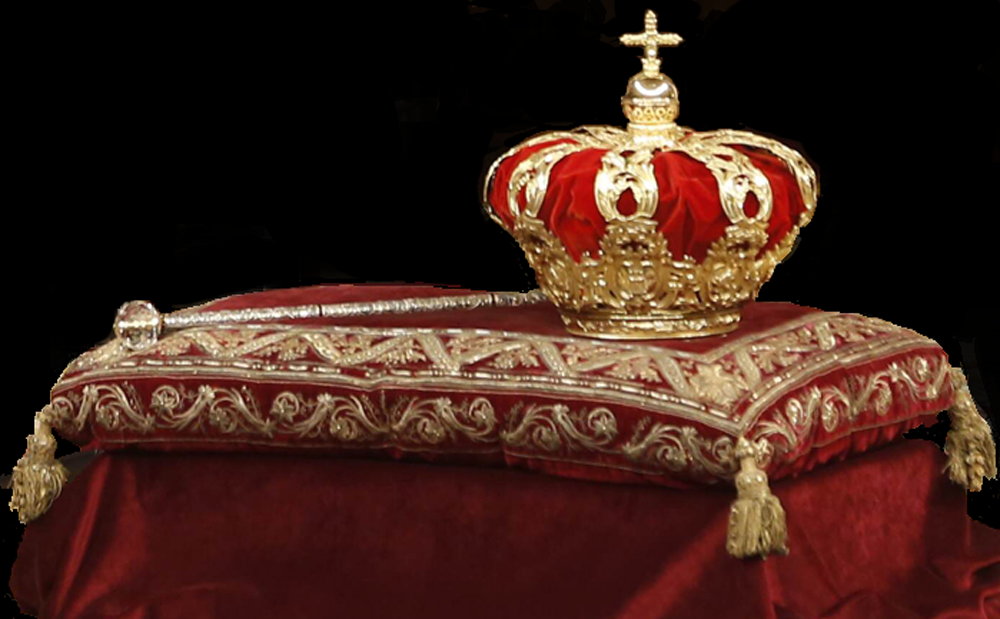
File:Símbolos de la Monarquía Española.png

The crown and scepre of Spain

Image:Wikipedia

There are some very well illustrated articles about the heraldic arms of the Crown and of the Princes of Asturias on Wikipedia - which is always a good source of informationon such matters I find. They can be viewed at Coat of arms of Spain, at Coat of arms of the King of Spain and at Coat of arms of the Prince of Asturias and there is more heraldry and information about the premier chivalric Order of the monarchy at Order of the Golden Fleece.

A friend has sent me a link to an up-to-date online piece from Wikipedia about the Spanish Royal Standard. This was with a red background under the Hapsburgs and earlier Bourbons, changed to purple for Queen Isabella II and her succrssors - as in the example preserved on display in St James Spanish Place in London, and was blue for King Juan Carlos. With King Felipe it has reverted to red. My friend considers the red is best, though he adds he misses the Cross of Burgundy and yoke and arrows as used by the previous King. I would agree with him. The illustrated article can be viewed at Royal Standard of Spain.

I would slightly quibble  with the article when it states that a heraldic banner has not been used by the Kings since 1931; whilst it may not have been used in Spain, there is one over King Juan Carlos' Garter stall at St George's Windsor.

The history of the various titles used by or available to the Spanish King and Royal family are discussed in Titles and honours of the Spanish Crown, which has both a history of them and illustrations of their armorial bearings.


    Thursday, 19 June 2014

    New Reign in Spain


    Today has seen the formal enthronement ceremonies of King Felipe VI of Spain following the coming into force of his father's abdication at midnight.


    King Felipe VI, Queen Letizia , the Infanta Lleonor, Princess of Asturias and the Infanta Sofia with the Crown and sceptre in the foreground at the Accession ceremony

    Image:dw.de


    BBC News has an article with links to profiles of the King and of his father and a good selection of photographs of today's events in King Felipe calls for 'new Spain' 

    There is another online biography of the King, with appropriate links, here.

    There is what seems to be a well balanced article from the Guardian about the accession which can be read at Crown Prince Felipe on brink of becoming King Felipe VI and the same paper has a good account of the formal occasion at Spain's Felipe VI promises a 'renewed monarchy' as he is sworn in as king and also a good selection of photographs at Spain's King Felipe VI begins a new reign.

    Such essentially positive coverage by the Guardian,is, dare one suggest it, rather interesting in itself, and perhaps an happy augury.

    Coat of Arms of Spanish Monarch.svg

    The Spanish Royal Arms

    Image: Wikipedia 

    Viva El Rey Felipe!


    Monday, 9 June 2014

    A positive reaction to the Spanish abdication


    The Daily Telegraph has an article about an opinion poll which points to a fairly significant upsurge in popular support for the Spanish monarchy in the days following the King's announcement of his intention of abdicating in favour of the Prince of Asturias. The article , which has some other relevant links, including one with comments from the King that he did not wish his son to grow too old waiting to succeed to the throne, can be seen at Was King Juan Carlos right to abdicate?

    The suggestion may well be that in terms of serving the long term interests of the monarchy and the nation it has been the right, or appropriate, decision by King Juan Carlos. The King has shown himself a shrewd operator of the royal office since 1975, and this decision doubtless need to be understood in that light.

    That said, it is unfair to all that he has achieved as King that recent difficulties should be seen to lead to abdication. It is also unwise that monarchs become, or are perceived to be, dependent upon popular support as reflected in such ephemeral things as public opinion polls. I am sure there are far deeper levels of support for the institution as well as the personalities of the Spanish monarchy, and that those will stand the future King Felipe VI in good stead.

    Tuesday, 3 June 2014

    Spanish abdication


    The announcement by King Juan Carlos that he will abdicate as King of Spain appears to have come as something of a surprise, although there has been talk of the possibility of such a move on and off for the last couple of years. 

    Given his remarkable and enduring achievements since 1975, as all serious commentators have agreed, it is unfortunate that in recent years that has been clouded by public criticism over what should be seen as minor problems. The economic and social crisis affecting Spain has clearly not helped, and must have told upon the King as well as his age - he certainly looks older and more tired, and he has had several operations in recent years.

    I recall my own sense of excitement, indeed exhilaration, at the 1975 restoration, and the King's success,  and so ably supported by Queen Sofia, is both of historic significance for Spain, and an example other countries should follow.

    Given that background I would think that he and the Spanish royal family would be anxious to avoid anything that might tend towards a repeat of the 1931 disaster when the economic crisis combined with the political fall-out from the end of the Primo de Rivera military government of the 1920s and the decline in popularity of King Alfonso XIII effectively turned the local elections of that year into a referendum on the monarchy and led to the establishment of the appalling second republic.

    The King says that he decided to abdicate at this birthday in January, when he turned 76, but presumably has waited until after European elections to make his announcement, but before the Catalan independence referendum planned for the autumn.

    A point I have seen made in recent years is that whilst many in Spain have and do admire the King as a person and for what he has done for the realm, the support for the monarchy is for the person rather than for the institution in itself. It may well be that in abdicating now the King sees the opportunity to follow in the patterns of events last year with the abdications in the Netherlands, Belgium and the Papacy, as well as the relatively recent case of Luxembourg, and to give the Prince of Asturias the opportunity to reforge and reinforce the bonds that the monarchy is there to provide and has provided not only in recent decades but through the history of Spain and its constituent realms.

    This is then a way to manage the situation in the best interests of the nation and of its central institution, and potentially outflanking possible future problems. It seems clear that the Prince and Princess of Asturias have high public approval ratings and that the Prince has worked conscientiously as heir in a manner very similar to his cousins across Europe. He always appears serious minded man with genuine dedication to his future role.

    It is also worth pointing out that abdications are not that unusual in Spain - indeed almost commonplace. King Charles I(i.e. Emperor Charles V)abdicated in 1556, and in 1724 King Felipe V (one used to think of him in English as Philip, but maybe we shall get used to thinking of the various Spanish Kings of that name as Felipe) abdicated - possibly thinking he might succeed the temporarily sickly King Louis XV in France, only to find that the French King recovered, but that his own son and successor, King Luis I, died the same year and he was recalled to the throne. King Charles IV abdicated in favour of his sone King Ferdinand VII, and his daughter Queen Isabella II, following the 1868 revolution abdicated in favour of her son King Alfonso XII, who was resored toi the throne in 1875. Indeed she outlived him by nineteen years, only dying in France in 1904.  I believe I am right in saying that King Alfonso XIII, realising his condition was terminal, abdicated afew days before his death in 1941 in Rome, presumably to ensure the formal transfer of authority to his de jure successor, his son King Juan III. He in turn renounced his rights in 1977, two years after his son King Juan Carlos was proclaimedas monarch. So having a former monarch around is not that unusual. There has been no conventional succession of an adult son or daughter to a deceased monarch really since 1788 when King Charles III and was succeeded by King Charles IV.

    This evening a BBC report covered a military review at El Escorial attended by the King and the Prince of the Asturias, and as it pointed out the setting in front of the great palace monastery necropolis did stress continuity, which has been very much a theme of the reign of King Juan Carlos. Thus in burying his father as King Juan III and reinterring his grandparents King Alfonso XIII and Queen Victoria Eugenie at the Escorial the King symbolically indicated the continuity of his position with his ancestors, and that the monarchy was not a new creation of the Franco era.

    The BBC website has various linked articles about the abdication and reaction to it which can be accessed at Spain sets out abdication plan.

    As in this country in 1936 the monarch's abdication requires special legislation in the Cortes, so King Felipe VI will presumably take the oath and be acclaimed in June 18th.

    The Mad Monarchist blog has a very good piece which I would endorse and concur with at The Abdication of King Juan Carlos.

     Viva El Rey!

    Saturday, 19 May 2012

    The reign in Spain


    The most notable absentees from the Monarchs' lunch at Windsor were the King and Queen of Spain, whose government interdicted their visit because of the continuing dispute over the sovereigny of Gibralter - the issue which prevented their attending the wedding of the Prince and Princess of Wales in 1981.

    This year is proving something of an annus horribilis for the King and Queen, who did not publically celebrate their Golden wedding last Monday. The various rumours of scandal around members of the Royal family as are recorded, in a rather negative way, in this report in the supposedly conservative Daily Telegraph.

    In one sense this can be seen as a coming of age for the restored Spanish monarchy - like the other reigning dynasties of Europe they have become fair game for the bored and opinionated, for those with a fine nose for scandal and the grinding of particular axes. Too often, far too often it is the open season for sniping. Misjudgements there may have been, and mistakes made, but monarchs are human - that is one of the strengths of monarchy - it is not a machine.

    In the last generation or so we have seen the Swedish monarchy prounced terminally doomed from before the present King's accession in 1973, the hostility to the present Queen of the Netherlands' marriage in the 1960s, the allegations around her father in 1976, and doubts as to the future at the time of her accession in 1980.

    Here in the United Kingdom the problems of the mid 1990s were only too publically aired and discussed, and even in Denmark Prince Henrik has been the centre of various storms as indicated here.

    In Luxembourg and Lichtenstein the constitional position of the monarch has been under fire and in Belgium the very future of the country, and hence the monarchy, questioned.

    For the Spanish monarchy there is the problem of the hiatus between 1931-75, even if the monarchy was formally re-established in 1947. It has been argued that, despite the hitherto enormous popularity of the King, Spain itself is not a sufficently monarchist society. I do not know if that is true, but I can see that there might be some cause for concern for the future there. On the other hand this could be dismissed as the chattering classes at it again - and how they can chatter on such matters.

    So it is not easy, and for the moment it is the Spanish crown that is under the public scrutiny. The country has far more serious problems with which to concern itself, and should in no way belittle the extraordinary and fundamental achievements of the King and Queen and the Prince of Asturias in providing the stable constitutional framework that allows it as a nation to try to deal with the consequences of the eurocrisis, and which has guided it since 1975.

    Viva El Rey!


    Thursday, 5 January 2012

    Birthday of the King of Spain


    Today is the 74th birthday of the King of Spain, and an opportunity to express good wishes to a sovereign who has not only proved dutiful and capable but is also a shining example of what a monarchy can offer a nation.

    http://www.barcelonareporter.com/img_uploads/King_Juan_Carlos_and_Queen_Sofia_of_Spain.jpg

    The King and Queen of Spain

    Image:barcelonareporter.com

    His reign shows what could be done in other countries less fortunate than Spain and which have not restored their historic institutions of governance. The recent problems surrounding one of his sons-in-law are unfortunate and the Royal family are clearly showing their distance from allegations of financial scandal, but the King's achievements far outweigh what must be, I trust, a passing shadow.

    An insight into his approach to kingship in the modern age can be gleaned from this article from 2008 which is based around letters he wrote to the Prince of Asturias whilst the Infante was studying in the USA.

    Spain's King Juan Carlos and Queen Sofia with their son Crown Prince Felipe

    The King and Queen of Spain and the Prince of Asturias

    Image: Daily Telegraph

    Spain is very fortunate indeed in its King and Queen and their royal family, as is the cause of monarchy across Europe and the world.

    Monday, 22 November 2010

    The King of Spain - thirty five years on


    Today is the 35th anniversary of the King of Spain assuming the crown when he took the constitutional oath in front of the Cortes and the Council of the Realm, thus definitively re-establishing and restoring the Spanish monarchy in 1975.

    http://www.voicesofthetransition.net/images/coronation.jpg

    The accession ceremony in 1975

    Now for me that was indeed a time when to be (relatively) young was very Heaven. Here one was witnessing the restoration of a great and historic institution. I remember reading at the time John Evelyn's account of the arrival of King Charles II in London in 1660 to put events in historical context.

    Back in 1975 clever people dismissed the King's chances of survival - he was going to be 'Juan Carlos the Brief'...

    Thirty five yeas on he and his people can look back over the process whereby the restored monarchy has enabled the various and varied groups which comprise Spanish society to reconcile differences and find means of living together as a society. In a time of constitutional, political and social change the Crown has provided a symbolic and actual centre of unity, and been an enabling force, as in 1981 when the King withstood the attempted coup.

    As I posted recently Portugal as a neighbour and as a country with a not dissimilar history is one that I think could profit from the Spanish experience, as could those countries which became free after 1989 - indeed Bulgaria did have the novel experiment of the legitimate King as Prime minister of a republic. The achievement of King Juan Carlos and Queen Sofia, and of their family is considerable, and worthy of emulation. Long may they reign!


    King Juan Carlos of Spain undergoes surgery

    The King of Spain

    Monday, 8 November 2010

    The Pope in Spain


    The Pope's recent visit to Spain to Santiago de Compostella and to Barcelona has highlighted several themes clearly of importance in his papacy and also in the history of Spain and the Spanish church.

    Pope Benedict XVI is greeted by Prince Felipe, ...

    The Pope is greeted by the Prince of the Asturias at Santiago

    The Santiago Holy Year - the Jacobeo - is an opportunity to recall the key role played by the belief in the intercession of St James the Great and the centuries old pilgrimage to Compostella in the formation of Christian Castile and Spain, and its sense of isdentity and mission as aCatholic country. The pilgrimage route, especially under the influence of the Cluniacs, became a major conduit of ideas, of arts and architecture, and of devotion linking much of medieval Europe. I believe that by the mid-nineteenth century it had declined to a small number of pilgrims. Today it is firmly re-established, with many walking the ancient routes across norther Castile and Galicia. Some may go more as holidaymakers than pilgrims, but go they do. Now they have been joined by the Pope, greeted at the cathedral as a pilgrim. This is a reminder of those ancient and traditional bonds of Christian Europe that the Holy Father so often speaks about and seeks to reinvigorate and re-establish. That happened at Santiago - it can happen elsewhere.

    Santiago was a very suitable place for the Pope to remind Europe of its Christian roots, culture and heritage. The Holy father did not shirk addressing in his comments onthe journey to santiago the issue of ther emergence of anticlericalism in Spain, and reminding us of what that led to in the terrible enents of the years 1931-1939 in that country. The Church believes that 4,184 clergy were murdered, particularly in 1936. In recent years a considerable number of these, along with lay victims, have been beatified or canonized, or their caiuses are being considered - a reminder for the future of what happened, but which too many peopel prefer to forget.


    Pope Benedict XVI ,

    The Pope greets the crowds in Santiago


    Pope Benedict XVI waves during his visit ...

    The Pope inside the cathedral at Santiago

    To understand something about the camino I would recommend Edwin Mullins The Pilgrimage to Santiago - it is a travel book as much as a history and the work of an agnostic - but you feel the attraction, the power of the shrine drawing you across the hills and valleys to the remote, windy, wet province of Galicia and the great church of Compostella. If you cannot go there, call in to the cast gallery at the Victoria and Albert Museum to be awed by the cast of the great twelfth century west portal. This is serious religion.

    From Santiago the Pope travelled on to Barceslon to consecrtae Gaudi's Sagrada Familia - begun in 1882 and still unfinished - and indeed designate it a Minor Basilica. The Wikipedia article on Sagrada Familia is here.


    Pope Benedict XVI, at center, leads a mass ...

    The Pope celebrates Mass at the church of Sagrada Familia in Barcelona


    Pope Benedict XVI, left, pours holy oil ...

    The Pope pours holy oil on the main altar of Sagrada Familia during the consecration ceremony.

    The Pope by consecrating so famous a building, whose architect's cause for beatification is being considered, again signifies one of the great themes of his papacy - the application of the arts to worship and devotion, and indeed to a true humanism - the historic Christian Humanism of our civilisation.

    That it was in Barcelona, at the heart of a region which witnessed much of the worst attacks on the Church and its faithful in the 1930s, made it more significant and poignant, and also hopeful. Gaudi, who had died in 1926, left his church incomplete; during the Civil War the model and plans of the church were lost or dispersed. Yet now it is approaching completion - scheduled for 2026 - and has been consecrated by the Pope in the presence of the King and Queen of Spain. Those facts are redolent with hope.

    Barcelona in particular, and much of modern Spain may indeed be socially liberal, but the heritage of the Most Catholic Kingdom is by no means exhausted. Like that of the rest of Europe it need to be sustained and reasserted. In Pope Benedict it has a sure and confident champion. We must support him in that, as it is vital to our future.

    Spanish King Juan Carlos greets Pope Benedict ...

    The Pope is greeted by the King of Spain

    Photos from Associated Press