Once I was a clever boy learning the arts of Oxford... is a quotation from the verses written by Bishop Richard Fleming (c.1385-1431) for his tomb in Lincoln Cathedral. Fleming, the founder of Lincoln College in Oxford, is the subject of my research for a D. Phil., and, like me, a son of the West Riding. I have remarked in the past that I have a deeply meaningful on-going relationship with a dead fifteenth century bishop... it was Fleming who, in effect, enabled me to come to Oxford and to learn its arts, and for that I am immensely grateful.


Showing posts with label St James Spanish Place. Show all posts

Tuesday, 5 May 2015

A day out in London

Today I had a day trip to London. It was a bright but blustery day and the countryside between Oxford and London lush with fresh foliage and blossom

I was struck by the fact that two days before a General Election there was such a lack of election posters - I noticed but one window sticker, two small billboards and one large one all way from Oxford to London and back again. Apathy reigns, the electorate are I sense bored and uninterested.

My purpose in going was to meet at the
British Museum a new acquaintance from California to discuss possible tours for US visitors here next year. I joined his tour group for a conducted introduction to the great collection of Assyrian sculpture, including the Royal Lion Hunt, and the Elgin Marbles, neither of which I had seen before I must admit. Then it was upstairs to visit the Mesopotamia displays from Ur. The guide brought out the Biblical links it being a church group.

I walked from the coach stop to and from the Museum, taking in the blue plaques and the architecture of the eighteenth century development of the Bedford estate, and the architectural mix that is Fitzrovia.

On the way back I went to the evening Mass at St James Spanish Place, one of my favourite Catholic churches.

A good day out, with a change of scene and new things to see.

Thursday, 27 November 2014

Ordinariate Use Wedding at Spanish Place


The New Liturgical Movement has a post about the recent marriage of Mr and Mrs James Turner according to the Ordinariate Use at St James Spanish Place in London. 

I knew James when he was here as a student in Oxford. He is a former Sacristan of Pusey House - after my time there - and someone whose reception into the Catholic Church at the Oxford Ortaory I attended. That was just before the establishment of the Ordinariate group here. James was involved with that before moving to London, and I occasionally meet up with him on Ordinariate major celebrations. 

The post, with some fine pictures of the liturgy and of the very splendid church, can be seen at Pictures of a Wedding in the Ordinariate Use

My congratulations and good wishes to the happy couple.


Friday, 20 June 2014

Spanish Monarchy - theories, symbols and ceremonies


I was already planning this post before I saw on Rorate Caeli the slightly waspish post from New Catholic A Message from the King to the People of Spain Mensaje del Rey al Pueblo de España.
By contrast the online version of the Catholic Herald has amorepositive assessment in Spain’s uncontroversial new king is good news for the Church, and the paper also reprints  an article from the US website First Things about evidence of a significant revival in Church life in Spain by Filip Mazurczak which can be read here.

 The absence of a formal religious element to the oath taking - a silver crucifix, from the collection of the Congress of Deputies was also on display alonside the regalia - or of a Mass of thanksgiving, as there was in 1975 - reflects , I imagine, the current constitution and is perhaps also an unfortunate legacy of the Zapatero government. That point is to some extent addressed in Mazurczak's article.

Spain's newly-crowned King Felipe VI and his wife Spain's Queen Letizia  (AP)

 King Felipe VI and  Queen Letizia 

Image: Catholic Herald/AP

The Spanish Royal family have shown continuing support for the practice of the Catholic faith, with their presence at Papal visits to the kingdom, with the pilgrimage to Santiago on July 25th, at the Mass for the victims of the rail disaster there the other year, with weddings theat are publically Catholic, and with a regular appearance outside the cathedral in Palma de Mallorca on Easter Day after Mass, very like the British Royal family at Sandringham at Christmas.

Despite its Catholic heritage and title the Spanish monarchy never had a Divine right tradition like Stuart England or France. For all its imagined absolutism - and most absolute monarchies turn out upon examination to have been very far from absolute - the Spanish crown represents a complex series of interrelated powers and limitations, exercised in varying ways over the centuries.

If Castile showed a more centralised monarchic tradition from the middle ages, the lands of the Crown of Aragon - in effect a federation - had a strong tradition of limited monarchy, expressed most famously in the coronation formula which stressed the near equality of King and nobles and its closing formula with its implicit, if not explicit, right of resistance of "if not, not", and where the Justiciar could veto royal enactments.

These traditions can be seen in the present constitution, including its devolved regional assemblies  - including swearing to the Viscayan privileges of the Basque region at Guernica - and expressed in the differing titles used by the new King as heir in different parts of the country not only Prince of Asturias, but distinct ones as heir to Aragon, and for its other territories of Catalonia, Valencia and Majorca, and for Navarre.

Even King Philip II was not as absolute as popular opinion might still think. He not only cut back on court ceremonial derived from his Burgundian ancestors in terms of outward display, but, as is pointed by a quotation in Henry Kamen's excellent Spain 1469-1714: A Divided Society, could be sued by his subjects in civil matters; on one occasion the King told a judge to be careful, as if the case came to court he would have to find against the King.

Unlike England and France, or central Europe, sacral kingship and the ceremonies of anointing and coronation never found much of a place in Iberia (The crown of Portugal obtained the privilege of anointing in the early fifteenth century, but abandoned the rite of coronation after 1640) and largely ceased in the later middle ages.

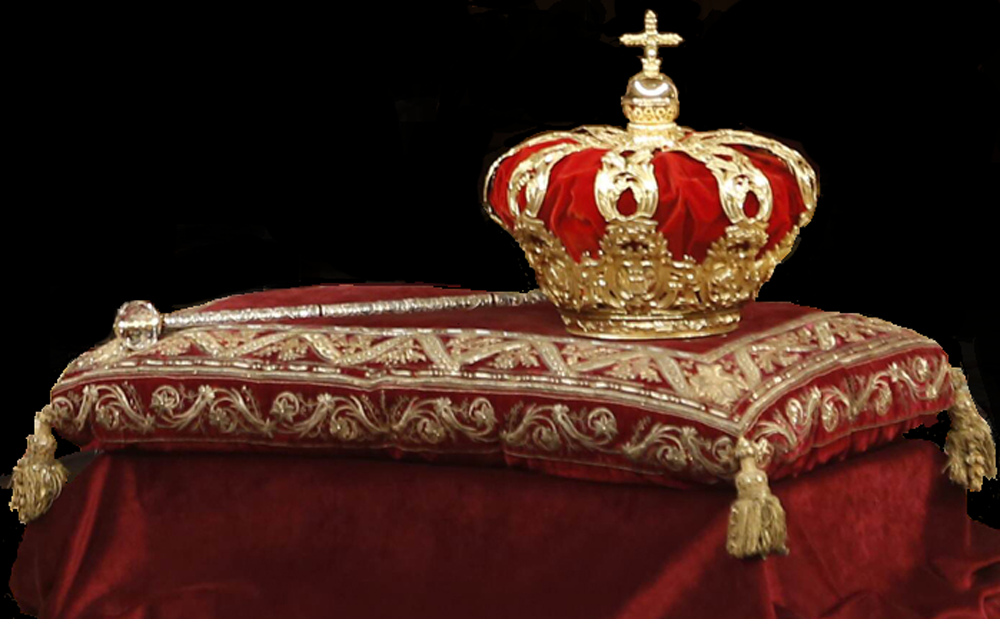
The last Spanish monarchs to be solemnly crowned were King John I of Castile in 1379, King Ferdinand I of Aragon  in 1414, and Queen Eleanor of Navarre in 1479). Queen Joan (Jeanne) III of Navarre was crowned as late as 1555, although she only ruled that part of Navarre beyond the Pyrenees. After them, all Spanish monarchs have assumed their role  by proclamation and acclamation before the Church and since the eighteenth century, before the Cortes Generales. The royal crown has been physically present in these ceremonies. When King Juan Carlos I was proclaimed King of Spain on November 22 1975 and when King Felipe VI was proclaimed this week the crown and sceptre were displayed in front of them in the Cortes. The last occasion on which the crown was seen at apublic ceremont was at the reburial of King Alfonso XIII in 1981 at El Escorial.

The crown itself , made of silver gilt and without gems, displays the emblems of the founding kingdoms of Castile and Leon, a castle and lion respectively. It was made by order of King Charles III (1759-88)in Madrid, following the loss of previous regalia in the fire which had destroyed the old Royal palace in the city.

The sceptre was a gift from Holy Roman Emperor Rudolf II to King Philip II and was made in Vienna.

File:Símbolos de la Monarquía Española.png

The crown and scepre of Spain

Image:Wikipedia

There are some very well illustrated articles about the heraldic arms of the Crown and of the Princes of Asturias on Wikipedia - which is always a good source of informationon such matters I find. They can be viewed at Coat of arms of Spain, at Coat of arms of the King of Spain and at Coat of arms of the Prince of Asturias and there is more heraldry and information about the premier chivalric Order of the monarchy at Order of the Golden Fleece.

A friend has sent me a link to an up-to-date online piece from Wikipedia about the Spanish Royal Standard. This was with a red background under the Hapsburgs and earlier Bourbons, changed to purple for Queen Isabella II and her succrssors - as in the example preserved on display in St James Spanish Place in London, and was blue for King Juan Carlos. With King Felipe it has reverted to red. My friend considers the red is best, though he adds he misses the Cross of Burgundy and yoke and arrows as used by the previous King. I would agree with him. The illustrated article can be viewed at Royal Standard of Spain.

I would slightly quibble  with the article when it states that a heraldic banner has not been used by the Kings since 1931; whilst it may not have been used in Spain, there is one over King Juan Carlos' Garter stall at St George's Windsor.

The history of the various titles used by or available to the Spanish King and Royal family are discussed in Titles and honours of the Spanish Crown, which has both a history of them and illustrations of their armorial bearings.


    Tuesday, 9 October 2012

    Ordinariate Evensong


    Photo: Charlotte Bromley Davenport


    Here, thanks to the Ordinariate on line mailing, is a picture of Fr Daniel Seward Cong. Orat., the Provost of the Oxford Oratory,preaching at the  Solemn Evensong and Benediction in St James', Spanish Place on Sunday. The text of his excellent sermon can be read here.

    Monday, 8 October 2012

    Ordinariate evensong at Spanish Place


    Yesterday afternoon I travelled up to London to attend the Ordinariate Solemn Evensong and Benediction to mark the external feast of Bl. John Henry Newman at St James Spanish Place. As with previous Ordinariate liturgies at the church this was a fine occasion.


    photo

    The interior of St James Spanish Place

    Image:simon_white on Flickr

    St James' is a very fine church indeed - I got the feeling that this what the great churches of the English middle ages would still have been like if it had not been for the disasters on the mid-sixteenth century. So, despite its origins as the Spanish Embassy chapel and the hadsome nreminders of that inheritance, this felt like patrimony.

    The choir sang beautifully and the ceremonial was dignified - although, as I have written before, I have come to genuinely prefer the traditional Catholic structure of Vespers and Compline rather than the Anglican combination of the two.

    The sermon was preached by Fr Daniel Seward, Provost of the Oxford Oratory as the advertised preacher, Fr Paul Chavasse from the Birmingham Oratory, was unable to attend due to illness. This was a fine homily, linking Newman's theological contribution and personal search for holiness with the forthcoming Year of Faith and its application to daily Christian living.

    Following prayers for the work of the Ordinariate to the exposed Blessed Sacrament and Benediction the service concluded.

    Afterwards there was areception in the Social centre under the church and an opportunity to catch up with old friends from Oxford  who are now based in Londobn and to hear their news  and learn how other Ordinariate groups are faring. I received some compliments on this blog from readers - which I appreciated. I also had some banter with Mgr Newton, the Ordinary, about which faction of the Oxford Newman Society my tie represented (this is a highly technical and complicated matter which insiders will appreciate, and others would, probably rightly, think pointless...) and also a conversation with Mgr Robert Mercer.

    When photographs of the service are available I will post a link to them.

    As always on these large Ordinariate occasions I came away with a confidence in what has been achieved and the promise it holds for the future.

    Then, in best Oxford tradition, I moved on from the drinks reception to meet another Oxford friend who lives nearby and to have a drink with him in a nearby pub... ah, the pleasures of church going and friendship!


    Wednesday, 25 July 2012

    St James in England


    Although both the pilgrimage to Compostella itself was very popular and the presence of a major relic of St James the Great at Reading Abbey - about which I posted in The Hand of St James  and More on the Holy Hand of Reading last year, medieval parish church dedications to St James are relatively rare in England. I wonder if some urban examples - Bury St Edmunds,Great Grimsby, Louth - being slightly later in date, do indeed reflect twelfth century devotion to him arising from the Pilgrimage.

    Probably the best known, and the most striking, is the great parish church of Louth in north east Lincolnshire.
     

    Louth church from the west

    Image:panoramio.com

    The chancel and nave were re-built between 1430 and 1440. Work began on the spire in 1501 and it was completed, with great local ceelebrations for which the accounts survive, in 1515. The cost of the work was £305-7s-4d, and it is the tallest Anglican parish church spire at 295 feet high.

    In itself it is evidence of the vitality of the English church at that time, so close to the catastrophic tragedies of the next few decades. It was in the church in the autumn of 1536 that there began that courageous but unsuccessful resistance to the changes being imposed  upon them known as the Lincolnshire Rising, the precursor of the Pilgrimage of Grace.

    Amongst modern churches I aways enjoy my visits to St James Spanish Place in London, which originated as the Spanish Embassy Chapel, and was thus one of the few Catholic churche sopen to the public in the period before the 1791 legislation. Although rebuilt in the style of the English thirteenth century its many associations with the Spanish Church and crown make it alittle bit of Spain in the West End - a beautiful and stylish church.


    St James Spanish Place as designed in 1885

    Image:archiseek.com


    The interior of St James Spanish Place

    Image:ordinariateexpats.wordpress
    

    Friday, 4 May 2012

    LMS Conference - June 9th


    I have been asked to publish details about the conference the Latin Mass Society will be holding on

    The Traditional Mass and the Catholic Life

    on
    Saturday, 9 June 2012


    Regent Hall, 275 Oxford Street, London W1C 2DJ
    (opposite BHS, less than 5 minutes' walk from Oxford Circus)


    This is the first time that the LMS has organised such a one-day conference, and there are some excellent speakers lined up. Designed principally for ordinary LMS members, non-members are very welcome to join them in attending. 

    Timetable for the day:
    9am Low Mass at St James, Spanish Place.

    10am Doors open - Registration until 11am. Stalls in the Conference Hall will be available to browse around


    11am - 11.50am Dr John Rao (Roman Forum)
    12 noon - 12.50pm  Stuart McCullough (Good Counsel Network)

    Lunch

    2pm - 2.50pm  Fr John Zuhlsdorf (Fr Z)
    3pm - 3.50pm  Fr Tim Finigan (columnist and blogger)
    4pm - 4.50pm  John Hunwicke (of the Ordinariate)

    5pm - 6pm Panel discussion
    6pm Close


    BOOKING INFORMATION:
    Admission is by ticket only.
    Ticket prices:
    LMS Members £15
    Non-LMS Members £20
    (includes morning and afternoon refreshments)
    Optional: Buffet lunch, including drinks, £9 supplement


    Tickets may be purchased by phoning the LMS office on 020 7404 7284, by sending a cheque (payable to 'LMS') to LMS, 11-13 Macklin Street, London WC2B 5NH or online through the Latin Mass Society website.

    Tuesday, 3 April 2012

    Ordinariate Chrism Mass


    Yesterday morning I went to London to attend the Chrism Mass for the Ordinariate of Our Lady of Walsingham which was celebrated by the Papal Nuncio, H.E. Archbishop Antonio Mennini, at St James Spanish Place.

    The setting was splendid, there was a good line-up of priests in choir and the body of the church was filled by the laity as well as some non-participating priests.


    The Papal Nuncio, the Ordinary and the clergy of the Ordinariate.
    The photograph also indicates how splendid setting for the liturgy is the church.

    Image: Ordinariate

    The New Liturgical Movement blog has an illustrated report in First Chrism Mass of UK Ordinariate at St. James, Spanish Place. The Ordinariate Portal has a link to a full set of photographs of the liturgy here.

    photo

    The Archbishop mixes the Chrism

    Image:Ordinariate on Flickr/© Mazur/catholicnews.org.uk


    photo

    The Archbishop bestows the blessing at the end of Mass

    Image: Ordinariate on Flickr/© Mazur/catholicnews.org.uk

    Beforehand a friend had expressed the view that the Chrism Mass is merely a modern invention. Whilst it is true tht it is, in its present form, a product of the liturgical changes of the 1950s and 1960s, it is nonetheless a restoration of an ancient practice. My 1930s edition of the St Andrew's Missal refers to its former existence. I assume that at some point the idea that there should only be one solemn Mass on Maundy Thursday, or sheer fatigue at the liturgical schedule, led to it being subsumed within the Bishop's Mass in his cathedral (or wherever he was celebrating Easter), accompanied by twelve priests, seven deacons and seven sub-deacons.

    Reinstating a separate liturgy strikes me as a recovery of tradition rather than the invention of tradition. Once the ceremonies of Maundy Thursday moved back to the evening there are practical issues of time to determine events. In its present form, with the modern re-statement of priestly vows, it does serve to be a reaffirmation of priestly responsibility and duty, and, in a somewhat demotic way, by making it a public liturgy, brings that home to the laity as well.

    In the context of the novus ordo liturgy and the thought which inspired it this does seem an appropriate occasion for concelebration, as is indicated by the interview to which I linked in my recent post Concelebration. The liturgy so celebrated does assert the unity of the local church around the bishop.

    On the other hand it can equally well be argued, on a more traditionalist basis, that here, as elsewhere, concelebrants are not necessary at all, and that the key figure is the bishop as celebrant. Indeed it is important to stress the episcopal function as consecrator of the oils, that this is an hierarchical event, indeed a quintessentially one. The bishop is the mediator of the descent of Grace through tangible sacramental means, and requires no more than the appropriate traditional priestly and diaconal support.

    Looking at the older liturgy I see that there, following the blessing of the oil of the sick, the oil of Chrism was consecrated first, and then the oil of the catechumens was blessed. The modern rite reverses this, concluding with the Chrism. This suggests an element of theatricality in the minds of the compilers, rather than adhering to the traditional order of proceeding, and is, I think, to be regretted.

    So perhaps I favour restoring a separate Chrism Mass, but would favour a more traditional form, and indeed understanding of its theology.

    Saturday, 11 February 2012

    London churches - existing and envisaged


    One of my regular readers has drawn my attention to two post by other bloggers which make for interesting reading.

    The first, from last November, on the Jacobite Intelligencer is an account of the oldest Catholic churches in London, and can be read here. Of these I have worshipped at St James Spanish Place, which is very splendid, and seen St Patrick Soho Square from the outside, and hear good things of its life as a parish. I knew of the former Sardinian chapel in Kingsway but have not so far seen it. The old Royal Bavarian Chapel in Warwick Street has, of course, been in the news and on the blogosphere recently, and not for its architecture but rather for hosting rather debatable activities.

    In any case an inducement to do a church crawl in London sometime to view the architecture.

    The other post is more recent and from Andrew Cusack with a "what might have been" - the design by Sir Ninian Comper for a new church at Clerkenwell for the Venerable Priory of St John of Jerusalem, that is the nineteenth centuryAnglican re-establishment of the English branch of the Order of Malta. The design looks very fine indeed, and an interesting, indeed exhilarating, combination of styles.


    I suspect the central altar owes something to the Crusading knights chapel at Tomar in Portugal, about which there is an article here, and ultimately the Holy Sepulchre itself. As so often in these case of grand designs it is to be regretted that the scheme was not carried out. The article can be read here.

    Tuesday, 17 January 2012

    Pictures and sermon from the Ordinariate Anniversary Evensong


    The Ordinariate website now has links to pictures of the service of Solemn Evensong and Benediction at St James Spanish Place in London last Sunday at Images on Flickr . There is also the text of Mgr Newton's Sermon.


    Image: Ordinariate website


    Monday, 16 January 2012

    Ordinariate Evensong


    After Mass and lunch in Oxford yesterday I went up to London to attend the Ordinariate's Solemn Evensong and Benediction to mark the first anniversary of their erection as part of the Church. This proved to be a splendid and striking event, and which proved to be very well attended.

    Now let us be clear - St James Spanish Place where the service was held is, as one might say, a seriously tasty church - fine gothic revival architecture, splendid furnishings and all those Spanish royal connections. It is the sort of church that reaches parts other churches don't. So we were off to a good start with such a location.


    http://farm4.staticflickr.com/3143/2631620730_7beec01420_z.jpg

    The interior of St James Spanish Place

    Image: Paul Lew on Flickr

    Furthermore this was a great reunion with many friends - long standing fellow converts from Pusey, more recently acquired Oxford Ordinariate friends, cradle Catholic friends, and some faces from years ago, plus new friends. In other words, the usual suspects were there. I was hailed in the street as I walked to the church by one freind, and on the steps of the church beforehand and afterwards there was a buzz of greetings, enquires as to what one another was doing and swapping of information and banter.

    The officiant was the Ordinary and amongst those sitting in choir was Bishop Peter Elliott, the Australian bishop responsible for the setting up of an Ordinariate there, and the new US Ordinariate was commended to our prayers.

    The grandeur of the setting was matched by the music - Howells, Parry - "I was glad"always makes the hairs on the back of my neck rise - and Stanford - and its performance. In the music and the staging of the liturgy one saw what I consider the essence of "patrimony" - a way of doing liturgy and worship rather than specific forms. As I have written before I really do prefer traditional Vespers to Anglican Evensong, but the similarity was close.

    After a sermon from Mgr. Newton which quoted Bl.John Henry Newman writing in 1848 to the father of the future Cardinal Bourne, as in the Apologia, of his spiritual relief at finding himself secure within the Catholic Church and applied it to the members of the Ordinariate, and their gratitude for all that has been achieved there was a procession of the Blessed Sacrament and Benediction. Escorting the Sacrament as canopy bearers and supporters were Knights of Malta - those in Solemn Profession, those in Simple Profession and Knights of Grace - an impressive display of support for the Ordinariate.

    In addition to those in the church I had a strong sense that we were joined in communion with those who rejoiced upon a different shore at what has been achieved and is being achieved through the Ordinariate.

    Whatever the size of the individual groups as they start out on their pilgrimage of faith, here, gathered together was positive evidence of personal commitment and the support of many others within the Catholic Church.

    The reception afterwards packed out the undercroft of the church in the best ecclesiastical tradition - and after a few minutes there I went off with friends to the Angel in the Fields, a hostelry close to the church which provided us with excellent Tadcaster beer to sustain and enliven our conversation.

    All round a jolly good evening and very well worth the effort to go up to London.

    Photographs of the service were being taken and will doubtless appear on the web.

    Monday, 9 January 2012

    Celebrating a year of the Ordinariate


    Monsignor Newton will preside at this commemoration celebration, which has been organised by Fr Christopher Pearson and the Marylebone Ordinariate Group, and to which all are invited.

    The music for the event has been chosen to reflect some of the familiar repertoire of the Anglican Choral Tradition and will include works by Sir Charles Hubert Hastings Parry, Sir Charles Villiers Stanford, Henry Balfour Gardiner and Sir Edward Elgar.