Once I was a clever boy learning the arts of Oxford... is a quotation from the verses written by Bishop Richard Fleming (c.1385-1431) for his tomb in Lincoln Cathedral. Fleming, the founder of Lincoln College in Oxford, is the subject of my research for a D. Phil., and, like me, a son of the West Riding. I have remarked in the past that I have a deeply meaningful on-going relationship with a dead fifteenth century bishop... it was Fleming who, in effect, enabled me to come to Oxford and to learn its arts, and for that I am immensely grateful.


Showing posts with label Königsberg Castle. Show all posts

Sunday, 25 June 2017

What's in a name...


Earlier this evening whilst with friends I glanced at the Mail on Sunday, and in particular at Peter Hitchens' column.


Now it is not unknown for him to be criticised these days for having a somewhat pro-Putin stance - well, he is entitled to such views - but here he wrote of NATO jets flying near the "Russian city of Kaliningrad." Surely he meant the occupied German city of Königsberg...

What's in a name you might say .... well rather a lot actually.

Image result for konigsberg

Königsberg before the Second World War

Image: The Baltic Review

Königsberg was the capital of East Prussia, and the symbolic capital of the Kingdom of Prussia, the place chosen for the coronations of 1701 and 1861. There is a history of the city at the web-article  Königsberg and a history of the royal castle at Königsberg Castle. It was inter alia the city of Immanuel Kant, and is the background for the question known, for obvious reasons, as The Seven Bridges of Königsberg

Image result for konigsberg

 Königsberg Castle befire the First World War

Image: Wikipedia

A large, German, city then, but now a Russian one - the reason for that being the events of the 1940s.


The fate of the city in the Second World War is recorded in Bombing of Königsberg in World War II 
and in Bombing of Königsberg in World War II - Metapedia and in a book link at The Bombing of Königsberg, August 1944.  The fall of the city is set out in Battle of Königsberg, in The Destruction of Königsberg - Königsberg, East Prussia and 11 April 1945: The rape and loot of Konigsberg, capital of Prussia. The comments on these two posts indicate the strong emotions that can still be elicited by thinking about these events.  The capture of the city is also set out in Isabel Denny The Fall of Hitler's Fortress City: The Battle for Königsberg.

From photographs as in the links above and in Königsberg, East Prussia - Remembered,which has a series of old photographs and before-and- after pairs of images, it was once an attractive and distinctive Baltic city with a rich heritage.

The conquest of East Prussia an utterly appalling orgy of Soviet murder and rape. The city, together with the northern half of East Prussia was happily conceded by the supine western Allies to the Soviet Union at Potsdam, whilst the southern half of the province was given to Poland as part compensation for the territories seized by the Russians in 1939. The fact that in a plebiscite little more than twenty years earlier only a tiny percentage there had been in favour of uniting with Poland was conveniently ignored and the centuries old, long standing German community forced out - officially this was to be done " orderly and humanely"! By giving Königsberg to the Soviets the other allies implicitly endorsed the takeover of the Baltic States in 1939-40 - an injustice that was not put right until 1991.
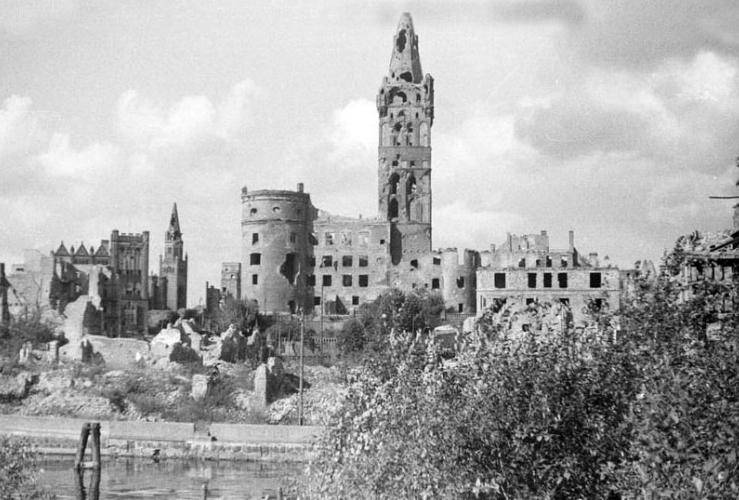
https://europebetweeneastandwest.files.wordpress.com/2015/07/konigsberg-castle-in-ruins-photo-taken-in-1950.jpg

 The ruins of Königsberg Castle in 1950

Image: europebetweeneastand west

In place of the German city of  Königsberg there came the Soviet city of Kaliningrad. The story is set out in From Konigsberg to Kaliningrad: Burying Prussia's past in concrete. Not inconsiderable parts of what had survived - notably the remains of the Castle - were destroyed to obliterate the memory of Prussia.

Königsberg <b>Castle</b> - Kaliningrad - Wikimapia 

The  destruction of Königsberg Castle
Image: Pinterest
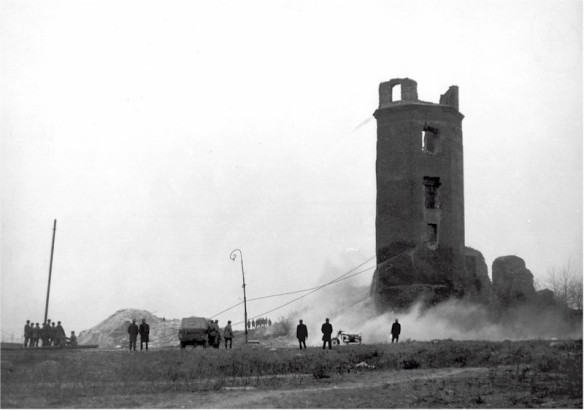
 
The final remains of Königsberg Castle being demolished in 1968

The final destruction of Königsberg Castle in 1968 

Image: europebetweeneastand west

After 1991 as a city and territory it was left stranded, and looking for a new role. That has included the rebuilding of the cathedral - which is now Russian Orthodox. Once surrounded by old houses it now sits alone amidst the wasteland created by war, deliberate destruction, communism and modern town planning.

Two recent impressions of the city can be found at Königsberg. The city that withstood destruction - Baltic Worlds and Окраина: The Myth of Königsberg. These do refer to such things as the survival of parts of the old city and something of its spirit. it is now accessible in ways that it was not after 1945, and looks to be a strange and eery mixture of what was and what has been and what is.


Even if some survives much is irretrievably lost - although the reconstruction of Warsaw and more recently in Dresden and Berlin-Potsdam shows what can be achieved. There has indeed been talk of such a project in 2010 for example as Architect seeks to rebuild historic core of Königsberg

The current situation of this detached bit of what is once again Russia ( but never was itself), the Kaliningrad Oblast, is set out in Kaliningrad question.

One suspects its status has become one of those matters politicians like to skirt around - it raises too many awkward questions about the present, let alone the not too distant - and often uncomfortably recent - past. On these points see Baltic Review.com/Eastern Prussia: Freedom to Königsberg 

Nor should we forget that what can be said about Königsberg can be said about the whole of East Prussia.

As I said above,what's in a name .... well rather a lot actually.


Sunday, 18 January 2015

Prussian Palaces


Today,January 18th was a significant date in teh calendar of the Kingdom of Prussia - it was on this day in 1701 that King Frederick I was crowned and on which in 1871 German Empire, presided over by the King of Prussia as German Emperor was proclaimed at Versailles.

As I am justa bout to sart reading Christopher Clark's acclaimed Iron Kingdom: The Rise and Downfall of Prussia 1600-1947 today seems a good day on which to post some pictures of Prussian palaces and royal residences.

I have posted previously about the rebuilding of the Royal Palace in Berlin in Rebuilding the Berlin Stadtschloss and in The reconstruction of the Royal Palace in Berlin

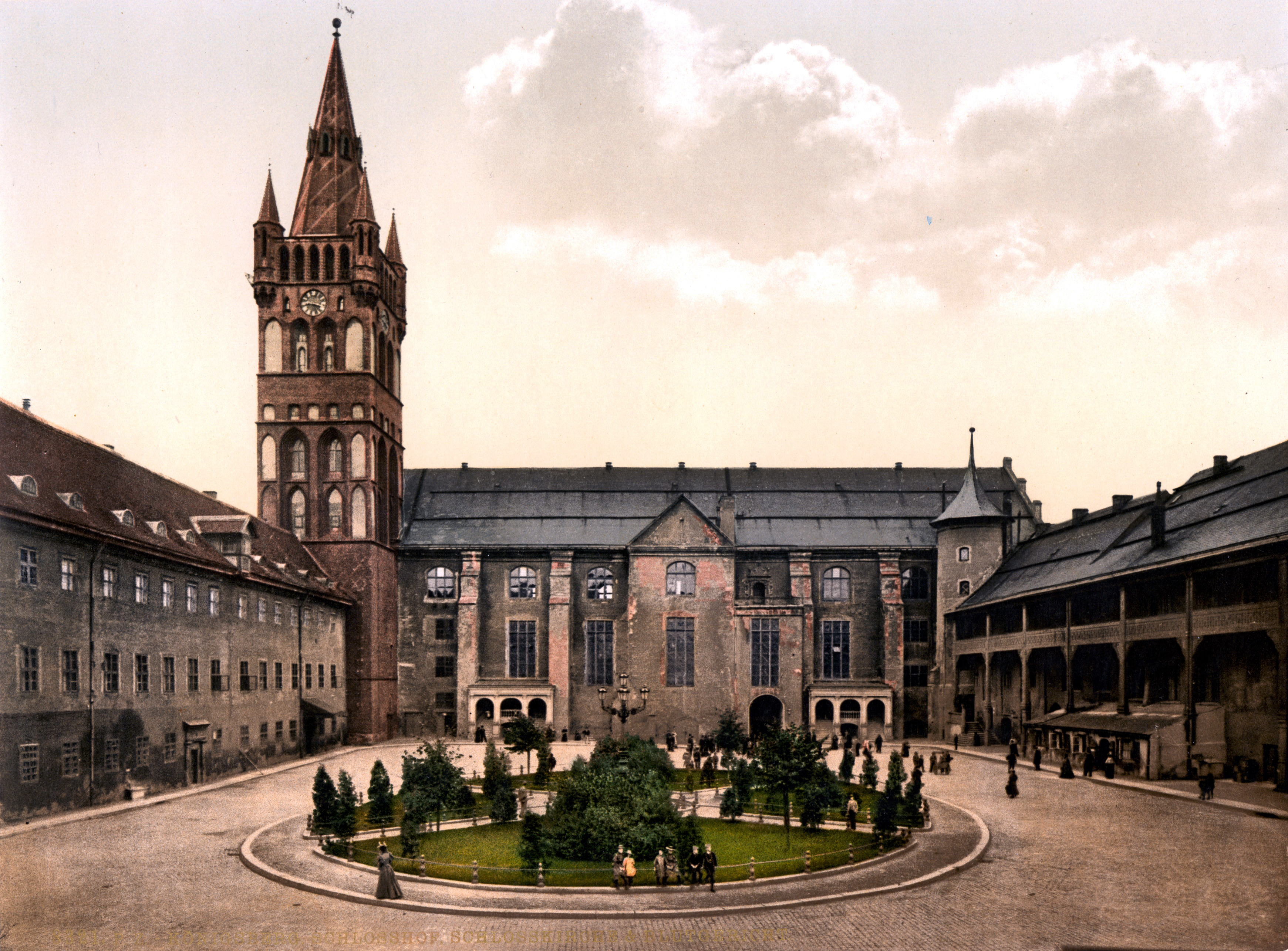
The coronation of 1701 took place in the church of the castle in Königsberg. The buildings were destroyed in the latter stages of the Second World War and afterwards, being finally blown up in 1986. Subsequently there has been talk of rebuilding it. The case for that is set out in a very interesting illustrated post, which includes aplan of the buildings, from a blogger in the city here.  There is an illustrated history of the buildings at the online piece Königsberg Castle

File:Königsberg Castle courtyard.jpg

The courtyard and church of Königsberg castle in the 1890s

Image:Wikimedia


Prior to World War II, Königsberg was a major German city in East Prussia. The...

The castle before the Second World War

Image:spiegel.de

As Kings the Hohenzollerns were in the eighteenth century prodigious builders in the Baroque and Rococco styles, despite the rather dour image we often have of Prussian court and social life.

The first of these palaces which survives intact is Charlottenburg, in the western part of Berlin. There is an illustrated account of the history and architecture of the building at Charlottenburg Palace.

http://berlin.citysegwaytours.com/blog/wp-content/uploads/2014/05/CharlottenburgPalace.jpg

Charlottenburg Palace

Image:berlin.citysegwaytours.com

Further to the west of the city a whole series of royal residences were created at Potsdam. Of these the oldest, of which there is an illustrated history at Potsdam City Palace, has recently been rebuilt following its final deliberate destruction by the East German authorities after wartime bombing. There is an illustrated post by Andrew Cusack about the plans from 2010 at Potsdam's City Palace to be Resurrected. Whether such a partial reconstruction of the interior is right is, of course, open to debate.I would prefer to see a full reconstruction.

There is more about the rebuilding at Reconstruction projects in Potsdam (City Palace, baroque Quartier) and the history of the building, its destruction and the begining of reconstruction work is covered in awell illustrated article at Rise and Fall of the City Palace

Potsdam City Palace

Potsdam City Palace in 1928
The dome is that of St Nicholas Church which is next to the Palace

Image:v-like-vintage.com

Inspired by King Louis XIV's palace at Marly King Frederick II created his own palace for relaxation, at Sanssouci in the park at Potsdam. This was an idyllic place situated above terraced vineyards where he couls escape the cares of state and military operations. The palace was built in 1747-7, towards the end of the War of the Austrian Succession. There is an account of it at Sanssouci. A fine set of photographs of the Palace can be seen here.


There are a fine series of photographs of the palace here.


Photo of Schloss Sanssouci Germany Stylish

 Sanssouci

Image:wallnyc.com


Following his next major European conflict, the Seven Years War , the King built the Neue Palais in Potsdam in the years after 1763. On top of the dome naked figures of his three female opponants - the Empress Maria Theresa, the Empress Elizabeth of Russia and Madame de Pompadour - are to be seen, holding up the King's crown.

Insider's Potsdam

The Neue Palais built by King Frederick II

Image:insidertour.com

There is an account of the building at the illustrated article New Palace Potsdam, which shows how it was built to entertain other royal guests and only used as a regular residence in the late nineteenth century. It survived the Second Wotld War relatively unscathed.


If the eighteenth century was the great age of Prussian palace building - and its achievements were spectacular - in the late nineteenth century the tradition continued with structures such as the Empress Frederick's Schloss Friedrichshof, built in the Taunus in her widowhood, and now a hotel, and her son Emperor Wilhelm II's Romanesque palace at Posen/Poznan, about which there is an illustrated article at Imperial Castle, Poznań. This was built in 1905-10.

1910 look of Palace

The Imperial Castle as originally built.
Following damage in the Second World War the tower was reduced in height

Image;info-poland.buffalo.edu