Once I was a clever boy learning the arts of Oxford... is a quotation from the verses written by Bishop Richard Fleming (c.1385-1431) for his tomb in Lincoln Cathedral. Fleming, the founder of Lincoln College in Oxford, is the subject of my research for a D. Phil., and, like me, a son of the West Riding. I have remarked in the past that I have a deeply meaningful on-going relationship with a dead fifteenth century bishop... it was Fleming who, in effect, enabled me to come to Oxford and to learn its arts, and for that I am immensely grateful.


Showing posts with label Cardinal Reginald Pole. Show all posts

Tuesday, 6 May 2025

Cooking for the Conclave in 1549


In a recent article I referred to the presence of  Cardinal Reginald Pole in the Papal Conclave of 1549-50, and that he was almost elected at one point.

The always enthusiastic and entertaining Tasting History with Max Miller has a topical video about Conclaves. He begins with the improvised one of 1268 -1271 at Viterbo and the consequent election of Pope Gregory X. This was followed by the issuing of Ubi periculum by the new Pope to regulate future elections. There is a video about Pope Gregory, his election and his subsequent legislation, as well as his tomb at Arezzo, at The Origins of the Conclave

Max Miller then turned to the well documented, and very open, three to four month Conclave of 1549-50 at which Pole was present. The details recorded in his published recipe book by the chief cook, Bartolommeo Scappi, who was in charge of feeding the Cardinals and their sizeable entourages within the Conclave are used by Max Miller to prepare one of the dishes that was doubtless served. 

He also sets out the well documented diplomatic rivalry being played out between the ambassadors of the Emperor Charles V and King Henri II of France and their very political interest in the result of the Conclave. After a return to the strict discipline of Ubi periculum the Cardinals very cynically elected the ineffectual Cardinal del Monte who became Pope Julius III

The video can be seen at Feeding the Papal Conclave


Thursday, 19 February 2015

Pope Paul IV, Cardinal Pole and the allegation of heresy


There is an interesting post by New Catholic at the Rorate Caeli website which is a translation of an article by Roberto de Mattei about the theological factions within the College of Cardinals in the 1550s and 1560s, including the allegations of heresy or error brought against the English Cardinal Pole.

The article can be read at Paul IV and the Heretics of His Time

The text of Pope Paul IV's Bull Cum ex Apostolatus Officio, referred to in the article, can be read in translation here.

There is an online account of the Pope at Pope Paul IV, and of one of the other principal figures in the article which can be read at Giovanni Morone.

Paul IV.jpg

Pope Paul IV

Image: Wikipedia

In recent years there has been quite an amount of academic work done on Pole, with at least two biographies, and a re-evaluation of his achievements as Legate and Archbishop in the reign of Queen Mary I. The Mattei article gives the Roman context for the pressing issues facing the respective Popes and Cardinals in these decades, and the more general point as to how to address suspicions of heresy at the heart of the Church.

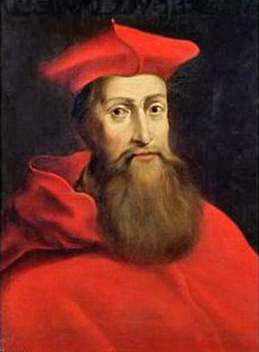
Cardinal Reginald Pole.jpg 

Cardinal Reginald Pole

Image:Wikipedia


Sunday, 17 November 2013

Religious change in 1558


Today marks the 455th anniversary of a set of events in 1558 which shaped the future religious history of England. On that day there occurred the deaths, early in the morning, of Queen Mary I and, later in the same day, that of Cardinal Pole of Canterbury, and the accession of Queen Elizabeth I. With these events the 1559 settlement of the Church of England became possible.


Queen Mary I

Image:simondickinson.com

If Queen Mary had lived longer her government and bishops might well have been able to continue with further success the work they had carried out to restore Catholic belief and practice to the country, something they can now be seen to have done to a great extent as has been shown by Professor Eamonn Duffy with The Stripping of the Altars and more particularly in Fires of Faith. Given that the majority appear to have favoured traditional religion this made the likelihood of a deeper renewal of the Papal allegiance and acceptance of Tridentine initiatives would follow. For this the Queen needed a  Catholic heir. If she herself did not have child, then Elizabeth was the next heir under the 1544 Succession Act, and Elizabeth played her cards skillfully. The next Catholic heir was Queen Mary of Scots, Dauphine of France and unacceptable on those grounds to both Mary of England and her husband Philip of Spain. King Philip did not possess the crown matrimonial under the 1554 marriage treaty, so he had no continuing rights. He may have offered to marry Elizabeth - with, no  doubt, no likelihood on either side of interest - but what he sought was diplomatic security for hios domains in the Netherlands. Had he and Queen Mary I had a son then he would have joined England and Ireland in a union with the Habsburg lands in the Low Countries- which raises some intersting possibilities of what might, in theory, have happened. The crucial thing was the need for a securely Catholic heir, and that there was not.


  Reginaldus Pole (1500–1558), Cardinal Pole

Cardinal Reginald Pole
Cristoforo Dell' Altissimo
Portrait at Shute Barton

Image: National Trust/BBC My Pictures

Cardinal Pole - royal by descent, Cardinal, papabile in 1550, dangerous liberal or dangerous reactionary depending how you looked at him - by dying when he did removed the leadership of the English hierarchy at a critical time. How he would have dealt with the new Queen Elizabeth is an unknown, and, I think, unknowable. Without Queen Mary's backing he might have had to depend upon King Philip for aid against his old sparring partner Pope Paul IV, who suspected Pole ( and not only Pole of course) of heresy. How he might have got on with Pope Pius IV, elected when Pope Paul died in 1559, and the reconvened Council of Trent, which was yet to complete the restatement of Catholic belief in a time when so much seemed shifting and unsure, again raises imponderables.


Queen Elizabeth I in the 1560s
The portrait stresses the Queen's evangelical credentials, with her restrained dress and the prayer book she is holding

Image: philipmould.com

Queen Elizabeth I was to be both initially cautious in her religious policy and then bold in re-establishing asystem based on her half-brother's settlement. That it may not have been what she herself favoured is likely - David Starkey's interpretation of her as favouring a Henrician style of a Catholic style combined with evangelical reforms, a liturgy with ceremony and certainly the crucifix as well as music appears convincing to me. A Papal settlement was not acceptable - had not the Pope bastardized her in the womb as she herself said, and her legitimacy and right of succession was central to her  being. Unfortunately for the new Queen, and to her surprise, the surviving Marian bishops were not prepared to abandon the barque of Peter - well, all save Bishop Kitchen of Llandaff - and she was forced to deprive them. Finding replacements led her to men less attracted than she was by the more traditional forms of worship. Given an international settlement at Cateau-Cambresis which brought peace to Europe the new Queen had more room to manoeuvre diplomatically, and to play anot especially string hand very skillfully. By not pushing conformity too far, although legislation existed to do that, the Queen and her ministers maintained a consensus that for a few years proved manageable. However both Ctaholic and Puritan opposition remained, and bevcame more assertive as time, and the reign, went on. Nevertheless the curious compromise that is  the 1559 Settlement is one which, for all its cobbling together, has survived for more than 450 years. Not even the Civil War and regicide in the mid-seventeenth century could destroy it. I am somewhat surprised more was not done to mark the 450th anniversary in 2009. The pity of it is that under the second Queen Elizabeth the Church of England seems to be doing to itself what its adversaries have failed to do over the previous four hundred years.

Had Queen Elizabeth died in 1562, as she very nearly did of smallpox, then the country would have faced a real crisis. The Council were divided as to who to approach as the next heir - Lady Catherine Grey or Henry Earl of Huntingdon. The Queen solved the problem by recovering, but had she not done so her legacy would be very unclear. With either of those two candidates on the throne a more Protestant Church of England might well have ensued, as of course might Catholic opposition, not to mention Queen Mary I of Scots, as  yet unbesmirched by scandal...

If for Queen Mary I the succession was a continuing dilemma, then so it was for her half-sister - indeed almost more so. Queen Elizabeth I held out against naming an heir for almost forty five years, and turned the whole matter into  a national concern that dare not really speak its name. Their father's break with the Papacy and Rome had made the nation's religious life a matter for the monarch to determine, and yet there was no way to determine the way a new monarch might take the Supreme Headship or Governorship. Not until 1688-9 and 1701 was a settlement made to limit that range of possibilities.


Friday, 30 November 2012

St Andrew's Day 1554


It was on St Andrew's Day in 1554 that England was formally absolved from schism and received back as a kingdom into the bosom of the Catholic Church.

Led by King Philip and Queen Mary the Lords and Commons knelt before the Papal Legate, Cardinal Reginald Pole and besought absolution which was granted by the Legate in the name of Pope Julius III.

For the Queen this must have been one of the happiest days of her life, the vindication of all she had hoped and no doubt prayed for for a quarter of a century.
St Andrew's day was appointed as aperpetual celebration of the reconciliation, but that can have last happened in 1558, just after the Queen's death.

As I have written before it was reading about the part played in this process by Bishop Stephen Gardiner in Glyn Redworth's superb biography of him,  In Defence of the Church Catholic that removed on eof the last props of my Anglo-Catholic position and influenced, indirectly my own path to Rome in 2005. In particular there is the text of the great sermon preached by Gardiner at Paul's Cross on the Sunday following the reconciliation - it is very well worth reading.

Which brings us neatly up to date. In the 1980s there did appear to be apossibility of some form of organic reunion of the Anglican Church with Rome - remember ARCIC in 1982. That may well have been afudge in advanc eof the papal visit of that year, but there was, not so long ago, a real hope of such an outcome. Now we know better, as is indicated in this post from Fr Tim Finigan  Goal of corporate reunion no longer realistically exists.

The way to unity now lies clearly with individual reconcilition either through the Ordinariate or as a traditional convert. But think what might have been in the 1550s or even in our own times!

Thursday, 17 November 2011

Good Queen Mary


Amongst my birthday presents was a signed copy from the author, my friend John Edwards, of Mary I: England's Catholic Queen, the latest in the Yale UP series of biographies of English monarchs.


I was delighted both to be given a copy of the book, and to find what a superb piece of work it appears to be - I say appears to be merely because I have only had a chance to glance at it and read some passages rather than devour it cover to cover. It has received some excellent reviews, and from what I have seen deservedly so. As John Edwards' expertise is rooted in late medieval and sixteenth century Hispanic studies he has explored as no-one appears to have done hitherto the full, Spanish dimension of Queen Mary's formation and the wider context of her marriage to King Philip.

I must get on and read the book through, but thought that the anniversary of the death of the Queen, and of Cardinal Archbishop Pole, which falls today, was a good occasion upon which to draw attention to the book. It is also a good occasion, as Fr Blake urges his readers in Death of Catholic England, upon which to pray for the repose of the souls of the Queen and the Cardinal.

My post from last year Queen Mary I and Cardinal Reginald Pole has pictures of the Requiem celebrated for Carsdinal pole in 2008 at magdalen, his Oxford college.

Tuesday, 30 November 2010

St Andrew's Day


Fr Hunwicke has two posts relevant to today - well worth reading with their comments, both about the reconciliation of England to the Church in 1554, and of the diocese of Durham in 1569, and about the possible options for the Ordinariate liturgy. You can find them here and here.


Wednesday, 17 November 2010

Queen Mary I and Cardinal Reginald Pole


November 17th is the anniversary of the deaths on the same day in 1558 of Queen Mary I and of her cousin and Archbishop of Canterbury, Cardinal Reginald Pole.

In recent years both Queen and Cardinal, as well as her husband King Philip, have the subjects of new biographies which seek to present them in a much more favourable and nuanced light, and taking ccount of new research and understandings of sixteenth century life and realities. This process is continuing, and although it may take some time before everyone is speaking of "Good Queen Mary" her reign, and the considerable progress made during it in restoring Catholicism is being reappraised and understood more impartially. There have been a series of recent biographies and other studies of the Queen which have presented a much more balanced account than has been usual, and we await my friend John Edwards' biography of her in the Yale English Monarchs series. Henry Kamen's King Philip is a very readable account of the life of her husband, who emerges as a far more human and attractive figure than he is often presented in popular perception.

There is a continuing series of articles about the Queen at the website Mary Tudor- Renaissance Queen There is a catalogue of portraits of the Queen here.

This stained glass depiction of Queen Mary and her husband King Philip is little known in this country but which is contemporary.

http://tudorhistory.org/groups/mary_philip_window.jpg
Queen Mary I and King Philip II

From a window in Sint Janskerke Gouda, The Netherlands, made in 1557

File:Cardinal Reginald Pole.jpg

Cardinal Reginald Pole

Image: Wikipedia


For many years Pole was awaiting an academic biographer; this gap has been filled to a considerable extent with the publication of Thomas F. Mayer's Reginald Pole: Prince and Prophet (Cambridge Studies in Early Modern British History), although it is not always the easiest book to read.

The Queen and Pole's considerable efforts to re-establish Catholicism in England have most recently been studied in Eamonn Duffy's Fires of Faith.

Two years ago, on the 450th anniversary of the Cardinal's death, and long before I started blogging I served as thurifer at a Requiem Mass in the Extraordinary Form for Cardinal Pole in the chapel of his college, Magdalen here in Oxford. These photographs, taken by Br Lawrence Lew, O.P., appeared, together with the link to his Flickr set of the Mass, on the NLM site.


    photo

    The Mass, organized by the Latin Mass Society, was celebrated in the chapel of Magdalen College, with the permission of the President and Dean. Cardinal Pole had been an undergraduate in this college, and it was a privilege for us to assist in the Mass celebrated in the Extraordinary Form in this beautiful (essentially) medieval chapel. The Mass included absolutions at the catafalque, which bore the Cardinal's arms
    The celebrant was Fr John Osman, parish priest of Dorchester-on-Thames, and the Mass was expertly and prayerfully sung by the Schola of Bl. Thomas Abel, Oxford University's Gregorian chant society, which was founded by the current Chairman of the LMS, Dr Joseph Shaw.

    Elevation of the Sacred Host

    More photos in my Flickr set.