Once I was a clever boy learning the arts of Oxford... is a quotation from the verses written by Bishop Richard Fleming (c.1385-1431) for his tomb in Lincoln Cathedral. Fleming, the founder of Lincoln College in Oxford, is the subject of my research for a D. Phil., and, like me, a son of the West Riding. I have remarked in the past that I have a deeply meaningful on-going relationship with a dead fifteenth century bishop... it was Fleming who, in effect, enabled me to come to Oxford and to learn its arts, and for that I am immensely grateful.


Tuesday, 31 December 2024

John Wyclif 640


Today is the 640th anniversary of the death at lotto off in Leicestershire of the rector, John Wyclif - also, of course, spelt as Wycliffe. 

Wyclif had been rector for the previous decade since 1374, but only resident since 1382, and probably reluctantly, for all his inveigling against negligent clergy, He apparently suffered a stroke during Mass in the church on December 28th and died hree days later. He was buried in the church with a memorial, of which fragments were taken in later years by Bohemian admirers back to central Europe. In 1428, by order of the Council of Constance, confirmed by Pope Martin V, and at the order of the diocesan Bishop Richard Fleming of Lincoln, Wyclif’s bones were dug up, burned and the ashes thrown into the local river Swift. Later romantically minded admirers have seen this as spreading his influence worldwide.

To many he came to be seen, and still is, as the “Morning Star of the Reformation”, founder of the Lollard movement and enthusiastic translator of the Bible into English. That is very much the interpretation offered by H.B. Workman in his two volume early twentieth century biography of Wyclif

Twenty or so years later the immensely influential Oxford Historia and reinterpretor of late Medieval English politics K.B. Macfarlane wrote a short but significant life of Wyclif. Unlike Workman Macfarlane was not a religious man and for him Wyclif was a disappointed careerist with high blood pressure. Forced out of Oxford because of his highly controversial views, and after failing to secure a fixed place there and dependent on various small benefices for his income he became ever more critical of the established Church and succumbed to a stroke.

Such were the two prevailing views of Wyclif when I was an undergraduate.

Since then studies on all aspects of Wyclif, his immediate circle, their influence, the development of Lollard ideas and Lollard ( if it existed,that is, as a coherent movement )the impact of his ideas on Jan Hus in Bohemia and on, or arguably not on, the English reformation, and its enduring legacy. As has been pointed out long ago he anticipated almost the whole range of reformist ideas, but not in a systematic way, being in that respect more like Luther than Calvin and his followers.

The result has been much excellent scholarship, much light has been shed and some heat generated. The result is we think we know something or indeed more about Wyclif, but it seems to me that often the more we know, or think we know, the more perplexing he is. That extends to his - putative - followers, and the place of all of them in Ricardian and fifteenth century England.

Just a brief glance at the Wikipedia account of Wyclif indicates something of this. It can be seen at John Wycliffe

It begins with the old emphasis on him as the proto-English protestant but what have been I suspect later revisions indicate how far and wide scholarship has gone in recent decades. There are no easy answers with the life and thought of Wyclif. 

Ten years ago I posted about the anniversary of his death in John Wyclif

In it I recommended the ODNB life by Anne Hudson and Anthony Kenny. That remains a major introduction, as does Kenny’s ‘Past Mastets’ OUP account.  G.R. Evans’ biography is readable and brings late fourteenth century Oxford to life.

Kenny compared Wyclif to Wesley and Newman as three Oxford men with the same Christian name, exiled from Oxford but ever nostalgic for it. For all their immense differences he makes a useful, memorable comparison. All three risked sanctions from essentially the same academic code of regulation and conduct in the age before Victorian reform got to work on the University. I would add that all three wrote vast amounts, and trawling through it all takes time and skill.

Today he might well be a television don, a pundit on everything, or one exiled to the internet for being too politically or ecclesially incorrect.

There is an illustrated account of the church at Lutterworth at Lutterworth Church St Mary Leicestershire | Leicestershire & Rutland Church Journal


I wrote about following Wyclif’s footsteps in modern Oxford in 2014 in Walking round Wyclif's Oxford


Monday, 30 December 2024

The Battle of Wakefield


Today is the 564th anniversary of the Battle of Wakefield in 1460. The Lancastrian victory resulted in the death of Richard Duke of York, who had in October of that year been recognised by the Act of Accord as heir to the throne. This most certainly did not accord with the views of the Lancastrian grouping who had not been in the Parliament which agreed it, and their reaction was to remove York, his second son the Earl of Rutland, and his nephew Sir Thomas Neville on the battlefield. The following day the Duke’s bother-in-law, and father of Sir Thomas, was beheaded at nearby Pontefract by a group of Lancastrians. What we know as the Wars of the Roses was intensifying and becoming more vicious.

The political background to the events of that December day in Wakefield can be seen in Dr Simon Payling’s post on The History of Parliament blog at The brief triumph of Richard, duke of York: the Parliamentary Accord of 31 October 1460

This includes a reproduction of one of the two known surviving images of Richard Duke of York in the Hall of Trinity College at Cambridge 

Richard duke of York
This fragment is in a chapel in Cirencester Parish Church

Image: Wakefield Historical Society

Fourteen years ago I posted on this day about the battle in The Battle of Wakefield 1460
In that article I point out my particular connection with the events of that winter afternoon in that I, like not a few other twentieth century people, was born at a maternity hospital situated on part of the onetime battlefield. 

The Duke of York had spent Christmas at Sandal Castle with the other prominent casualties of the battle together with an army he was leading north to deal with Lancastrian opposition to his new position. They had been attacked in a skirmish near Worksop but there appears to have been a truce of some kind with the Lancastrian forces based at Pontefract. Befor the festive season was over the Lancastrians moved against the Yorkist headquarters at Sandal. Even allowing for chroniclers exaggerated estimates most of York’s troops must have been outside the relatively small compact castle overlooking the curve in the river Calder and the town of Wakefield on the opposite bank. The need to ensure supplies for them may have been the reason York was drawn out of the castle to find himself in a Lancastrian trap 

The blog and website A Nevill Feast offered some thoughts about the battle in 2013 at Wakefield and murder at Pontefract

The blog of the The History of Parliament has another useful article by Dr Payling which draws upon the biographies researched by the project on fifteenth century MPs. This can be seen at Richard, duke of York’s last Christmas: the Battle of Wakefield, 30 Dec. 1460

I would however query the points he makes in his last paragraph, which seem to me to suggest an unconscious bias towards the Yorkists because they emerged victorious a few months later. As he says in his other article to which I have linked the Lancastrian leadership would never accept the Act of Accord passed by a Parliament in which they were not present. The relative capabilities of York and Salisbury, Edward of March and Warwick the Kingmaker are open to discussion, and the deaths of political opponents in or after battles a grim reality of the age. Somerset, Northumberland and Clifford would no doubt have seen their fathers’ deaths at the First Battle of St Albans in 1455 as a murderous ambush, and similarly the nobles killed at the battle of Northampton the previous summer. In consequence they were now responding in kind. Nor is it clear that York - as per Shakespeare - was taken alive.


The very damaged remains of the effigy of Richard Neville Earl of Salisbury from Bisham Priory, where he was reburied in 1462-3, now in Burghfield Church in Berkshire

Image: The History Jar 

The effigy is discussed in fascinating detail by Pauline Routh in an article available from The Ricardian website of the Richard III Society

Wikipedia has an illustrated biography of the Earl of Salisbury at Richard Neville, 5th Earl of Salisbury

Despite much modern building resulting from the expansion of Wakefield, new roads or realignments of their fifteenth century position and the addition of the railway it is still relatively easy to envisage the scene as it would have been in 1460. Sandal Castle has been re-excavated and is open to the public, and within easy walking distance is the nineteenth century replacement of the destroyed monument to where the Duke of York was said to have been killed. A little further to the north is the medieval bridge over the Calder with its famous chantry chapel. Near here is where the Earl of Rutland was slain, and the original facade has been restored and can be seen in a park to the south of the battlefield area.

There is a useful discussion of the topography of the battlefield at Battle of Wakefield – Waterton's Walton

Other places associated with the aftermath of the battle such as Pontefract Castle and Micklegate Bar in York can also be visited. In the church at Fotheringhay is the replacement tomb created at the suggestion of Queen Elizabeth I for great great grandfather the Duke of York. I wrote about the 1476 reburial there by the seemingly victorious Yorkists of York and Rutland in The reburial of Richard Duke of York in 1476

Monument to Battle of Wakefield, Wakefield, West Yorkshire

The memorial to the Duke of York as rebuilt in 1897 on Manygates Lane, Wakefield 

Image: Historic England


Friday, 27 December 2024

St John the Evangelist


Today is the principal feast day of St John the Apostle and Evangelist.

Unlike his namesake St John the Baptist the life of the Evangelist has not provided artists with the dramatic inspiration of the life and death of the Great Foreunner. Mysticism is not as good material as Martyrdom. Even his deliverance from boiling oil at the Latern Gate is a rarity for patrons and artists, as is the tradition that he was accorded the privilege of being assumed into Heaven - an idea that was popular in later medieval Germany. Far too many depictions show him as a pale youth looking, frankly, a bit soppy, or as another venerable patriarch.

El Greco however did create an image which is both youthful and yet resolute - even if he does look slightly as someone performing a party trick - and of a young man you would want on your side.

File:El Greco - St. John - Google Art Project.jpg

St John the Apostle and Evangelist 
El Greco, 1610-1614
Image Wikipedia 

Another late work by El Greco, the uncompleted, and definitely dramatic The Vision of Saint John, dated to 1608-14, and now in the Metropolitan Museum in New York is discussed in an article from The Independent from 2013 at Great Works: The Vision of St John, 1608-14, By El Greco

Today it is the custom to bless wine, apparently by association with St John drinking deliberately poisoned wine and being unscathed.  I watched this ceremony online from SS Gregory and Augustine in Oxfordat the conclusion of the evening Mass.

The New Liturgical Movement had an article about this tradition last year which can be seen at The Blessing of Wine on the Feast of St John the Evangelist

Fr Zuhlsdorf has posted twice about this custom in recent years, and those pieces can be seen at 27 Dec – St. John the Evangelist – Today we bless WINE! and at Blessing wine on 27 December – St. John’s Day… or “another beverage”?


Thursday, 26 December 2024

Celebrating St Stephen in the Ambrosian Rite


The New Liturgical Movement website marks St Stephen’s Day with an interesting article about the Gospel reading for the Mass for today in the Ambrosian Rite as used in Milan. It demonstrates very well the antiquity of the traditional lectionaries.  

It also includes a video from a parish under his patronage in Ticino, near Milan, of the opening of the Mass there on St Stephen’s Day in 2018 with the lighting of the faro. A splendid ceremony, very laudable, but not one to do without ecclesiastical approbation, or indeed, a fire extinguisher to hand ….

The article can be seen at The Ambrosian Gospel of St Stephen


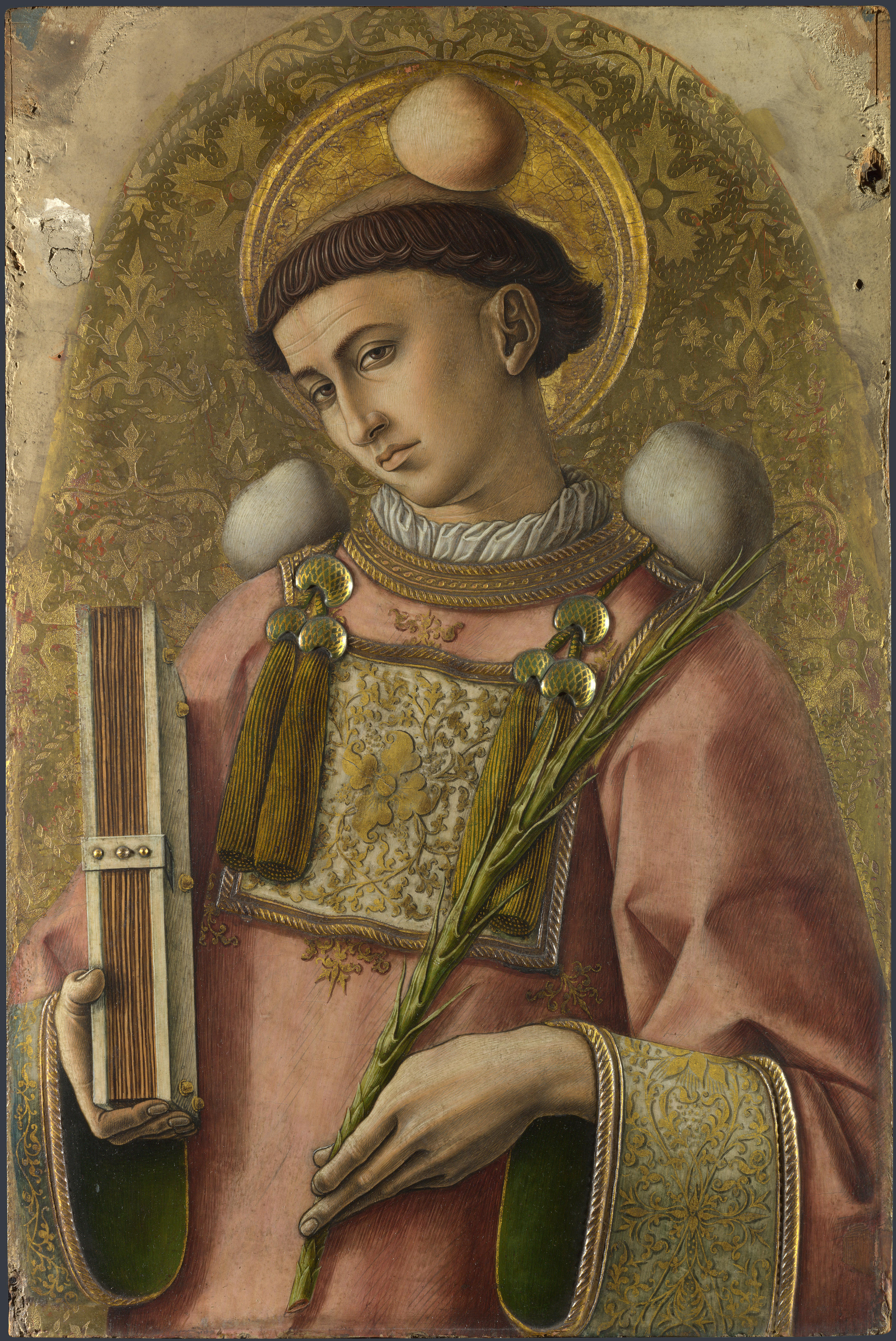
St Stephen

 
Today is the Feast of St Stephen the Martyr.

File:St-stephen.jpg

St Stephen from The Demidoff Altar by Carlo Crivelli. Painted in 1476 it is now in the National Gallery.

Image: Wikipedia 

Wikipedia recounts the life of St Stephen from the Acts of the Apostles and discusses his veneration in Saint Stephen

Ten years ago I wrote about St Stephen and linked several artists depictions of him and his martyrdom in St Stephen's Day

I would add to the notes about the painting of the diagonal ordination a link to the Catholic Encyclopaedia about the delivery of the instruments, in this case the chalice and paten for the deacon to prepare at Mass, which can be seen at Holy Orders


In my post there is also a reference to the sermon of St Fulgentius of Ruspe. This is quoted in the fourth, fifth and sixth lections at Matins in the Traditional Breviary as follows:

Yesterday we were celebrating the birth in time of our Eternal King; today we celebrate the victory, through suffering, of one of His soldiers. Yesterday our King was pleased to come forth from His royal palace of the Virgin's womb, clothed in a robe of flesh, to visit the world; today His soldier, laying aside the tabernacle of the body, entereth in triumph into the heavenly palaces. The One, preserving unchanged that glory of the Godhead which He had before the world was, girded Himself with the form of a servant, and entered the arena of this world to fight sin; the other taketh off the garments of this corruptible body, and entereth into the heavenly mansions, where he will reign for ever. The One cometh down, veiled in flesh; the other goeth up, clothed in a robe of glory, red with blood.

The One cometh down amid the jubilation of angels; the other goeth up amid the stoning of the Jews. Yesterday the holy angels were singing, Glory to God in the highest; today there is joy among them, for they receive Stephen into their company. Yesterday the Lord came forth from the Virgin's womb; today His soldier is delivered from the prison of the body. Yesterday Christ was for our sakes wrapped in swaddling bands; today He girdeth Stephen with a robe of immortality. Yesterday the new-born Christ lay in a narrow manger; today Stephen entereth victorious into the boundless heavens. The Lord came down alone that He might raise many up; our King humbled Himself that He might set His soldiers in high places.

Why brethren, it behoveth us to consider with what arms Stephen was able, amid all the cruelty of the Jews, to remain more than conqueror, and worthily to attain to so blessed a triumph. Stephen, in that struggle which brought him to the crown whereof his name is a prophecy, had for armour the love of God and man, and by it he remained victorious on all hands. The love of God strengthened him against the cruelty of the Jews; and the love of his neighbour made him pray even for his murderers. Through love he rebuked the wandering, that they might be corrected; through love he prayed for them that stoned him, that they might not be punished. By the might of his love he overcame Saul his cruel persecutor; and earned for a comrade in heaven, the very man who had done him to death upon earth.

Quotation from Divinum Officium

A damaged, but still charming, late medieval English depiction of St Stephen from the rood screen in the rural church at Hempstead in north Norfolk can be seen on Flickr Hempstead screen: St Stephen | St Andrew, Hempstead, Norfolk


Wikipedia has a separate article about an old English carol with a wildly implausible account of the saint’s death at Saint Stephen and Herod


JSTOR has an article about an old English and Irish custom, that of killing wrens ( the feathered variety, not the naval ones) to mark St Stephen’s Day. Much as I favour maintaining and reviving old customs I definitely think this one should be relegated to the past. The article can be read at Wren Folklore and St. Stephen's Day - JSTOR Daily


Tuesday, 24 December 2024

Christmas 2024


Fine_Arts_Image_10-1
 
Statue of the Virgin and Child
English work dated to 1340-80
Discovered with two other statues under the floor of Flawford church when it was demolished in 1779.
Now in Nottingham Castle Musem

Image: Nottingham City Council

With every good wish and my prayers for a blessed, peaceful and happy Christmas to all my readers


Saturday, 21 December 2024

Friends in high places


I was pleasantly surprised yesterday afternoon to see in the list of new life peerage creations on the recommendation of the Leader of the Conservative party the name of Professor Nigel Biggar. 

I first met him in October1993 when as a fresher postgraduate student I went on my first Sunday to the college communion service at 9 am. There I met the chaplain the Rev. Dr Biggar and his wife and I was rapidly drawn into the life of Oriel chapel as a communicant and then as a Bible Clerk, and then Head Bible Clerk. Until Nigel left in 1999 Chapel was a very important part of my Oriel life. Although our churchmanship might have been rather different, we nonetheless were on very friendly terms. He was a very conscientious and popular Chaplain, with a ministry that extended far beyond the regular chapel goers - sports teams would want him to preside at their annual dinners because he was good fun and genuinely interested in the lives and hopes of students.

Since he has returned to Oxford in 2007 he has become well known for taking a decided stand on a number of controversial and important issues about academic freedom, freedom of speech and the validity of historical interpretation as well as about the Just War theory and the ethics of military action. This has not always made him popular in the academic community but he has stood his ground and received considerable acclaim for his constancy. He has set out these ideas in a very readable article in the Daily Telegraph which can be seen at It’s time to come off the fence: I’m a conservative

Although there are some points of detail with which I would venture to disagree with him, on all his fundamental points I would be essentially in agreement with him. When I first met him I think would have seen him as liberal, yet conservative in a non-political sense, which is very much what he describes himself as being at the time. Now we clearly share a veneration for the thought of Edmund Burke as the voice of post-1784, and certainly post-1789, conservatism, and indeed, Conservatism. In some ways I am more conservative or, if you like, traditionalist, yet we share much common ground.

I recall him speaking of his doctoral work on the moral life of individuals in the public and political world, and of his admiration for historical figures who witnessed at great personal cost to their understanding of the truth. In those respects he himself is a living witness to those traditions.


Thursday, 19 December 2024

The Coronation of King Henry II and Queen Eleanor in 1154


Today is the 870th anniversary of the coronation at Westminster of King Henry II and his Queen, Eleanor of Aquitaine.

Henry II of England - Wikipedia
King Henry II from the Gospels of his son-in-law Duke Henry the Lion of Saxony

Image: Wikipedia 

Wikipedia has a good and detailed biographical account of the King and his reign, which discusses, inter alia, his education, appearance and style of living and governance, at Henry II of England


The same site has a very good online account of Queen Eleanor’s long and remarkable life at

Eleanor of Aquitaine


She was Duchess of Aquitaine in her own right, and nine years older than the twenty one year old.King. Her previous marriage to King Louis VII of France was annulled early in 1152 and eight weeks later she married the nineteen year old Henry, Having campaigned as a teenager in England he was already established as Duke of Normandy and the next year by treaty was recognised as heir to King Stephen. The rather unexpected death of the latter in October 1154 brought this determined and energetic couple to the English throne.


The coronation was carried out by the Archbishop of Canterbury, Theobald of Bec.

The new King was crowned with one of the crowns that had belonged to his mother’s first husband the Emperor Henry V, and which she had brought to England as his widow. 


The outward ceremonial of kingship appears to have mattered little to King Henry. After a few recorded ‘crown-wearings’ on July 17th 1157, or at Easter the following year - authorities vary - he and Queen Eleanor laid their crowns on the altar of Worcester Cathedral or the shrine of St Willian and swore not to wear them again.


Little survives of the Westminster that saw that coronation day beyond some of the claustral buildings of the abbey and the shell of Westminster Hall, which was the work of King William II. In 1154 the new King and Queen moved on to celebrate their Christmas Court at Bermondsey Abbey across the Thames rather than at Westminster.


Together with their sons King Richard I and King John, King Henry and Queen Eleanor are well reported by contemporary chroniclers and writers, shaped by the literary models of their time, as well as in the emerging and continuing records of royal administration. As a result the Angevin monarchs emerge more vividly on the modern printed page than their later medieval descendants often do.

Walter Map, who was a member of the peripatetic Angevin court, recorded his impressions of life there - with maybe the emphasis of a skilled raconteur making the most of a good story on occasion - in De nugis curialum 

In it he writes of the King as follows:

He was slow in settling the business of subjects, whence it happened that many, before their affairs were settled, died or departed from him dejected and empty-handed under the compulsion of want. It was another of his faults that, whenever he was lounging, which happened rarely, he never allowed approach to him, in answer to the prayers of the good, but, remaining in inner chambers tightly closed, he was accessible to those only who seemed unworthy of such access. His third fault was that he was impatient of peace, and felt no qualm in harassing almost the half of Christendom. In these three was his sin; in regard to the rest he was strikingly good, and in all respects lovable, for no one ever surpassed him in gentleness and affability. 

Whenever he went forth, he was caught up by the crowd, carried from place to place and forced to go where he desired not; and, what is remarkable, he gave ear patiently to individuals, and even when assaulted, now by general cries, now by violent hauls and pushes, to none on this account did he bring disgrace or make it serve as a pretext for his anger. And when he was too sorely tried he held his peace and fled to spots of peace. He was never haughty or puffed up; he was sober and restrained and pious, loyal and far-seeing, generous and often victorious, and a doer of honour to the good.

On occasion, indeed famously, King Henry could very publicly, lose his temper ( he did not have red hair for nothing ) as, most famously with “Will no -one rid me of this turbulent priest?” Another instance is recorded by John of Salisbury, although I am not alone in strongly suspecting that the King was channeling his anger to achieve the maximum effect:

I heard that when the king was at Caen and was vigorously debating the matter of the king of Scotland, he broke out in abusive language against Richard du Hommet for seeming to speak somewhat in the king of Scotland’s favor, calling him a manifest traitor. And the king, flying into his usual temper, flung his cap from his head, pulled off his belt, threw off his cloak and clothes, grabbed the silken coverlet off the couch, and sitting as it might be on a dungheap, started chewing pieces of straw.


The effigies of King Henry II and Queen Eleanor as they are now displayed at Fontevrault Abbey

Image: historicalragbag.com