Once I was a clever boy learning the arts of Oxford... is a quotation from the verses written by Bishop Richard Fleming (c.1385-1431) for his tomb in Lincoln Cathedral. Fleming, the founder of Lincoln College in Oxford, is the subject of my research for a D. Phil., and, like me, a son of the West Riding. I have remarked in the past that I have a deeply meaningful on-going relationship with a dead fifteenth century bishop... it was Fleming who, in effect, enabled me to come to Oxford and to learn its arts, and for that I am immensely grateful.


Tuesday, 13 October 2020

Vikings ... back again


As I opined the other day in my post Vikings that eponymous group have a habit of turning up raiding into the Internet just as they did in real life a millennium and more ago. Just when I thought I had seen them off for a while they have beached their boats on another stretch of the blog...

In May The Times had a report about a proposed excavation to rescue the remains of a longship from possibly the late seventh century which has been identified in southern Norway. There is an element of urgency to this as the remains are under attack from an agricultural fungus. The report can be read at Race to unearth rotting Viking longship

For a later period the website Aeon has an interesting piece which ties up with my previous post and evidence for settlement by Scandinavians, however briefly, on the eastern tip of Canada.  This new article, by a Yale academic looks at that and how it relates to complex trading patterns within North America around the year 1000, and then proceeds to consider the possibility that some Vikings may have had contact with the Maya in Yucatan. The evidence is slight at present, but intriguing. The scale of trade at the time suggests to the author that one can speak, however cautiously,  of globalisation beginning a thousand years and more ago.


Monday, 12 October 2020

Of Sacraments and Sacramentals


The FSSP has come up once more with an excellent Minute Missive, this time on sacraments and, more central to the article, sacramentals.

The author, Fr Rock, shows the difference between the two, but in doing so shows that sacramental dare not “second class” means of grace, and indeed may be very rich sources of it. They have been created by the Church - which one holds to be of Divine origin - to sanctify many aspects of life, from the means used to accompany the sacraments as in chrismation and in the anointing of monarchs* down to the blessing of a humble rosary.

It is a valuable and elegant exposition and can be seen at Sacraments and Sacramentals

* The Council of Trent defined as such only the traditional Seven Sacraments, thus excluding it.  In contrast the French referred to their coronation rite as the ‘Eighth Sacrament’, Le Sacre, and I can see that the anointing of Old Testament Kings such as Saul, David and Solomon could be interpreted as a direct Divine command to Samuel and to Zadok.

In the Investiture Contest Popes and Papal propagandists denied sacramentality to regal consecration, seeing it as being a sacramental.


Remembering Mother Pascalina


Rorate Caeli has a most interesting piece on its site. It reproduces an interview originally published in Inside the Vatican with Fr Charles Murr who knew Mother Pascalina, the famous housekeeper of Pope Pius XII. Fr Murr wrote a biography of her and in the interview he talks about her recollection of events in the Vatican as well as his experiences of Curial politics in the post-Conciliar era. 

It makes for very interesting reading, and further confirms many suspicions and indeed interpretations of what happened in those years. It can be seen at EXPOSÉ: New Interview with Fr. Charles Murr on Mother Pascalina, Bugnini, Paul VI, and Other Major Figures


Vikings


The Vikings seem to be turning up on the Internet and in this blog these days about as frequently as they were turning up on the coasts of the British Isles in the eighth, ninth, tenth and eleventh centuries.

I recently posted Downtime with the Vikings at Torksey and Another winter, another camp...the Great Army moves on about the Great Army and its winter camps at Torksey and Repton in the early 870s. Viking genes was about research into the genetic makeup of the Scandinavian raiders and settlers. In Viking insights I posted about research into the lives of some remarkable women in the community and a study of Viking personal names.

I have now come across posts about the excavation of the site of a pagan ‘God House’ in western Norway. There are reports about it from the MailOnline at 1,200-year-old pagan temple used to worship Old Norse gods in Norway and from LifeScience at 1,200-year-old pagan temple to Thor and Odin unearthed in Norway

I was particularly interested in the explanation that pagan Norwegians copied Christian church bellturrets to ornament their temples - a striking instance of cultural appropriation. Given that only post holes remain it is worth adding that I recall attending a seminar on medieval Scandinavian wooden churches and similar buildings many years ago here in Oxford. The point was made that surviving Norwegian stave churches are of great beauty and elaborate decoration, yet of one destroyed all that remains are post holes and possibly a few stone footings. The reconstruction of the ‘God House’ does attempt to bring that point into play.

The LiveScience article has a series of links to other reports they have carried about life in the Viking era including one from 2016 on Viking Outposts Possibly Found in Canada

There is also a report on an excavation of Scandinavian burials in Turkey near Constantinople. These were presumably Rus, of predominantly Swedish origin, who traded along the Volga and across the Black Sea. The description from The Times can be seen at Vikings were ‘weaklings’, Turkish excavation reveals

The type of expensive goods they traded from the near and Far East can be seen in the contents of the reliquary chests of King Cnut II, The Holy, of Denmark and his brother Benedikt at Odense cathedral. Expensive silks with the bones have been dated to the time of the King and his brother’s murder in a revolt over his imposition of tithes in 1086. His planned invasion of England from the previous year died as a project with him, but it is thought that it was concern about the threat he posed which led King William I to commission the Domesday survey of his realm at the Gloucester assembly meeting at Christmas 1085.

The examination of the silks, which once more serve as a reminder that this was a society that had high status and luxurious appurtenances, is described and illustrated in an article from Ancient Origins at Viking King Buried With a Pillow and Fine Silk, New Study Confirms


The Matter of Authority


The latest Minute Message from the Priestly Fraternity of St Peter is a reflection on Authority in the Church, and the necessity for it as a guarantee of fidelity and orthodoxy. I am copying and reproducing the text with its illustrations:

Authority and the Open Mind

We need authority to live almost as much as we need air and sunlight.
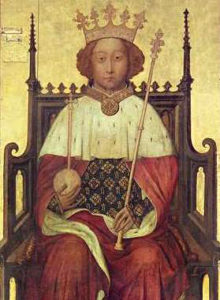


Authority is required for order and harmony. We move to a new location and ask someone we know if he could recommend a good doctor; in other words, we use that person as an authority. We are selective in what avenues we use to obtain accurate news of current events or the weather. We trust the airline who employs the pilot who flies the plane we are sitting on.

There could be a long list of examples, but the key point is that we seek out authority in most instances of our lives because we are not competent, are not capable, and don’t have the time to do the individual labor involved in finding out everything on our own.

Even if we were, it would not be appropriate in the majority of cases, as there is an expectation for us to accept the authority structures around a given need or circumstance. We see a dentist’s license displayed on the wall of her office, and that should be sufficient; it would be inappropriate to want to see the scores of her board examinations.

Our reason, made for truth, constantly seeks after trustworthy authority in its search for truth. One trusted authority leads us to another.

But in today’s age where “open-mindedness” is praised as a virtue, the underlying impetus for open-mindedness (particularly in the realm of ethics and morality) amounts to a challenge to established authority. Those wishing to subvert and undermine our society, like any revolutionary force, always need to call into question the structures responsible for that authority’s existence and sow seeds of doubt about its integrity and trustworthiness.
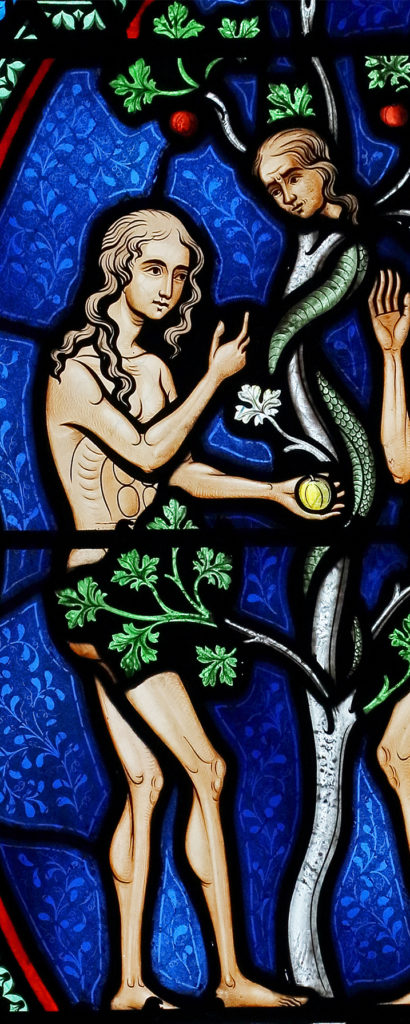
This is as old as Eve, though. The serpent questions her about whether God actually said something and meant it in the way she thought; Satan is quite clever, starting with some truth and then twisting it for his own devices.

In tempting Eve, the devil – the first revolutionary – wanted her to transfer where she placed her trust and authority. Some command, some truth, was dependent upon God, and the serpent wanted to compromise that. He succeeded.

After conversing with the devil (one of several mistakes she made), Eve’s correct perception of God’s command was altered; she doubted God’s trustworthiness, acted contrary to His command, and all hell broke loose as a result.

Putting things back together would take a long time and come at a great price.

Evidently, we must select well who we hold in authority; but sometimes we do not get to choose.

We witness with genuine alarm how our civil authority structures are called into question, making us feel a bit exposed, yet these structures still command respect.

It is no different with the Church. Failures within various sectors of the Church can also leave us doubting her authority and the integrity and truth of the Faith. Any legitimate authority carries responsibility with it, and scandal is the result when this responsibility is neglected.

Because of the Church’s mission to proclaim the truth of the Gospel for the salvation of souls until the end of time, the greatest authority and responsibility rest upon her. No wonder why Christ sternly warned about scandal, because it undermines the integrity of an authority that ought to be trusted for the sake of truth and security, causing far-reaching damage (cf. Mt. 18:7-10).

But while the failures of the human element of the Church can be evident and egregious (the behavior of the Apostles at the time of our Lord’s arrest was indicative of what the Church would look forward to through the centuries), our Faith constantly challenges us to look for the divine element through it all and to remember the words of St. Peter: Lord, to whom shall we go? Thou hast the words of everlasting life (Jn. 6:69).
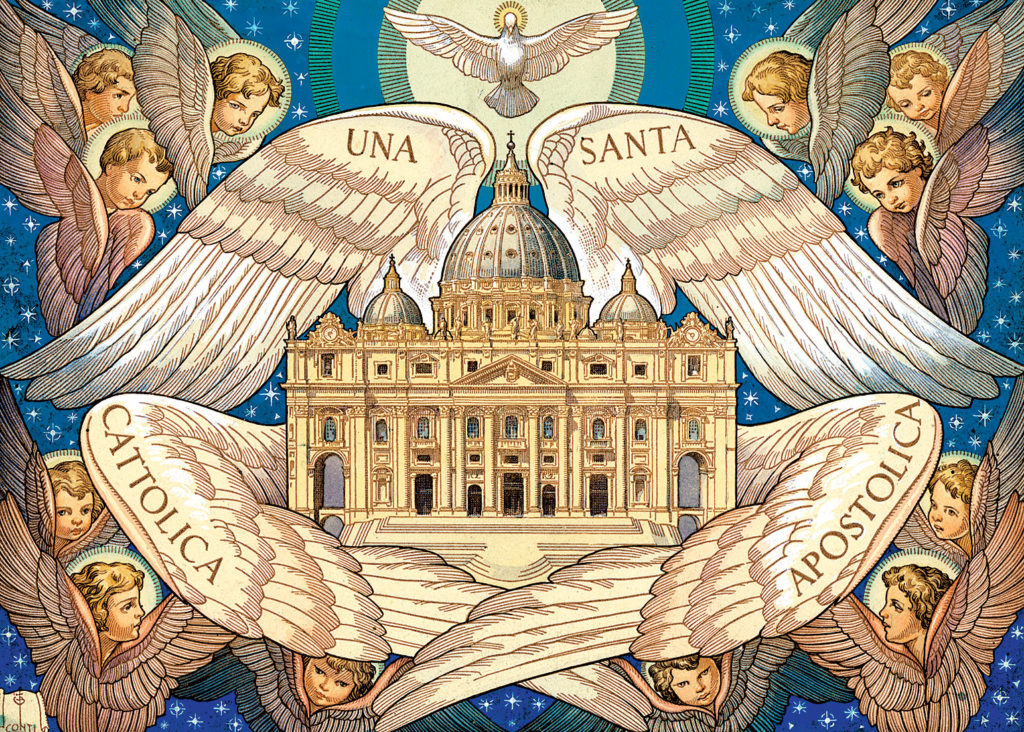
The Church still remains the only revealed and certain pathof salvation; the constitution of the Church does not change because of scandal; governance of souls is still dependent upon the hierarchy in union with the Roman See; and the administering of the Sacraments is still left within the hands of priests, men taken from amongst men, ordained for men in things that appertain to God, complete with all their fallen humanity (cf. Heb. 5:1).

Like a music score with all the correct notes written in it, we have the deposit of Faith formulated in both Creed and catechism, with a long Sacred Tradition to rely on when the musicians go off-key.

Despite the failures of the Apostles, our Lord remained faithful to them. He kept all His promises to a motley crew that seemed to deserve so little from Him. He prayed for them, that they be unified, and He endured the Cross for this prayer to be realized through the centuries, in view of the failures and scandals that would come. The kingdom of heaven suffers violence, and the violent bear it away (Mt. 11:12).

So how pleasing must it be to our Lord when we hold firm to the Faith and remain faithful to the structure He established. The truth at times may be obscured by weakness, failure, and scandal, but it is never destroyed and will always rise again.

That belief alone should keep us from being too open-minded when the devil comes to make us doubt the authority of the Church, prompting us to take to heart the words of Justin Martyr: I open my mind like I open my mouth, ready to close it on something solid.

Wise is the man who knows what to close his mind on, because his eternal survival is dependent on it.


Now quite apart from its innate common sense and truthfulness something else about the article caught my eye - and that was the first illustration, the great and majesterial portrait of King Richard II dated to circa 1395, and still in Westminster Abbey. Now the FSSP author was writing about the Church, not the State, yet chose to include this classic image of monarchical authority. What the author says applies, mutatis mutandis, to the secular as well as the spiritual world. 

To say that is not to deny the validity of the proper processes of politics in the ways appropriate to the times and places in which people live. The secular and the ecclesial both exist in the context of temporality and territoriality, and for both that requires the use of reason and due process.

Just as the author accepts the failings of individual clerics cause scandal so too do the failings of individuals, politicians and administrators in their respective spheres. The correction of such abuses is part of the proper function of the legitimate authority. Authority should be exercised with restraint and appropriate limits. Those exercising it must respects those limits, and those under its jurisdiction must respect its legitimate reach.

The hollowing out of respect for proper authority in both spheres is deeply corrosive - corrosive of tradition, corrosive of discipline, corrosive of society - and threatens disaster. A moment or two’s thought about the events of the past century will provide far too many examples, terrible examples, of what happens with the abandonment of received legitimate inheritance in favour of the passing fad or the seemingly promising alternative...


Saturday, 10 October 2020

Restoring St Denis


Yesterday was the traditional feast day of St Denis, the Martyr Bishop of Paris and patron of France. He is my favourite cephalaphore. There is an account from Wikipedia of his life and legend, of his hagiography and depiction in art at Saint Denis of Paris and another about his cult from the New Liturgical Movement today at The Legend of St Denis

His shrine church is, of course, the basilica of St Denis, now in the northern suburbs of Paris, and not reputed to be a very savoury place for the unwary visitor. The basilica, the abbey of St Denis, is, of course, famous both as the first fully gothic church as rebuilt by Abbot Suger and as the necropolis of the Kings and Royal House of France. There is a good illustrated account of it from Wikipedia at Basilica of Saint-Denis

Saint-Denis - Façade.jpg

The west front of St Denis following the 2012-15 restoration

Image: Wikipedia 

That story is not a happy one at times - the desecration of the abbey church and of the royal tombs by the revolutionaries in 1793 is a truly shocking event, and later restorers of the church did not help with their heavy handedness and squabbles, not least in the events of 1845-6.

West façade of Saint-Denis, before the dismantling of the north tower
Image: Wikipedia 

Now regular readers will be aware that the Clever Boy is not a Yorkshireman for nothing, and combines the sense of vague gloom integral to such an origin, as indicated in the previous paragraph, with that of a certain type of traditional ( or Traditional ) Tory - please note Tory, nothing so modern as “Conservativism” - pessimism about the way the world is going. That does not mean he is a depressive, and is normally (?) quite cheerful, but from bitter experience he views the world with a cold eye when it comes to the true restoration of those things that are gone to decay. Occasionally however something happens which does fill his soul and mind with delight at seeing the return of that which had been lost. The rebuilding of the Frauenkirke in Dresden and of the Berlin Schloss are examples that lifted his heart. They are replacing losses from 1945, but the Clever Boy could still hardly believe they had been rebuilt. Now he feels that special joy again, repairing this time destruction from not seventy five years ago but from 175 years ago...

A short while ago he came across this passage on the Wikipedia account of the basilica of St Denis...
 
In the early 1840s, cracks appeared in the north tower's masonry following several extreme weather events. A violent storm on 19 August 1845, notable for spawning a tornado, proved critical, and the tower's walls were soon found to have flexed and become dangerously unstable. With François Debret's reconstructive works, carried out after an 1837 lightning strike, proving inadequate, in February 1846 the authorities decided to "temporarily" dismantle the north tower to avoid a catastrophic collapse, with the stones stored for later reconstruction.

In December 2016, 170 years after the north tower's dismantlement and following several false starts, the Ministry of Culture again proposed its reconstruction after concluding it was technically feasible—albeit without public funding. 

An association, Suivez la flèche("Follow the Spire"), chaired by Patrick Braouezec, has since been established to support the reconstruction, with the aim of raising the necessary funds by opening the reconstruction works to the general public, along the model of the Guédelon Castle. In March 2018 the culture ministry signed an accord with the association, officially launching the reconstruction project, with works expected to commence in May 2020.

There is more about the scheme in an illustrated article - with occasionally curious Franglais - from the Paris Bulletin at Saint-Denis Basilica spire

Saint-Denis Cathedral with the new spire

The scheme envisioned - an anticipation of what will be achieved

Image: Paris Bulletin

Such indeed brings joy to the heart of the Clever Boy. Never could I have believed such a thing could happen after all the passage of events since 1845-6 - how many upheavals of state and politics in France, how many conflicts, how much of an assault on the Faith - yet now the north tower and spire of the Royal Abbey of St Denis are going to be rebuilt. Laus Deo !

St Denis Pray for us
St Louis Pray for us


Friday, 9 October 2020

St John Henry Newman


This is the first occasion on which we can celebrate the Feast of St John Henry Newman. His canonisation last year marked the culmination of a long process of prayer, study and mobilisation of the sensus fidelium. 

The current situation means alas that not all that is usually done to mark his day is possible in Oxford this year - no Night Walk to Littlemore along the route taken by Bl. Dominic Barberi last night for example. Two of the three evenings this week I have been able to attend the Oratory’s preparatory Triduum prayers only through Livestream - but one is so grateful that has been a benevolent consequence of the virus. However I shall be going to the sung Solemn Mass at the Oxford Oratory this evening when the Abbot of Farnborough will preach.

I feel that St John Henry has accompanied me on my spiritual journey for many years, assisting in my course into the one fold of the Redeeemer. May he continue to accompany me, and many others, as we journey o’er moor and fen.

St John Henry Newman Pray for us
St John Henry Newman Pray for me


Thursday, 8 October 2020

Fishy business


A German friend sent me this link to this news story from the Guardian at Belgian ambassador throws King Charles II treaty into EU fishing debate

As he says: It just goes to show that one should never thre away old treaties. One never knows.