Once I was a clever boy learning the arts of Oxford... is a quotation from the verses written by Bishop Richard Fleming (c.1385-1431) for his tomb in Lincoln Cathedral. Fleming, the founder of Lincoln College in Oxford, is the subject of my research for a D. Phil., and, like me, a son of the West Riding. I have remarked in the past that I have a deeply meaningful on-going relationship with a dead fifteenth century bishop... it was Fleming who, in effect, enabled me to come to Oxford and to learn its arts, and for that I am immensely grateful.


Sunday, 5 May 2024

Fr John Hunwicke RIP


Although it was not altogether unexpected the news last week of the death of Fr John Hunwicke still shocked and greatly saddened me.

I first became aware of him, before I went to Oxford, through the Ordo published by the Church Union which set out clearly and in great detail a wide series of options for saying the Daily Office for those of an Anglo-Catholic persuasion. Fr Hunwicke edited this each year and enquiries were to be sent to him at that citadel of Anglo-Catholic formation, Lancing College.

Some years later when I was a daily attender at Pusey House I met Fr Hunwicke who was there on a study visit. Now I could put a face and an identity to the name. Here was a man of great erudition and one who was also entertaining, with not a little of engaging English eccentricity. This acquaintance deepened and I saw why he was appreciated as a teacher and guide.

At that time he and his wife were living in retirement in north-west Devon and I distinctly recall thinking during the vacancy at St Thomas’ where I was Churchwarden that Fr Hunwicke was just the sort of parish priest the church needed, but alas, he was retired. A few months later, after my reception at the Oratory, I was delighted to be told that Fr Hunwicke was returning to active ministry as Vicar of St Thomas’. I went to his induction, when he graciously cited my history of the church and said in front of the Bishop of Oxford and the congregation that the floor having been paid for in part by John Henry Newman ( still then an Agnglican in the early 1840s) that if “we stand on a floor laid by John Henry Newman we shall not go far wrong.”

It was at St Thomas’ that he was persuaded to start his blog and its wide readership is testimony to his breadth of knowledge and skill in presenting ideas - in part no doubt the legacy of teaching Classics at Lancing. His anniversary of Ordination liturgy at St Thomas’ was one of those services you simply had to have been at, “a simple prayer book service in a little back street church“ using the ‘62 service book ( guess which ), a celebration of his faithful ministry but also of a vision, a very Oxford vision, of what the Ecclesia Anglicana might be.

With the advent of the Ordinariate wand his wife were received at the Oxford Oratory in a service I attended and I was present when he was finally ordained as a priest in full communion with the Holy See. For a man of such clear Anglo-Papalist sympathies and one who felt so keenly a sense of communion with late medieval and sixteenth century English Catholics that raised scruples with him, but ordained he was. As I said as I knelt for his First Blessing outside the Oratory that evening “ Not before time!”.

As Dr Shaw of the LMS has demonstrated in his obituary the succeeding years saw an active and lively ministry as tutor, scholar and blogger based in Oxford.

I am very grateful for having known him and shall miss not just our conversations when we met but also the fact of knowing someone who would know the answer, or a possible answer, to so many obscure, but always, fascinating questions. I can see him seeking out a new ministry in the afterlife as chaplain to his great hero the fourteenth century Bishop John de Grandison of Exeter.

May he rest in peace.


Marian Pilgrimage - Our Lady of Grace by the Pillar in St Paul’s


The Pilgrimage now moves from Westminster along The Strand to St Paul’s Cathedral. Within were several statues and chapels in honour of Our Lady which Waterton, drawing upon Dugdale, documents. The one which appears to have been the principal object of pilgrims, and of their offerings was the statue in the nave by the second pillar west of the crossing on the south side. 

Waterton’s account can be seen on pp 68-70 of his work, and details the ceremonies associated with the statue and the management of its revenues. My previous articles about it can be seen, beginning in 2021 with Our Lady of Grace by the Pillar in St Paul’s, from 2022 at Marian Pilgrimage - Our Lady of Grace by the Pillar in St Pauls, and from last year at Marian Pilgrimage - Our Lady of Grace by the Pillar in St Paul’s

May Our Lady of Grace by the Pillar pray for The King and all the Royal Family and for us all


Saturday, 4 May 2024

Marian Pilgrimage - Our Lady at the North Door and Our Lady of Pew in Westminster Abbey

 
The Pilgrimage now moves to Westminster Abbey and Palace to three medieval shrines of Our Lady. The modern Pilgrim can also go along to Westminster Cathedral to see the renewed shrine there with a medieval English alabaster statue of the Virgin and Child as well as seeing a copy of that in the Abbey’s restored chapel of Our Lady of Pew. 

I set out the complexities of these various places of devotion in my 2021 article Our Lady of Westminster

In that I also cite the work of my friend the late Fr Mark Elvins OFM Cap. about the central place of the chapel of Our Lady of Pew in the story of King Richard II and his vow to make England the Dowry of Mary in 1381. 

My 2023 version can be seen at Marian Pilgrimage - Our Lady of Westminster

Edmund Waterton gives reference to both statues in the Abbey. He quotes an inventory which lists the gold cope for the statue at the North Door. He also discusses the origin of the term Pew to describe the chapel and statue in both the abbey and the chapel of both the abbey and the royal chapel in the palace. Waterton inclinded to the view that the term Pew was a term to describe a Pièta, and it is clear from his work that such statues were by non means infrequent in later medieval England. The other explanation is that the chapels both in the Abbey and the Palace were places designed for private devotion by the King and his companions.
 
Edmund Waterton gives many examples from records of financial offerings to Our Lady of Pew by Kings, Queens, and courtiers.

May Our Lady at the North Door and Our Lady of Pew at Westminster pray for The King and all the Royal Family and for us all.


Friday, 3 May 2024

Marian Pilgrimage - Our Lady of the Red Ark in York Minster


The third station on the Pilgrimage is made at the second Metropolitical cathedral of the realm, York Minster. 

Looking at Waterton’s compilation it is not clear why the itinerary as created in 1960 chose the statue of Our Lady of the Red Ark in the Minster when in fact there were so many devotional images of Our Lady in the cathedral. Like Canterbury York Minster had a chapel on her honour in the Undercroft created to support the High Altar and Shrine of St William reusing fabric from the Norman cathedral. That was restored in the early twentieth century with a damaged twelfth century relief of the Virgin and Child discovered in 1829 during restoration work in the east wall of the principal Lady Chapel beneath the east window. To the right of the High Altar was an elaborate decorated statue of the Virgin. Both the  north and south choir aisles had their own statues of her, as well as one over the Treasury and the one by the Red Ark. 

My account of that particular statue, and links to two others, can be found at Marian Pilgrimage - Our Lady of the Red Ark in York Minster

At Beverley Minster there was a similar arrangement with a statue of the Virgin by their donation Ark which was also painted red. That should no doubt be added to the itinerary.

May Our Lady of the Red Ark in York Minster pray for The King and all the Royal Family and for us all


Thursday, 2 May 2024

Marian Pilgrimage - Our Lady of the Undercroft in Canterbury Cathedral


The second shrine on the Pilgrimage is that of Our Lady of the Undercroft in Canterbury Cathedral.   

Our-Lady-in-the-Undercroft1
General view of the Chapel of Our Lady in the Undercroft

My post about it from last year can be seen at Marian Pilgrimage - Our Lady of the Undercroft in Canterbury Cathedral


Edmund Waterton notes on the screeens the presence of coats of arms of members of the nobility from the time of King Henry VI. Presumably they visited the shrine on the way to or from Calais in the latter stages of the French war. He also cites offerings by Queen Elizabeth of York in 1502, and by her son King Henry VIII, who offered 6/8 in both 1514 on the Tournai campaign and 1520 on the Field of Cloth of Gold visit. 

In the 1520s Erasmus described the shrine as follows: 
From the shrine of St Thomas, we returned to the crypt. Here the Virgin Mother has an abode, but somewhat dark, inclosed within a double screen of iron, for fear of thieves, for indeed I never saw a thing more laden with riches. When lamps were brought we beheld more than a royal spectacle, which in beauty far surpassed that of Walsingham. This is only shown to men of high rank or great friends. 
 
Waterton p 9, quoting Erasmus Peregrinatio religionis ergo
  
Our-Lady-in-the-Undercroft2
The screen work of the chapel dated to circa 1370

chapel has a beautiful quality of tranquility and although much damaged retains much of its original decoration. Because it is not on the main tourist route in the cathedral it has, as a Catholic priest and I were discussing a few weeks ago, a profound spiritual impact and one feels close to those who created and adorned it.
   
Our-Lady-in-the-Undercroft3
The modern statue by Mother Concordia Scott OSB
Images: Canterbury Historical and Archaeological Society 

May Our Lady of the Undercroft pray for The King and all the Royal Family and for us all.


Wednesday, 1 May 2024

The Legend of St Philip the Apostle

 
Today is the traditional date for the Feast of SS Philip and James. This was moved in what became both OF and EF usage following a set of very twentieth century political manoeuvres in respect of the Calendar. Much to be deplored.

The New Liturgical Movement has an interesting article about the Gospel and Acts narratives in respect of St Philip, and of the later legends about him. It also considers how these were selected for devotion according to later centuries assessment of their veracity or indeed probability. Such calculations also extended, as the article shows, to his depiction in art.

The article can be seen at The Legend of St Philip the Apostle

I posted in 2011 about excavations at the reputed site of his ministry and martyrdom at Hieropolis in Tomb of St Philip the Apostle and in 2012 about what is believed to be a a substantial relic of his scull at Limassol in Cyprus in St Philip the Apostle


Marian Pilgrimage - Our Lady of Glastonbury


The Pilgrimage begins at Glastonbury, that unique cradle of so many English traditions.

The amended post introducing the Glastonbury devotion to Our Lady can be seen at Marian Pilgrimage - Our Lady of Glastonbury

The statue in the Lady Chapel was claimed - time, circumstance and the catastrophic fire of 1184 notwithstanding - to be the work of St Joseph of Arimathea himself. According to Pynson’s ballad of 1520,

There Joseph lyved with other hermyttes twelfe
That were the chyfe of all the companye,
But Joseph was the chefe hym-selfe;
There led they an holy life and gostely.
Tyll, at the last, Jhesu the mighty,
He sent to Joseph thaungell gabryell,
Which bad hym, as the writing doth specify,
Of our Lady’s Assumpcyon to bylde a chapell

 So Joseph dyd as the aungell hym bad,
And wrought there an ymage of our Lady; 
For to serue her gret devocion he had,
And that same ymage is yet at Glastenbury,
In the same churche; there ye may it se
For it was the fyrst, as I vnderstande
That ever was sene in this countre;
For Joseph it made with his own hande 

From Life of Joseph of Arimathea EETS xliv,43
Waterton, 280

Pynson was, of course, the man who preserved in another ballad the story of the foundation of the Walsingham shrine.

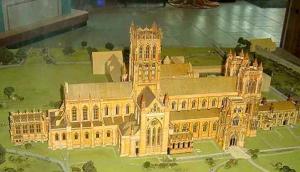
It was at about this time that the chapel of St Joseph was created beneath the twelfth century rebuilding of the “Old Church” or Lady Chapel, and that the penultimate Abbot, Richard Bere added a chapel of Our Lady of Loretto to the north transept. He had visited Loretto whilst in Italy and clearly sought to provide more for pilgrims to his abbey. It’s unusual position is indicative of the way the original house now at Loretto has only three walls in front of a cave. Nothing remains above ground of the Abbot’s chapel but its site is marked out in the turf.

GlastonburyAbbey_pic1

Model of Glastonbury Abbey on the eve of the dissolution in 1539.
The Lady Chapel is to the right, and the Loretto Chapel in the centre foreground extending west of the north transept.
Image: citydesert.wordpress.com

May Our Lady of Glastonbury pray for The King and all the Royal Family and for us all


May Marian Pilgrimage


In 2020 to celebrate the rededication of England as the Dowry of Our Lady I took up an idea of Fr Hunwicke from his blog. This was, in the circumstances of lockdown, to have an online virtual Pilgrimage to medieval Marian shrines in England, visiting one each day in May. 
 
Fr Hunwicke derived this from a booklet outline such a series of virtual shrine visits produced at Walsingham about 1960. This in turn drew on the great scholarly endeavours of Fr.T.E.Bridgett in Dowry of Our Lady (1875) and of Edmund Waterton in Pietas Mariana Britannica (1879). These remainly largely unchallenged as resources for the serious study of medieval English Marian piety. Both are available online, as well as physical reprints of Waterton, and probably also of Bridgett. I will post separately about Edmund Waterton, a man local to my home area and the however many times great nephew of ‘my’ Bishop Richard Fleming.

These books cover the whole range of Marian devotion and this Pilgrimage only scratches the surface. I have basically followed the original route of the Walsingham booklet, adding in a few serious omissions, but not changing its idiosyncratic route from Glastonbury to Walsingham with its curious spurts across country - it is not one to attempt by public transport or by private!

The route takes in well known places for pilgrims and more local sites, but not what may be termed recorded parish devotion to a well-loved and honoured statue in a particular parish or monastic church. These are often recorded as the recipients of bequests in late medieval wills. To include all of these would mean barely leaving one’s home county. 

My original notes have been supplemented with additional notes each year as this Pilgrimage has become an established annual feature of this blog. Last year I focussed in particular on the royal links of many of these shrines to mark the Coronation and suggested that an intention of the Pilgrimage should be The King and The Queen. This year, given the health issues facing His Majesty and the Princess of Wales, I suggest that praying for the King and all the Royal Family should be one intention as well as any private ones we wish to make.

I have thought of including Welsh, Scottish and Irish shrines, using Bridgett and Waterton as a beginning, but to do that will require a separate Pilgrimage, hopefully for Assumptiontide in August.

So, with virtual Palmer scrip and staff in hand let us set off for Glastonbury…