Once I was a clever boy learning the arts of Oxford... is a quotation from the verses written by Bishop Richard Fleming (c.1385-1431) for his tomb in Lincoln Cathedral. Fleming, the founder of Lincoln College in Oxford, is the subject of my research for a D. Phil., and, like me, a son of the West Riding. I have remarked in the past that I have a deeply meaningful on-going relationship with a dead fifteenth century bishop... it was Fleming who, in effect, enabled me to come to Oxford and to learn its arts, and for that I am immensely grateful.


Sunday, 13 August 2023

More about Bess of Hardwick’s tapestries


Hardwick Hall seems to have taken over a corner of the blog. Having posted about the restoration of the Long Gallery tapestries in Restoring Bess of Hardwick’s tapestries and then about the conservation of the adjacent Old Hall in More restoration work at Hardwick Hall I now see that Apollo has a more detailed study of the tapestries and their conservation.

The illustrated article gives much more detail than the original BBC account about the tapestries, their design and their manufacture as well as their position within Elizabethan culture and it can be seen at A massive success at Hardwick Hall


Saturday, 12 August 2023

Making more of the history of Glastonbury accessible


Glastonbury is an historic site, a spiritual site, a legendary site, and one that has long held a fascination for me. I was fortunate in the later 1980s and early 1990s to be able to visit it on quite a number of occasions, both on retreat and as a visitor, and to come appreciate more fully the rich and varied events which have shaped the extraordinary life of this small Somerset town.

The BBC News website reported the other day on proposals for a new heritage interpretation centre at Beckery on the edge of Glastonbury. Beckery features in some of the medieval Arthurian romances and archaeological investigation in recent years has established it as the earliest known monastic site in England, dating back to the fifth century

There is a BBC report about the excavations at Beckery which was published in 2016 at Beckery Chapel near Glastonbury 'earliest known UK monastic life'

The new plans for the presentation of the site are outlined at Glastonbury ancient monument to be opened up to the public

Other recent research at Glastonbury has included a comprehensive analysis of the pottery found on the site of the abbey during excavations in the twentieth century. Not only did this reveal locally sourced utensils but also decorated jugs from the Saintonge, probably linked to the fourteenth century Gascon wine trade, and part of a decorated tile from early sixteenth century Seville. This is outlined in a report from the BBC from 2011 at Glastonbury Abbey's pottery link to Dark Ages

Work has also been done on Anglo-Saxon glass found on the abbey site. This is the earliest physical evidence of glass making in the era, although written sources attest to it at the same time at York and Wearmouth. This was reported in 2012, again by the BBC, in Glastonbury Abbey excavations find Saxon glass industry

The wider reinterpretation of the archaeological evidence from the abbey site in Glastonbury following a four year project is summarised in a 2015 report at New research 'rewrites' Glastonbury Abbey history

Not only do all these studies add to our knowledge of the complex history of the site but they demonstrate once again that whenever someone thinks they have said the last word about the myths, origins, and history of Glastonbury they are going to be proved wrong. Glastonbury continues to reveal, or perhaps I should say disclose, its past as an ever more intricate, ever more intriguing, fabric of connections and possibilities.


More restoration work at Hardwick Hall


I recently wrote in Restoring Bess of Hardwick’s tapestries about the completion of the restoration of the tapestries in the Long Gallery at Hardwick Hall in Derbyshire. This is not the only scheme of restoration that has been carried out at Hardwick. 

Adjacent to the great house built in her last years by Bess of Hardwick are the substantial but roofless remains of her previous house, now known as Hardwick Old Hall. Much altered and extended by the Countess before she decided to build a completely new house it became guest and servant accommodation after the new house was built before being finally abandoned in the eighteenth century. Now cared for by English Heritage the important surviving plaster work friezes have recently undergone extensive conservation work and are now accessible to visitors.


Thursday, 10 August 2023

Celebrating St Lawrence


The mark the feast day of St Lawrence the New Liturgical Movement has a post about how his feast is celebrated by various Western liturgical traditions at The Feast of St Lawrence in Other Western Rites
 
The Liturgical Arts Journal also has a post for today about vestments for the feast and statues of St Lawrence at Vestments in Honour of St. Lawrence

To that I will add a link to a post of my own from 2013 which reproduced a statue of the saint by Tilman Riemanschneider dated to 1502-10 can be seen at St Lawrence


St Lawrence


Today is the feast of St Lawrence, who, together with St Stephen and St Vincent, is one of the three great deacon martyr saints. In the case of St Lawrence his fame outshines that of his fellow martyr victims in 258, Pope St Sixtus II and other clergy:

He was crowned with martyrdom. He was bishop in the time of Valerian and Decius, when there was the great persecution. At that time he was seized by Valerian and taken to offer sacrifice to demons. But he despised the commands of Valerian. He was beheaded and with him six others, all deacons, Felicissimus, Agapitus, Januarius, Magnus, Vincentius and Stephen, about August 6…And after the passion of the blessed Sixtus, on the third day, Lawrence, his archdeacon, suffered also, August 10, likewise the subdeacon Claudius and Severus, the priest, and Crescentius, the reader, and Romanus, the doorkeeper…He himself was buried in the cemetery of Calistus on the Via Appia and the aforesaid six deacons were buried in the cemetery of Pretextatus on the Via Appia, August 6. 

From the Liber Pontificalis

His story is recounted on Wikipedia in an article which suggests the topic which has dominated the iconography of St Lawrence, his martyrdom on a gridiron, may have arisen from a scribal error whereby passio - suffer - was rendered as assio - to roast. The article can be seen at Saint Lawrence

The image of St Lawrence suffering on the grill, whether historical or not, is however firmly entrenched in the Christian consciousness.

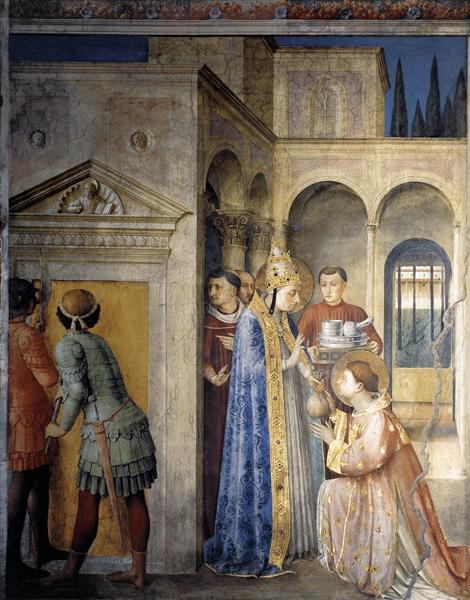
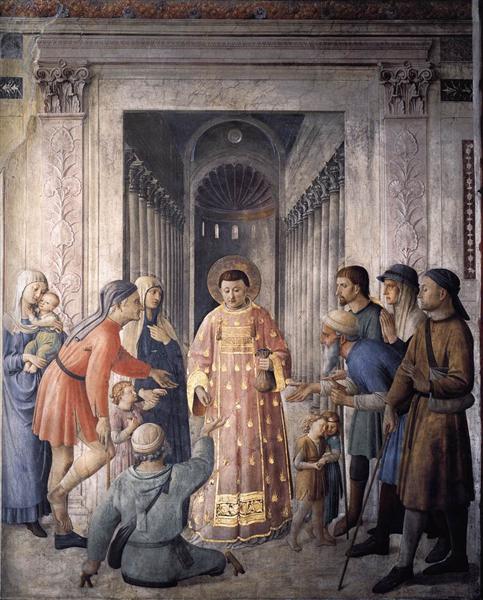
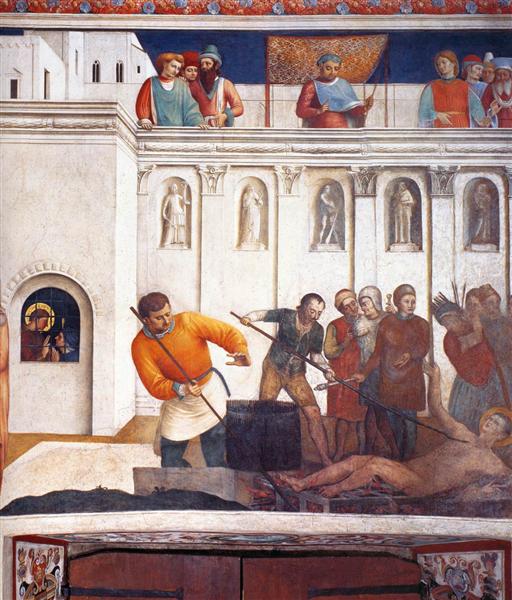
The following images are from Fra Angelico’s fresco cycle from 1447-9 illustrating the lives of St Stephen and St Lawrence in the Niccoline Chapel of the  Apostolic Palace of the Vatican. The figure of St Sixtus is a portrait of Pope Nicholas V ( 1447-1455 ) the builder of the chapel.


St Lawrence is ordained a deacon by Pope St Sixtus II

Image: mycatholic.life

Saint Lawrence Receiving the Treasures of the Church from Pope Sixtus II, 1447 - 1449 - Fra Angelico

St Lawrence receives the treasures of the Church

Image: Wikiart

St. Lawrence giving alms, 1449 - Fra Angelico


St Lawrence is tried and condemned

Image: Wikidata

Martyrdom of St. Lawrence, 1447 - 1449 - Fra Angelico

Image: Wikiart

There is more about the cycle of frescoes at Frescoes on the Life of St. Lawrence, Fra Angelico


St Lawrence Pray for us


The Hampton Court Conference of 1604


The Daily Telegraph has published as a separate article an extract from Gareth Russell’s new book on the history of Hampton Court. In it he recounts the circumstances around the 1604 Conference which was held there and which in turn led to the creation of the Authorised Version of the Bible that was eventually published in 1611.

Reading his account of the faction fighting within the Church of England reminds one of the battles of recent years within the General Synod. As with so many things in ecclesiastical  history what goes round comes round.

The very enjoyable extract can be read at Sodomy and theology: the feverish birth of the King James Bible


Tuesday, 8 August 2023

The marriage of King James IV and Queen Margaret 1503


520 years ago, on August 8th 1503, King James IV of Scots married Margaret the daughter of King Henry VII of England in the abbey church of Holyrood. 

The King was thirty and his bride a few  months short of her fourteenth birthday. Concern about ensuring the safe delivery of children led the new Queen’s grandmother the formidable Lady Margaret Beaufort, influenced no doubt by her one very difficult pregnancy aged thirteen, and aware of King James’ existing brood of illegitimate children to insist on delaying the consummation of the marriage for a time. As it was only one of their children, King James V,  was to live to adulthood. 

Margaret’s journey from Richmond began in May and was recorded in considerable detail together with the wedding celebrations by Somerset Herald, John Young. The events in and around Edinburgh were lavish and cost about half of the new Queen’s dowry. King James appreciated that he needed to display the appropriate level of magnificence both to his own subjects and to his wife’s countrymen.

King of Scotland James IV
King James IV of Scots
Detail of a painting dated to 1620-38 and attributed to Daniel Mytens based on a portrait contemporary to the King.

Image: onthisday.com
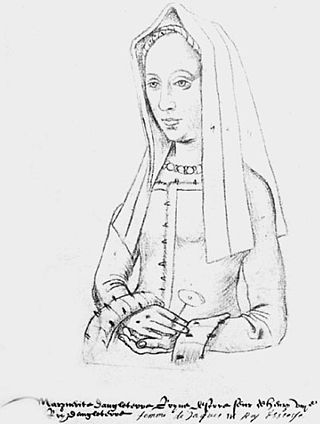
Queen Margaret from the Recueil d’Arras

Image: Wikipedia 

The marriage was a return to the policy pursued, without success, by the bridegroom’s father King James III of peace secured by a royal marriage with England. For all its promise this marriage was to end a decade later when the King was killed, along with so many of his nobility at the battle of Flodden when he invaded England as an ally of France.

Nonetheless the marriage did lead a century afterwards in 1603 to the Union of the Crowns in the person of King James VI, who was descended twice over from Queen Margaret through his paternal grandmother the Countess of Lennox. From the personal Union there flowed the parliamentary Union of 1707.

To mark the anniversary the Royal Collection Trust had an online lecture about the wedding by Dr Lucy Dean, which I booked into. This was extremely interesting and showed how the extensive surviving records can be correlated about the clothes made for the couple, the repairs to the King’s crown and sceptre and the preparation- just to be prepared - for the King’s tomb at Cambuskenneth. 

The Royal Collection Trust lectures I have booked into have been well worth hearing and can be found on the RCT website.
King James IV of Scotland, attended by St James, from the Book of Hours of James IV and Margaret Tudor. This book of hours was a gift from James to his bride on the occasion of their wedding in 1503.  It is currently held at the Österreichische Nationalbibliothek, Vienna.

Image: Wikimedia 

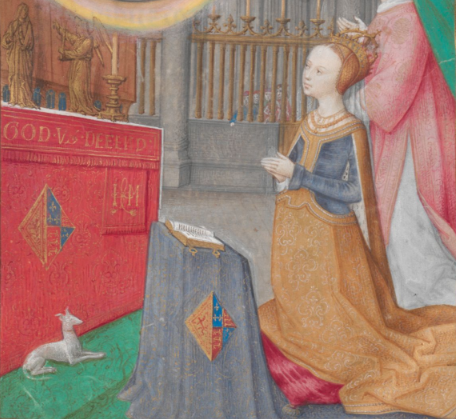
Detail of the miniature of Queen Margaret at prayer on f. 243v of the Prayer Book of King James IV of Scotland, c.1503, Österreichische Nationalbibliothek Cod. 1897 Han 

Image: philippagregory.com

Monday, 7 August 2023

Black Shuck of Bungay


This past weekend the people of Bungay in Suffolk, together with visitors to that attractive market town, have been celebrating their Black Shuck festival. This is a recent creation but commemorates an event on August 4th 1577. It was a Sunday and whilst parishioners were in the former priory church of St Mary at morning service, and during a thunderstorm, a huge black dog - known to history as Black Shuck - came into the church to their terror, attacked and killed two of the congregation and injured a third before disappearing. It also appeared several miles away at Blythburgh church where it manifested similar behaviour.
As the parish website there recounts

“ … in a great storm in August 1577, the church was struck by the hand of God (or was it the devil?). During the morning service, lightning 'cleft the door, and returning to the steeple, rent the timber, brake the chimes, and fled towards Bongay, six miles off,' leaving on the Great North Door, clearly to be seen today, the fingerprints of the Devil in scorch marks. A man of forty and a boy of fifteen were found 'starke dead'. “

There was to be a similar event at Widecombe in the Moor in October 1638 as is set out by Wikipedia in The Great Thunderstorm

Clearly the hound in Suffolk was beyond the capabilities of the parish dog catchers to deal with.

Given that thunderstorms are not that unusual events, and even allowing that this was before Benjamin Franklin came up with the lightning conductor, there must have been something very spectacular indeed about these storms that they made such an impact - both literal and psychologically - on those who witnessed them.

There are pictures and a description of St Mary’s Bungay from the Churches Conservation Trust here 

The excellent Suffolk Churches website discusses Blythburgh at Suffolk Churchesas does the National Churches Trust site at Blythburgh Holy Trinity

Information about this year’s Bungay festival can be found on its website at Black Shuck Festival 2023

A few weeks back the Daily Telegraph reported in some detail on the legend and the festival, and the fact that Bungay appears to have the largest concentration of self-identifying Satanists in the country. The article can be accessed at Inside the Satanist capital of Britain

One might wonder, incidentally, what, in this age of ecumenical and inter-faith dialogue, the Christian denominations are doing about that particular development.

BBC News had an article in 2002 about an academic looking into the psychology of such manifestations which are quite common in local traditions and, indeed, modern reports. It can be seen at Black Dog of Bungay under study

The spectral appearance of black dogs in different parts of the country is well attested as in the article cited above. In my home county apearances by a large black dog with ‘saucer eyes’ known as Padfoot is recorded at York, Whitby, and in the area around my home town Pontefract as late as the nineteenth century. In that last instance at least it was seen as benign and a protective presence.

The events at Bungay and Blythburgh in 1577 - and at Widecombe in 1638 - doubtless indicate something of a society where the supernatural was close at hand, and the Devil a lurking and omnipresent threat. The legacy of centuries of that awareness was doubtless reinforced by a post-reformation Calvinistic sense of the elect and the reprobate under direct challenge or threat from the Evil One. To the south the county of Essex was to produce a significant number of witchcraft cases in the sixteenth and seventeenth centuries. Whilst today that is often seen as the product of a misogynistic and superstitious society as a friend once made the point to me there may have been some at least who believed they did have access to ‘black arts’ and used that, or the threat of them, to their own advantage. The post-reformation world was not one that banished superstition but rather one that promoted it in new and diverse forms. Evidence from the mid-seventeenth century of this in East Anglia can be seen in these cases documented in an academic thesis at Appendix 6

The religious profile of East Anglia was complex and must have heightened sensibilities. If Essex had developed and strengthening Protestant communities that pattern was probably less well developed in Suffolk and Norfolk, and all three counties had a still lively recusant tradition. Just over a decade later Fr John Gerard was travelling the region and finding a considerable Catholic response. Such tensions, which as we know remained lively and divisive for the coming century, with the iconoclastic actions of William Dowsing and the activities of the ‘Witchfinder General’ Matthew Hopkins in the region, may well underlie the response to what happened at Bungay and Blythburgh. 

With that all said the question still remains - what the hell did actually happen in the churches at Bungay and Blythburgh on that August morning 446 years ago?