Once I was a clever boy learning the arts of Oxford... is a quotation from the verses written by Bishop Richard Fleming (c.1385-1431) for his tomb in Lincoln Cathedral. Fleming, the founder of Lincoln College in Oxford, is the subject of my research for a D. Phil., and, like me, a son of the West Riding. I have remarked in the past that I have a deeply meaningful on-going relationship with a dead fifteenth century bishop... it was Fleming who, in effect, enabled me to come to Oxford and to learn its arts, and for that I am immensely grateful.


Saturday, 11 December 2021

Boy Bishops


This being Advent and the week that has seen the feast of St Nicholas it is also the season for Boy Bishops to enter into their responsibilities.

The New Liturgical Movement has a post about the custom and about the installation of one such at the school at Chavagnes in France. A priest friend of mine was a pupil there, though I do not know if he ever attained to the status of being Boy Bishop.

The illustrated post can be seen at A Boy-Bishop for the Feast of St Nicholas

I am however somewhat sorry to see that the Boy Bishop’s mitre is red to match his cope rather than the correct colour for all mitres, which is either white ( or similar such as ivory ) or gold, and with appropriate decoration. However it is good to see the custom being practised.

Last year I posted about this traditional  custom in Boy Bishops which has some more Illustrations of modern boy bishops.


Murder in early fourteenth century London


I came across a series of online articles from 2018 about research by a criminologist into murders in London in the period 1300-1340.

The records are analysed in terms of matters such as incidence, location, method, motive, sex or gender of both victim and assailant, time of day and suchlike.

The articles themselves can be seen at Medieval London map reveals grisly 14th Century deaths - including dagger stabbings, sword beheadings and eel skin killings from The Sun ( dare I say it not the most obvious paper in which to seek scholarly work on the medieval period ), at Medieval London's murder hotspots revealed from the BBC News and at Digital map reveals medieval London's homicide 'hot spots' from Medievalists.net.

There has been a similar study for medieval Oxford and published some years ago in Past and Present. This also revealed a diversity of patterns in terms of such things as risk and location.


Friday, 10 December 2021

Good news from Guadalajara


Rorate Caeli has a hopeful report about the FSSP quasi-parish of San Pedro en Cadenas in Guadalajara in Mexico. This had been suppressed in the immediate wake of Traditionis Custodes by the Cardinal
Archbishop of Guadalajara but now, following an apparently fruitful meeting with the parishioners, he has revoked this and allowed them to resume liturgy according to the 1962 Missal.

This does appear to be a very positive development and it must be hoped, indeed prayed, that this Traditionat community will be maintained and sustained. I have on occasion during lockdown watched online the Mass from Guadalajara and very much appreciated that it was being offered. Long may that continue.


Thursday, 9 December 2021

Crucifixion in Roman Britain


There are a number of online reports about the discovery in 2017 at Fenstanton in Huntingdonshire of the remains of a man who had been crucified in the period 130-337 according to radiocarbon dating. The third or early fourth century has been suggested as a likely time for this execution to have occurred. This appears to be the first such tangible evidence from Britannia of such a punishment having been inflicted, and one of the very few examples to survive from the entire Roman world. 

The reports can be seen - if you can get beyond pay walls in several instances - from Life Science, which was the first one I read, at Thrre is considerably more detail from the Daily Telegraph at First physical evidence of Roman crucifixion in Britain unearthed in housing estatefrom The Times at Roman crucifixion remains unearthed at Fenstanton housing estatefrom the Mail Online at 'World's best example' of crucifixion found in Cambridgeshire, and from The Independent at Crucifixion was practised in Roman Britain, new evidence reveals, The BBC News website also has a report at First example of Roman crucifixion in UK found, and there is another from Ancient Origins at At Last! First Evidence of Roman Crucifixion in Britain Found

It is, I think, interesting that the last in that group seems to assume the executed man was somehow a victim. That says something about modern sensibilities. For all we know he was a notorious criminal who got what the Roman authorities and maybe the populace at large thought were his just desserts. Equally the fact that he received a decent burial might indicate that someone at least held him in regard. The thing is, we do not know.

This discovery has clearly attracted considerable interest which points to the continuing cultural impact on our own society of Christianity, for although thrrr is nothing st all to indicate a religious element in this man’s conviction the image of death on a cross has a place deep in our consciousness.

What is also striking is how this and other discoveries in the hinterland of the Wash have added to our knowledge of the area and of Roman Britain in general. The area around Peterborough and stretching towards Cambridge is not, perhaps, the best known area for Roman antiquities to outsiders yet it is proving a rich source of archaeological material which offers new insights into life and death in Britannia.


Wednesday, 8 December 2021

More about Blair Atholl Man


As so often happens with online journalism it can take several days for a story to go the rounds and reach its potential readers. Having posted a link two days ago to a news report about the latest analysis of the so-called ‘Blair Atholl Man’ in my post Blair Atholl Man I have subsequently found a fuller account on the Mail Online site about the research. This gives considerably more information about the burial and the Pictish context and can be seen at Man with strong jawline buried in Scotland in 421 AD was NOT a local


Tuesday, 7 December 2021

King Henry VI - 600


Yesterday, the feast day of St Nicholas, was the 600th anniversary of the birth at Windsor Castle of the future King Henry VI.

Personality of King Henry VI

King Henry VI
Image: schoolshistory. org.uk

The only son of the marriage of King Henry V and Queen Catherine he was born heir to both the thrones of England and Ireland and to that of France under the terms of the Treaty of Troyes, which was itself the background to his parents’ marriage the preceding year.

Within a year he had succeeded his father as King of England and his grandfather as King of France. The high hopes, doubtless not unaccompanied by fears which surrounded those events were the prelude to a reign that was to end in the loss of France, illness, civil war in England and the King’s deposition, flight, capture, imprisonment. readeption and finally murder. This was accompanied by the death of his only son in battle and there or on the scaffold of so many of his supporters. 

Alongside that tale of woe are the foundations of Eton, Kings in Cambridge and, with Archbishop Chichele, of All Souls in Oxford. There is also the fact that the country as a whole appears prosperous and creative in such a time of political and military upheaval - the actions of the political elite appear not to have hampered that solid prosperity of late medieval England.

As a man King Henry appears genuinely devout, and was indeed, to be esteemed in the decades following his death as a candidate fir sainthood. A gentle man he sought to reconcile his feuding subjects and indeed realms by peaceful persuasion and pious intentions. That said he was also willing to act decisively and, for all his recorded delight in quiet scholarly interests, was conscious of the dignity and duties of his royal office. This has not, I think, attracted as much recognition as it ought amongst historians. 

Most people’s image if him derives, as with the other monarchs if the fifteenth century from Shakespeare. As with all those images there are the simplifications necessary to the dramatist, who is telling a story, and not necessarily the story about them. Shakespeare’s character King Henry Vi lacks the resolve he did show and the concern for his foundations - he is pious and peaceful, and ineffectual, whereas at times the real King was perhaps over assertive and very conscious of his position. A threat to that would be met by a firm response, if not perhaps directly but certainly in his name.

The story of King Henry VI is in many ways a terrible, personal one as well as a national tragedy. If in his last years he perhaps found personal serenity in captivity, his seeming failure found a strange response both in his cult as a saint-king beloved of his humble subjects and in the vindication of his line by his relative’s victory at Bosworth. What he might have thought of the actions of the successors of King Henry VII is another matter.

I am currently reading inter alia Lauren Johnson’s recent biography of him, The Shafow King: The Life and Death of Henry VI. In this book she seems to depict him as a complete human being rather than as a semi-caricature as in the past or as simply a failed ruler which might be the view of modern academics. She draws well upon surviving contemporary material to recreate for her readers the court and country within which the King lived out his earthly pilgrimage. As I read it I sense more than ever that the problems which confronted the young King were ones which would have overwhelmed many men, and indeed he would have needed to be his formidable father to have solved them. That he was not was a large part of his tragedy. That he  was a man of principle in a time of vicious conflict stands to his credit and seems to have been respected by his support, even by his enemies, and by his people.

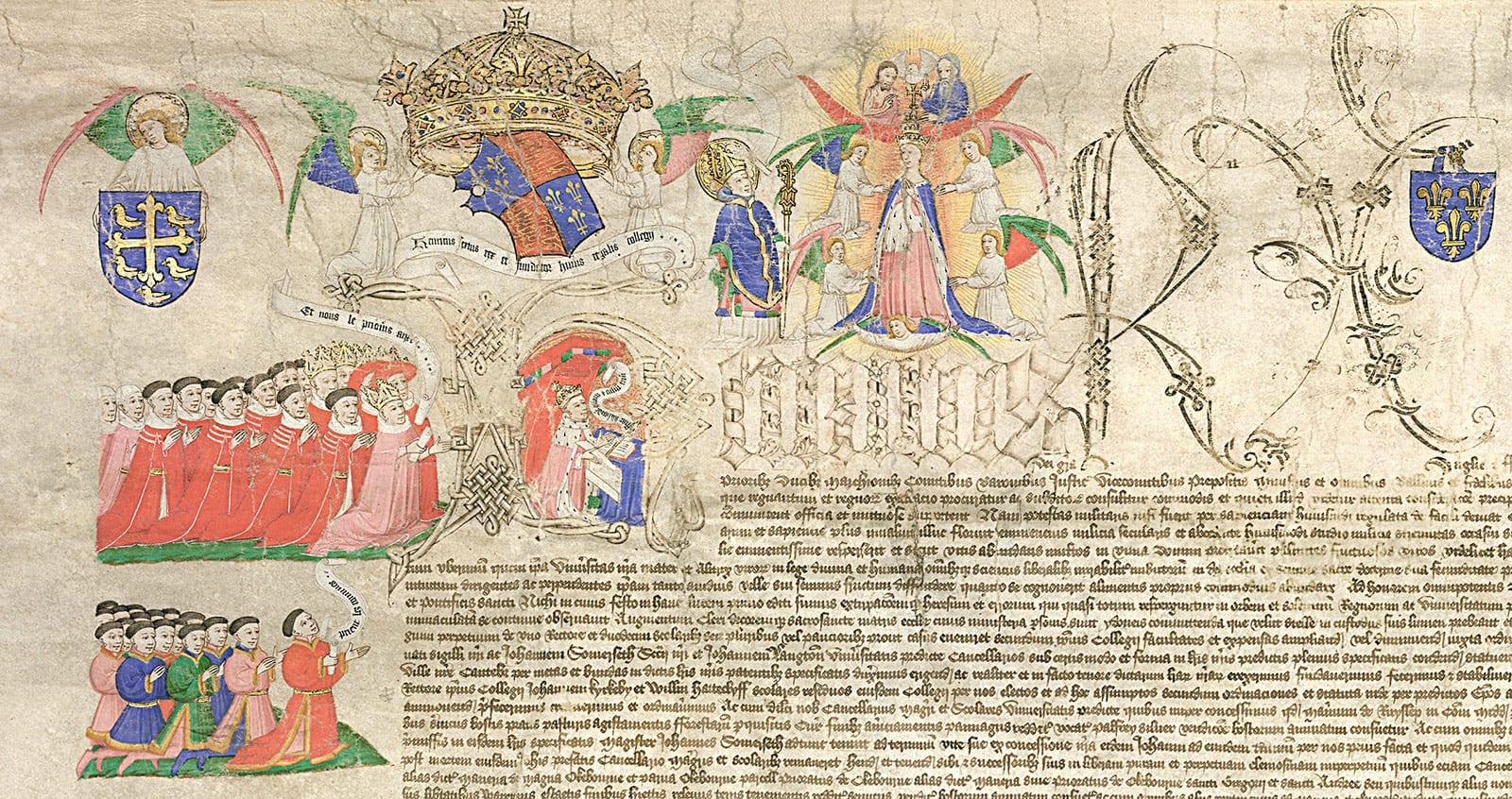
As a kind of anticipated twentieth birthday present for himself and a gift to learning in February 1441 King Henry founded the College of Our Lady and St Nicholas - King’s College - Cambridge.

King Henry VI with Representatives of the Lords and Commons, 1446, (1947) 

King Henry VI together with the Lords and Commons and with St Nicholas at top right 
Charter upon Act of Parliament to King’s College Cambridge March 16th 1445-6

Image: Media Storehouse

There is a more detailed description of the charter and more illustrations in an article from King’s College at Illuminating the Foundation of King’s College

King’s College founded by King Henry VI
The illuminated section of the charter 
Image: kcs.cambs.sch.uk


Manuscript page showing Henry VI's coat of arms
The arms of King Henry VI together with his banner

Image:1henry6.wikidot.com

This evening at St George’s Chapel at Windsor there had been a special Evensong to commemorate the King’s birth with Etonians  laying white lilies and red roses on his tomb.

King Henry VI Pray for us
Detail of the Charter upon Act of Parliament, 16 March 1445-6

Monday, 6 December 2021

Blair Atholl Man


Lie Science has an interesting report about the recent analysis of a male skeleton found near Blair Atholl in 1985 and dating from the 400-600 era.

The latest research into his bones shows that the man, who was about 45 when he died, came originally from the western coastal area of what is now Scotland, if not even
Ireland. The fact that he had migrated ties in with similar burial evidence from eastern Scotland from the same period. Whether or not he was a Pict is not revealed but he was buried according to Pictish practice, which would suggest that he was at least accepted into the society of Pictdom.


Sunday, 5 December 2021

More nonsense


I was somewhat bewildered the other week when I came across King James!  The Black King Who Had The Bible Translated Into English! with its confident assertion that King James I and VI was Black ….., yes, the son of Mary Queen of Scots and her second husband, King Henry, better known as Lord Darnley ( himself a Stuart/Stewart of Anglo-Scottish stock ) was, er, Black, as in Black…..

I then came upon a piece from History Debunked which looks at this latest nonsense and puts it in its proper context as both modern fable and conspiracy theory. It can be seen at Was King James I of England black?

Some of it, ironically, is, I assume, an unconscious reworking of the engaging medieval myth of Scotia, the daughter of Pharoah migrating to Scotland - though that would sit oddly with the idea of the Black Hebrew Elect.

One might be tempted to dismiss this idea as the manifest nonsense it is, but in the age of instant messaging and ever accessible videos online, anf the acceptance of so many conspiracy theories by the gullible, one should perhaps be forewarned and prepared to answer such ideas when they do crop up.

I will just add, rhetorically, what does the Duchess of Sussex and her erstwhile friend Ms Winfrey make of all this? After all, if the Royal Family are actually Black, what does that do to their claims about prejudice?