Once I was a clever boy learning the arts of Oxford... is a quotation from the verses written by Bishop Richard Fleming (c.1385-1431) for his tomb in Lincoln Cathedral. Fleming, the founder of Lincoln College in Oxford, is the subject of my research for a D. Phil., and, like me, a son of the West Riding. I have remarked in the past that I have a deeply meaningful on-going relationship with a dead fifteenth century bishop... it was Fleming who, in effect, enabled me to come to Oxford and to learn its arts, and for that I am immensely grateful.


Wednesday, 9 June 2021

Commemorating Edward Prince of Wales


Yesterday was the 645th anniversary of the death at the Palace of Westminster of Edward Prince of Wales in 1376.


Man of action, man of prayer
The gilt bronze effigy of Edward Prince of Wales in Canterbury Cathedral 

Image: Medievalists.net

There is an online biography of the Prince from Wikipedia at Edward the Black Prince and another account at THE DEATH OF THE BLACK PRINCE - Naked History This has an emphasis in part on his funeral the following September at Canterbury.

In recent months I have come across several online video features about his heraldic achievements which, after the funeral
ceremonies were hung above his tomb in Canterbury Cathedral. These are rare and precious survivals.
Replicas, made in the 1950's, of the armorial achievements of the Black Prince, including his jupon.
Replicas of the Prince’s achievements made in the 1950s
Image: trc-leiden.nl 

There are features about the analysis of the tomb and more particularly the effigy, itself an assembly of forty five pieces, which gives an idea of what arming a knight involved, at The Tomb of the Black Prince and at Investigating the Black Prince's Tomb


I particularly like the practicality of the idea of the detachable tail for the crest on the helm.

The jupon still surviving at Canterbury is discussed in this report from the Textile Research Centre in Leiden at Jupon of the Black Prince

A longer feature is about the creation of a reproduction of his jupon using the appropriate fabrics. This is from a BBC series  can be seen at A Stitch in Time S01E05 The Black Prince

The overall result is very splendid and gives an idea of the vividness and colour of medieval military and chivalric life. Would one really want to get such an item spoiled in the heat of battle or jousting? Evidently people were indeed prepared to, and presumably that kept craftsmen and craftswomen in business. It is certainly far from the too frequent modern cinematic idea of everything medieval being in shades of grey and beige, or even black ( which was, of course, a very expensive colour to produce ), and on days when it always rained.... For the mind of modern film costumers that all changes with the advent of the Tudors of course ....

The resulting jupon recreated for the Prince can also be seen in this photograph:


Image: ninyamikhailya.com

May he rest in peace


Tuesday, 8 June 2021

A Yorkshire lass on Crusade


The online History Extra website last week had a feature on twelfth century Queens of Jerusalem - notably Melisandre and Sibylla - and further reflections about the role of women in the Crusader Kingdom.

One item from the article, which caught my attention, as it clearly had that of the editor, is as follows:

In this feature from Katherine Pangonis, you can find out more about some of the other players. Queen Sibylla for instance, who seems to have had a role in the defence of Jerusalem against the army of Saladin in 1187, is a similarly fascinating figure. 

My favourite woman in this story is less exalted though, as Katherine Pangonis describes: “An ordinary woman called Margaret of Beverley, who had come to Jerusalem on pilgrimage, had become trapped in the city as Saladin advanced. Wearing a cooking pot as a helmet, Margaret helped defend the city. She related: ‘I carried out all the functions of a soldier that I could. I wore a breastplate like a man; I came and went on the ramparts, with a cauldron on my head for a helmet. Though a woman, I seemed a warrior, I threw the weapon; though filled with fear, I learned to conceal my weakness.’”


So here we have a Yorkshirewoman who in 1187 had got herself to Jerusalem on pilgrimage, and then took an active part in the defence of the Holy City. It is a story which challenges so many of our contemporary assumptions about the past that it deserves to be shared.

As a Yorkshireman myself I will reprise the point I made about another medieval Yorkshirewoman - in that case from the battle of Wakefield in 1460 - and speculate if Margaret of Beverley was perhaps an ancestor of that icon of Yorkshire feminity, the incomparable Nora Battye …*

* For the uninitiated this is a reference to a key figure in the onetime long-running BBC telecom series Last of the Summer Wine. As a fellow son of the West Riding one made the point to me, people down south think it was a comedy programme; we however knew that it was a fly-on-the-wall documentary.


Saturday, 5 June 2021

Festschrift for Peter Nockles


Earlier this afternoon I was able to join in by invitation in the launch of Religion in Britain, 1660-1900: Essay in Honour of Peter B. Nockles which has been published as a special edition of the Bulletin of the John Rylands Library. 

Peter worked in connection with or at the John Rylands from 1979 until his retirement and this was a tribute to his work as a librarian and archivist as well as a scholar. 

I first met Peter about fifteen years ago on one of his many return visits to Oxford and we became friends and dining companions.

The festschrift appears to cover a wide range of topics and should have a wide appeal to scholars of the periods covered in that it gives an opportunity to get into print and place before readers those specialised piieces of research which can so illuminate hitherto neglected aspects of the past.


Feast of Our Lady of Doncaster


Last month I virtually visited the Shrine of Our Lady of Doncaster with a post which linked to the one I wrote last year at Our Lady of Doncaster

Yesterday was the day assigned as the feast day of the devotion in the Hallam diocesan calendar and today, as the nearest Saturday, should have seen a Lay Carmelite pilgrimage to the Catholic church in central Doncaster which houses the restored shrine.

The website carmelite.org has a handsomely illustrated piece about the modern shrine and pilgrimage to it at Feast of Our Lady of Doncaster

There is another article about the history of the Doncaster Whitefriars at The Priory

This puts the extent of devotion to the image in context by citations from wills and references to burials and also has something to say about the Doncaster Greyfriars who were situated at the northern tip of the town by the main road - the Great North Road as it later came to be known of course - as it left the town by the bridge over the River Don.

Our Lady of Doncaster Pray for us


Friday, 4 June 2021

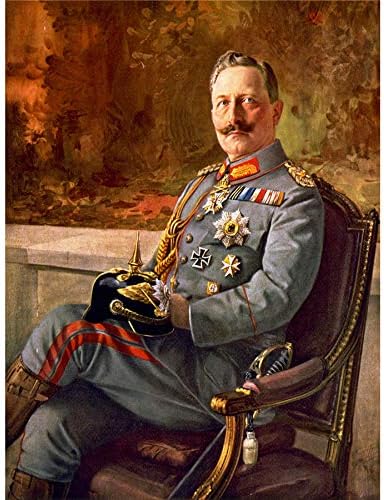
Kaiser Wilhelm II


Eighty years ago today Kaiser Wilhelm II died in exile at Doorn in the Netherlands.

Wee Blue Coo Paintings Portrait Kaiser Wilhelm II German Emperor Art Large Art Print Poster Wall Decor 18x24 inch

Emperor Wilhelm II
image: Amazon

I recently saw a comment online from German saying that he thought most people in Germany now see the Emperor as a tragic figure but that he remains controversial in the Anglophone world. This seems a good point, and today an appropriate one on which to reflect a little on the claims and counterclaims.think that the Kaiser is much misunderstood and continues to attract disapprobation as a legacy of a highly successful propaganda initiative from the western Allies during World War I. As Emperor he was, and had been since 1888, the public face of Germany. His close relationship to the British Royal Family and many visits to the country had heightened that perception of him. He might well be flattered to be the personification of the Second Reich, but was thus in line to be vilified as the enemy incarnate. His appearance was a gift to cartoonists, and he could be depicted as a monster to suit the purposes of public persuasion. He, and he alone, was presented as the driving force in German policy and actions.

The reality was different. Although as Kaiser he had greater freedom to appoint the Chancellor than his British relatives might to appoint a Prime Minister both the Reich and Prussia were constitutional monarchies. He might have fancied at times being an absolute monarch but was not. The absolutism in First World War Germany came from the army in a nation at war, not the ever more symbolic monarch. The final split with Bismarck came over the niceties of such matters in 1890. In the last months of the War the principle of accepting as Chancellor the leader of the majority in the Reichstag was conceded and could have led to evolution on lines similar to Britain and the Scandinavian monarchies ( where these issues were also being thrashed out in the early twentieth century ). After the unfortunate episode of the Daily Telegraph interview in 1908 the Kaiser stood back from internal political matters, and his part in the diplomatic events of the July crisis of 1914 surely suggests a lack of engagement, having reassured his nation’s principal ally of formal support ( reasonable enough surely ) he went off on holiday. He returned when it became clear events had moved shockingly out of anyone’s control. During the War his role was that of a morale boosting monarch distributing medals, the Supreme War Lord who was told little about the conduct of the war, but whose photographs could be used by friend and foe alike.

In the world into which he was born in 1859 the structures of government of the Great Powers were still small scale and monarchs by personal contact could make a significant difference. Just at that time in the 1860s things began to change - government expanded, popular political pressures began to be articulated through representative institutions and to have greater impact, and after 1871 the buffer regions of Europe were largely gone - nation state faced nation state across clear and defined, if not hard, frontiers. Industry and commerce had the means to provide the states with the means for overseas expansion and for warfare as never before. In this situation, changing behind the scenes, monarchs and the old order, and popular perception appear to have not realised how much had changed and how quickly. In the 1880s exchanges of letters between Queen Victoria and Kaiser Wilhelm I could enable the diplomatic process and facilitate peace; in 1914 similar messages between King George V and Kaiser Wilhelm II could do little. Both bewailed the fact of what was happening but the unstoppable juggernaut of destruction had been unleashed.

The personality of the Kaiser and the effects upon it of his stunted left arm and other health issues figure in all biographies of him. Less credit is given to him for overcoming such handicaps as well as he did as a public figure. He was undoubtedly a complex man but much of that was part of his make-up as a man born into particular circumstances when he was. His attitudes in part were those of his milieu, nothing more, nothing less. His far from easy relationship with his mother has so often been presented to the English speaking world with his mother as the long suffering victim. Reading more one feels that may indeed how she saw herself, and one is grateful not to have had her as a parent. The intelligence of her father and the emotion of her mother without both their common sense was a fairly fateful inheritance, combined quite probably with porphyria, and a rather too biddable husband in the future Kaiser Freiderich III made for stresses in growing up. One senses young Wilhelm rushed into marriage with Augusta Victoria just to get away from home. His difficult relationship with his mother, shaped in part by her inability to be other than English in Germany and vice versa as her brother King Edward VII observed certainly made for family tension with her eldest son. His reactions in the 1880s did not lead directly to the First World War.

For all the stories of a rather, or very, brash manner the memoirs of his cousins and others, as well as there who met him in later life, suggest a man of humour and not a monster. Many families have at least one relative who has the knack of making their presence felt and being just a bit too much. Wilhelm had all that as a young man, but it should not damn him.

From his parents and his very mid- nineteenth century education to create a future monarch he had many cultured interests and was clearly intelligent, if perhaps possibly showing something of Aspergerism.

His tendency to think before he spoke and to be carried away by his ideas is a recurring theme. As Emperor the Palace press officers used to persuade newspaper reporters to tone down the more lurid phrases when they were able. He may have been prolix and not always thought what he was saying or writing, but words are just that. It might on occasion have amused his people who well into the War remained attached to him and the carefull presented image of a close Imperial Family.
 
One of the causes of his breach with Bismarck - not the first or last political leader to fail to see the time had come to retire - was over the Chancellor’s attitude to workers’ rights. The young Kaiser’s speech setting out a vision of national cohesion in such matters was an influence on Pope Leo XIII in drawing up Rerum Novum.

I have read the first of the three volumes of John Röhl’s monumental biography of the Kaiser. The second and third await. As a reviewer said what other subject of a biography has forty pages devoted to their birth.... It is a tremendous achievement yet one so often feels the author is always seeking to portray the Emperor as the cause of all the woes of his people and nation. Bad behaviour as a child does not, and should not be presented as, marking a man for life. Thus in other works Professor Röhl cites anti-Semitic passages from the Kaiser. They are probably no different from many of his contemporaries, if not normal today. Yet as a pupil at the Gymnasium in Kassel the young Prince’s great school friend was a Jewish boy ( who was in turn an ancestor of the historian Sir Geoffrey Elton ), he had Jewish friends in the yachting world of the pre-1914 Kiel regattas, and for all his intemperate remarks about some Jews at least in the 1920s was appalled in 1938 by Kristellnacht as a blot on Germany.

Röhl is a marvellous resource - no detail missed - but too often it is a prosecutor’s charge sheet. Standard length biographies by Sir Christopher Clark Kaiser Wilhelm II : A Life in Power - which is good on the constitutional position of the Emperors and on the Wilhelminne concept of monarchy - and Giles MacDonagh The Last Kaiser are well researched and balanced in their assessment. There is also, though I have not yet read it myself, Christina Croft’s The Innocence of Kaiser Wilhelm II which has received positive reviews and seeks to rehabilitate the Emperor’s reputation.

A strange, complex and fascinating man - worth exploring as a major historical figure, and as a human story of a fallible but far from evil man struggling to do what he thought was his duty and calling.


Celebrating Corpus Christi


Yesterday being the traditional Feast of Corpus Christ I went to the EF Mass at teatime at SS Gregory and Augustine here in Oxford - the Oxford Oratory were also having a Solemn Mass for the feast at the same time, so traditional practice was well honoured in the city.

At SS Gregory and Augustine Fr Saward preached with particular reference to the part played in promoting Corpus Christi as a devotion by St Thomas Aquinas. As is of course well known St Thomas was asked by Pope Urban IV in 1264 to compose the Office and Propers of the new feast, and this gave Fe Saward the opportunity to link this both to St Thomas’ wider achievement as the synthesiser of Catholic thought and Aristotelianism and to the Angelic Doctor’s own spiritual insights in his last months in 1273-4 in Naples and on his deathbed at Fossanova. A suitably academic way in Oxford to mark this great feast.

As I discussed with a friend over dinner afterwards it was not until a couple of generations later with the publication of the Extravagantes - a lovely name for a collection of canon law - by Pope John XXII that the wider Church realised it should be keeping this  new feast. The speed and enthusiasm with which it was taken up is an indicator of the public desire to celebrate the gift of the Eucharist, of the Blessed Sacrament.


Wednesday, 2 June 2021

Coronation Day


Today is the sixty eighth anniversary of the Coronation of H.M.The Queen in 1953. Today has also been chosen for the release of plans for the celebrations of Her Majesty’s Platignum Jubilee which will be focussed on four days beginning exactly a year hence. From what has  been said this looks a distinct improvement on the Diamond Jubilee celebrations, but we shall have to see what transpires in coming months as plans are finalised.

This evening my intention at Mass was for The Queen and to give thanksgiving for her Coronation. On that day I was a babe or toddler-in-arms and slumbered through the television broadcast at my grandmother’s house. I have been making up for that dereliction of loyalty ever since ....

For those of my generation and older the images of the Coronation were part of our growing up, and with three others earlier in the century in 1902,1911 and 1937 the mystery and majesty of the rite was relatively familiar. In 1953 television brought it into the homes of the nation.

Today, in the longest reign in British history, for all the online availability of film and photograph, I suspect that is less so. As and when a future Coronation is being planned it is to be hoped that those with real expertise in liturgy and ceremonial, and also historians like J.H. Round in 1902, Percy Schramm in 1937 and Roy Strong more recently, can help to make the seemingly arcane ceremonies no less dignified and solemn than as on past occasions, but also convey to the uninitiated their profound significance. A Coronation is not mere dressing up and processing around - it is a unique moment of national coherence around the Monarch, who links it both to itself, to it past and its future, and to the Almighty.


Tuesday, 1 June 2021

Unpacking the Galloway Hoard


I have posted before about the wonderful Viking era Galloway Horad from Scotland, which was found seven years ago. Last week The Independent had an excellent article about the latest interpretation of this major discovery, about its contents and about the way in which it had been concealed. This all reveals the wealth and established nature of Christianity in the region at the time, and the ways in which such treasures indicate trading an cultural links across the Mediterranean world to the Near East.

The article is a curtain raiser to the National Museum of Scotland exhibition of the items which has now opened in Edinburgh and will travel to Kirkcudbright and then to Aberdeen. It can be read at Solving one of Viking Age Britain’s greatest mysteries