Once I was a clever boy learning the arts of Oxford... is a quotation from the verses written by Bishop Richard Fleming (c.1385-1431) for his tomb in Lincoln Cathedral. Fleming, the founder of Lincoln College in Oxford, is the subject of my research for a D. Phil., and, like me, a son of the West Riding. I have remarked in the past that I have a deeply meaningful on-going relationship with a dead fifteenth century bishop... it was Fleming who, in effect, enabled me to come to Oxford and to learn its arts, and for that I am immensely grateful.


Friday, 4 April 2014

The Memorial Service for Provost Nicholson


Last Saturday afternoon I attended the Memorial Service for the Rev. Professor Ernest Nicholson, Provost of Oriel from 1990-2003, which was held in St Mary's, the University Church, and one of the first endowments of Oriel in 1326.

Revd Ernest Nicholson

Rev. Prof. Ernest Nicholson

Image:blog.spc.ox.ac.uk

There was a good congregation, comprising past and present Fellows of the college, former Oriel staff and students as well as friends alongside his family.

The three addresses, by Canon Noel Battye,who had been Chaplain of Pembroke Cambridge when the Provost was Dean of Chapel there, Peter Collett,who was a leading figure in the Oriel appeal under Ernest Nicholson and Canon Prof. John Barton, his successor as Professor of the Interpretation of Holy Scripture at Oriel, looked respectively at him as family man, Provost and scholar. The portrait they gave was, I think, very fair and nuanced, and the key phrase that emerged from all three, and with this I would entirely concur, was Provost Nicholson's kindness. Academia is not necessarily renowned for that, but it was a central feature of his being, and one I certainly remember with regard.

Afterwards there was tea in the Hall of college, and an opportunity to talk to both Mrs Nicholson and old friends. 

An afternoon for remembrance, but not, I think, a sad one - I felt sure it was just the kind of occasion Ernest Nicholson would have enjoyed, old friends united in happy recollection of a life well lived.

My previous posts about him can be seen at Ernest Nicholson and Ernest Nicholson obituary.

Wednesday, 2 April 2014

A corner of London that is forever Norway


On Monday evening I went up to London to dine at the Norwegian Church in London, which is located in Rotherhithe. The invitation came through my good friend Fr Martin Stamnestro, whom I first knew when we were both members of the congregation at Pusey House, and when he was doing his doctorate. Having served as Sacristan at Pusey he was received as a Catholic just after I was, and is now the priest at Ålesund (Aalesund) in his native Norway. He tells me that his parish is the size of Norfolk. 

 
Fr Martin is on a brief visit to this country and was staying at the Norwegian Church, whose Pastor and Chaplain, the Rev.Torbjørn Holt, I had met frequently through Fr Martin when we were all in Oxford -  Torbjørn was then based here as Chaplain to Norwegian students in the UK. the invitation was to dine and to sleep over and return on Tuesday. I felt able to relax my Lenten discipline as I was travelling, and receiving hospitality, and it was also the ninth anniversary of my reception as a Catholic.

The church is near the Bermondsey tube station so the journey was easy, and I found myself at a dinner party whose other guests included another old Pusey friend who is now a Catholic and a barrister in London, the local Anglican vicar and his curate, who himself was a more recent Sacristan of Pusey House, and members of the Norwegian community, some of whom I had met before when I visited the church at Easter 2007. This was the beginning of an evening of very generous and graceful hospitality in the Chaplain's very handsome flat, which is situated on the first floor of the church building. We had lively and cheerful discussion about most topics under the sun - and in religious terms a true and generous ecumenical friendship was once again very apparent.


 St Olav's Church Rotherhithe

Image:tony-dingle.blogspot.co.uk

There has been a Norwegian church in London since the late seventeenth century and was originally a seaman's mission. The present church itself dates from 1927, the foundation stone having been laid the year before by Crown Prince Olav - later King Olav V  -  and during the Second World War was accorded pro-Cathedral status , and used by the exiled King Haakon VII and his government.

Today it is very much a Norwegian cultural centre in London, as are the other Scandinavian churches for their respective national communities, and as can be seen here.

Therte is an article about the church and its ministry here and another with good pictures of the building and its furnishings here. 

On Tuesday I joined in a hearty Scandinavian style breakfast of cold meat and cheese  before travelling with Torbjørn and Martin by taxi across London, dropping Torbjørn off at Church House for ameeting before going to Brompton Oratory where Martin had arranged to say Mass. Very unfortunately I was unable to stay for that as I had to be back in Oxford by mid-afternoon and the taxi-ride had taken longer than any of had expected, and we were running late. However we plan to meet today for lunch when he is here in Oxford.

A most enjoyable break with good friends in London, and almost a foreign holiday in itself.


Tuesday, 1 April 2014

Coughs and sneezes spread diseases


There are some very interesting archaeological conclusions from the examination of the skeletons of victims of the Black Death found near Charterhouse in London, where mass burials are known to have taken place during the epidemic. The evidence suggests they died of pneumonic rather than bubonic plague, and that the infection was not therefore spread by rat fleas, but by human interaction. Many of the victims were the undernourished of the city's population. There is a newspaper report on the investigation which can be read here.


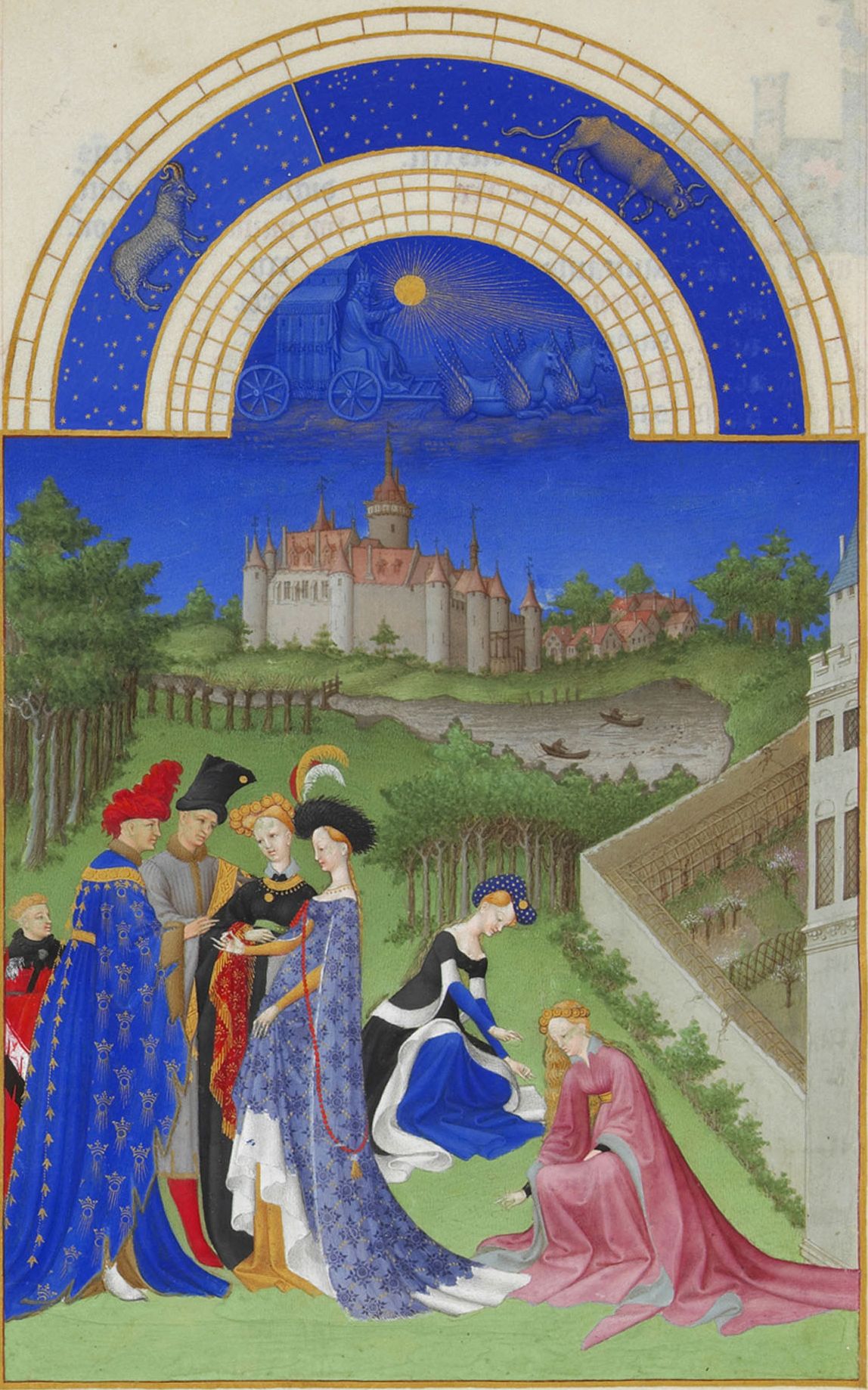
April


File:Les Très Riches Heures du duc de Berry avril.jpg

The April calendar page of the Très Riches Heures is attributed to Jean de Limbourg.

The scene depicts a bethrothal before two witnesses whilst two young women in attendance pick flowers. On the right is a walled garden or pleasance, the plants of which are not fully in bloom, but all is prepared for the coming season of growth. In the background is the Château de Dourdan, west of Paris, which had been held by the Duke of Berry since 1385, and of which much of the buildings still survive.  There is more about the history of the chateau and many more pictures here.

Romance and the spring clearly went together in the early fifteenth century mind. There is in its aristocratic rural idyll something we recognise in later artists and even in modern advertisements such as those for firms like Barbour.

Monday, 31 March 2014

Nine years peace and full communion


Nine years ago today I was received into full peace and communion with the Catholic Church in the Oxford Oratory. As is my habit on this significant personal anniversary I am re-posting my reasons for that decision and also some of my reflections on the subsequent years. I do not think I have anything to add to what I wrote last year, so to read something of my spiritual history - or to re-read it if you have done so before - follow the link to the post from twelve months ago Eight years in peace and full communion.

Saturday, 29 March 2014

Victims of the Battle of Towton


Today is the anniversary of the Battle of Towton in 1461, fought in a snow storm on Palm Sunday and reputedly the bloodiest battle fought in English history. I have posted about it previously in Palm Sunday Field 1461,  Towton links, The Battle of Towton - 550th anniversary and Towton - remembering the dead. I have a longstanding interest in the battle which was fought in my home area.

In recent years there have been several books about the battle, but so far I have not managed to read them. However one I would draw attention to is based on the detailed archaeological examination of skeletons of soldiers who died in the fighting and which were discovered in a mass burial at Towton in 1996.


Image:Amazon

Blood Red Roses is published by Oxbow Books, who are based very close to where I live in Oxford. the book is now in a second edition and is established as an exemplary case study of such battlefield archaeology.

In the years before I came to Oxford I used to organise a Requiem for the fallen of Towton in Saxton church, where many are buried in the churchyard, and in whose parish the battle sites lie. I always try to remember them in my prayers on this day and invite others of you as readers of this blog to do as well.


Friday, 28 March 2014

Fr Longenecker on the Ordinariates


I saw on the Zenit website an interesting and forceful piece by Fr Dwight Longenecker about the place of the Anglican Ordinariates in the contect both of the ARCIC discussions and of the future of Ecumenical schemes. He sees the Ordinariates as a rather surprising fruit of the Anglican-Catholic dialogue, and as offering real hope for drawing people into the Catholic Church. His article, which is trenchent and not afraid of being blunt about both communions,  can be read at A-new-ecumenism.


Wednesday, 26 March 2014

What will Dame Edna say?


I saw in the Times today that Tony Abbott, the staunchly monarchist Prime Minister of Australia, has announced the reintroduction of the classes of Knight or Dame of the Order of Australia. These classes, added a year after its first foundation, were removed from the Order's ranks in 1986. The first appointments are those of the outgoing Governor General, Quentin Bryce, as a Dame, and of General Peter Cosgrove, her successor in office, as a Knight. The Governor General will act as senior Knight or Dame ex officio, as well as being Chancellor of the Order, and up to four appointments will be made each year. There is a further report, with more background and comment than the Times article, from the Guardian which can be read here.

There is an online account of the Order, first established in 1975, its structure and insignia, here. The statutes and history of the Order can be seen at Order of Australia, and the Australian Government website about the Order is here. 


Companion of the Order of Australia - front 

Companion of the Order of Australia
The design of the Companion of the Order of Australia is a badge with a gold insignia of the Order in the centre.
The central insignia is circled with blue enamel edged in gold with citrines and is inscribed with the word ‘Australia’ in gold capital letters. The circle also contains two gold sprigs of mimosa.
The insignia is ensigned with the Crown of St Edward in full colour.
The medal is hung from the ribbon of the Order. It is royal blue with a central band of mimosa blossoms.

Image:itsanhonour.gov.au 

The other classes of the Order - Officer and Member, and the Medal  - are similar in design.

This insignia will now be rejoined by that of Knights and Dames as appointed between 1976 and 1986:


Knight: Badge

Dame: Badge

Insignia of a Knight and of a Dame of the Order

Knight or Dame: Star

Star of the Order

Images:medals.org.uk

Personally I think this is an excellent move, re-establishing a category to honour the most distinguished Australians in an appropriate and dignified way. Which brings me back to the title of this post - was Dame Edna self-promoted to an Imperial or an Australian honour?