Once I was a clever boy learning the arts of Oxford... is a quotation from the verses written by Bishop Richard Fleming (c.1385-1431) for his tomb in Lincoln Cathedral. Fleming, the founder of Lincoln College in Oxford, is the subject of my research for a D. Phil., and, like me, a son of the West Riding. I have remarked in the past that I have a deeply meaningful on-going relationship with a dead fifteenth century bishop... it was Fleming who, in effect, enabled me to come to Oxford and to learn its arts, and for that I am immensely grateful.


Monday, 4 April 2011

Catechesis in Welsh


My friend Rhidian Jones, as his name suggests, is Welsh, and a Welsh speaker.* Like me he is a convert to Catholicism and now based in Oxford.

Apart from his work as an author on Canon Law - and more on the second edition of his handbook on that subject in a few days - he is anxious to encourage the use of the Welsh language in devotional life, both in the Catholic Church in Wales, and in assisting those interested in the Ordinariate there. He is keen to remind his fellow Welsh speakers of their Catholic heritage, symbolised by the restored shrine of Our Lady of the Taper at Cardigan, and to encourage the use of the rich tradition of Welsh hymnography in the Catholic tradition, stretching back to the middle ages.


Our lady of the Shrine

Our Lady of the Taper
There is more about the history of the shrine here.

He has recently produced an English-Welsh bilingual booklet Church Teaching on the Eucharist/ Athrawiaeth yr Eglwys ar yr Ewcharist of quotations from Pope John Paul II and Pope Benedict XVI as well as the Catechism of the Catholic Church about Exposition and Adoration of the Blessed Sacrament for use by parishes and individuals. One Welsh parish is already using it as its Lent devotional book this year.

It costs £2.00 plus p&p, and if readers are interested I can supply Rhidian's e-mail address.


* Despite many happy holidays in Wales in my youth my knowledge of the language is virtually nil. However I am assured by another friend that my name translates in Welsh as Sion Pen Gwyn.

St Richard of Chichester


Yesterday, had it not been Sunday, would have been the feast, or at least the commemoration, of St Richard of Chichester.


I have adapted the following piece from the post by Terri Morgan on the Medieval Religion discussion group Saints of the day feature:

Richard de la Wych, born in 1197, was a native of Droitwich in Worcestershire. He studied at Oxford and Paris, and there he lodged in the same room with two other poor scholars, and fed on bread and porridge (potagium); and so poor were they that the three had only one respectable coat between them, and could only go alternately to the lectures in the coat, whilst the others sat at home without.

He became the Chancellor of Oxford University after he returned to England from seven years of studying canon law at the University of Bologna. One of his former tutors, (St.) Edmund of Abingdon (who had become Archbishop of Canterbury), became his dear friend and, impressed by Richard's skills, made him diocesan chancellor. In the words of the Dominican Ralph Bocking, Richard's confessor and biographer: "Each leaned upon the other - the saint upon the saint: the master upon the disciple, the disciple upon the master: the father on the son, and the son on the father."

Richard was a strict vegetarian, but would serve meat to his visitors; when he saw poultry or young animals being conveyed to his kitchen he was wont to say: "Poor little creatures, if you were reasoning beings and could speak, how you would curse us! For we are the cause of your death, and what have you done to deserve it?"

The next archbishop arranged the election of Richard as Bishop of Chichester - which enraged King Henry III, who refused to allow Richard to assume his office. In the two years before Henry acquiesced, Richard lived in a priest's house and did visitations of the diocese on foot. Richard was a reformer and model bishop. Richard died in Dover on this day in 1253 while preaching the crusade. Miracles were reported shortly after his death. A commission of inquiry was established in 1256 and in 1262 Urban IV canonized him. He has two thirteenth-century Vitae, of which the second, by the Dominican hagiographer Ralph Bocking, is full of anecdotes about his solicitude for the poor and the sick.

St Richard is perhaps best remembered by the wider public today for the prayer: "Thanks be to thee, my Lord Jesus Christ for all the benefits thou hast given me, for all the pains and insults which thou hast borne for me. O most merciful redeemer, friend and brother, may I know thee more clearly, love thee more dearly, and follow thee more nearly, day by day."

There is another, longer, online biography here.

Over and above his connections with Oxford, and the presence nearby of the painting at Black Bourton, or the fact that some of my ancestors came from Sussex, I have always had an interest in St Richard because the only medieval church dedicated to him was in my home town of Pontefract. In 1256, three years after the death of the Bishop, Edmund de Lacy, Earl of Lincoln, founded a Dominican friary in Pontefract and dedicated to Our Lady, St Dominic and St Richard. According to Bocking the three-fold dedication received divine approval when the flawless foundation stone split into three pieces when the Earl was laid it. The friary was dissolved in 1538 and the the buildings destroyed. The site is now covered by Pontefract General Infirmary. Something of the plan and sequence of buildings was recovered in excavations before the hospital was extended, and as a boy I helped with those.

Many years later as a voluntary chaplaincy assistant there I suggested, and the suggestion was accepted, that the reconstructed hospital chapel be dedicated once more to St Richard. I helped provide a photographic reproduction of a pair of fourteenth century stained glass figures from the north choir clerestory of Wells Cathedral, which fortuitously shows St Richard side by side with St Giles, the patron saint of the parish church in Pontefract. This I had spotted on a visit to Wells whilst on retreat at Glastonbury.

St Richard of Chichester,
Wells Cathedral
Image: therosewindow.com


Sunday, 3 April 2011

LMS Pilgrimage to York


Following on from my previous post with its reference to the recusant heritage of York and the recent Latin mass Society Pilgrimage there, which I commented on last month in Mass in York Minster there are two illustrated accounts of the Pilgrimage on the LMS Chairman's blog and they can be seen here and here. The pictures include not only the Mass itself but also the visit to the shrine of St Margaret Clitherow in The Shambles.

Friends who were there commented on the beauty of the celebration in the Minster and how enjoyable the whole weekend had been.

Saturday, 2 April 2011

Recusant women


In my series of tutorials last term on women in sixteenth century England we moved from the Protestant women of the 1540s to their antitypes, the Catholic recusant women of the 1570s and 1580s and later.

Some of them were aristocrats, such as Madeleine, Lady Dacre, whose religious opinions earned the respect of Queen Elizabeth I, and about whom Alice Hogge has written in God's Secret Agents, Lady Vaux and the other well-born ladies who appear in Fr. John Gerard's Autobiography, and Anne, Countess of Arundel, the wife of St Philip Howard.


Anne Countess of Arundel in later life.
Image: Wikipedia

As women of birth and rank they were able to exercise their authority in their local communities and in some cases protect their co-religionists.

Rather different was the story of the York housewife St Margaret Clitherow. As a regular visitor to York I have known her story virtually all my life.


St Margaret Clitherow

Image: Sacred Destinations

Here is an account of her life which I have adapted from that given by Terri Morgan on the Medieval Religion discussion group on March 25th this year - St Margaret's feast day.

Margaret was a native of York, the daughter of a prosperous candle maker. She married the butcher John Clitherow in 1571. A few years after the marriage, Margaret converted to Catholicism. She became notorious for her recusancy. Her husband was repeatedly fined because Margaret would not attend the services of the Church of England. She was even imprisoned for two years - and on her release set up a Catholic school. She even sent her oldest son to Douai to study, for which she was put under house arrest for over a year.

Margaret was also a prominent hider of fugitive priests. In 1586 her house was searched, and a missal and Mass vessels were discovered. She was arrested and put on trial, but she refused to plead so as to protect those she had helped. She refused to enter a plea, so was sentenced to the peine fort et dure (laid on the ground with a door over her, with a sharp stone under her neck, and then weights added to the door until she should finally answer the courts with a plea) which was carried out in the crypt of the despoiled chantry chapel of St William on Ouse Bridge and so died, refusing to speak.

By not entering a plea meant there was no trial at all. She thereby saved her children, her stepchildren and her neighbour’s children from being hauled into the witness box and being bullied into giving the evidence to condemn her. (There was no minimum age for giving evidence and no protection for minors). This evidence would have pointed to other Catholics in York. By keeping silent she sabotaged the entire anti-Catholic clampdown and gained the moral high ground in popular opinion - even among the extreme Protestants in the neighbourhood. This was of course not only at the price of her own life but the life of her unborn - and unbaptised - child. Has she pleaded (guilty or not guilty would have made no difference) and been found guilty then her execution would have been deferred until after the child's birth. It was an even harder choice that it looked at first.

Visitors to York can see the house in the Little Shambles where she lived for some time, and the dormer window at the Black Swan, which she hired as a Mass-house. You can also see her hand at the Bar Convent Museum in York.


2006 03 19_8678

St Margaret Clitherow's hand, venerated at the Church of the English Martyrs in York on the recent Latin Mass Society Pilgrimage.

Image: LMS Chairman blog

To this I would add links to other websites about her, beginning here, and which has the interesting point that St Margaret's martyrdom appears to have arisen from an excess of zeal on the part of the local authorities, who were subsequently reprimanded by Elizabeth I in a letter - another woman faced with the same penalty was kept in prison on the Queen's orders, but the penalty not exacted, as described in Alice Hogge's book.

There are two other sites of interest about St Margaret here and here.

What emerges is Margaret Clitherow's remarkable dedication to the Catholic cause, and the fact that a woman from the middle ranks of life in York could achieve so much. She does not appear to have been dominated by her husband or social convention.

One of the priests she helped was Bl. William Hart, arrested on Christmas night 1582, apparently in her house. When he was executed in March 1583 the crowd apparently would not let the executioner draw and quarter him as he hanged - that is they ensured he was dead before he was hacked to pieces, which suggests sympathy either for him or his cause, which was not uncommon at public executions in the period. There is an account of his life here.

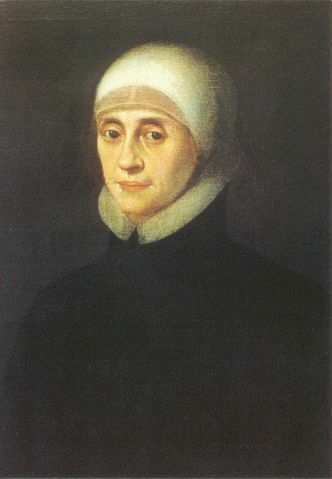
Another remarkable Yorkshire-born recusant woman was Mary Ward (1585-1645). She came from an old Yorkshire family, grew up in this time of persecution and was connected to some of those involved in the Gunpowder Plot. Her active life was largely lived in exile on the continent and in her attempts to establish a new type of religious order for women, the institute of the Blessed Virgin Mary, inspired by the Jesuit model. In 1630 she was imprisoned for three months by the Inquisition and her communities dispersed, and only after death did her ideas begin to find official favour in the Church. She is probably better known in the area she worked in on the continent - Germany and Belgium - than in her own country. She died in York, and the Bar Convent there belongs to her order, and includes a museum of recusant history.

There are online lives of her here and here.


Ven.Mary Ward

Image:Wikipedia


Friday, 1 April 2011

Knights of Malta


On Wednesday evening I attended a most interesting talk at the Oratory here in Oxford by Julian Chadwick about the history and present role of the Order of Malta, or to give it its proper title The Sovereign Military Hospitaller Order of St John of Jerusalem of Rhodes and of Malta.

Mr Chadwick is in Simple Profession as a Knight, and, dressed in his habit and equipped with modern computer technology, symbolised the way in which the Order combines its original monastic and hospitaller charism with modern methods so as to continue to serve Christ and the Church as well as the sick and the poor.

Amongst the points he made was that the Order, founded in 1099, is the oldest chivalric order in existence, predating those of the national and dynastic monarchies, such as the Garter, the Annunziata and the Golden Fleece, founded from the fourteenth century onwards.

In England the Grand Priory was restablished in 1993, having been in abeyance since 1559, although there had been English Knights of Malta throughout that period. The previous Grand Master and the present one were both born in England. The Order is growing in numbers in this country, and this appears to be a consequence of their fidelity to their traditions.

He also indicated the wide extent of their humanitarian work, and fact that the Sovereign status of the Order enables it to work where other groups might not be accepted and to be a means of directing aid rapidly to disaster areas.


A meeting of the Sovereign Council of the Order,
with the banners of the national langues displayed

I have added the English website of the Order of Malta to the side bar, and it provides a great deal of information about the history and current activities of the Order.

San Clemente in Rome


There is a very interesting article on the New Liturgical Movement about the church of San Clemente in Rome by Dino Marcantonio which explains the iconography and symbolism of the building and its decoration.


The interior of San Clemente

A view of the nave, the schola cantorum with the ambos to either side,
the altar and confessio under the ciborium,
and the bema at the back of the apse.


It is well worth looking at and, if you have not already seen it, can be read here.

Emperor Charles of Austria obit

Thursday, 31 March 2011

Vestments from Abbey Dore


Whilst looking for pictures of maniples for the last post I came across this picture of a velvet kneeler, embroidered burse, stole and maniple, thought to have belonged to the Cistercian house at Abbey Dore in Herfordshire, and now in the Victoria and Albert Museum.

Velvet kneeler, embroidered burse, stole and maniple

© V&A

I was unaware of their survival until today, and thought readers might also be interested to see this picture.

I have not so far in my travels visited Abbey Dore, but part of the monastic church still serves as the parish church, having been restored in the early seventeenth century by Viscount Scudamore.