Once I was a clever boy learning the arts of Oxford... is a quotation from the verses written by Bishop Richard Fleming (c.1385-1431) for his tomb in Lincoln Cathedral. Fleming, the founder of Lincoln College in Oxford, is the subject of my research for a D. Phil., and, like me, a son of the West Riding. I have remarked in the past that I have a deeply meaningful on-going relationship with a dead fifteenth century bishop... it was Fleming who, in effect, enabled me to come to Oxford and to learn its arts, and for that I am immensely grateful.


Showing posts with label St Margaret Clitherow. Show all posts

Friday, 1 May 2015

Pilgrimage for St Margaret Clitherow and the York Martyrs - May 9th


This year's pilgrimage for St Margaret Clitherow and the York Martyrs will be on Saturday, 9th May. We will be joined by members of the Guild of Our Lady of Ransom.

Fr Richard will give a talk in the Bedern Hall at 11.30am on the history of Christian York. There will be a High Mass in the Extraordinary Form at 1.30pm, followed by a procession at 3.00pm taking in St Margaret's House in the Shambles and the site of her martyrdom on Ouse Bridge. The day will end with Benediction back in St Wilfrid's at 3.45pm.


13580390663_88f1c1d377_n

Text and image:stwilfridsyork.org.uk 


For anyone free to go to this pilgrimage I am sure that it would be an excellent occasion to attend.


Sunday, 21 July 2013

St Wilfrid's York


The announcement this weekend by the Bishop of Middlesborough that he has invited the Oxford Oratory to take charge of the church of St Wilfrid in York, and the consequent hopes that this will lead to the eventual establishment of a York Oratory represents a very positive challenge for both the Oratorians and the parishioners in York. The parish includes the shrine of St Margaret Clitherow in The Shambles. It is a project that will need our prayers to support it, but it holds great possibilities.

The Oratory website has a piece about the proposal, and a copy of Bishop Drainey's letter to the parish which can be seen in the article  St Wilfrid's, York. 

There is an online account of the church here. Although I have often passed the church when in York, which is close to my home town, I do not think I have ever been inside it to look around. It has a very distinctive French or continental appearance. It stands in strong contrast to the Minster, which is only yards away. Here are some pictures of the church:


The church from Duncombe Place


St Wilfrid's Church and its near neighbour YorkMinster

 The highly ornate doorway. 
St Wilfrid's Church was designed by George Goldie and was built in 1862-1864. For some years it served as the pro-cathedral of the diocese of Beverley until that was divided in 1878.


The view down the nave to the polygonal apse and altar. It is built in late 13th century  style and the pillars of the aisle arcade arches are quite massive and assertive with a pronounced shaft ring and elaborate Early-French Gothic capitals.

Images: docbrown.info


photo

Another door opens for the Oratorians

Image: Patrick Costello on Flickr

May Our Lady, St Philip Neri and St Wilfrid pray for this proposal


Saturday, 2 July 2011

Books on St Margaret Clitherow


Amongst the books I am currently reading is Saint Margaret Clitherow by Katharine Longley, which was published in 1986, and is a readable and well researched account of the life of the York housewife who was martyred in 1586. It brings out her remarkable qualities as a devout woman, and also gives an insight into just what was possible for an urban wife to do and how she lived in the period. I wrote about St Margaret in April in my post Recusant women. Coming as I do from quite close to York I have always known the story of St Margaret, and the more I know about her the more interesting she proves to be.

A modern statue of St Margaret Clitherow

Image: Our Lady's catechists

Today I saw on Stephanie Mann's Supremacy and Survival blog a review of a new book by Peter Lake and Michael Questier on St Margaret which sets her in the context of the issues facing recusants in the later sixteenth century. Her post can be read at Book Review: The Trials of Margaret Clitherow. From the post this would appear to be an intersting contribution to our understanding of the world of Elizabethan recusancy.


Thursday, 7 April 2011

St Margaret Clitherow


Via the Hermeneutic of Continuity I have come across another online biography of St Margaret Clitherow which may be of interest to those who read my posts on Recusant women and the LMS Pilgrimage to York.

http://www.catholicwomensleague.org/images/mc5.jpg

A modern statue of St Margaret Clitherow

Image: Catholic Women's League

It is by Daniel F. McSheffery and entitled St Margaret: Mother and Martyr and can be read here.

Here is a picture of the site of St Margaret's martyrdom.


Old Ouse Bridge and St William's Chapel, 1803 or 1805,

by John Varley, York Art Gallery

Image: historyofyork.org.uk

The medieval Ouse Bridge had become crowded with buildings. As well as houses and shops, the bridge supported St William’s Chapel at one end, which was transformed into apartments after the Reformation.

The thirteenth century chapel commemorated the saint-archbishop, who died in 1154, and whose prayers were believed to have saved those who fell into the river when the bridge collapsed upon his return to the city.


In the winter of 1564 snow, a frost, a sudden thaw and a flood caused the central arches to collapse again. Twelve houses fell into the river and 12 people drowned.

The new bridge, opened in 1566, had five arches, with the central one 81 feet wide and more than 17 feet high. The bridge had a chapel, St William's, on the south side of the river. The Council chamber was housed next to the chapel and the damp city gaol was below. It was one of the sights of the city.

It was in the gaol, in the basement of the desecrated chapel, that St Margaret died.

The bridge was cleared and rebuilt in the years after 1810, but a plaque marks the site of the chapel.

Saturday, 2 April 2011

Recusant women


In my series of tutorials last term on women in sixteenth century England we moved from the Protestant women of the 1540s to their antitypes, the Catholic recusant women of the 1570s and 1580s and later.

Some of them were aristocrats, such as Madeleine, Lady Dacre, whose religious opinions earned the respect of Queen Elizabeth I, and about whom Alice Hogge has written in God's Secret Agents, Lady Vaux and the other well-born ladies who appear in Fr. John Gerard's Autobiography, and Anne, Countess of Arundel, the wife of St Philip Howard.


Anne Countess of Arundel in later life.
Image: Wikipedia

As women of birth and rank they were able to exercise their authority in their local communities and in some cases protect their co-religionists.

Rather different was the story of the York housewife St Margaret Clitherow. As a regular visitor to York I have known her story virtually all my life.


St Margaret Clitherow

Image: Sacred Destinations

Here is an account of her life which I have adapted from that given by Terri Morgan on the Medieval Religion discussion group on March 25th this year - St Margaret's feast day.

Margaret was a native of York, the daughter of a prosperous candle maker. She married the butcher John Clitherow in 1571. A few years after the marriage, Margaret converted to Catholicism. She became notorious for her recusancy. Her husband was repeatedly fined because Margaret would not attend the services of the Church of England. She was even imprisoned for two years - and on her release set up a Catholic school. She even sent her oldest son to Douai to study, for which she was put under house arrest for over a year.

Margaret was also a prominent hider of fugitive priests. In 1586 her house was searched, and a missal and Mass vessels were discovered. She was arrested and put on trial, but she refused to plead so as to protect those she had helped. She refused to enter a plea, so was sentenced to the peine fort et dure (laid on the ground with a door over her, with a sharp stone under her neck, and then weights added to the door until she should finally answer the courts with a plea) which was carried out in the crypt of the despoiled chantry chapel of St William on Ouse Bridge and so died, refusing to speak.

By not entering a plea meant there was no trial at all. She thereby saved her children, her stepchildren and her neighbour’s children from being hauled into the witness box and being bullied into giving the evidence to condemn her. (There was no minimum age for giving evidence and no protection for minors). This evidence would have pointed to other Catholics in York. By keeping silent she sabotaged the entire anti-Catholic clampdown and gained the moral high ground in popular opinion - even among the extreme Protestants in the neighbourhood. This was of course not only at the price of her own life but the life of her unborn - and unbaptised - child. Has she pleaded (guilty or not guilty would have made no difference) and been found guilty then her execution would have been deferred until after the child's birth. It was an even harder choice that it looked at first.

Visitors to York can see the house in the Little Shambles where she lived for some time, and the dormer window at the Black Swan, which she hired as a Mass-house. You can also see her hand at the Bar Convent Museum in York.


2006 03 19_8678

St Margaret Clitherow's hand, venerated at the Church of the English Martyrs in York on the recent Latin Mass Society Pilgrimage.

Image: LMS Chairman blog

To this I would add links to other websites about her, beginning here, and which has the interesting point that St Margaret's martyrdom appears to have arisen from an excess of zeal on the part of the local authorities, who were subsequently reprimanded by Elizabeth I in a letter - another woman faced with the same penalty was kept in prison on the Queen's orders, but the penalty not exacted, as described in Alice Hogge's book.

There are two other sites of interest about St Margaret here and here.

What emerges is Margaret Clitherow's remarkable dedication to the Catholic cause, and the fact that a woman from the middle ranks of life in York could achieve so much. She does not appear to have been dominated by her husband or social convention.

One of the priests she helped was Bl. William Hart, arrested on Christmas night 1582, apparently in her house. When he was executed in March 1583 the crowd apparently would not let the executioner draw and quarter him as he hanged - that is they ensured he was dead before he was hacked to pieces, which suggests sympathy either for him or his cause, which was not uncommon at public executions in the period. There is an account of his life here.

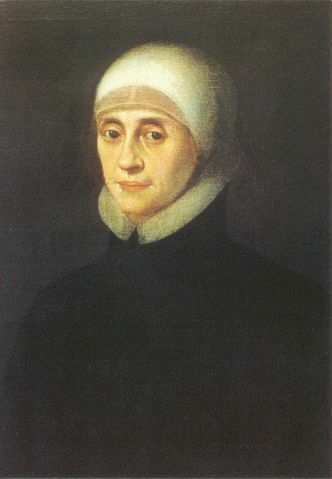
Another remarkable Yorkshire-born recusant woman was Mary Ward (1585-1645). She came from an old Yorkshire family, grew up in this time of persecution and was connected to some of those involved in the Gunpowder Plot. Her active life was largely lived in exile on the continent and in her attempts to establish a new type of religious order for women, the institute of the Blessed Virgin Mary, inspired by the Jesuit model. In 1630 she was imprisoned for three months by the Inquisition and her communities dispersed, and only after death did her ideas begin to find official favour in the Church. She is probably better known in the area she worked in on the continent - Germany and Belgium - than in her own country. She died in York, and the Bar Convent there belongs to her order, and includes a museum of recusant history.

There are online lives of her here and here.


Ven.Mary Ward

Image:Wikipedia