Once I was a clever boy learning the arts of Oxford... is a quotation from the verses written by Bishop Richard Fleming (c.1385-1431) for his tomb in Lincoln Cathedral. Fleming, the founder of Lincoln College in Oxford, is the subject of my research for a D. Phil., and, like me, a son of the West Riding. I have remarked in the past that I have a deeply meaningful on-going relationship with a dead fifteenth century bishop... it was Fleming who, in effect, enabled me to come to Oxford and to learn its arts, and for that I am immensely grateful.


Showing posts with label St Wulfstan. Show all posts

Monday, 19 January 2015

St Wulstan of Worcester


Today is the feast of St Wulstan, born c.1008, and Bishop of Worcester from 1062 until 1095. He was the only Anglo-Saxon bishop to retain his see following the Conquest. At Worcester he initiated the rebuiilding of the cathedral and it was under his auspices that Great Malvern Prory was founded. His cult came into prominence in the early part of the thirteenth century, when miracles at his tomb began to be recorded. He was canonized in 1203.


photo

St Wulstan
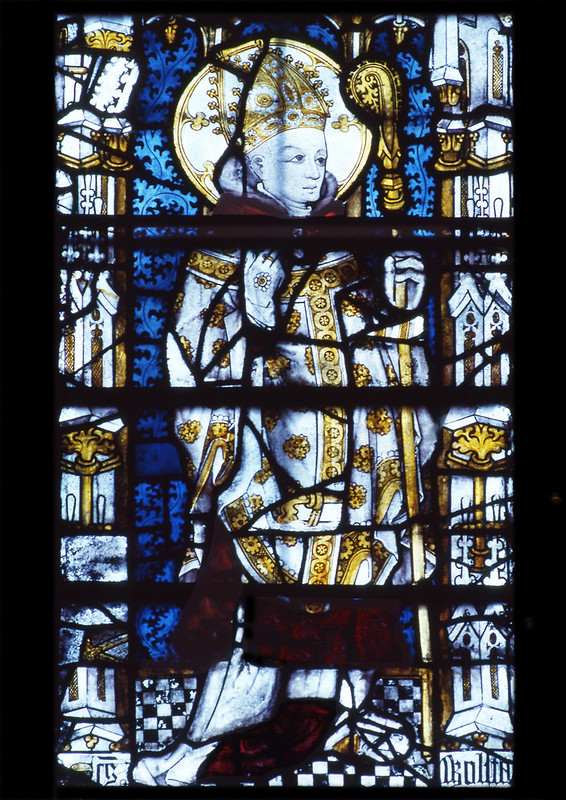
Later fifteenth century glass at Great Malvern Priory

Image: Gordon Plumb on Flickr


Thursday, 19 January 2012

St Wulfstan in stained glass


Today is the feast of St Wulfstan (or Wulstan), Bishop of Worcester, who died in 1095 and was the last surviving Anglo-Saxon bishop from the pre-Conquest hierarchy. My post about him from last year can be read at St Wulfstan of Worcester.

This year I am posting this photograph of a window in the north clerestory of Great Malvern priory, which is a late medieval depiction of one of the patrons of the diocese. Although it is not in any way contemporary to St Wulfstan's lifetime, it does indicate both late medieval devotion to him and is a handsome example of the glazier's art - the face and head definitely suggest a monastic:

photo


Image: Gordon Plumb on Flickr


Wednesday, 19 January 2011

St Wulfstan of Worcester

Today is the feast of St Wulfstan, Bishop of Worcester, who died in 1095.

There are online biographies of him here and here. The more comprehensive Oxford Dictionary of National Biography life by Emma Mason is available here.

St Wulstan was a fine pastor and was to be the only pre-Conquest bishop to retain his see until his death a generation after the Conquest. He worked with King William I and entered into the spirit of the reforms carried out under Archbishop Lanfranc.

Like his Norman contemporaries he rebuilt hios cathedral, and his biographer records how the bishop wept to see the old cathedral with all its associations being demolished whilst still rejoicing that a new and more splendid cathedral was to take its place. Of that cathedral only the beautiful crypt survives beneath the later medieval rebuilding. The restoration some years ago made it a wonderful place to visit and pray in.


St Wulfstan's Crypt at Worcester Cathedral

Photo:Paradox Place.com


Which leads me to share a thought. St Wulfstan's reaction to the rebuilding can be seen as analogy forthe situation facing Anglo-Catholics contemplating the Ordinariate. Memories of past glories and times should not blind one to the wonderful possibilities of a new structures and all that they can bring.