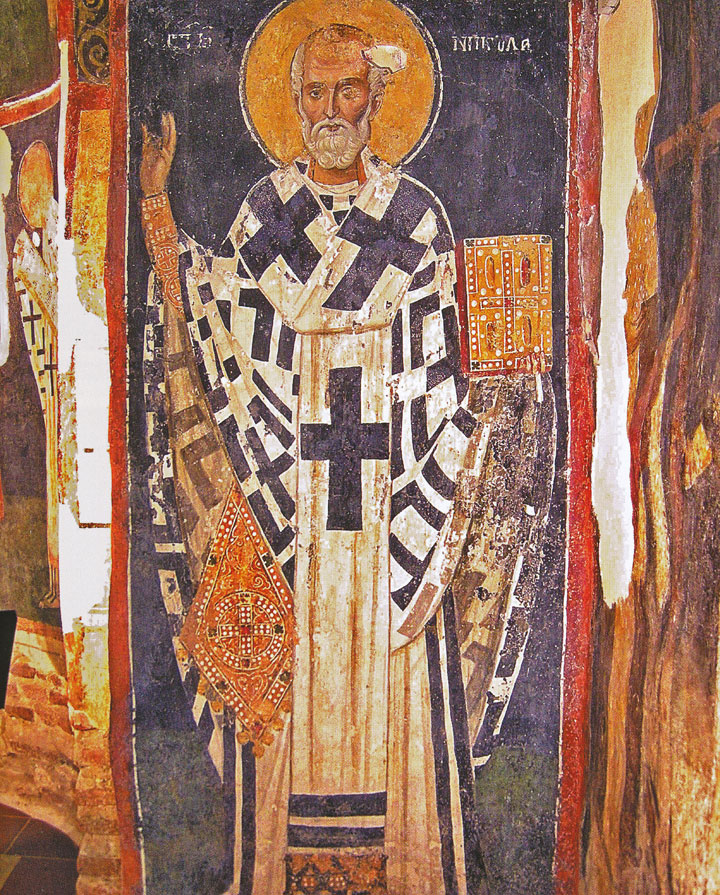
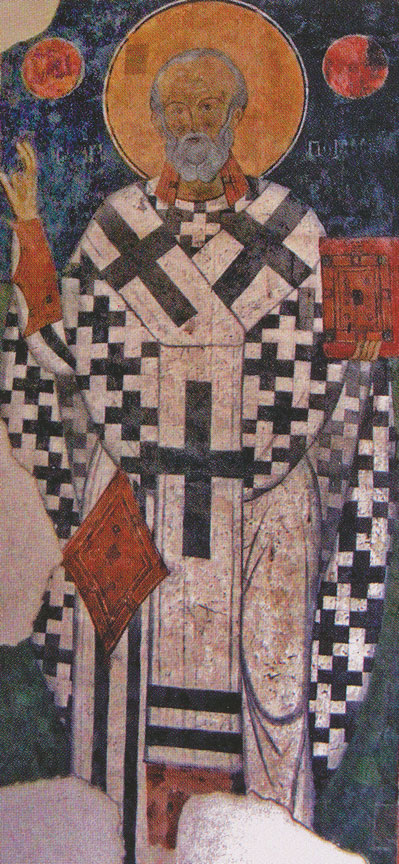
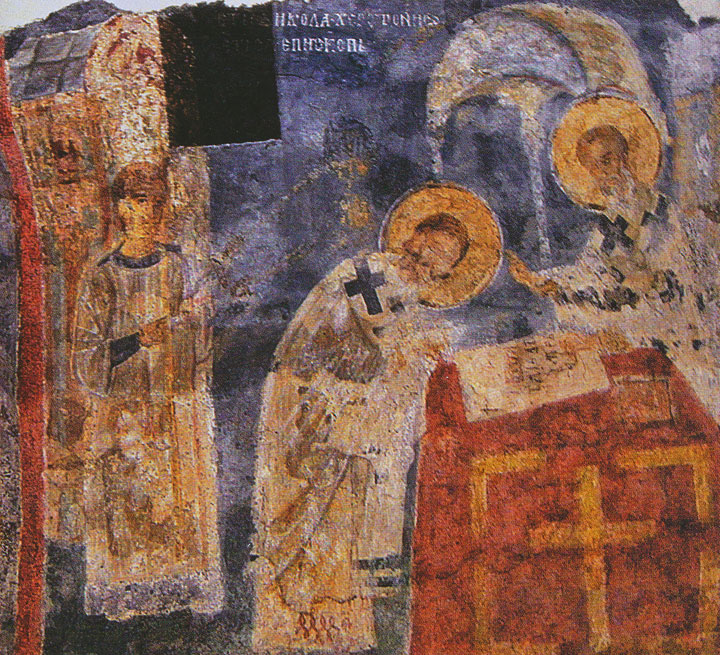
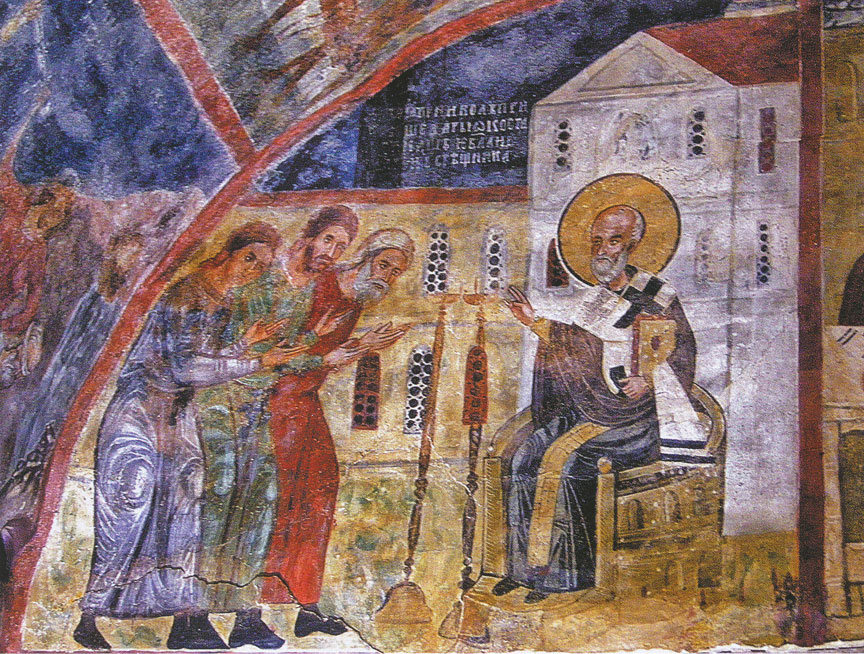
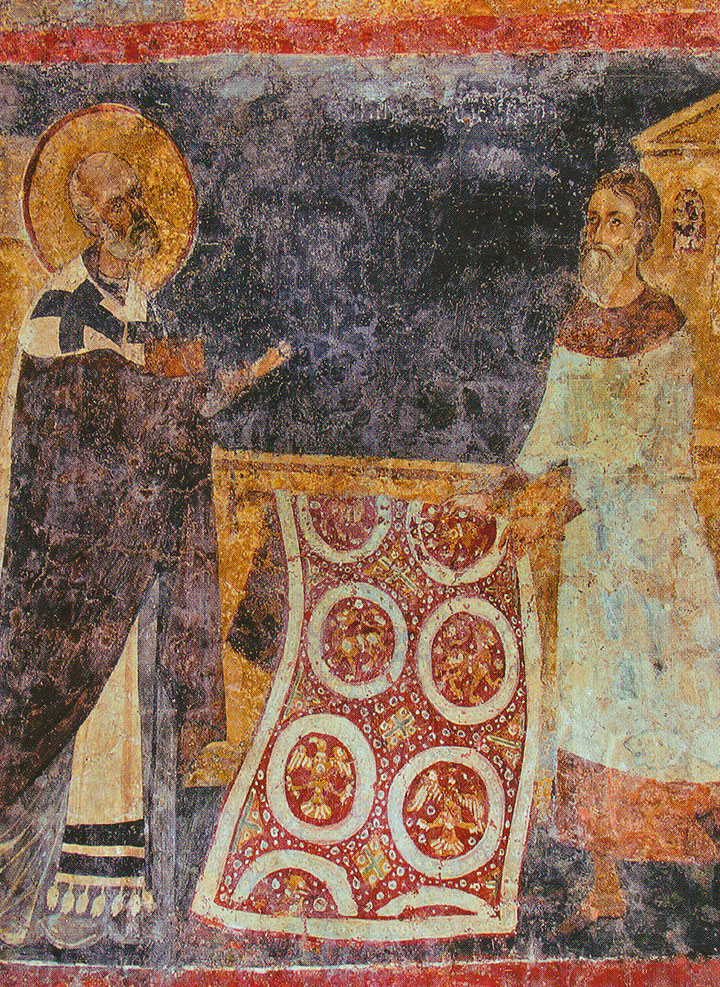
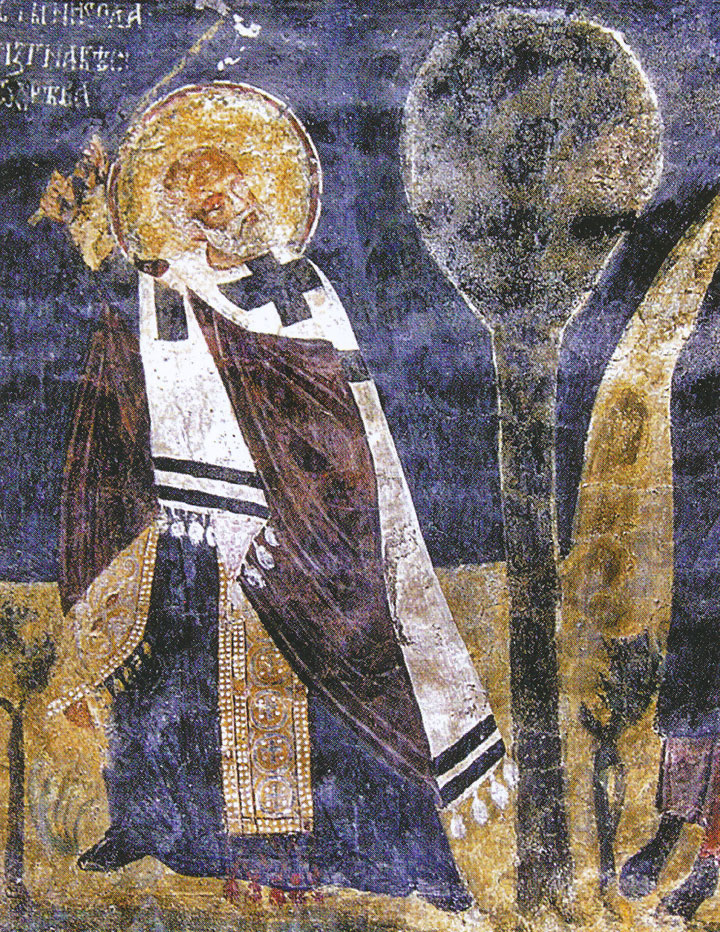
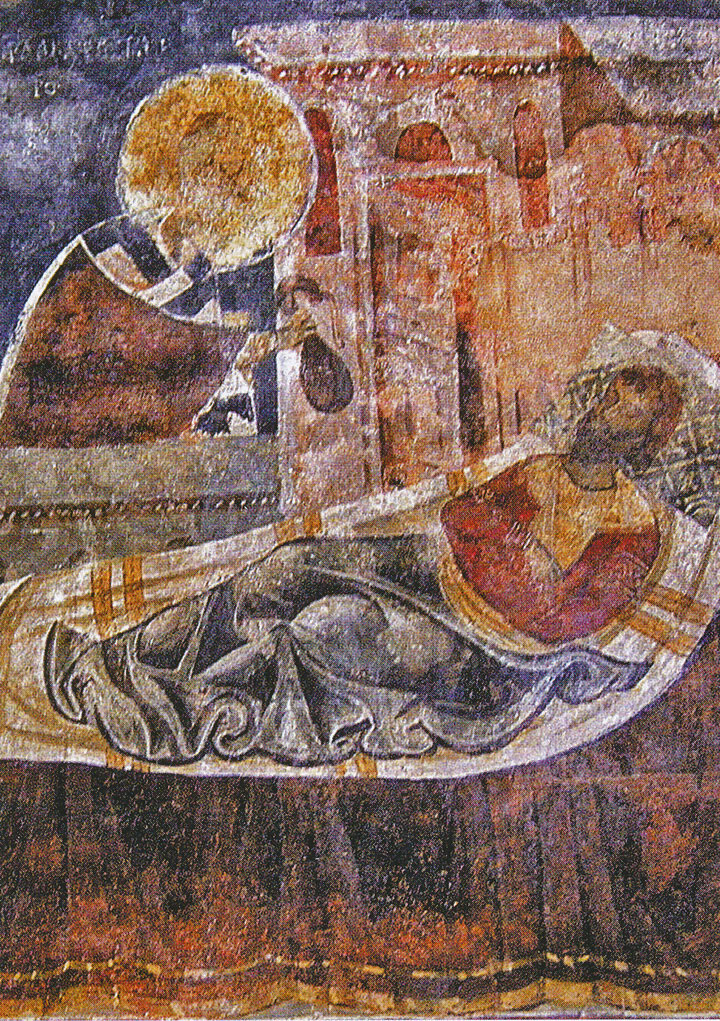
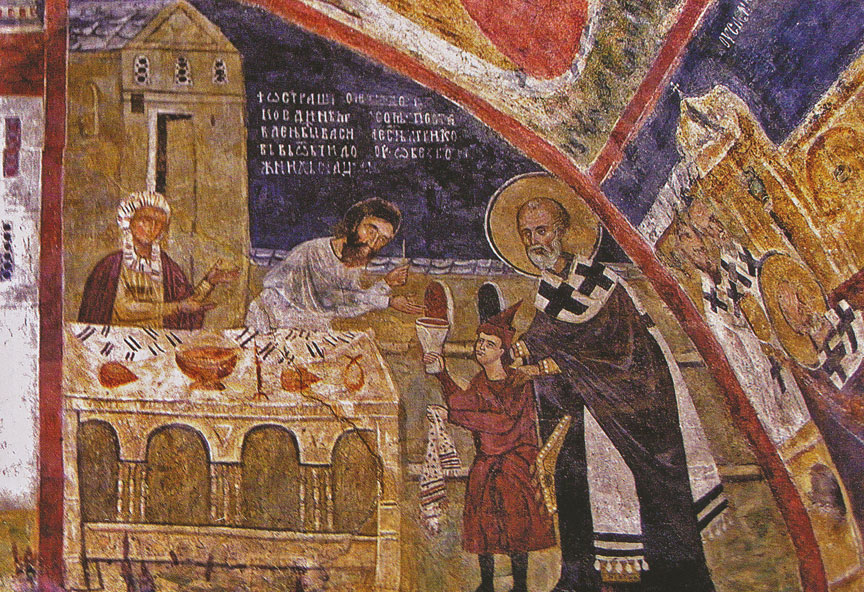
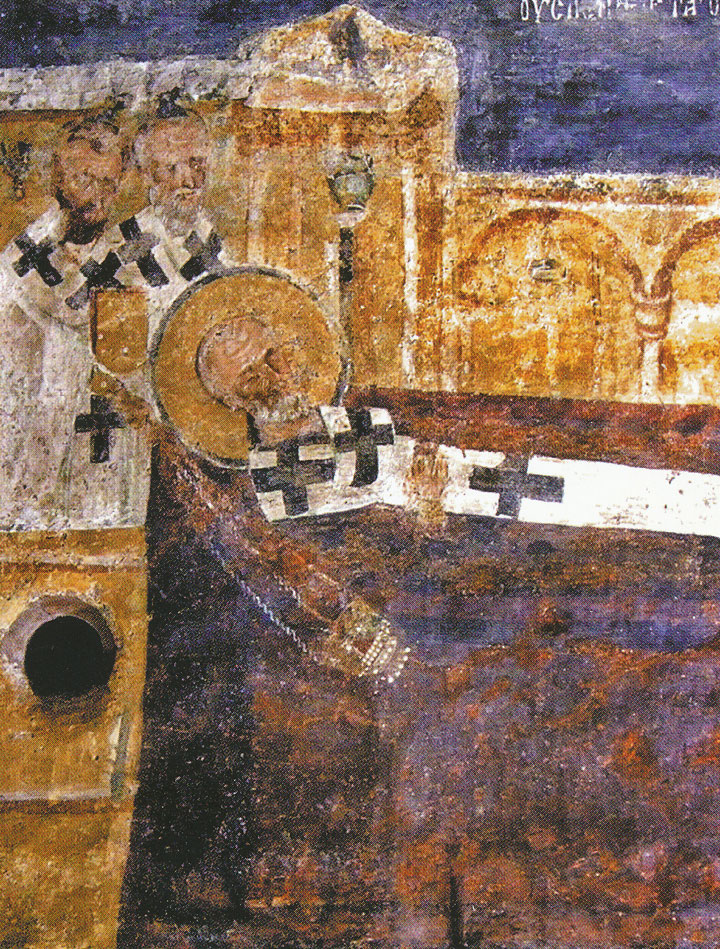
To mark St Nicholas' day John Dillon posted the following piece on the Medieval religion discussion group, into which I have pasted Gordon Plumb's post of stained glass representations of the saint
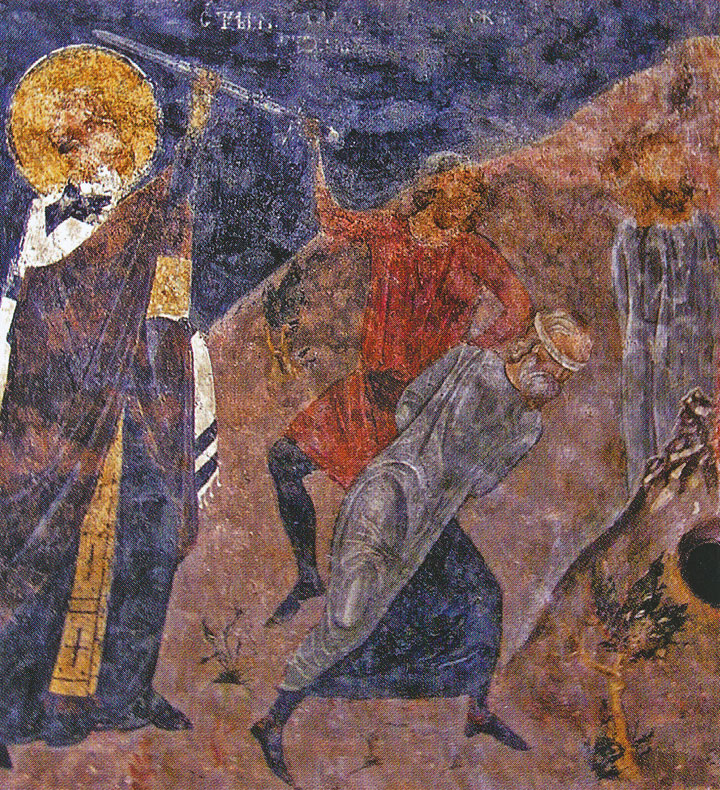
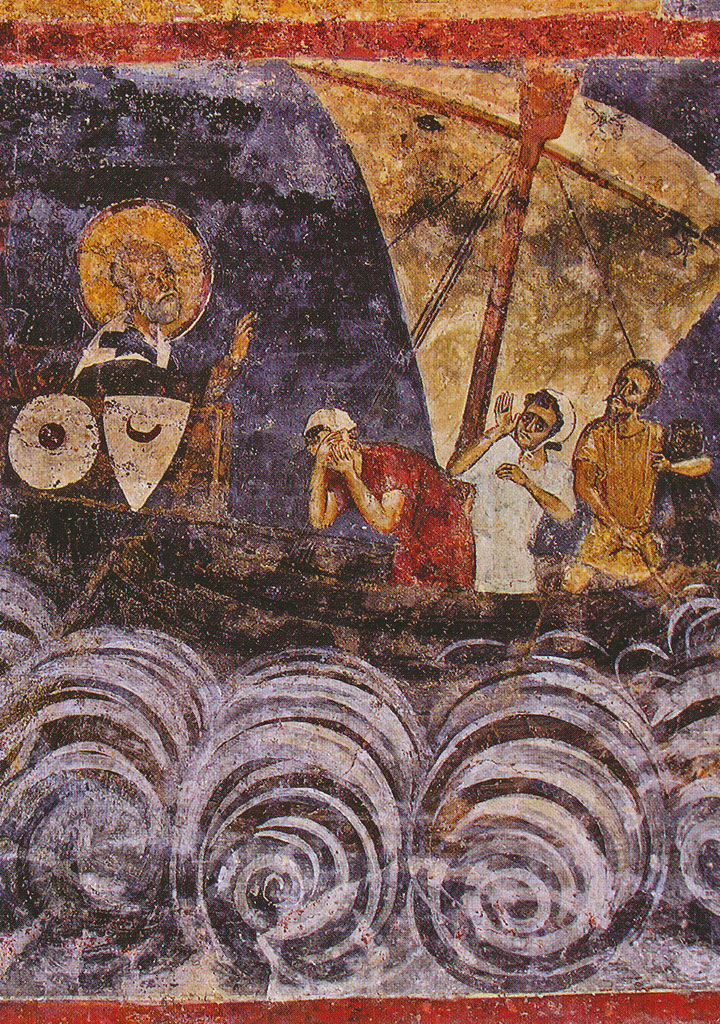
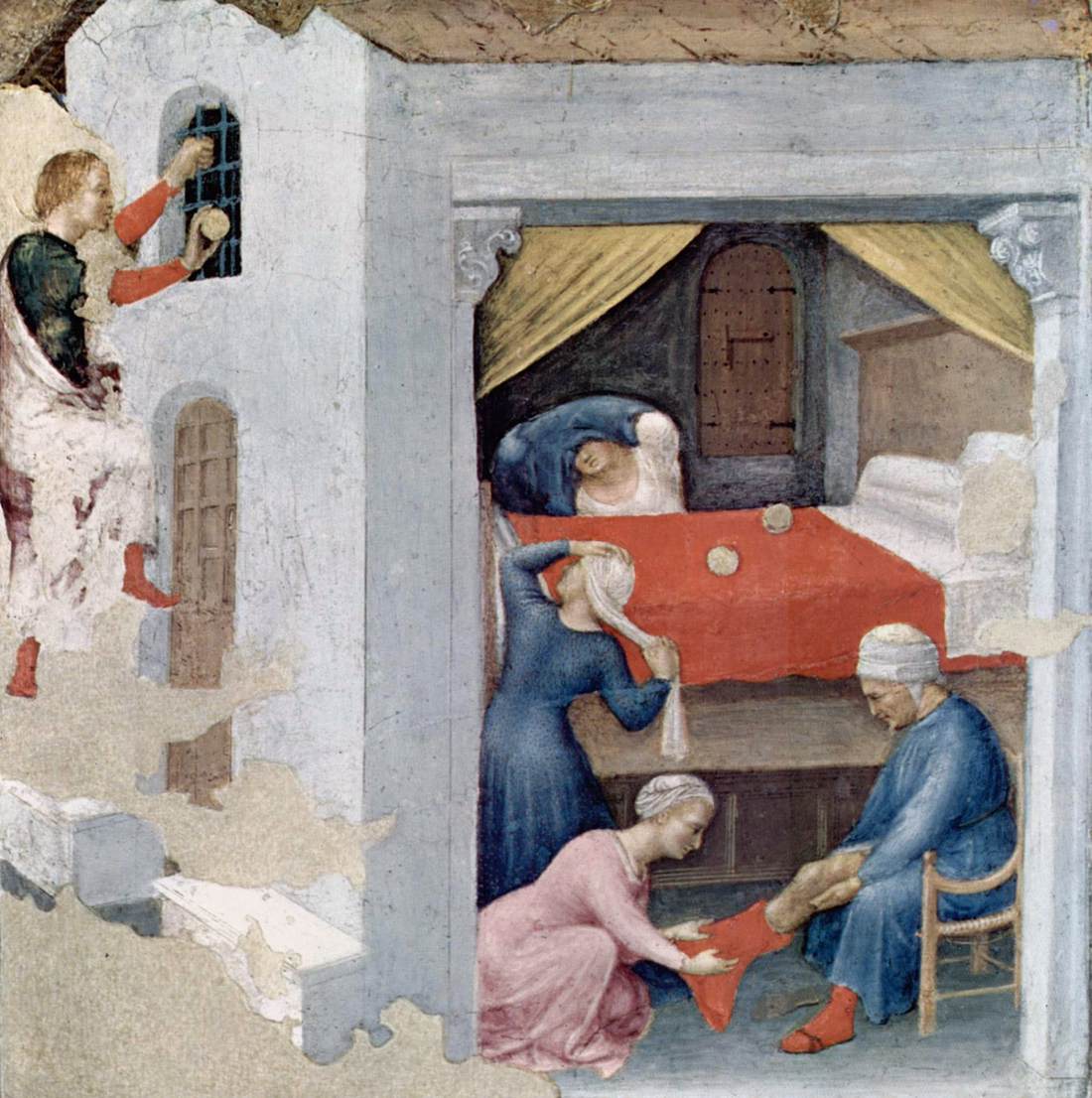
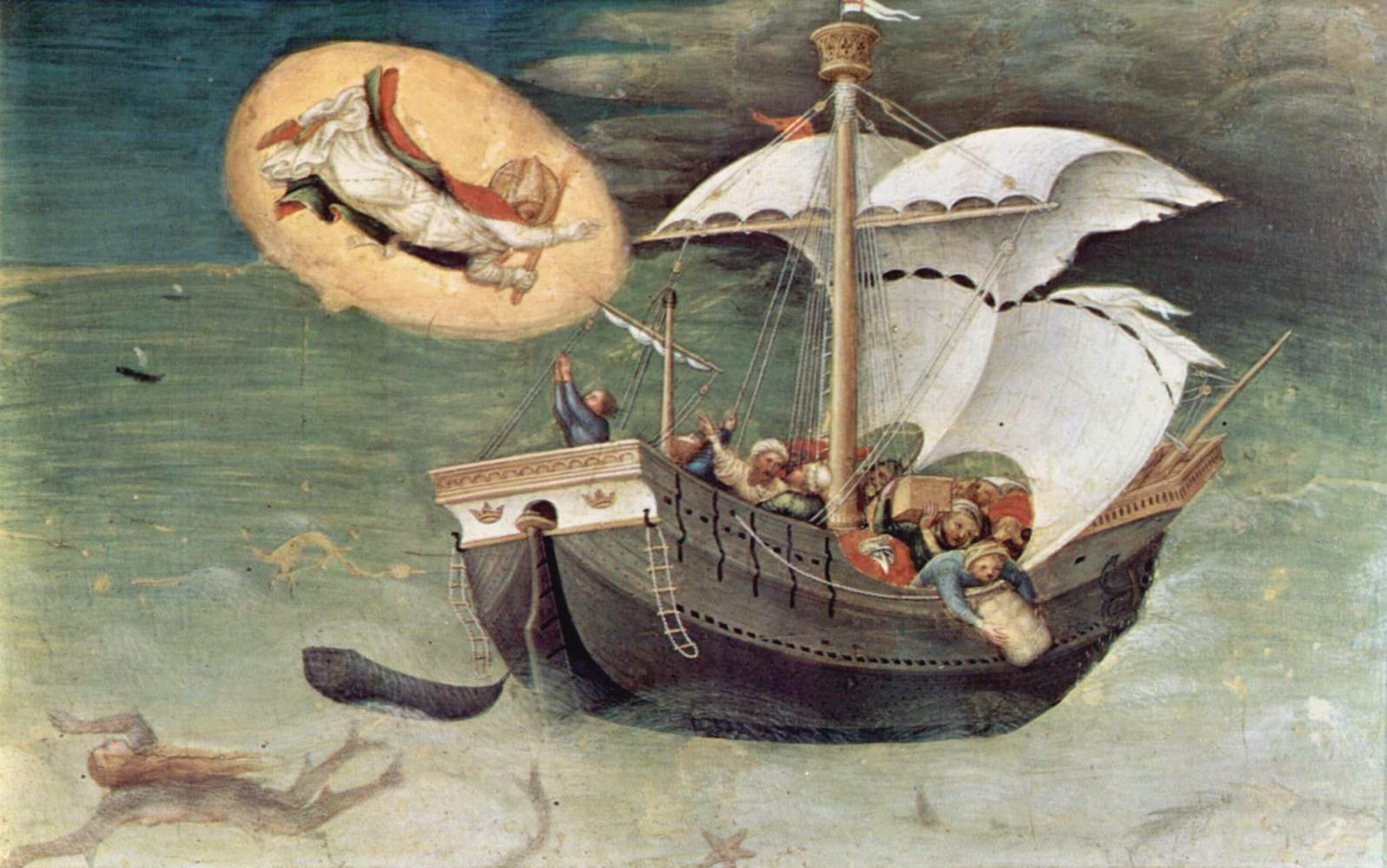
Virtually nothing is known about the historical Nicholas of Myra (d. earlier 4th cent. ?). What gives him a question mark after "4th cent." instead of the "supposedly" one would use for, e.g., the likewise at least very largely legendary St. Panteleimon / Pantaleon of Nicomedia and St. Blasius / Blaise of Sebaste is the presence of bishop Nicholas of Myra in the longer lists of participants in the First Ecumenical Council. Were it certain that Nicholas was among those at Nicaea in 325, as opposed to having been added later when legend had made him a contemporary of St. Constantine I, one could dispense with the question mark altogether. But that would still leave us with a dearth of reliable information about this person's earthly life. While the earliest testimonies both for the existence of his cult at Myra and elsewhere and for his popular construction as a holy man and thaumaturge come from the sixth century, his earliest comprehensive Bios (BHG 1348) and earliest Vita (BHL 6104-6109) seemingly appear only the ninth century (some would date BHG 1348 to the eighth century). These, though they depend ultimately on a source with some knowledge of late antique Myra, are already very largely legendary in character, including such well-known tales as the saving of three condemned soldiers, the providing of dowries for three destitute daughters, and the saving of storm-tossed seamen.
In the tenth century Nicholas' Bios by St. Symeon Metaphrastes (BHG 1349) added other matter, including miracles drawn from the Bios of the earlier sixth-century St. Nicholas of Sion. At this point Nicholas' cult was widespread both in the Greek-speaking world and in places importantly influenced from it. Seemingly new legends continued to spring up: three that are thought to be of "Western" origin are those of the barbarian (later, the Jew) with an icon of Nicholas, of Nicholas reviving three pickled students, and of Nicholas and the boy with the golden cup. In lands that were liturgically Latin Nicholas' cult was to varying degrees already established before his translation to Bari in 1087. But the latter certainly brought him a considerable increase in popularity. In short order he was one of the great saints of Christianity in general.
An illustrated, English-language page on Nicholas' relics:
http://www.stnicholascenter.org/pages/relics/
An illustrated, English-language page on the examinations in the 1950s of the relics at Bari believed to be those of Nicholas:
http://www.stnicholascenter.org/Brix?pageID=943
By way of supplement to Gordon Plumb's posts of earlier today of medieval stained glass depictions:
York Minster, SXXVIII, panel of miracle of St Nicholas, c.1180:
https://www.flickr.com/photos/22274117@N08/3052665759
Chartres, Cathédrale Notre Dame, Bay 39, Life of St Nicholas, a set of images, c.1210-15:
https://www.flickr.com/photos/22274117@N08/albums/72157606508944155
Bourges, Cathédrale Saint-Étienne, Bay 19, St Nicholas window, a set of images, c.1210-15:
https://www.flickr.com/photos/22274117@N08/albums/72157623037192023
Rouen, Cathédrale Notre Dame, Bay 51, a few Nicholas images amongst others, c. 1200-1210:
Birth of Nicholas:
https://www.flickr.com/photos/22274117@N08/15099582913
infant Nicholas refuses breast of mother:
https://www.flickr.com/photos/22274117@N08/15099014864
Nicholas consecrated bishop:
https://www.flickr.com/photos/22274117@N08/15533551768
butcher welcomes three young men:
https://www.flickr.com/photos/22274117@N08/15533791827
butcher murders three young men:
https://www.flickr.com/photos/22274117@N08/15718986445
Jew entrusts his treasure into protection of Nicholas:
https://www.flickr.com/photos/22274117@N08/15534129220
Jew beats statue of Nicholas after treasure stolen:
https://www.flickr.com/photos/22274117@N08/15533547388
Lincoln Cathedral, sXXIX, three scenes from miracles of Nicholas, c.1230:
sXXIX.2, Nicholas stilling storm:
https://www.flickr.com/photos/22274117@N08/5458681395
sXXIX.4, miracle of butcher and the three boys brought back to life:
https://www.flickr.com/photos/22274117@N08/5459294976
sXXIX.5, story of boy with the golden cup:
https://www.flickr.com/photos/22274117@N08/5459297610
Sées Cathedral, St Nicholas Chapel, Bay 13, Nicholas scenes, glass of 1270-80:
St Nicholas provides gold to save three girls from prostitution:
https://www.flickr.com/photos/22274117@N08/4056609262
and detail of Nicholas:
https://www.flickr.com/photos/22274117@N08/4056617082
Butcher kills the three boys, illuminated by wife with candle:
https://www.flickr.com/photos/22274117@N08/4055830710
Chetwode, St Mary and St Nicholas, Buckinghamshire, sII, 1c, 14thC:
https://www.flickr.com/photos/22274117@N08/8040506444
Yarnton, St Bartholomew, Oxfordshire, nIV, A3, c.1400-1420:
https://www.flickr.com/photos/22274117@N08/2967285936
Saint Nicholas-de-Port, Lorraine, Bay 101 1a-4a, by workshop of George le Verrier, c.1508-10:
https://www.flickr.com/photos/22274117@N08/15012189374
Hillesden, All Saints, Buckinghamshire, sIV, a set of images of the window showing early 16th century scenes from the life of St Nicholas displaying Flemish influence:
https://www.flickr.com/photos/22274117@N08/albums/72157604761597066
John Dillon continues herewith links to further period-pertinent images of St. Nicolas of Myra, some probably familiar, others perhaps not:
a) as depicted (at lower left; at lower right, St. John Chrysostom) on a pair of leaves from a seventh-century encaustic triptych in the Holy Monastery of the God-trodden Mount Sinai, St. Catherine (South Sinai governorate):
b) as depicted in a tenth-century glazed ceramic icon of Byzantine origin in the Walters Art Museum, Baltimore:
http://tinyurl.com/a3cmubb
c) as depicted in the earlier eleventh-century mosaics (restored between 1953 and 1962) in the katholikon of the monastery of Hosios Loukas near Distomo in Phokis:
http://tinyurl.com/d7r8kjz
d) as depicted (at left) in an eleventh- or twelfth-century fresco in the church of the rupestrian Eski Gümüs monastery near Gümüs in Turkey's Niğde province:
http://tinyurl.com/728zxto
e) as depicted in a twelfth-century fresco in the patron niche of the church of Agios Nikolaos tis Stegis at Kakopetria (Nicosia prefecture) in the Republic of Cyprus:
http://www.mlahanas.de/Cyprus/Geo/AgiosNikolaosStegis01.jpg
f) as portrayed (three scenes from his Vita) around the curving head of the mid- or later twelfth-century ivory St. Nicholas crozier (c. 1150-1170) of French or English manufacture in the Victoria and Albert Museum, London:
St Nicholas Crozier
Winchester, England (probably)
1150 - 1170
Carved ivory
Width 11 cm x height 12 cm
Museum No. 218-1865
This crozier shows scenes relating to Jesus Christ and St Nicholas. At the end of the volute (or scroll) an angel supports the Lamb of God, a symbolic image of Christ. Its head is now missing. On the other side is the Nativity (or birth) of Christ. Angels appear to shepherds and announce Christ's birth on one side of the shaft.
The rest of the crozier shows three scenes from the Life of St Nicholas. The first scene depicts his birth. The choice of scenes suggests that the crozier was made for a bishop or abbot who was either named after the saint or in charge of a foundation dedicated to him. This crozier is one of the finest achievements of the ivory carver's art.
g) as depicted in the later twelfth-century frescoes (1164) in the church of St. Panteleimon at Gorno Nerezi (Skopje municipality) in the Former Yugoslav Republic of Macedonia:
http://tinyurl.com/hvjr5yy
Detail view:
http://tinyurl.com/op3slhf
h) as depicted, in the patron niche, in the later twelfth-century frescoes (betw. 1160 and 1190) of the church of St. Nicholas Kasnitzes in Kastoria in northwestern Greece:
http://www.flickr.com/photos/millinerd/2672308962/in/photostream/lightbox/
Detail view:
http://tinyurl.com/35q6wod
i) as depicted in the later twelfth-century frescoes (c. 1180) of the church of Agioi Anargyroi in Kastoria in northwestern Greece:
http://tinyurl.com/aag4ff7
j) as depicted (at right; at left, St. Achilles / Achillius) in the late twelfth-century frescoes (ca. 1191) in the church of St. George at Kurbinovo (Resen municipality) in the Former Yugoslav Republic of Macedonia:
http://tinyurl.com/paehsta
Detail view (Nicholas):
http://tinyurl.com/hw3vfr8
k) as depicted in a twelfth- or thirteenth-century fresco in the church of St. Peter (and Paul) at Stari Ras (Raška dist.) in Serbia:
http://tinyurl.com/7kjy66l
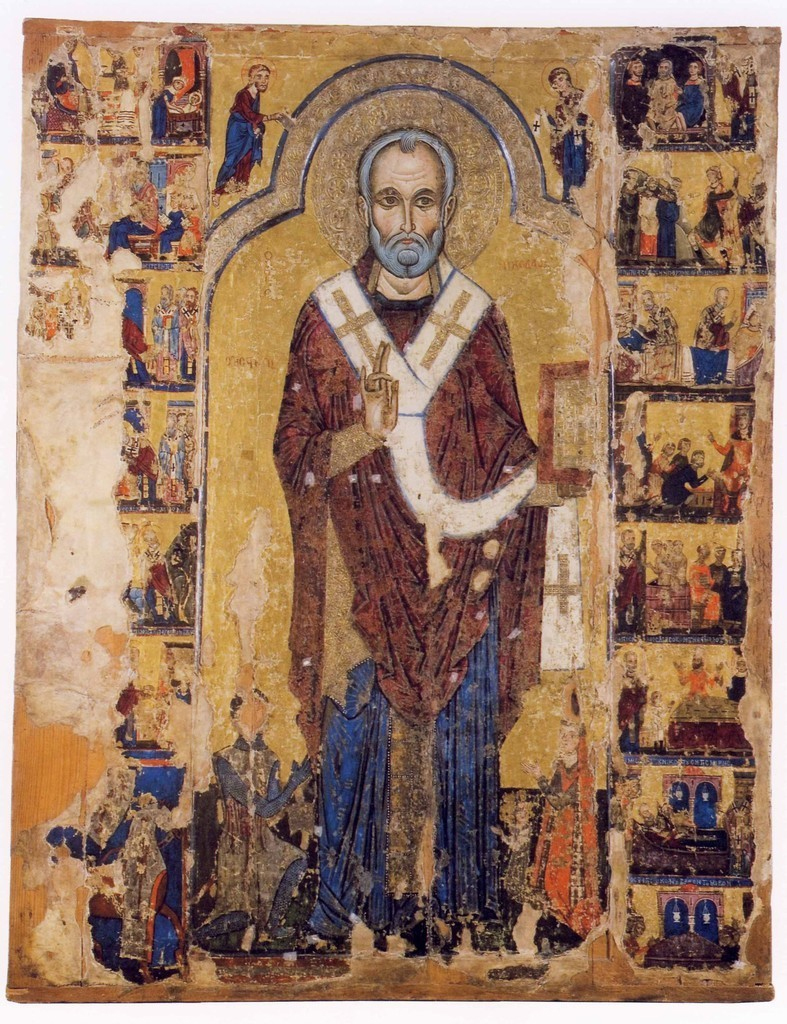
l) as depicted (with scenes from his Bios) in a late twelfth- or early thirteenth-century icon in the Holy Monastery of the God-trodden Mount Sinai, St. Catherine (South Sinai governorate):
http://tinyurl.com/aear2s2
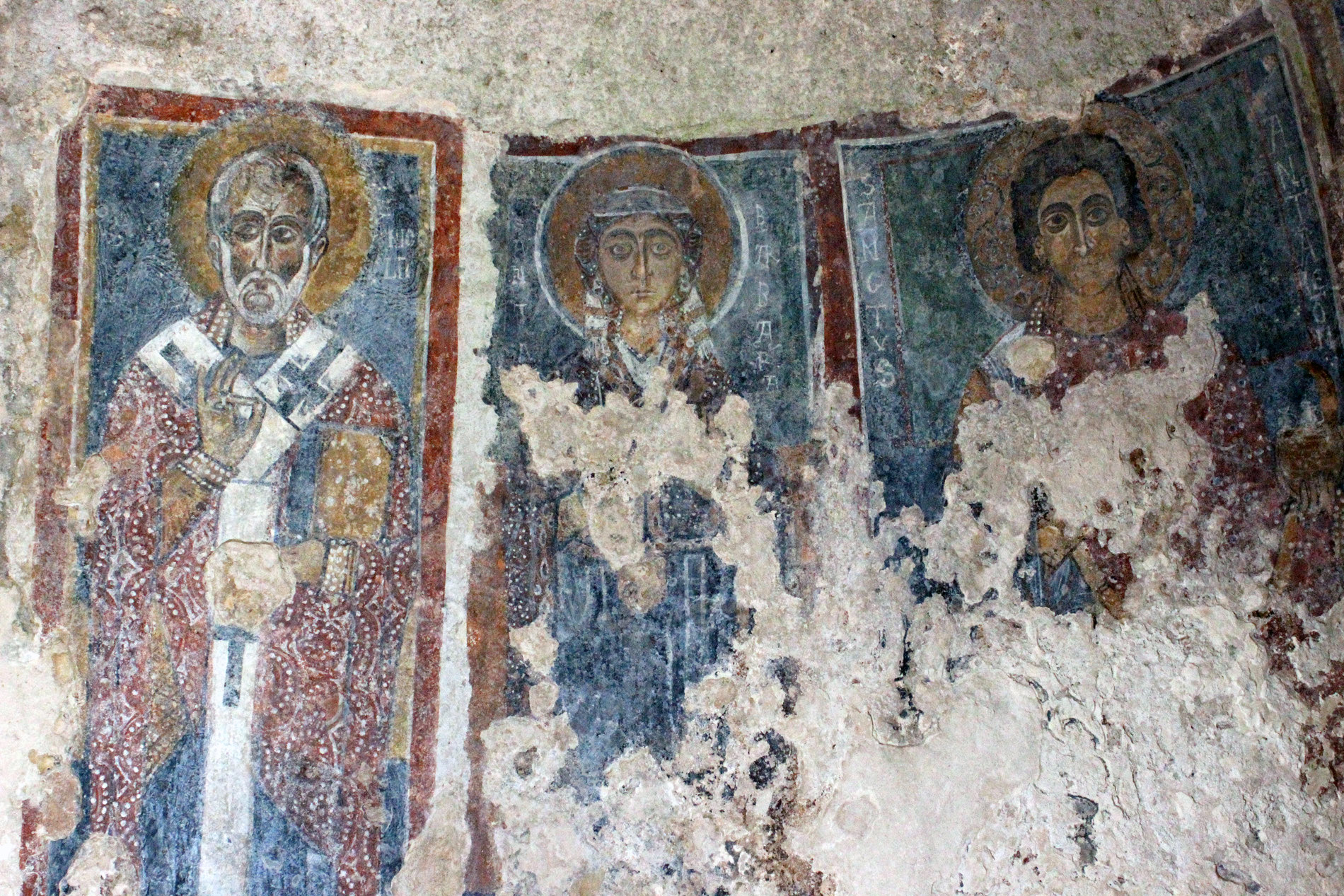
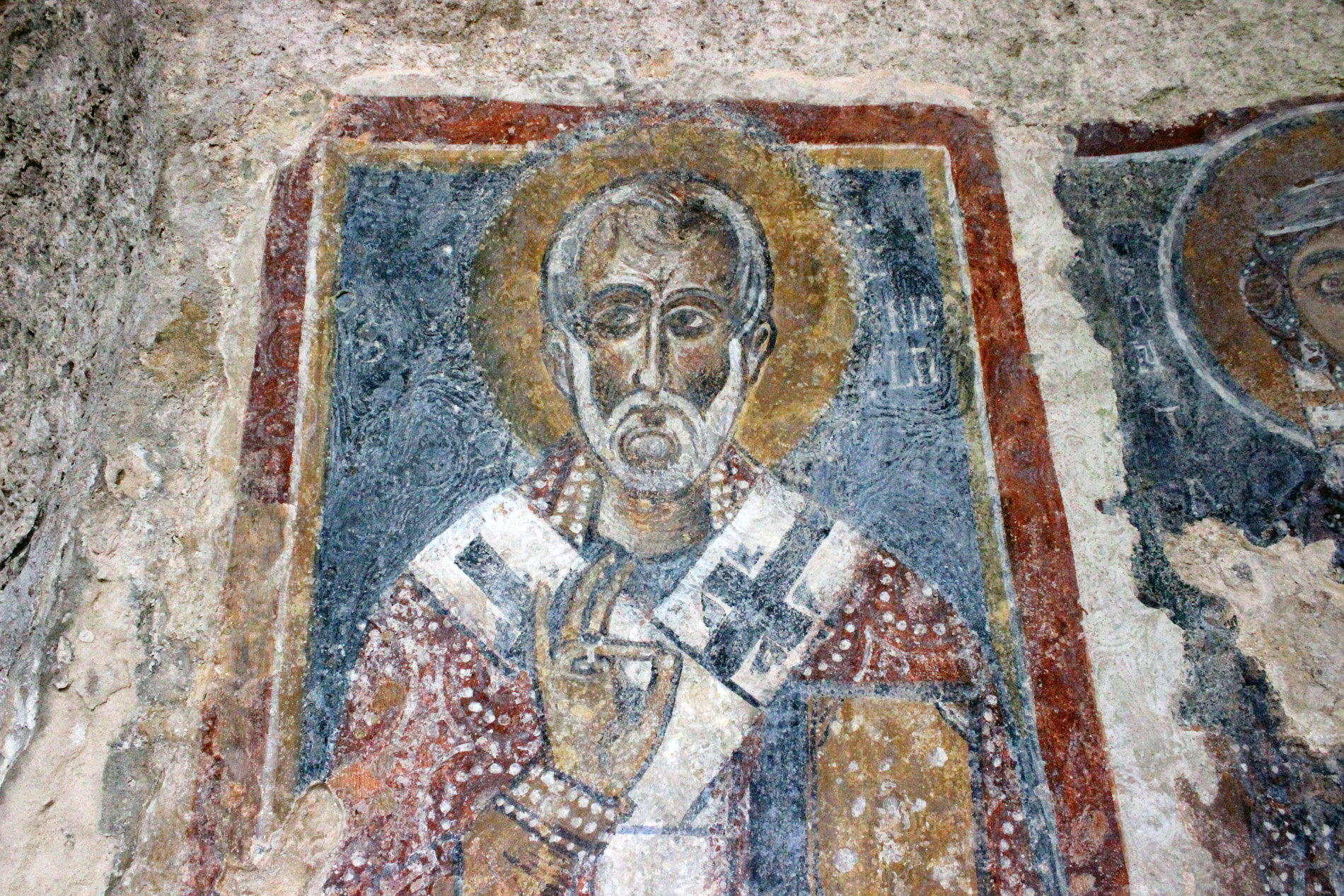
m) as depicted (at left; at centre, St. Barbara; at right, St. Panteleimon) in a thirteenth-century fresco in the rupestrian chiesa di San Nicola dei Greci in Matera:
Detail view (Nicholas):
n) as depicted (at centre; below and to the right, St. Lawrence of Rome) in a thirteenth-century wall painting in Hejdeby kyrka in Hejdeby (Gotlands län):
o) Nicholas as in the earlier thirteenth-century frescoes (1230s) in the narthex of the church of the Ascension in the Mileševa monastery near Prijepolje (Zlatibor dist.) in Serbia:
http://tinyurl.com/bx4cm3f
Detail view:
http://tinyurl.com/a37kwwr
p) as depicted on a seemingly earlier to mid-thirteenth-century map of the Mediterranean (c. 1234-1266; Lyon, Bibliothèque municipale, ms. 175, sheet 8):
q) as depicted (fifteen miracle scenes) in the earlier to mid-thirteenth-century St. Eligius and St. Nicholas window (w. 18; c. 1235-1250) in the cathédrale Saint-Étienne in Auxerre:
http://therosewindow.com/pilot/Auxerre/w18.htm
r) as depicted (reviving the three pickled students) in a mid-thirteenth-century psalter for the Use of Reims (Carpentras, Bibliothèque municipale Inguimbertine, ms. 77, fol. 176v):
http://www.enluminures.culture.fr/Wave/savimage/enlumine/irht4/IRHT_073118-p.jpg
s) as depicted in a mid-thirteenth-century Novgorod School now in the State Russian Museum in Saint Petersburg:
http://www.icon-art.info/masterpiece.php?lng=en&mst_id=446
t) Nicholas as depicted in the mid-thirteenth-century frescoes (1259) in the church of Sts. Nicholas and Panteleimon at Boyana near the Bulgarian capital of Sofia:
http://galenf.com/Bulgaria/36/bu_0015.jpg
http://tinyurl.com/d5sdgmf
This fresco's position in the church:
http://www.flickr.com/photos/vintagedept/4967294741/lightbox/
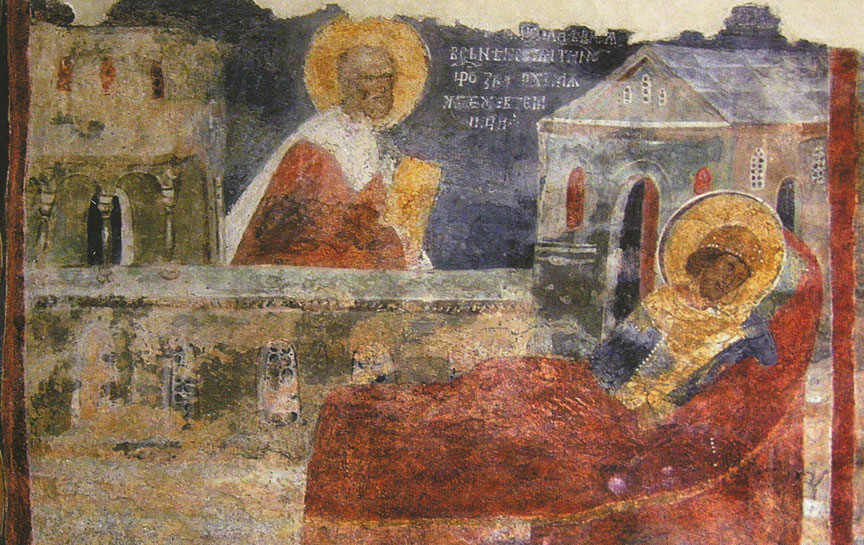
Another portrait of Nicholas and scenes from his Bios in the same mid-thirteenth-century frescoes in this church:
http://galenf.com/Bulgaria/36/bu_0011a.jpg
http://galenf.com/Bulgaria/36/bu_0011b.jpg
http://galenf.com/Bulgaria/36/bu_0012.jpg
http://galenf.com/Bulgaria/36/bu_0012a.jpg
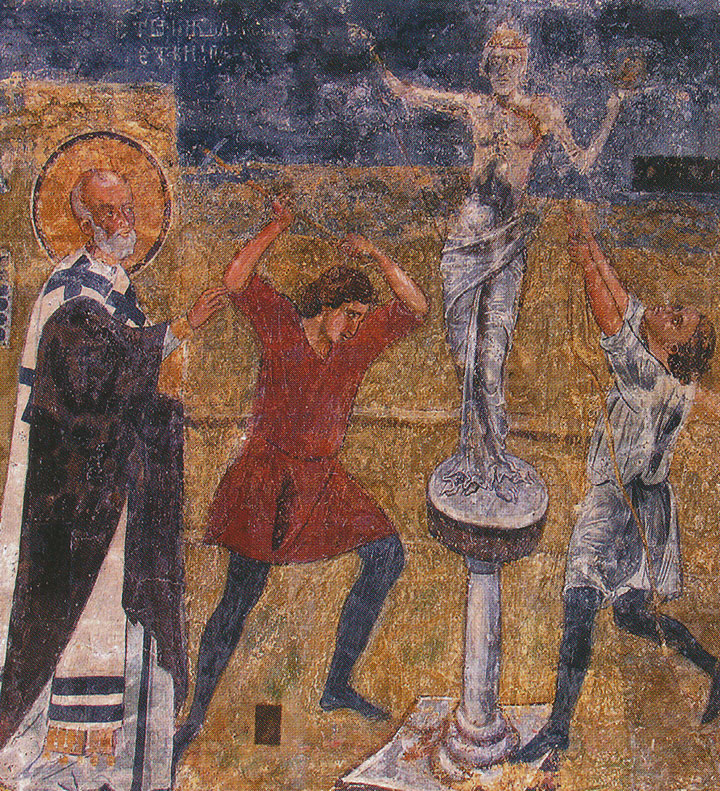
http://galenf.com/Bulgaria/36/bu_0012b.jpg [the idol is that of Artemis / Diana]
http://galenf.com/Bulgaria/36/bu_0013.jpg
http://galenf.com/Bulgaria/36/bu_0013a.jpg
http://galenf.com/Bulgaria/36/bu_0013b.jpg
http://galenf.com/Bulgaria/36/bu_0014c.jpg
http://galenf.com/Bulgaria/36/bu_0014.jpg
http://galenf.com/Bulgaria/36/bu_0011.jpg
http://galenf.com/Bulgaria/36/bu_0014b.jpg
u) as depicted in a later thirteenth-century fresco (between c. 1263 and 1270 or slightly later) in the chapel of St. Symeon Nemanja in the monastery church of the Holy Trinity at Sopoćani (Raška dist.) in Serbia:
http://tinyurl.com/cergvfa
v) as depicted (lower register) in a later thirteenth-century fresco (between 1263 and 1270 or slightly later) in the chapel of St. George in the monastery church of the Holy Trinity at Sopoćani (Raška dist.) in Serbia:
http://tinyurl.com/6lpm895
w) as depicted (standing, with scenes from his Bios) in a late thirteenth-century icon from the church of Agios Nikolaos tis Stegis at Kakopetria in the Republic of Cyprus, now in the Byzantine Museum of the Archbishop Makarios III Foundation, Nicosia:
http://www.noteartistiche.it/traduzioni/files/nicola_kacopedia.jpg
x) as depicted (reviving the three pickled students) in a late thirteenth-century copy of French origin of the
Legenda aurea (San Marino, CA, Huntington Library, ms. HM 3027, fol.1r:
http://digitalassets.lib.berkeley.edu/ds/huntington/images//000849A.jpg
y) as depicted (providing dowries for the three destitute daughters) in the late thirteenth-century Livre d'images de Madame Marie (ca. 1285-1290; Paris, BnF, ms. Nouvelle acquisition française 16251, fol. 90v):
http://tinyurl.com/262f2jt
z) as depicted in a late thirteenth-century icon (1294; from the church of St. Nicholas on Lipnya in Veliky Novgorod) in the Novgorod State United Museum:
http://tinyurl.com/28wxm65
aa) as depicted in the late thirteenth-century frescoes (c. 1295) by Eutychios and Michael Astrapas in the church of the Peribleptos (now Sv. Kliment Ohridski) in Ohrid:
http://tinyurl.com/7ar7xzb
Detail view:
http://tinyurl.com/na282ae
bb) as depicted in a late thirteenth- or very early fourteenth-century fresco in the church of the Holy Apostles in the Patriarchate of Peć at Peć in, depending upon one's view of the matter, either the Republic of Kosovo or Serbia's province of Kosovo and Metohija:
http://tinyurl.com/y8wqrl7
cc) as depicted in a late thirteenth or very early fourteenth-century fresco, attributed to Manuel Panselinos, in the bema of the Protaton church on Mt. Athos:
https://www.stnicholascenter.org/galleries/gallery/5657/
dd) as depicted (three scenes from his Vita) in the very late thirteenth- or very early fourteenth-century frescoes (c. 1300-1301), attributed to Guido di Palmerino, in the cappella di San Nicola in the lower church of the basilica di San Francesco in Assisi:
1) providing dowries for the three destitute daughters:
2) halting the execution of the three soldiers:
3) forgiving the corrupt magistrate at Myra:
ee) as portrayed (standing, plus scenes from his Vita) on a fourteenth century relief mounted on the exterior of the basilica di San Nicola in Bari:
http://tinyurl.com/jnolx59
ff) as depicted (at left) in an early fourteenth-century fresco in the apse of the right transept of the basilica di San Nicola in Bari:
http://www.pbase.com/querido/image/50660484
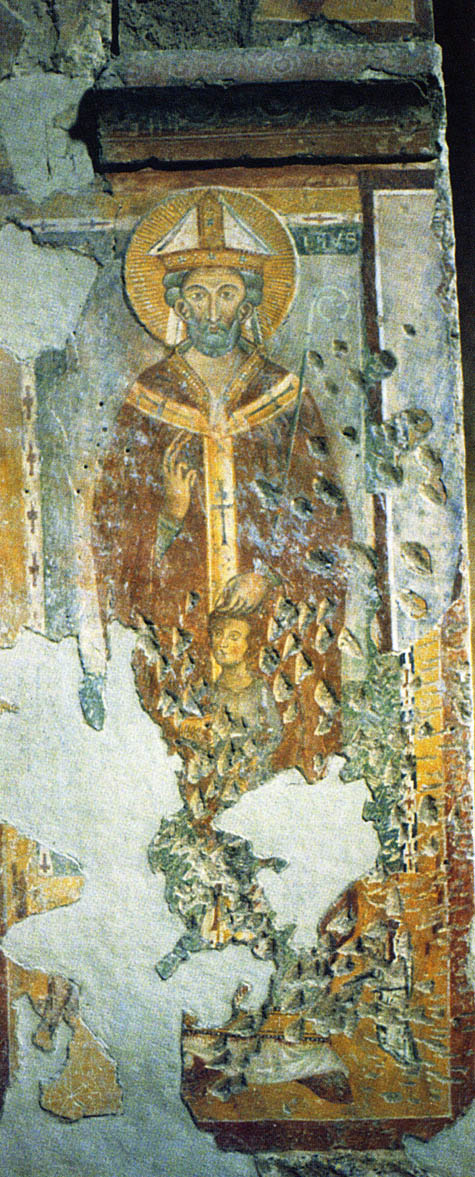
gg) as depicted (with the boy with the golden cup) in an early fourteenth-century fresco in the rupestrian chiesa di Santa Maria delle Grotte in Rocchetta a Volturno (IS) in Molise:
Detail view (Nicholas):
hh) as depicted in the earlier fourteenth-century frescoes (between c. 1308 and c. 1320) by Michael Astrapas and Eutychios in the church of St. Nicetas the Goth (Sv. Nikita) at Čučer in today's Čučer-Sandevo in the Former Yugoslav Republic of Macedonia:
http://tinyurl.com/hwmgp8d
Detail view:
https://plus.google.com/photos/110067756467697073060/album/5245719451287580257/5245728971001399346
ii) as depicted (scenes from his Bios) in the earlier fourteenth-century frescoes (between c. 1311 and c. 1322) in the church of St. Nicholas Orphanos in Thessaloniki:
http://tinyurl.com/6veqz5c
http://tinyurl.com/74xgadu
http://tinyurl.com/7lnggfe
http://tinyurl.com/bw7r4n8
http://tinyurl.com/cwkvo8h
http://tinyurl.com/czvqzta
http://tinyurl.com/7becpxb
http://tinyurl.com/7r75n56
Nicholas' badly degraded portrait next to the door below those frescoes:
http://tinyurl.com/7svfqqb
jj) as depicted (at lower right) by Simone Martini in an earlier fourteenth-century polyptych (betw. 1320 and 1320) in the Fitzwilliam Museum in Cambridge:
Detail view (Nicholas):
kk) as depicted (providing dowries for the three destitute daughters) in an earlier fourteenth-century copy of the
Legenda aurea in its French-language version by Jean de Vignay (c. 1326-1350; Paris, BnF, ms. Français 185, fol. 143r):
http://tinyurl.com/2bovzh4
ll) as depicted in an earlier fourteenth-century icon donated to the church of St. Nicholas in Bari by the Serbian Tsar Stefan Uroš IV Dušan in 1327:
On the left is the icon, and on the right it is shown with its silver riza
Detail view:
mm) as depicted (his birth) in an earlier fourteenth-century French-language legendary of Parisian origin with illuminations attributed to the Fauvel Master (c. 1327; Paris, BnF, ms. Français 183, fol. 141v):
http://tinyurl.com/2fnf2zx
nn) as depicted in the earlier fourteenth-century frescoes (1330s) in the apse of the church of the Hodegetria in the Patriarchate of Peć at Peć in, depending on one's view of the matter, either the Republic of Kosovo or Serbia's province of Kosovo and Metohija:
http://tinyurl.com/yzb6xly
oo) as depicted in the earlier fourteenth-century frescoes (betw. 1335 and 1350) in the nave of the church of the Holy Ascension at the Visoki Dečani monastery near Peć in, depending on one's view of the matter, either the Republic of Kosovo or Serbia's province of Kosovo and Metohija:
http://tinyurl.com/2a4j82d
Detail view:
http://tinyurl.com/2bcl6qc
pp) as depicted (at right; at left, St. Sabas of Jerusalem) in a December calendar composition in the earlier fourteenth-century frescoes (between 1335 and 1350) in the narthex of the church of the Holy Ascension at the Visoki Dečani monastery near Peć in, depending upon one's view of the matter, either the Republic of Kosovo or Serbia's province of Kosovo and Metohija:
http://tinyurl.com/bszau2d
qq) as depicted (scenes from his Bios) as depicted in the earlier fourteenth-century frescoes (betw. 1335 and 1350) of the parecclesion of St. Nicholas in the church of the Holy Ascension at the Visoki Dečani monastery near Peć in, depending on one's view of the matter, either the Republic of Kosovo or Serbia's province of Kosovo and Metohija (three pages beginning here):
http://tinyurl.com/39ajslh
rr) as depicted in the mid-fourteenth-century frescoes of the monastery church of St. Michael the Archangel at Lesnovo in the Former Yugoslav Republic of Macedonia:
http://tinyurl.com/nksu8vp
Detail view:
http://tinyurl.com/pbx9hv8
ss) as depicted (with scenes from his biographies) in a later fourteenth-century Moscow School icon in the State Tretyakov Gallery in Moscow:
http://www.icon-art.info/masterpiece.php?lng=en&mst_id=443
tt) as portrayed by Frà Giovanni di Bartolomeo (a.k.a. the Master of the Magi of Fabriano) in a later fourteenth-century polychromed wooden statue in the chiesa di San Niccolò in Fabriano:
uu) as depicted (two scenes from his Bios) in the later fourteenth-century frescoes (1360s and 1370s; restored in 1968-1970) in the church of St. Demetrius in Marko's Monastery at Markova Sušica (Studeničani municipality) in the former Yugoslav Republic of Macedonia:
1) three innocent generals condemned by Constantine appeal to him:
2) his dormition:
vv) as depicted in a later fourteenth-century fresco (c. 1372) in the church of St. Michael the Archangel in the Varoš monastery in Prilep in the Former Yugoslav Republic of Macedonia:
http://tinyurl.com/z6yqnut
ww) as depicted (reviving the three pickled students) in a late fourteenth- or early fifteenth-century copy of the
Legenda aurea in its French-language version by Jean de Vignay (Rennes, Bibliothèque de Rennes Métropole, ms. 266, fol. 12v):
http://tinyurl.com/pentlf6
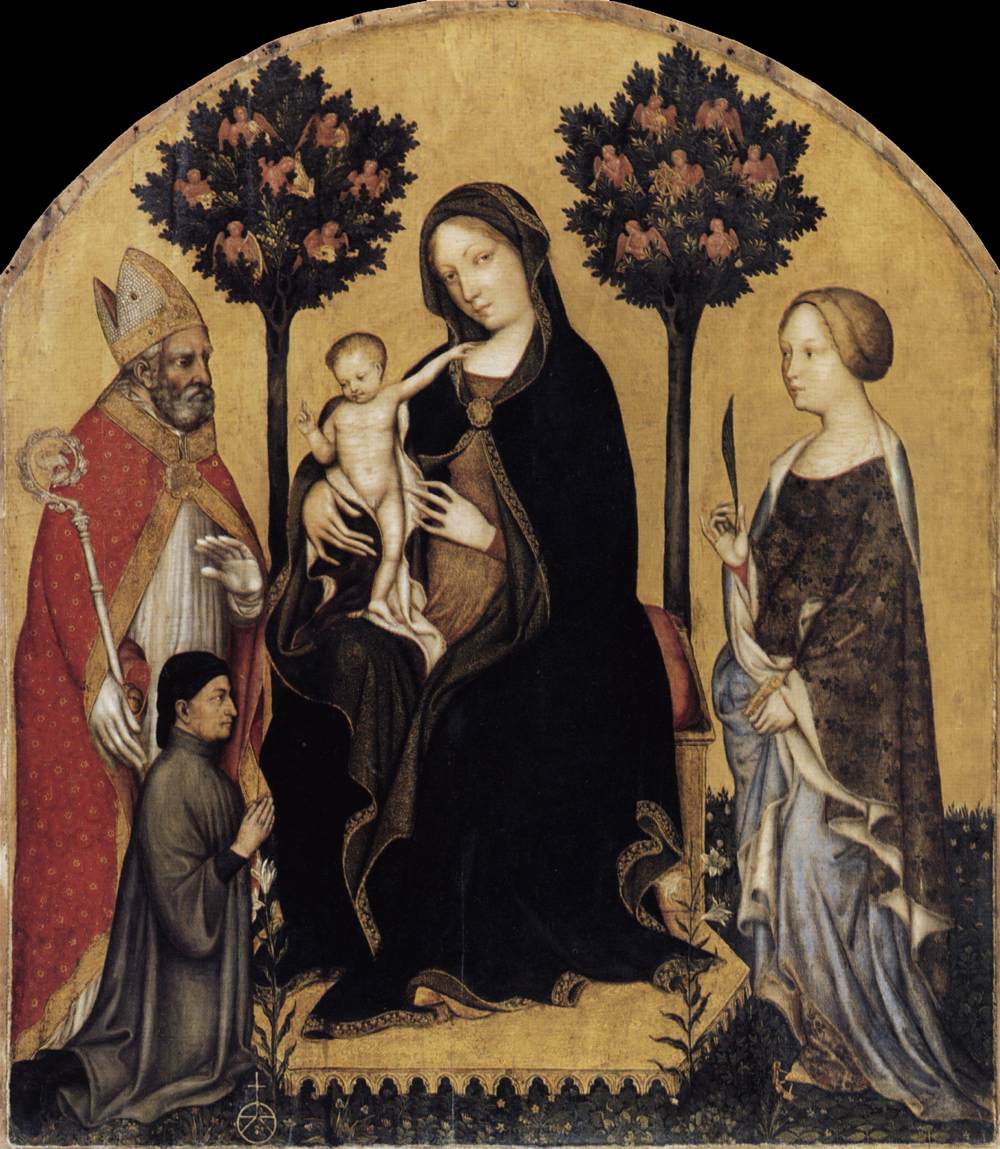
xx) as depicted by Gentile da Fabriano (at left, flanking the BVM and Christ Child; at right, St. Catherine of Alexandria) in a late fourteenth- or early fifteenth-century panel painting (c. 1395-1400 or c. 1405) in the Staatliche Museen in Berlin:
yy) as depicted in a fifteenth-century Novgorod School icon in the Karelian Fine Arts Museum in Petrozavodsk:
http://www.icon-art.info/masterpiece.php?lng=en&mst_id=2770
zz) as depicted (second from left) by Gentile da Fabriano in his dismembered earlier fifteenth-century Quaratesi polyptych (c. 1425):
1) second from left in a panel from the main structure in Galleria degli Uffizi in Florence :
2) four predella panels (scenes) in the Pinacoteca Vaticana:
Overview:
http://mv.vatican.va/3_EN/pages/PIN/PIN_Sala02_02.html
Dowries for the three destitute daughters:
Saving storm-tossed seamen:
Reviving the three pickled students:
aaa) as depicted by Beato Angelico in an earlier fifteenth-century panel painting (c. 1425-1430) in the Arp Museum Bahnhof Rolandseck, Remagen:
bbb) as depicted (reviving the three pickled students) in the earlier fifteenth-century Hours of Marguerite d'Orléans (Paris, BnF, ms. Latin 1156 B, fol. 172r):
http://tinyurl.com/3322ur8
ccc) as depicted (two scenes from his Vita) by Johann of Laibach the son of Friedrich of Villach in the mid-fifteenth-century frescoes (1443) in the cerkev sv. Nikolaja in Visoko pod Kureščkom, Slovenia:
1) halting the execution of the three soldiers:
2) saving storm-tossed seamen:
ddd) as depicted (at right; at left, St. Ulrich) by the Master of Liefering in a later fifteenth-century panel painting (c. 1460-1470; from a dismembered altarpiece) in the Pfarrkirche Liefering (Heilige Petrus und Paulus) in Salzburg-Liefering:
eee) as depicted (scenes from his Vita) in a later fifteenth-century copy (1463) of Vincent of Beauvais'
Speculum historiale in its French-language version by Jean de Vignay (Paris, BnF, ms. Français 51, fols. 117v, 118r, 119r, 121r, 122r):
http://tinyurl.com/36fgjjt
http://tinyurl.com/37wdb45
http://tinyurl.com/2vbe4gt
http://tinyurl.com/3y37c7a
http://tinyurl.com/32v9g3b
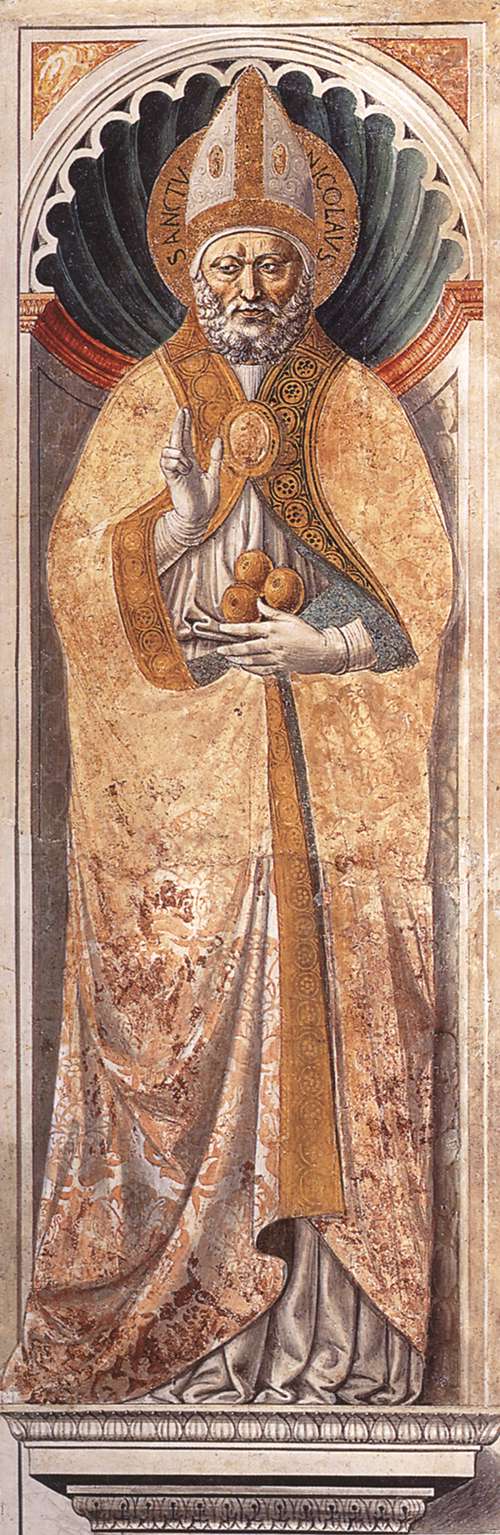
fff) as depicted by Benozzo Gozzoli in a later fifteenth-century fresco (1465) in the apsidal chapel of the chiesa di Sant'Agostino in San Gimignano:
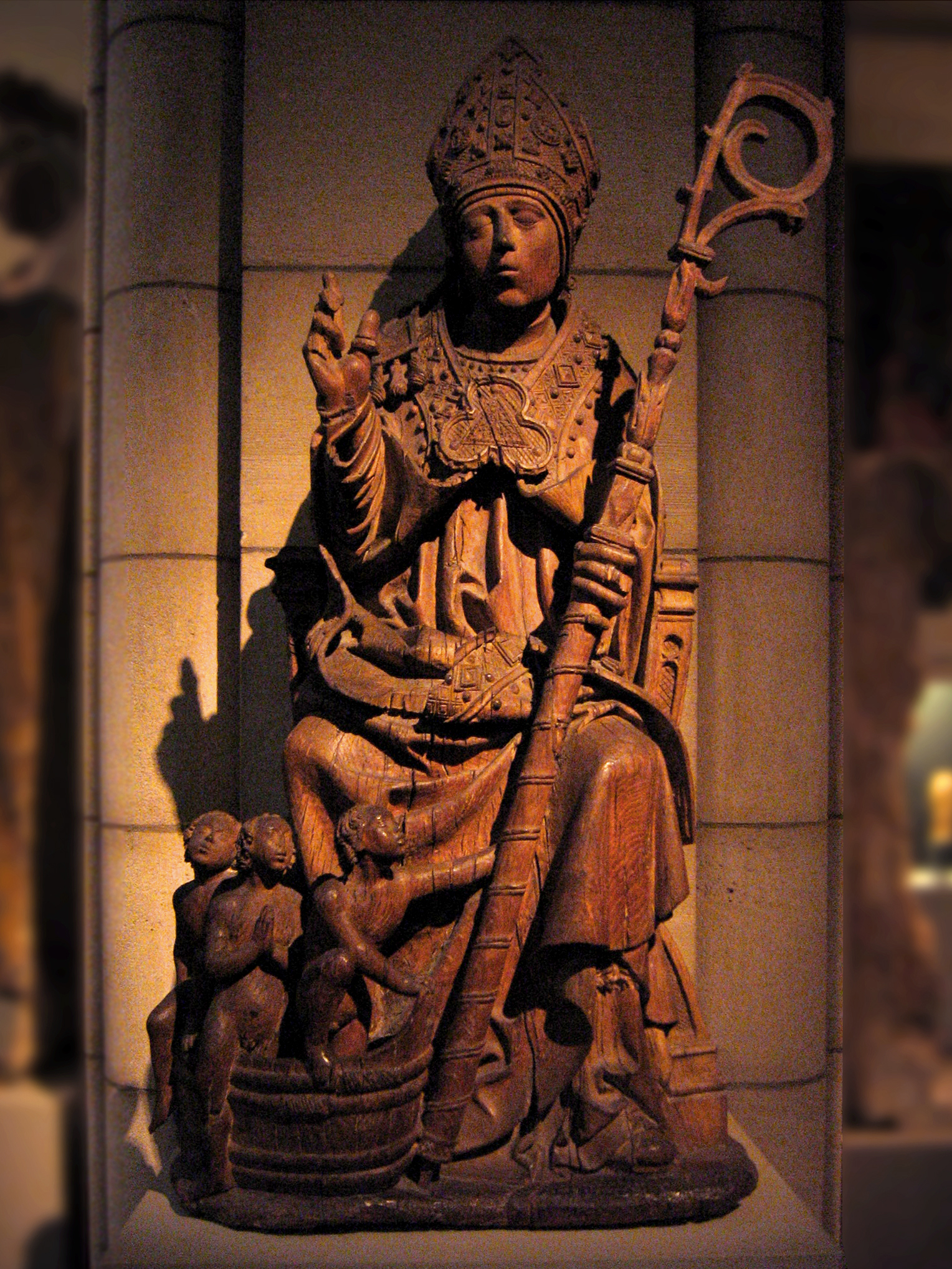
ggg) as portrayed (reviving the three pickled students) in a late fifteenth- or very early sixteenth-century wooden statue of southern Netherlandish origin now in the Metropolitan Museum of Art in New York:
hhh) as depicted in an earlier sixteenth-century Ukrainian icon from the village of Sushystya the Great (Lviv oblast):
iii) as depicted (conch portrait and scenes from his Bios) by Dionisy and sons in the early sixteenth-century frescoes (1502) in the Virgin Nativity cathedral of the St. Ferapont Belozero (Ferapontov Belozersky) monastery at Ferapontovo in Russia's Vologda oblast (expandable images on these pages):
http://www.dionisy.com/eng/museum/1195/
http://www.dionisy.com/eng/museum/1214/?frag
http://www.dionisy.com/eng/museum/1278/?frag
jjj) as depicted by Dionisy in an early sixteenth-century icon (c. 1502) in the icon museum of the Kirillo-Belozersky monastery at Goritsy in Russia's Vologda oblast:
http://tinyurl.com/cm2kpeh
Detail view:
http://tinyurl.com/dxqmhyy
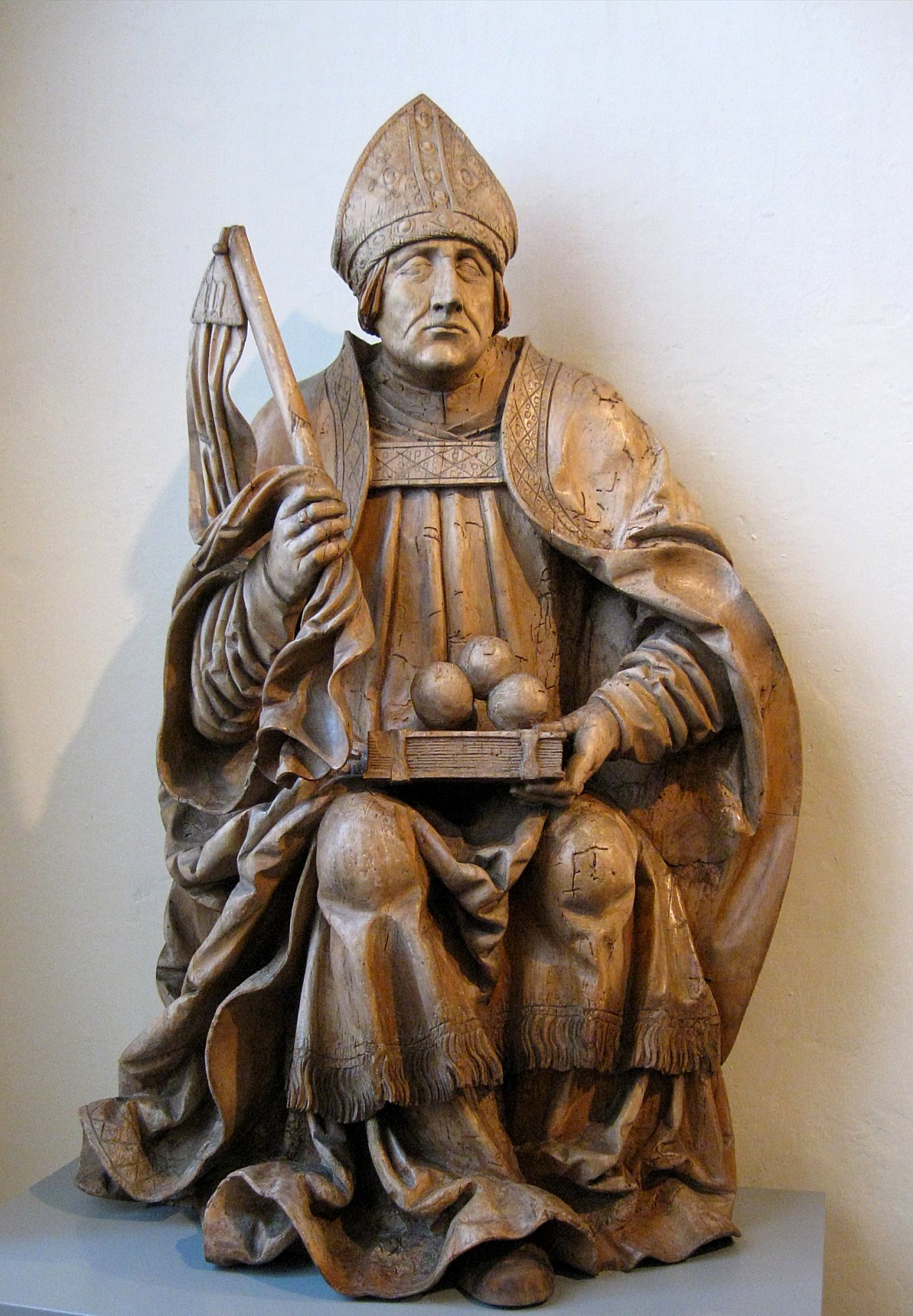
kkk) as portrayed by the Master of the Altötting Doors in an earlier sixteenth-century wooden statue (c. 1520-30; formerly polychromed) in the Bayerisches Nationalmuseum, München:
lll) as depicted by Theofanis Strelitzas-Bathas (a.k.a. Theophanes the Cretan) in the earlier sixteenth-century frescoes (1527) in the katholikon of the monastery of St. Nicholas Anapafsas in Kalambaka (Trikala regional unit) in northern Greece:
http://tinyurl.com/7sswsf6


![[7thSinaiTripWings.jpg]](https://blogger.googleusercontent.com/img/b/R29vZ2xl/AVvXsEiiER5U46m5665yDQBC0PJLsd28eMIm8FR4-AfHM1yEaCddCFy4BNZeKFiqFYSRtIei6edft9nRAXsMS-o21lI8NOkBCjThCtRFPnXtWiMMsw64nttUp2HuFDmqvenpa29Bcly0RRztLn4/s640/7thSinaiTripWings.jpg)