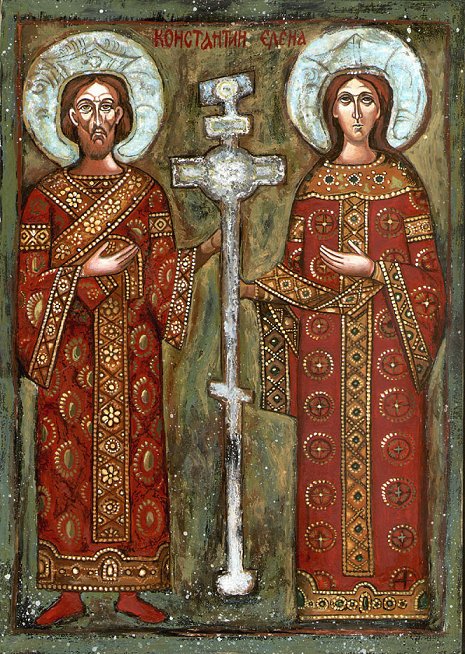
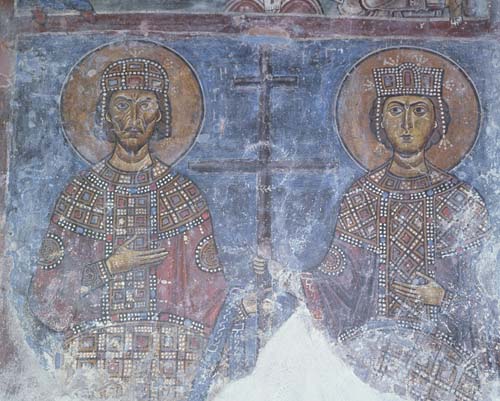
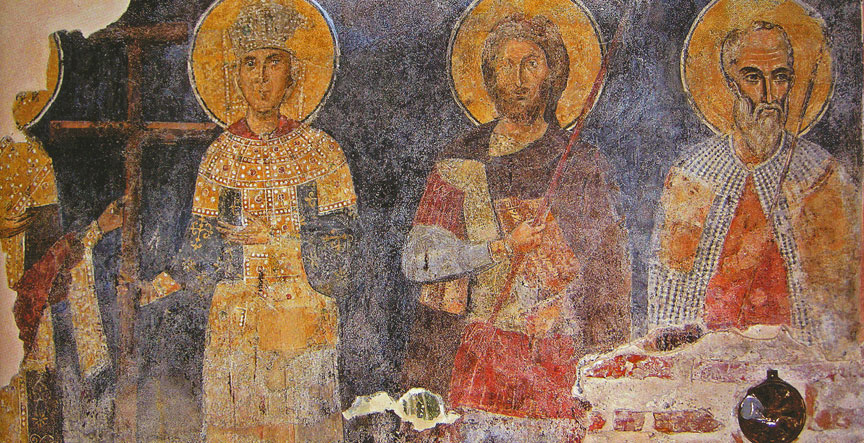
Today is the feast of St Helen, and John Dillon has again posteda selection of images of her on the Medieval Religion discussion group.Their geographical spread and wide range of dates points to the widespread devotion to her in past centuries. Slightly adapted, here is his post:
In the Roman Rite of the Roman Catholic Church, August 18th is the feast day of St. Helen, Empress. In churches that use the Byzantine Rite, in the Armenian Orthodox Church, and in churches of the Anglican Communion she is commemorated on May 21st together with her son, St. Constantine the Great.
Herewith a few earlier fourth-century images of Flavia Iulia Helena, mother of the Emperor Constantine I, followed by some more period-pertinent images of St. Helen, Empress (in her case the title is an honorific). It is not known when she converted to Christianity, or when she was baptized, or by whom. In 327 Helen made a trip to the Holy Land whose religious aspects are covered in some detail by Eusebius. Eusebius' silence about the discovery of the True Cross, first attributed to Helen in the later fourth century, permits the conclusion that she had nothing to do with the appearance of this potent relic. When viewing representations of the Finding of the True Cross in its various aspects it may be helpful to recall that Jacopo da Varazze's chapter thereon in his widely read
Legenda aurea provides two initially late antique versions of the Testing of the Three Crosses, one in which the True Cross is identified when it restores a dead youth to life and another in which such contact revivifies a woman already half dead.
a) as portrayed (probably) in the earlier fourth-century bust of an originally second-century statue in Rome's Musei Capitolini:
http://tinyurl.com/qz74ohh
Detail view (bust):
http://tinyurl.com/ojntt2j
b) as portrayed (at left) on Roman imperial coinage during her lifetime:
1) a bronze follis (318/319) struck at Thessaloniki:
http://www.wildwinds.com/coins/ric/helena/_thessalonica_RIC_048.jpg
2) a gold solidus (318/319) struck at Thessaloniki:
http://www.wildwinds.com/coins/ric/helena/_thessalonica_RIC_149.jpg
3) a fourth-century bronze follis (325/326) struck at Trier:
http://tinyurl.com/obav9yr
c) as depicted (upper left; at the Finding of the True Cross) in an earlier ninth-century compendium of canon law (ca. 825; Vercelli, Biblioteca capitolare, ms. CLXV):
http://tinyurl.com/n6qkl3
d) as depicted (bottom register, twice: enthroned and at the Finding of the True Cross) in a later ninth-century copy (between 879 and 882) of the
Orationes of St. Gregory of Nazianzus (Paris, BnF, ms. Grec 510, fol. 440r):
http://gallica.bnf.fr/ark:/12148/btv1b84522082/f891.image
The marginalium at right reads:
euresis tou timiou staurou ["finding of the Holy Cross"].
e) as portrayed in high relief (at right; at left, St. Constantine the Great) in the probably tenth-century Byzantine inner portion of a silver gilt reliquary box for a piece of the Holy Cross (staurotheke / staurotheca) in the Tesoro delle Sante Croci in the duomo vecchio of Brescia:
http://tinyurl.com/p5wzs9s
Detail view (Helen):
http://tinyurl.com/p6u2gld
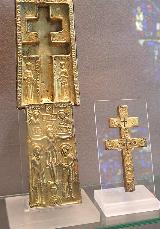
f) as portrayed in low relief (at right; at left, St. Constantine the Great) on an eleventh-century silver gilt reliquary box (staurotheca) of Byzantine inspiration but seemingly of Western origin, reportedly in the collections of the Musée du Louvre in Paris:
http://tinyurl.com/ndpxsxo
The object disassembled:
http://srg.hereses.perso.libertysurf.fr/image/reliquaire2.JPG
g) as depicted (at right; at left, St. Constantine the Great) in the earlier eleventh-century mosaics (restored between 1953 and 1962) in the narthex of the church of the Theotokos in the monastery of Hosios Loukas near Distomo in Phokis:
https://c2.staticflickr.com/6/5087/5222824610_fdb3dbedab_b.jpg
h) as portrayed in high relief (at right of center) on the mid-eleventh-century portable altar of countess Gertrude of Braunschweig (ca. 1045) in the Cleveland Museum of Art (photograph courtesy of Genevra Kornbluth):
http://www.kornbluthphoto.com/images/GertrudeAltar3.jpg
i) as depicted (at left; at right, St. Constantine the Great) in the eleventh-century frescoes of the Yılanlı Kilise ('Snake Church or 'Church of the Serpent') at Göreme in Turkey's Nevşehir province:
http://www.pbase.com/dosseman/image/41540419
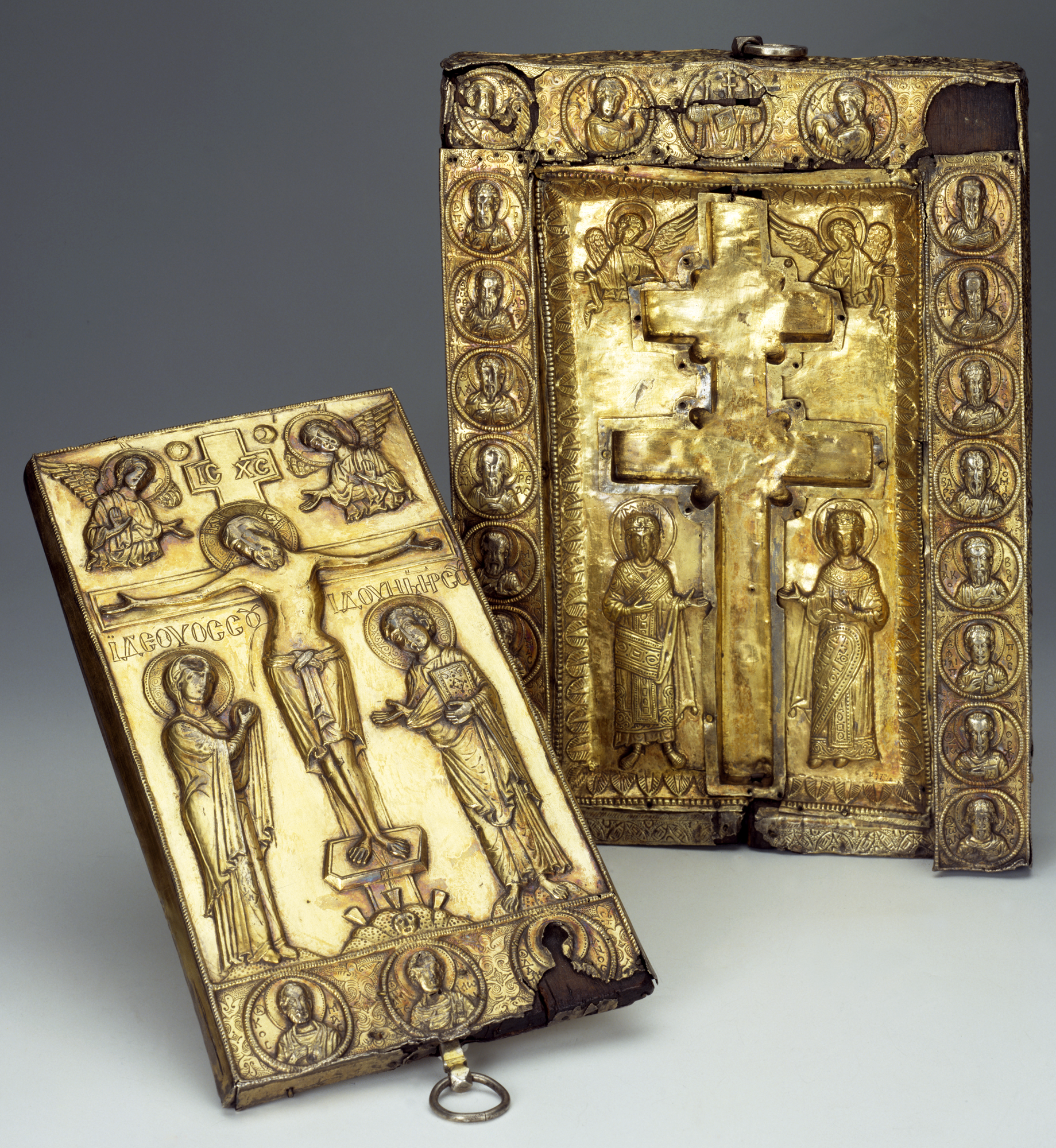
j) as portrayed in high relief (at right, lower register and to the right of the cross; to the left of that cross, St. Constantine the Great) on a seemingly late eleventh- or early twelfth-century silver gilt reliquary box of Constantinopolitan origin for a piece of the Holy Cross (staurotheke / staurotheca), in Russia since at least the fifteenth century and now in the State Hermitage Museum, St. Petersburg (zoomable image):
http://mini-site.louvre.fr/sainte-russie/COMMUN/zoom_png/41.png
k) as depicted in a twelfth-century fresco in Milan's basilica di San Lorenzo Maggiore:
http://tinyurl.com/rxpw4b
http://tinyurl.com/p2hwtq
l) as portrayed in low relief (at right or nearly at right; in True Cross scenes) in the three silver gilt and enamel roundels of the opened right wing of the mid-twelfth-century Stavelot Triptych (between 1156 and 1158) in the Pierpont Morgan Library and Museum, New York (zoomable image; read up from bottom):
http://www.themorgan.org/collections/collections.asp?id=217
The triptychs in the central portion of this object date from the late eleventh or early twelfth century. Helen is also portrayed in the lower of these (at right in the bottom register; at left, St. Constantine the Great).
m) as portrayed on an engraved copper shutter of the late twelfth-century Holy Cross triptych (shortly after 1180) in the Basiliek van Onze-Lieve-Vrouw in Tongeren:
https://www.flickr.com/photos/40922198@N00/5713092418
The triptych viewed from a greater distance:
https://www.flickr.com/photos/ana_sudani/5712533327/
n) as depicted (at far right) as depicted in an uncovered fresco from 1190/1191 above the entrance to the Confessio in the Basilika Sankt Gereon in Köln:
http://tinyurl.com/o3q9s5z
That is neither a large morel nor an incense burner that Helen is holding in her right hand. Rather, it's the Basilika Sankt Gereon in its earliest known depiction, showing only the Dekagon (the church's great polygonal nave, completed in 1227).
o) as depicted (at right; at left, St. Constantine the Great) in the late twelfth-century frescoes (ca. 1191) of the church of St. George at Kurbinovo (Resen municipality) in the Former Yugoslav Republic of Macedonia:
http://tinyurl.com/nt9aspl
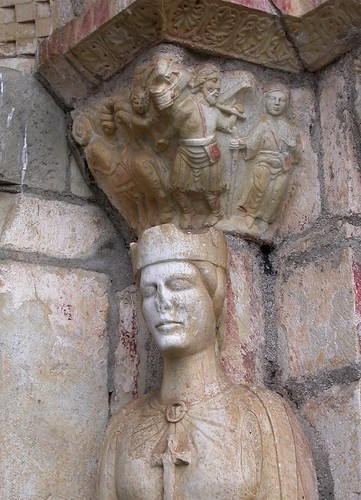
p) as portrayed in high relief (at left) on a jamb of the late twelfth-century portal (ca. 1199-1200) of the basilique Saint-Just de Valcabrère in Valcabrère (Haute-Garonne):
https://vialucispress.files.wordpress.com/2013/12/img_6152.jpg?w=549
Detail view:
http://farm2.static.flickr.com/1267/849896205_863605a312.jpg
q) as depicted (at right; at left, St. Constantine the Great) in the late twelfth- or early thirteenth-century frescoes of the Palaia Enkleistra ("Old Hermitage") in the St. Neophytus monastery at Tala near Paphos in the Republic of Cyprus:
http://www.soniahalliday.com/images/CY61-11-07.jpg
r) as depicted in two of the mid-twelfth-century frescoes (ca. 1250) of the oratorio di San Silvestro in Rome's basilica dei Santi Quattro Coronati:
1) fourth from left; at the Finding of the Three Crosses:
http://tinyurl.com/pga3w8j
2) third from right; behind learned Jews whom at Constantine's bidding she had brought to Rome to dispute with pope St. Sylvester (at left, the disputation's Miracle of the Bull):
http://tinyurl.com/ng7k9br
s) as depicted (second from left, after a partly preserved St. Constantine the Great) in the later thirteenth-century frescoes (1259) in the church of Sts. Nicholas and Panteleimon at Boyana near the Bulgarian capital of Sofia:
http://galenf.com/Bulgaria/36/bu_0017.jpg
t) as depicted (at right; at left, St. Constantine the Great) in a fresco of ca. 1300 in the nave of the church of the Holy Apostles in the Patriarchate of Peć at Peć in, depending upon one's view of the matter, either Serbia's province of Kosovo and Metohija or the Republic of Kosovo::
http://tinyurl.com/yz75gte
Detail view (Helen):
http://tinyurl.com/yjfv5vk
u) as depicted in two earlier fourteenth-century frescoes (betw. ca. 1301 and 1350) in the capilla de Santa Elena in the basílica metropolitana y primada de Santa María in Tarragona:
1) at right, ordering the placing of the Jew Judas in a dry well in order to induce him to reveal the hiding place of the Cross:
http://cdn2.vtourist.com/4/6930298-Frescos-Tarragona.jpg
2) at left, at the Finding of the Three Crosses:
http://tinyurl.com/qdwdbku
v) as depicted (at right; at left, a bit of St. Constantine the Great) in the earlier fourteenth-century frescoes (betw. ca. 1312 and 1321/1322) of the monastery church of the Theotokos at Gračanica in, depending on one's view of the matter, either Serbia's province of Kosovo and Metohija or the Republic of Kosovo:
http://tinyurl.com/pflltyy
Detail view (Helen):
http://tinyurl.com/q875s8v
w) as depicted (in this detail view, upper register at right, next to Constantine; at St. Sylvester I's disputation with the Jews and its Miracle of the Bull) by Maso di Banco in one of his earlier fourteenth-century frescoes (ca. 1335) in Florence's basilica di Santa Croce illustrating the Sylvester legend:
http://www.wga.hu/art/m/maso/bardi/07bardi.jpg
x) as depicted in the mid-fourteenth-century frescoes (1340s) of the monastery church of St. Michael the Archangel at Lesnovo (Probištip municipality) in the Former Yugoslav Republic of Macedonia:
http://tinyurl.com/o3sjjh3
Detail view:
http://tinyurl.com/nbx4bt3
y) as depicted (illumination in the left-hand column; at the Finding of the Three Crosses) in the mid- to later fourteenth-century Breviary of Charles V (between 1347 and 1380; Paris, BnF, ms. Latin 1052, fol. 369r):
http://gallica.bnf.fr/ark:/12148/btv1b84525491/f747.image
z) as depicted (at right, praying before the Cross; at left, also praying, a female figure in Dominican habit) by Simone di Filippo / Simone dei Crocifissi in a later fourteenth-century panel painting (ca. 1375-1380) in the Pinacoteca nazionale in Bologna:
http://tinyurl.com/ou9te25
aa) as depicted in two panels by Agnolo Gaddi and workshop in their later fourteenth-century fresco cycle on the True Cross (ca. 1380; alternate starting dates: ca. 1385, ca. 1388) in the principal chapel of the basilica di Santa Croce in Florence:
1) in red, nimbed, in two scenes at the Finding: at right, the Finding of the Three Crosses; at left, the cure of a dying woman during the Testing of the Three Crosses):
http://www.wga.hu/art/g/gaddi/agnolo/croce/1south3.jpg
Detail view (the Finding of the Three Crosses):
http://www.wga.hu/art/g/gaddi/agnolo/croce/1south5.jpg
2) nimbed, in a detail of the scene of her entry into Jerusalem with the True Cross:
http://tinyurl.com/nhu4exp
NB: Image 2 postdates the restoration campaign of 2005-2011.
bb) as depicted (upper register, left of center; at the Finding of the True Cross) by Giovanni di Benedetto and workshop in a late fourteenth-century Franciscan missal of Milanese origin (ca. 1385-1390; Paris, BnF, ms. Latin 757, fol. 355r):
http://gallica.bnf.fr/ark:/12148/btv1b8470209d/f713.image.r=
cc) as depicted in a fifteenth-century fresco in the apse of the church of Sv. Jelena in Oprtalj (Centralna Istra) in Croatia:
http://revitas.org/files/images/gallery/oprtalj-sv-jelena02.jpg
dd) as depicted (left-hand column; at the discovery of the True Cross) in the early fifteenth-century Hours of René of Anjou (ca. 1405-1410; London, BL, Egerton MS 1070, fol. 91v; image zoomable):
http://www.bl.uk/manuscripts/Viewer.aspx?ref=egerton_ms_1070_f091v
ee) as depicted (third from at left in the lowest register above the angel and at left in next peopled register above that; the Finding of the Three Crosses and then the Testing of the Three Crosses) in the early fifteenth-century Holy Cross window (a.k.a. Helena window; Fenster nord VIII; ca. 1410-1416/1420) in the Dom Beatae Mariae Virginis -- for most of its existence not a cathedral -- in Erfurt:
http://tinyurl.com/oof5hq2
Detail view (the Testing of the Three Crosses, with "before and after" depictions of both the young man and the woman):
http://tinyurl.com/ps34786
ff) as depicted (at center; at a conflation of the Discovery of the Three Crosses and the Testing of the Three Crosses) as depicted by the Master of Laufen in an earlier fifteenth-century panel painting (ca. 1440-1445) in the Universalmuseum Joanneum in Graz:
http://tarvos.imareal.oeaw.ac.at/server/images/7000557.JPG
gg) as depicted (touching the cross at center in the scene at right: the Identification of the True Cross) by Piero della Francesca in a mid-fifteenth century fresco (betw. ca. 1440 and 1462) in the choir of the basilica di San Francesco in Arezzo:
http://tinyurl.com/5h8nk5
Detail view (Helen):
http://tinyurl.com/m6c7um
hh) as depicted in two illuminated initials in the mid-fifteenth-century Prayer Book for Empress Barbara von Cilly (Wien, ÖNB, cod. 1767, fols. 139v, 271r):
1) identifying the True Cross through its resuscitation of a dead person in the Testing of the Three Crosses:
http://tarvos.imareal.oeaw.ac.at/server/images/7007371.JPG
2) standing with the Cross in a windowed interior:
http://tarvos.imareal.oeaw.ac.at/server/images/7007421.JPG
ii) as depicted (at far right, facing Constantine at far left; at St. Sylvester's Miracle of the Bull) by Francesco Pesellino (attrib.) in a mid-fifteenth-century predella panel (before 1458) in the Worcester Art Museum, Worcester, MA:
http://www.worcesterart.org/collection/European/1916.12.html
jj) as depicted (at right; at left, St. Constantine the Great) by Menas of the Marathasa valley in the later fifteenth-century frescoes (1474) in the church of Archangelos Michael in Pedoulas (Nicosia dist.), Republic of Cyprus:
http://tinyurl.com/nlnl3bb
kk) as depicted (second from right; blessing the youth restored to life by the Holy Cross during the Testing of the Three Crosses) in a later fifteenth- or early sixteenth-century panel painting (variously dated to ca. 1475-1485 and to ca. 1500) from a winged altarpiece and now in Vienna in the Schatzkammer des Deutschen Ordens:
http://tinyurl.com/needvzx
ll) as depicted in an initial "C" in a cutting from a late fifteenth- or early sixteenth-century antiphoner of north Italian origin in the British Library (ca. 1490-1510; London, BL, MS Add 18197, fols. D, G and I, fol. G):
http://britishlibrary.typepad.co.uk/.a/6a00d8341c464853ef01a73e027e77970d-popup
mm) as depicted (at left; at the Testing of the Three Crosses) by Ulrich Mair in a painting on one of the wings of his late fifteenth-century Dreifaltigkeitsaltar / Altarpiece of the Trinity (1482) in the Hessisches Landesmuseum, Darmstadt:
nn) as depicted by Miguel Ximénez and workshop in panels of his and Martín Bernad's late fifteenth-century altarpiece of the Holy Cross (completed, 1487) for the parish church of Blesa (Teruel) and now, after dismemberment, mostly in the Museo de Zaragoza:
1) enthroned among the Jews of Jerusalem:
2) being told where the Cross had been buried:
http://tinyurl.com/om5ws4u
3) entering Jerusalem with the Emperor Heraclius:
4) praying, together with Heraclius, before the newly erected Cross:
oo) as depicted by Cima da Conegliano in a late fifteenth-century panel painting (ca. 1495) in the National Gallery of Art, Washington, DC:
http://tinyurl.com/o98c7h4
pp) as depicted in an early sixteenth-century window in Aosta's cattedrale di Santa Maria Assunta e San Giovanni Battista:
http://www.icvbc.cnr.it/bivi/eng/schede/Vaosta/Aosta/8cattedrale1.htm
qq) as depicted (at left) by the painter Dionisy and his sons in an early sixteenth-century fresco (1502) in the Virgin Nativity cathedral of the St. Ferapont Belozero (Ferapontov Belozersky) Monastery at Ferapontovo in Russia's Vologda oblast:
http://www.dionisy.com/eng/museum/114/248/index.shtml
rr) as portrayed in three parts of the early sixteenth-century principal altar (1502) of the Filialkirche Hll. Helena und Maria Magdalena in Magdalensberg (Land Kärnten):
1) the polychromed wood central statue:
Detail views:
http://tinyurl.com/pxhmph7
http://tinyurl.com/qz8tl83
2) the painting on the predella, enthroned and asking Jerusalem's Jews for information about the hiding place of the Holy Cross:
http://www.aeiou.at/aeiou.history.data.jpg/001765.jpg
3) a painting on one of the wings (shuttered position), at centre in the Testing of the Three Crosses:
http://tarvos.imareal.oeaw.ac.at/server/images/7001775.JPG
ss) as depicted (at the Finding of the True Cross) by Jean Bourdichon in the early sixteenth-century Grandes Heures d'Anne de Bretagne (ca. 1503-1508; Paris, BnF, ms. Latin 9474, fol. 207v):
http://gallica.bnf.fr/ark:/12148/btv1b52500984v/f423.image
tt) as depicted (bottom register, first two panels from left: the Finding of the Three Crosses and the Identification of the True Cross) in the early sixteenth-century Triumph of the Cross window (Baie 8; ca. 1506) in the église Sainte-Madeleine in Troyes:
http://tinyurl.com/nzvbhcy
uu) as depicted (bottom register, first two panels from left: the Finding of the Three Crosses and the Identification of the True Cross) in the earlier sixteenth-century Legend of the Cross window (Baie 6; before 1524?) in the église Saint-Nizier in Troyes (image greatly expandable):
http://tinyurl.com/o4ox6xn
Gordon Plumb posted these two stained glass images of St Helen in England:
Tattershall, Holy Trinity, Lincolnshire, East window, 3d, 1482 by Robert Power of Burton upon Trent:
https://www.flickr.com/photos/22274117@N08/9121552138
Ashton-under-Lyne, Greater Manchester, album of images of the south aisle windows depicting the story of St Helen. The fullest coverage of the Helen legend in English glass, c.1497-1512:
https://www.flickr.com/photos/22274117@N08/albums/72157652182098552