Once I was a clever boy learning the arts of Oxford... is a quotation from the verses written by Bishop Richard Fleming (c.1385-1431) for his tomb in Lincoln Cathedral. Fleming, the founder of Lincoln College in Oxford, is the subject of my research for a D. Phil., and, like me, a son of the West Riding. I have remarked in the past that I have a deeply meaningful on-going relationship with a dead fifteenth century bishop... it was Fleming who, in effect, enabled me to come to Oxford and to learn its arts, and for that I am immensely grateful.


Showing posts with label Septuagesima. Show all posts

Sunday, 24 January 2016

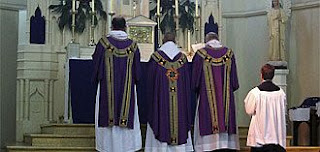
Septuagesima at St William of York in Reading


Today I travelled with a friend who, as a regular worshipped there, makes the journey most Sundays to Mass in the Extraordinary Form at the church of St William of York in Reading. We had an easy journey by train and bus from Oxford to Reading and on to the church.

St William of York was built in 1909, and designed to be enlarged if need arose. The modern extension is to a different plan and the Edwardian intention is still clear.

Today it is a part of a diocesan parish, and also used by the University chaplaincy, the FSSP and the Ordinariate.

We were going to the FSSP 11am Mass for Septuagesima in the Extraordinary Form, the 1962 Missal being their essential Rite. Their website can be seen a Facebook page accessible to all which can be viewed at https://m.facebook.com/fssp.england

The Fraternity celebrant was Fr Matthew Goddard.

As we had arrived early I had a good view of the Altar's transformation from its novus ordo style to a more traditional one, as the additional altar cloths were put on, then a violet frontal and finally the very handsome crucifix and set of six candles.

For the celebration of the Mass Fr Goddard had a particularly handsome Roman chasuble and matching stole and chalice veil in violet fabric with gold and blue decoration, which looked quite new.

The Mass was entirely traditional, beginning with the Asperges and with the Second ( Third ) Confiteor before Communion.

There was an excellent team of young servers and the choir in the west gallery sang the Propers.

All in all this was a prayerful and beautiful liturgy, one that was eloquent of 'otherness' and sacrifice, one that was thoughtful and serious. There was a good congregation, with a good number of children in addition to the servers.

Afterwards we went with another friend who sings in the choir at these FSSP Sunday Masses for lunch at his flat. This was an opportunity to see something of the converted country house in which he lives and to enjoy a series of tasty courses accompanied by fine wines.

After that it was back to Oxford for the three of us to go to Vespers at the Oratory.


Wednesday, 11 February 2015

The Septuagesima Season


Gregory DiPippo at the New Liturgical Movement has a post about the abandonment of the traditional season of Septuagesia with a link to an excellent article on the arguments for having such a period before Lent and a criticism of the way in which it was abolished in the Western Rite. It can be viewed at Some Notes on the Suppression of Septuagesima, by Amy Welborn

As is pointed out in these posts other Christian traditions  - Orthodox, Anglican and Lutheran  - retain it, and it has returned to the Roman calendar with its violet vestments and suppression of the Alleluia in the Ordinariate Use. At Sunday Vespers at the Oxford Oratory, when the Office is that of the gesimas, although the church is hung in green ready for the novus ordo Mass that will follow it, we have had this year the welcome sight of the Officiant vested in a violet cope for Vespers to accompany the traditional form and propers of the Office.

My previous posts on related themes can be viewed at Septuagesima, at Septuagesima,Sexagesima, Quinquagesima, at The Season of Septuagesima, at Septuagesima, at Burying the Alleluia and, linking to a post by Fr Blake, at Shrovetide.


Saturday, 22 February 2014

Shrovetide


Fr Blake has, as so often on his blog, an intersting set of ideas about the Septuagesima season - or, as he thinks we should call it in the traditional English usage, Shrovetide. His thoughts can be read at Pancakes and Excess.


Saturday, 15 February 2014

Burying the Alleluia


If one follows the Usus Antiquior then the eve of Septuagesiama was the day to bury the Alleluia until Easter. In the Novus Ordo it would be either the Sunday before Lent or Shrove Tuesday. Thus, for example, from tomorrow in the Roman Breviary at the end of versicles and responses instead of "Alleluia " "Laus tibi rex aeternae gloriae" is chanted at Solemn Vespers.

The custom was well established by the High Middle Ages as I have outlined in my past posts Burying the Alleluia and in Alleluia dulce carmen - another Neale translation.

There are examples of the practice being revived in places these days - indeed my post last year was followed by an e-mail from Christ Church cathedral here about their plans to do so.

There is are illustrated posts about the ceremony in 2010 in the Church of our Lady of the Atonement in San Antonio in Texas which can be seen here and from 2011 here.

Also in the USA the diocese of Paterson in New Jersey has revived it with a diocesan celebration presided over by the Bishop. There is an article about this from the diocesan website at 'Burying the Alleluia' - Diocese of Paterson, and there is a link to slideshow of the Solemn Vespers, presided over by Bishop Edward Serratelli, at which the interment occurred here.


The funeral procession of Alleluia in Paterson Cathedral

Image:patersondiocese.org


Septuagesima


Tomorrow is in the Usus Antiquior Septuagesima Sunday, and the beginning of the Pre-Lent season - and in some circumstances of the Lenten fast. There is an online introduction to the history and practice of Septuagesima here. I wrote last year about this season and the debate about its position in the liturgical year in The Season of Septuagesima.

My copy of the excellent St Andrew Missal (reprinted by the St Bonaventure Press) gives a good introduction to the development of this season, and explains it as originating in the liturgical themes of the three Sundays - the Fall, Noah and Abraham - and a consequential extension backwards of Lenten themes. One summary I have seen is that in Septuagesima we recognise that we are a fallen humanity, and in Lent by penitence we try to do something about it.


Image:wlms.blogspot.com


Earlier this evening I was at the Ordinariate Mass here in Oxford. In their calendar this weekend is called Septuagesiama, the next two Sundays have their traditional names. These terms were retained in the Book of Common Prayer, and have returned to the Catholic Church with the Ordinariate Use. 

However more than the name there is no change to Novus Ordo useage with this newly approved Use. The vestments are green not purple, the Gloria and Alleluia are not suppressed, and the readings are those of, this year, Sunday of Week 6 of Ordinary Time. Returning to the issue I linked to in my post Reform of the Reform or Reversal of the Reform? last week this is perhaps an indication of how far the Reform of the Reform could go at the moment. It is perhaps a pity that room for more provision of ancient uses has not been found with this liturgy. Maybe time will bring organic development.


Update Monday February 17th

The blog Rorate Caeli has this post about Septuagesima and its significance: Septuagesima: Christianity is as old as the world


Thursday, 7 February 2013

The Season of Septuagesima


Last year I posted Septuagesima, Sexagesima, Quinquagesima about the traditional forms of the current pre-Lent season, citing posts from the New Liturgical Movement and elsewhere. In Burying the Alleluia I wrote about about the long-standing practice of suppressing the Alleluia from Septuagesima in the pre-1970 Calendar and from the beginning of Lent in the Novus Ordo.

There is an introduction to the history of the season here.

The essential commonality of practice between the Eastern and Western Churches in the matter of fasting until recent decades when the Western liturgical seasons were simplified can be seen in the articles which the New Liturgical Movement has again written about in Some Notes on the Origins and Character of Septuagesimatide (NLM Reprint) . They have also linked to their post The Question of the Septuagesima Season and the Modern Roman Liturgy: Possible Enrichment? from three years ago which has drawn some interesting comments. 

Given the discrepancy which now exists between the OF and EF Calendars as to the Pre-Lent period this is a topic which could be resolved by reversion to ancient usage or by making observance of the pre-Lenten days at least an option in the Novus Ordo

Having written the other day about the way Candlemas is a link, a hinge if you like, between Christmastide and Lent-Easter I am inclined to the view that the traditional Septuagesima season makes for a more pastoral and psychologically satisfying. 

There is a fine set of photographs from the blog Ars Orandi of the traditional liturgy of Septuagesima Sunday in the Extraordinary Form as celebrated at Kinkora in Ontario in 2010 here.


Tuesday, 14 February 2012

Septuagesima, Sexagesima, Quinquagesima


The New Liturgical Movement has republished one of their articles from past years about the Pre-Lent season and its origins which can be read at NLM Reprint: Some Notes on the Origins and Character of Pre-Lent (Septuagesima, Sexagesima, Quinquagesima).

Not only is this an ancient part of the Church's liturgy and something that liturgy shares with the Byzantine tradition - I have Orthodox friends who progress into Lent giving up various foodstuffs along the way Sunday by Sunday - so it can be seen to have an ecumenical as well as a diachronic function.

There are other online articles about the season here and,from the Catholic Encyclopedia, here.
https://blogger.googleusercontent.com/img/b/R29vZ2xl/AVvXsEhbOQAOlviL5iuStUvIcS4ee42AHYk1RyM10ntNGWfoBEsypmr7spV8KVBPkCPdmWv5eM6duBNegZgR6jIOhWnx8zhFetyxdxcoUGt5DQB-Mw3sjQJr23UJ80ea06ufdjJRj8uoQx0Y/s320/Septuagesima.jpg

Mass for Septuagesima in Switzerland 2007

Image:roamincatholicphiladelphia.blogspot

In this photograph the deacon and sub-deacon are wearing dalmatic and tunicle rather than the folded chasubles usual in when violet vestments were worn until the 1950s and still by some churches today. There is a well illustrated article from the St Lawrence Press blogsite which explores their origins and development and gives several modern examples of their continuing use and which can be read here.

Whilst the abruptness of the change on Ash Wednesday has a real impact on our lives the traditional idea appears to be that in the gesimas we acknowledge that we have sinned and need to do something about it. In Lent we get on and actually do do something about that fact - fasting, acts of charity, spiritual preparation, confession, penance and the like to be ready for Easter.

Sunday, 20 February 2011

Septuagesima


Fr Hunwicke has once again been knocking some liturgical nails on the head with his post STILL WAITING FOR VATICAN II where he deals with the disappearance from the modern Roman rite of the Septuagesima season.

It's removal is one more example of that "false archaeology" which sought to restore the liturgy to what certain experts thought it had once been.

I think I can understand ( but not share) their desire to signify the seasonal change to Lent by removing the transitional phase of Septuagesima - purple vestements, no Alleluia or Gloria - which looked rather like the Lenten observance, so as to emphasise the importance of Lent itself. Nonetheless Septuagesima and the two following Sundays were a genuine, and ancient, part of the liturgical heritage of the Church - dare I call it patrimony? There is something wrong in principle in destroying something ancient so as to recover something perceived as more ancient, particularly when the two can coexist, and have done for centuries.

Not only was it part of the continuing tradition of the Church in the West, but it is similar to what is, I understand, the phased introduction of Lent in the Eastern Orthodox tradition. In any case Lent was marked off by other disciplines of fasting as well as the liturgical fast of no music and, of course, and they were bound to appear on this blog sooner or later, the folded chasuble and the broad stole.

http://img261.imageshack.us/img261/3602/violetfoldedandbroad2.jpg

The Lenten folded chasuble and the broad stole

Image: New Liturgical Movement

As Fr Hunwicke points out the Church still has enough cause to seek Divine assistance by a season of penitential prayer for its practical needs before the more intense period of personal penitence and preparation that is Lent.