Once I was a clever boy learning the arts of Oxford... is a quotation from the verses written by Bishop Richard Fleming (c.1385-1431) for his tomb in Lincoln Cathedral. Fleming, the founder of Lincoln College in Oxford, is the subject of my research for a D. Phil., and, like me, a son of the West Riding. I have remarked in the past that I have a deeply meaningful on-going relationship with a dead fifteenth century bishop... it was Fleming who, in effect, enabled me to come to Oxford and to learn its arts, and for that I am immensely grateful.


Showing posts with label Folded chasubles. Show all posts

Sunday, 13 April 2025

Liturgical colours, Folded Chasubles and the Broad Sstole


Now, dear reader, reading that title, don’t get too excited, but I do have some good things to share with you.

Mass this morning according to the 1962 Missal with its change of liturgical colours from red to violet after the Palm Procession made me realise I needed to be sure I was up to speed on what and when, the various changes were wrought in the 1950s and 1960s. Once Mass, Sunday lunch, and the Boat Race were out of the way I betook myself to the Internet in search of the answer.

The excellent Liturgical Arts Journal had three linked articles. The most recent from 2023 outlined the changes in the colours of the vestments for today between 1955 and 1969-70 and can be seen at Palm Sunday: Variations in the Vestments and Their Colours in the Span of Fifteen Years

That led me to two further, and related, articles which I am sure I have shared before with readers, but make no apologies for doing so again. They look at topics beloved of traditionally minded observers of liturgy and vestments, and particularly at this time of year. Both are very well illustrated and clearly well researched.

The more recent, from 2017, is about the History and Designs of the Folded Chasuble


An earlier article from 2009, is on the parent website, that of the New Liturgical Movement. It is rather more detailed and can be seen at Use, History and Development of the "Planeta Plicata" or Folded Chasuble

These days,thanks to the wonder of the Internet, one can sometimes find Masses online where the folded chasuble and broad stole make their traditional appearance. I had the good fortune to tune in to an FSSP Mass in Mexico in 2020 to find these historic vestments in use. If one is really lucky you might, of course, be able to attend such a liturgy celebrated according to the pre-1955 norms.

I am sure you will not need to ask what my views would be on the suitability of these changes to the liturgy.

Tuesday, 14 February 2012

Septuagesima, Sexagesima, Quinquagesima


The New Liturgical Movement has republished one of their articles from past years about the Pre-Lent season and its origins which can be read at NLM Reprint: Some Notes on the Origins and Character of Pre-Lent (Septuagesima, Sexagesima, Quinquagesima).

Not only is this an ancient part of the Church's liturgy and something that liturgy shares with the Byzantine tradition - I have Orthodox friends who progress into Lent giving up various foodstuffs along the way Sunday by Sunday - so it can be seen to have an ecumenical as well as a diachronic function.

There are other online articles about the season here and,from the Catholic Encyclopedia, here.
https://blogger.googleusercontent.com/img/b/R29vZ2xl/AVvXsEhbOQAOlviL5iuStUvIcS4ee42AHYk1RyM10ntNGWfoBEsypmr7spV8KVBPkCPdmWv5eM6duBNegZgR6jIOhWnx8zhFetyxdxcoUGt5DQB-Mw3sjQJr23UJ80ea06ufdjJRj8uoQx0Y/s320/Septuagesima.jpg

Mass for Septuagesima in Switzerland 2007

Image:roamincatholicphiladelphia.blogspot

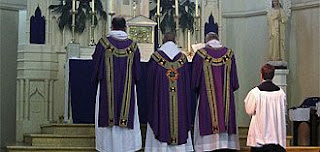
In this photograph the deacon and sub-deacon are wearing dalmatic and tunicle rather than the folded chasubles usual in when violet vestments were worn until the 1950s and still by some churches today. There is a well illustrated article from the St Lawrence Press blogsite which explores their origins and development and gives several modern examples of their continuing use and which can be read here.

Whilst the abruptness of the change on Ash Wednesday has a real impact on our lives the traditional idea appears to be that in the gesimas we acknowledge that we have sinned and need to do something about it. In Lent we get on and actually do do something about that fact - fasting, acts of charity, spiritual preparation, confession, penance and the like to be ready for Easter.

Thursday, 10 March 2011

Folded chasubles


As I thought the other week, and it being this time of year, the issue of Folded Chasubles and the Broad Stole has returned to my mind and to those of others.

The New Liturgical Movement has reissued an excellent article about the history and use of these particular vestments which it first carried in 2009. It is a lengthy piece, but very well worth reading, and can be found here.


Readers will doubtless not be surprised that I would be very pleased to see the return of these historic forms of the vestment for penitential occasions. They are part of the liturgical heritage of the Church, and their loss was one of the early symptoms of change for change's sake.


Sunday, 20 February 2011

Septuagesima


Fr Hunwicke has once again been knocking some liturgical nails on the head with his post STILL WAITING FOR VATICAN II where he deals with the disappearance from the modern Roman rite of the Septuagesima season.

It's removal is one more example of that "false archaeology" which sought to restore the liturgy to what certain experts thought it had once been.

I think I can understand ( but not share) their desire to signify the seasonal change to Lent by removing the transitional phase of Septuagesima - purple vestements, no Alleluia or Gloria - which looked rather like the Lenten observance, so as to emphasise the importance of Lent itself. Nonetheless Septuagesima and the two following Sundays were a genuine, and ancient, part of the liturgical heritage of the Church - dare I call it patrimony? There is something wrong in principle in destroying something ancient so as to recover something perceived as more ancient, particularly when the two can coexist, and have done for centuries.

Not only was it part of the continuing tradition of the Church in the West, but it is similar to what is, I understand, the phased introduction of Lent in the Eastern Orthodox tradition. In any case Lent was marked off by other disciplines of fasting as well as the liturgical fast of no music and, of course, and they were bound to appear on this blog sooner or later, the folded chasuble and the broad stole.

http://img261.imageshack.us/img261/3602/violetfoldedandbroad2.jpg

The Lenten folded chasuble and the broad stole

Image: New Liturgical Movement

As Fr Hunwicke points out the Church still has enough cause to seek Divine assistance by a season of penitential prayer for its practical needs before the more intense period of personal penitence and preparation that is Lent.