Once I was a clever boy learning the arts of Oxford... is a quotation from the verses written by Bishop Richard Fleming (c.1385-1431) for his tomb in Lincoln Cathedral. Fleming, the founder of Lincoln College in Oxford, is the subject of my research for a D. Phil., and, like me, a son of the West Riding. I have remarked in the past that I have a deeply meaningful on-going relationship with a dead fifteenth century bishop... it was Fleming who, in effect, enabled me to come to Oxford and to learn its arts, and for that I am immensely grateful.


Showing posts with label Museum of the History of Science. Show all posts

Wednesday, 15 March 2017

Animating the Antikythera mechanism


The Lead Education Officer at the Museum of the History of Science here in Oxford shared this piece about the Antikythera Mechanism which may well be of interest to readers:

The Antikythera Mechanism is the oldest mechanical work to survive, and is dated to between 205 and 100 BC. It is, however, incomplete.

The Museum of the History of Science has the oldest working geared mechanism to survive - a complex Persian astrolabe dating from 1222 AD.


Thursday, 3 November 2016

Back From the Dead


Earlier this evening I attended one of the events to mark the opening tomorrow of the exhibition Back from the Dead at the Museum of the History of Science in Oxford.


The exhibition commemorates the development of penicillin by researchers at the University in the early 1940s and the 75th anniversary of the first trials on patients of this life saving drug - one which seemingly abrought them back from the dead. The title also refers to the notion of bringing back to life the team of researchers and their assistants.

The current awareness of the limits of antibiotics and the development of bacterial resistance are also presented in the displays.

This is a very fine exhibition and tells a story full of human interest not just about a major scientific and medical breakthrough but also of the personalities who were engaged in the research. Their story would certainly lend itself to a dramatist or screenwriter.

The exhibition is on at the Museum until 21 May next year. 


Friday, 2 December 2011

Doing Time in Oxford


The current special exhibition at the Museum of the History of Science in Oxford is Time Machines and it illustrates from the collection ways of telling the time.

The oldest exhibit is a Roman sundial, the most recent research projects from the University on precise time measurements. There are some fascinating things to see, including the late fourteenth century Oriel astrolabe, the mid-seventeenth century Fromanteel longcase clock, chronometers by Harrison, and the dottiness of a French Revolutionary timepiece by a clockmaker named Janvier - ironically one of the terms the whole daft scheme abolished.

The exhibition is linked by the figure of a time travelling 'hende' Nicholas, the protagonist of The Miller's Tale, that delightful Chaucerian account of what purports to be some of the more questionable aspects of Oxford University and town life in the 1380s and 90s. Nicholas is presented as a cut-out figure and his comments on later methods of timekeeping point up the continuities and discontinuities in his time travel:

Nicholas of Oxford with Phone

Nicholas of Oxford puzzles over a mobile phone; what so many of people use for time telling today


One again the Museum has presented in an informative and attractive way a complex topic, and Time Machines is well worth visiting if you are in Oxford. There are a series of special lectures and presentations in connection with the exhibition - for details see the Museum website, which is available here.

The exhibition continues until April 15th, and the Museum is open Tuesday to Friday 12-5, Saturday 10-5, and Sundays 2-5. Christmas, New Year and Easter times will vary. Admission is free.


Thursday, 19 May 2011

Eccentricity


No, this is not about me.

Eccenticity
is the name of the new exhibition at the Museum of the History of Science in Broad Street in Oxford. It is based on eccentric objects in their stored collection - especially those things which lie outside their normal collecting range - and around eccentric scientists, especially in Oxford.

The following is adapted from their website about the exhibition:

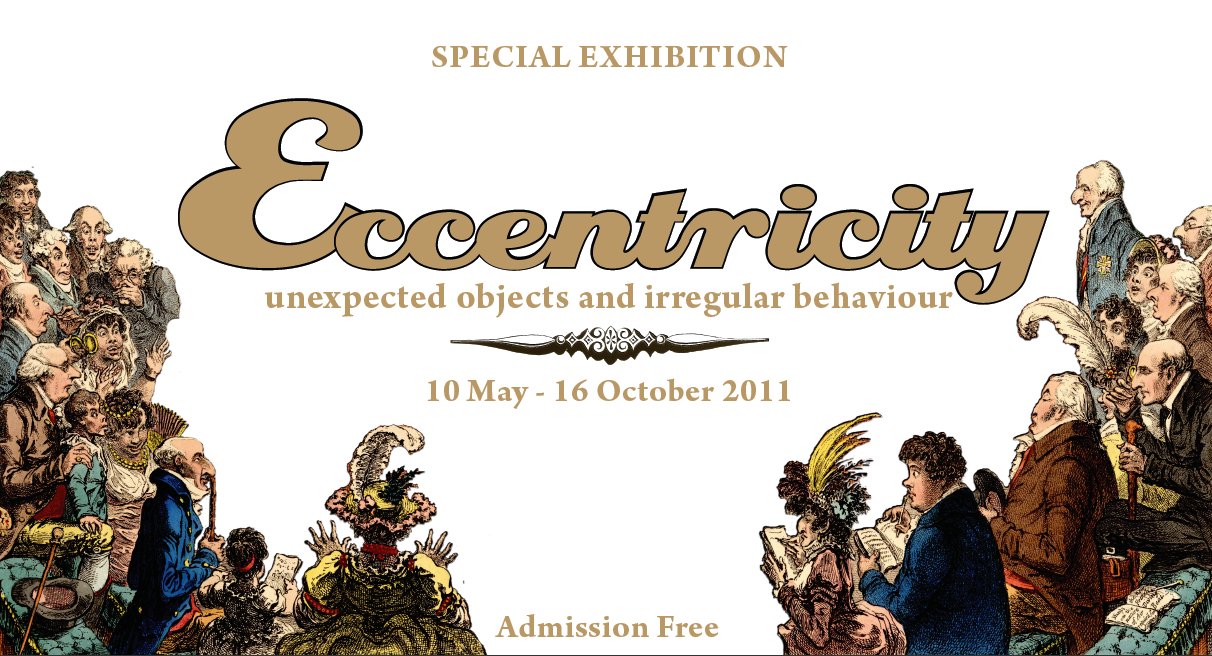
Eccentricity Special Exhibition Banner

Science and Oxford are two traditional sources of eccentricity. Eccentric scientists are familiar creations of the media and eccentric Oxford academics inhabit both literary fiction and historical fact.

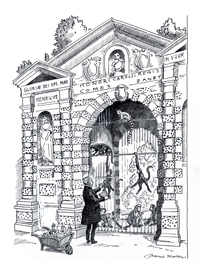
Charles Daubeny Feeding his Monkeys

Eccentric Oxford scientist Charles Daubeny kept monkeys in a cage in the gate of the Botanic Garden - until someone released the monkeys as a prank.

(Drawing by Francis Mosley)

Over the years the Museum has taken a broad approach to collecting, and contains many unexpected objects, often hidden away in the store. This special exhibition shows some of the most intriguing of these, telling their stories, and the stories of their eccentric owners. Who would have thought that a museum of science would have a large collection of typewriters, a Japanese mechanical fly-trap, a 19th-century clockwork bird-scarer or an astrolabe belonging to Nostradamus?

Having looked around the exhibition I would recommend it to anyone in Oxford this summer.

Amongst the objects on show which I would comment on are prototypes of the computer, including parts of Charles Babbage's calculating engine, and the aforementioned astrolabe and equitorium which it is believed may well have been owned by Nostradamus. Now with that and the Holy Table of his English equivalent Dr John Dee on permanent display in the Museum what more could you want to foresee...?

Eccentricity continues until October 16th. The Museum is open Tuesday-Friday 12-5, Saturday 10-5 and Sunday 2-5. Admission is free.

Friday, 29 October 2010

Oxford Exhibitions - Al Mizan


On Wednesday evening I attended the reception to mark the opening of Al-Mizan: Sciences and Arts in the Islamic World at the Museum of the History of Science here in Oxford. Al-Mizan means balance and is the Arabic name for the zodaic sign Libra.


The exhibition, to mark the 25th anniversary of the Oxford Institute for Islamic Studies, has a website here.

The display explores the balance achieved between science and art in historic Islamic culture, and is not only informative, but a visual delight.

The exhibition is on until March 20th 2011, and the Museum is open 12-5 Tuesday to Friday, 10-5 on Saturdays and 2-5 on Sundays. Admission is free.