Once I was a clever boy learning the arts of Oxford... is a quotation from the verses written by Bishop Richard Fleming (c.1385-1431) for his tomb in Lincoln Cathedral. Fleming, the founder of Lincoln College in Oxford, is the subject of my research for a D. Phil., and, like me, a son of the West Riding. I have remarked in the past that I have a deeply meaningful on-going relationship with a dead fifteenth century bishop... it was Fleming who, in effect, enabled me to come to Oxford and to learn its arts, and for that I am immensely grateful.


Showing posts with label King Louis XVIII. Show all posts

Tuesday, 17 September 2024

Aspects of the Bourbon Restoration


Whilst looking online into background for my post about King Louis XVIII I came upon these articles which may interest readers. They not only illustrate specific aspects of French political life in the King’s reign but help to indicate the tensions that ran through France at so many levels. Maintains national cohesion was no mean achievement.

Wikipedia has a good entry about the 1814 Charter granted by the King. The article gives a good introduction to its provisions, .points to its similarity to the British constitutional  arrangements at the time, and its status as a document - was it a Fundamental Law or a description of how the legislative life of the country was to be conducted? The article can be read at Charter of 1814

There is a short piece about a real risk to the survival of the main Royal House caused by the assassination of the Duc de Berry, nephew to King Louis, and third in line to the throne in 1820, and the pregnancy of his widow. It is from Elena Maria Vidal’s Tea at Trianon blog and can be seen at The Murder of the Duc de Berry and the Miracle Child

The third is an excellent article, the transcript of a podcast from The Siècle 1814-1914 and looks at the underground opposition to the Restoration in the early 1820s and the reaction to that of the government. Entitled ‘Charbonnerie’ it is a well researched and balanced account of the secret radical groups, imitating contemporary Italian examples, and  which sought to overthrow the Restoration. It describes the response of the government to their discovery,  and their signal failure to incite revolt in those years. Being in print rather than just a sound broadcast it boasts those academic desiderata of having both illustrations and footnotes. It is well worth reading and can be seen at  Episode 23: Charbonnerie


More on the death of King Louis XVIII


By chance I came upon a blog post by Catherine Curzon from a decade ago about the death of King Louis XVIII in 1824. 

The account records the declining health of the King from the beginning of 1824, and its distressing nature as gangrene worked its way slowly through his system. Notwithstanding that he continued as best he could to exercise his functions as monarch until only a few days before his death.

The article, together with comments, can be seen at "The king rotted on his throne": The Death of Louis XVIII


Tuesday, 16 September 2014

King Louis XVIII


Today is the 190th anniversary of the death in 1824 of King Louis XVIII.

There is an online biography of him here.


JPEG - 11.6 ko

King Louis XVIII 
Detail from the portrait below

Image:histoire-en-ligne.com

As effective King of France from 1814-15 he was successful in re-establishing the traditional monarchy within a model of contemporary understandings of constitutionalism. That might well have been a basis for alonger-term settlement than it turne dout to be. He himself expressed his doubts as to whether his brother and heir, Charles Count of Artois, was going to be able to maintain that settlement. The fact that he did not prove able to do so has always invited comparison with King Charles II and King James II in England.

Cynical and calculating, a wary man, he was successful as a monarch, less attractive as an individual. Unlike the jibe about his dynasty he certainly had learned from the events of 1789 and thereafter, as indeed had King Charles X, even if they were different lessons. When it came to forgetting King Louis remained hostile to the House of Orleans in a way his supposedly more reactionary brother was not.

In some respects, including his appearance, he remained in many ways an eighteenth century figure, unlike King Charles X, who, although only two years younger, had embraced ideas and concepts of the times in which he found himself. King Louis XVIII had late eighteenth century cynicism, suited to the politics of any age, King Charles X possessed early nineteenth century romantic idealism, which is a less sure source of political strength in troubled times.

Louis XVIII

King Louis XVIII at his desk

Image:nndb.com

When King Charles X died in 1836 King Leopold I of the Belgians wrote to his neice Princess Victoria in England  "Poor Charles X is dead. history will state that Louis XVIII was a most liberal monarch, reigning with great mildness and justice to his end, but taht his brother, from his despotic and harsh disposition, upset all the other had done and lost the throne. Louis XVIII was a clever, hard-hearted man, shackled by no principle, very proud and false. Charles X an honest man, a kind friend, an honourable master, sincerein his opinions and inclined to do everything that is right." 


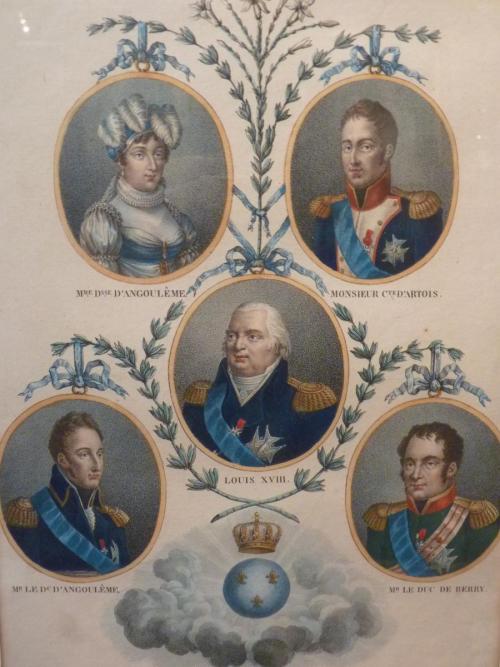
King Louis XVIII and the French Royal Family

Charles, Count of Artois, later King Charles X, King Louis XVIII, Marie Caroline, Duchesse of Berry, Marie Thérèse, Duchesse of Angoulême, Madme Royale, and her husband  Louis Antoine, Duke of Angoulême , later King Louis XIX, and Charles Ferdinand, Duke of Berry,father of King Henri V.
The bust of King Henri IV looks down on the family gathering 

A print by Gautier before 1820

Image Wikipedia 

King Louis XVIII was the last monarch in France to die in actual possession of his throne. 

Saturday, 3 May 2014

The entry of King Louis XVIII into Paris 1814


Today is the bicentenary of the entry into his capital city of King Louis XVIII in 1814. I posted about his arrival in France in Return of the Bourbons in 1814 - post I have revised slightly by adding another image.

The Senate having offered to Crown to King Louis XVIII on April 6th, on April 12 his brother the Count of Artois, who had been in France since earlier in the year, entered Paris in state as Lieutenant General of the Realm and what the Count described as the happiest day he had known for thirty years. On April 24th King Louis travelled from Dover to Calais accompanied by other members of the Royal family.

On the 2nd of May 1814 King Louis stopped in Saint-Ouen where, under pressure from Tsar Alexander I and urged on by Talleyrand, he signed the Saint-Ouen Declaration, re-establishing the monarchy whilst recognising significant constitutional changes established under the Revolution and the Empire.There is more about the Declaration here. This can be seen as similar to the Declaration of Breda by King Charles II in 1660, and the terms in respect of land confiscated and sold during the Revolutionary regime similar to the acceptance of the sale of monastic estate sin the 1554 English return to the Roman obedience.


The French Royal family in 1814
King Louis XVIII in the centre, with top left Madame Royale, daughter of King Louis XVI and Queen Marie Antoinette, top right the Count of Artois, the King's brother and successor as King Charles X, and at the base his two sons, the Duke of Angoulême, husband of Madame Royale, and later King Louis XIX, and the Duke of Berry, father of King Henri V

Image: Tea at Trianon


Nicolas Joseph Vergnaux:Louis-Antoine de France 1775-1844 Duc dAngouleme, at the Barriere de Vaugirard, 1814

The Duke of Angoulême at the Barriere Vaugirard
 by Nicholas Joseph Vergnaux
Musee Carnevallet

Image:1st-art-gallery


Presentation of the Keys of Paris to King Louis XVIII at the Barriere Saint-Denis on 3rd May 1814, c.1815-20 - Henri  (after) Courvoisier-Voisin

Presentation of the keys of the city at the Barriere Saint Denis to the King
by Henri Courvoisier-Voisin

Biblioteque des Arts Decoratifs, Paris

Image:mystudios.com

Nicolas Joseph Vergnaux:Entrance of Louis XVIII 1755-1824 through the Porte Saint-Denis, 1814

Entry of the King at the Porte Saint-Denis
 by Nicholas Joseph Vergnaux
Musee Carnevallet

Image:1st-art-gallery
                                                
  
The ceremonial entry of King Louis XVIII into Paris  A detail of  Melling’s painting of the scene. Brunot's equestrian statue of King Henri IV on the Pont Neuf as seen  here replaced the seventeenth-century original that was destroyed during the Revolution.

Image:sites.google.com

Entry into Paris of Louis XVIII 1814 by French School


A contemporary French print of the entry of the King and Royal Family

Image: Bridgeman art Callery/ easyart.com

Entrée de Louis XVIII à Paris : [3 mai 1814]. 26 : [estampe] / Courvoisier del. ; Dubois sculp. - 1

The procession through the streets
Drawn by Courvoisier, engraved by Dubois 

Image: gallica.bnf.fr 

Nicolas Joseph Vergnaux:Charles-Ferdinand de France 1778-1820 Duc de Berry returning to the Tuileries through the Place Vendome, 1814

The Duke of Berry returns to the Tuilleries through the Place Vendome
 by Nicholas Joseph Vergnaux
Musee Carnevallet

Image:1st-art-gallery


When the Royal party finally arrived at the Tuilleries the emotion of the occasion was to prove too much for Madame Royale on her return to the city which had seen the murder of her parents, aunt and brother by the revolutionaries and she fainted. One can hardly be surprised considering what she had witnessed or been subjected to in the city in the years after 1789 before her release from the Temple in 1795. 

Nonetheless the Restoration had taken place. The next year witnessed the Hundred Days, but the Bourbons were to return again. Asked if the Crown was secure King Louis opined, in his mordant fashion, that if he outlived his brother it was, but if his brother outlived him he could not be sure. The pity is that there was the 1830 revolution, and no satisfactory Restoration after that  - well not so far...


File:Coat of Arms of the Bourbon Restoration (1815-30).svg

Image:Wikipedia

Vive Le Roi!


Thursday, 24 April 2014

Return of the Bourbons in 1814


File:Louis XVIII relevant la France.jpg

Allegory of the Return of the Bourbons on 24 April 1814:Louis XVIII Lifting France from Its Ruins 

A painting by Louis-Philippe Crépin at Versailles

Image:Wikipedia

Today is the two hundredth anniversary of the return of the Bourbon dynasty to France in the restoration of 1814. King Louis XVIII returned to his kingdom at Calais, entering Paris on May 3rd.

In this allegorical painting the King, robed and crowned - he was in fact never to be have a coronation at Rheims due to his physical incapacity - is shown raising a somewhat distree personification of France. He is surrounded by his relatives, with, on the left, the seated figure of Madame Royale, Marie-Thérèse, daughter of King Louis XVI and Queen Marie Antoinette, who had been married to her cousin Louis, Duc d'Angoulème, who stands beside her, and who was the elder son of the King's younger brother Count of Artois, the future King Charles X, who was acting as Lieutenant -General of the Realm in anticipation of King Louis' return.

The 'Royal Sovereign' conveying Louis XVIII to France, 24 April 1814 Fine Art Print by Nicholas Pocock

The Royal Sovereign conveying King Louis XVIII to France 24 April 1814

 Nicholas Pocock
Image; Magnolia Box

At Burton Constable Hall in Yorkshire there is a small painting of the return of the French royal family which is not an allegory but appears to be a more direct, if dramatic, representation of the return. In it the seated King Louis XVIII and Madame Royale are presented with three lilies, symbolic of the kingdom whilst still on board their ship, the Royal Sovereign. A fascinating little picture to find amongst the other treasures of that very interesting country house.


The Arrival of King Louis XVIII of France in Calais in 1814 

The Arrival of King Louis XVIII at Calais in 1814

Edward Bird (1772-1819)

Image: BBC Your Pictures


The misfortune of France, in my opinion, since 1814 is that the Restoration celebrated in these images was not to last - consolidated under King Louis XVIII, jeopardised by King Charles X and his advisors, but not such that it might not have endured it was to be followed by a whole series of constitional experiments from 1830 onwards that have done little for the country, and at times its survival has indeed been in question. It is the enduring strengths of France, and they are far older than anything set off in 1789, which have enabled it to survive, and it is those which attract me on my visits.

Vive le Roi!


Monday, 24 March 2014

Out and about in Buckinghamshire


Last Saturday the Clever Boy had a day out visiting Buckinghamshire - not a county he knows well - when he went to visit friends who have recently moved with their baby son to live in the Chilterns.

I travelled to Aylesbury by bus, passing on the way the ruined structure of Dinton Castle, a folly built by Sir John Vanhatten in 1769 as an eyecatcher from his home, Dinton Hall.He used it to display his collection of geological specimens and subsequently it is said to have been used by a local Nonconformst congregation for their meetings. It stands on what was a Saxon cemetary and local legend has it that it is haunted by the ghost of John Mayne, who live locally and was the reputed executioner of King Charles I.


Dinton Castle

Image:englishbuildings.blogspot.co.uk

In November 2012 it was bought for £56,000 by a local businessman who plans to restore it as a weekend retreat

Aylesbury struck me as being one of those old English towns like Doncaster and Chelmsford which with relatively modern expansion in the last 150 or so years plus recent redevelopment schemes have lost much of their former charm and offer little to catch the visitor's eye. However I met up with my host and we set off to his home, with a quick detour to look at Drayton Beauchamp church.

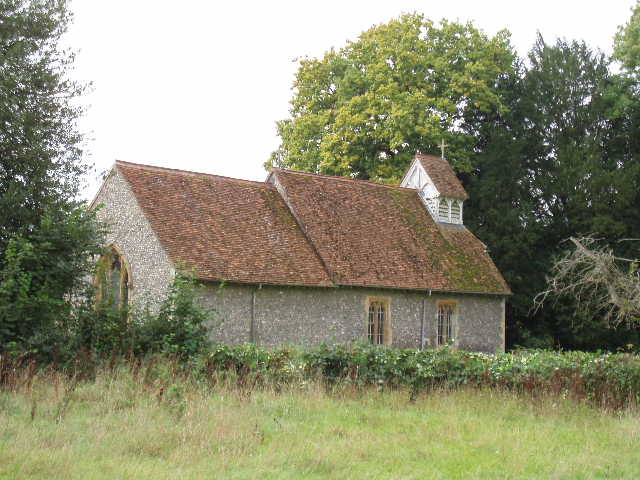
File:St. Mary the Virgin, Drayton Beauchamp - geograph.org.uk - 87564.jpg

DraytonBeauchamp Church

Image:Wikipedia

St Mary's is a fine late Perpendicular church, and apparently contains some good glass and a splendid eighteenth century tomb. There is a fine set of photographs of the church both inside and outside and of the furnishings on this Flickriver site which can be seen here. However it was locked, so we had to content ourselves with looking at the outside with its chequerboard masonry. The church's most famous incumbant was Richard Hooker, author of The Laws of Ecclesiastical Polity, who was appointed to the parish in 1584. 

We travelled on through classic Chiltern valleys and hills, past a rather charming pumping station erected by the Rothschilds to serve their various houses in the area, to my friend's new home.

After catching up on our news and activities and eating lunch we walked up to the church of St Lawrence at Cholesbury. This small medieval church was rather heavily restored in 1872 by a Vicar who held the parish for 59 years - those were the days - and who early in his time as incumbant in 1832 had to face that fact that his poor parish was made bankrupt by the Poor Law. The few relatively wealthy parishioners could not afford the rates; partly as a result of his drawing attention to the case in 1834 the law was changed to set up parish unions for the Poor Law.


Cholesbury Church

Image; pete's-walks.co.uk

In the bell turret is a bell dated to 1620 with the inscription COM AND PRAY - which looks like an intersting bit of word play.

The church is situated just inside the banks and ditches of a late Iron age hillfort dating from 500 BC onwards, and thought to have been used mainly as a refuge in time of danger.


The ditch around Cholesbury Camp

Image: themodernantiquarian.com

On the journey back to get my bus to Oxford my friend drove us to Hartwell. Hartwell House, of which there is an online account here, is now an exclusive hotel run by the National Trust, and not visible from the entrance - casual visitors are rather clearly not welcome. From 1808 until 1814 it was the home of King Louis XVIII of France, his family and his court in exile. It was at Hartwell that his Queen Marie-Josephine died in 1810, and where he accepted the invitation to return to France as monarch in April 1814. There is a more detailed history of the house and its occupants from the National Trust Hotels website here.


Hartwell House
The statue is of Frederick Prince of Wales and was moved to this site in reent years

Image:clarewestphotography.co.uk

On the edge of the grounds of the House is the church of the Assumption of Our Lady - an interesting survival as a dedicatioon in itself. The medieval church was rebuilt in 1754-6 by the architect Henry Keene for Sir William Lee, the owner of Hartwell, in the Gothick style. I imagine the design was such as to make it an eye-catcher in the grounds of the estate. The octagonal plan is said to derive from the Chapter House of York Minster as, I suspect, do the two towers, one as the west end, the other over the chancel. The church had a black and white marble pavement and fan vaulting, but shortly after the second World war the lead was stolen from the roof and it fell into disrepair, and was declared redundant in 1973. It is a rather sad story of neglect - the shell may have survived but the interior largely gone and the building not accessible. This photograph shows what we could see from the path along the edge of the estate.


Hartwell Church

Image:buckinghamshireremembers.org.uk

There is a picture of what remains of the interior and more details on the Churches Conservation Trust website here. There are pictures of the House, the Church and the grounds on aset by Mick Baker on Flickr which can be seen here

Just outside the perimeter of the estate is the Egyptian Spring, built in 1850 by the Egyptologist Joseph Bonomi the Younger. It is an alcove seat on the western side of Lower Hartwell opposite a small spring. Aa curious folly to find by the roadside:

The stone pylon bears the Greek inscription ΑΡΙΣΤοΝ ΜΕΝ ΥΔΩΡ, translated as "Water is Best", attributed to Thales.

John Lee, the then owner of Hartwell, was a teetotaller

Image:Wikipedia


From Hartwell we went on to look at Nether Winchendon. Here there are some fine timber-framed buildings, suggesting the woodland economy of past centuries in the area. The church of St Nicholas has a typical Buckinghamshire style stubby tower with a stair turret, and the interior is full of box pews dating from about 1815, including that for the manor house which is painted and decorated with gothic carvings. The three-decker pulpit dates from 1613, there are some nice fragments of glass in the otherwise clear windows and several brasses, one on a miniature table tomb of a lord of the manor from the Bernard family who died in 1935.


Nether Winchendon Church

Image: pete's-walks.co.uk


We passed the site of the medieval Augustinian Notley Abbey and passed through Long Crendon, over the county boundary and back into Oxfordshire at Thame. The great similarity of the church towers and apparently other features in both these places is, I think, worth noting. This clearly suggests the same master mason and evidence of local schools of design. I am rather inclined to think this is a topic which has not been sufficiently explored by historians of medieval church building.

photo

Long Crendon Church

Image:Phil Draper Church Crawler on Flickr


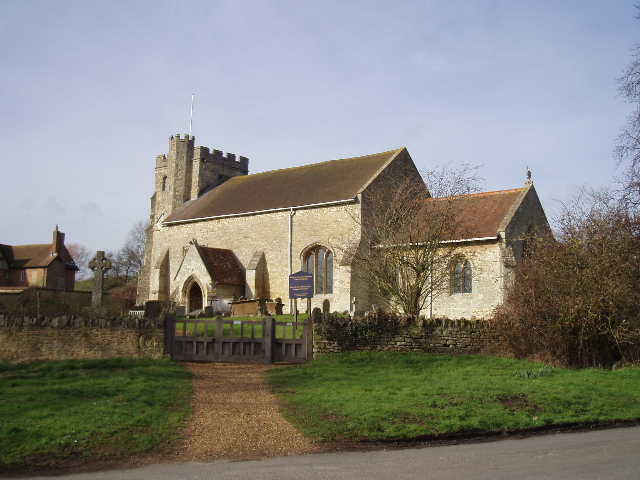
Thame Church

Image:Panoramio

In Thame - an attractive market town which once formed part of the estates of the Bishops of Lincoln (so Bishop Fleming was with me again) - I bade farewell to my friend and got the bus back to Oxford. A thoroughly enjoyable day out with good friends and conversation, and also plenty of history and architecture to enjoy.