Once I was a clever boy learning the arts of Oxford... is a quotation from the verses written by Bishop Richard Fleming (c.1385-1431) for his tomb in Lincoln Cathedral. Fleming, the founder of Lincoln College in Oxford, is the subject of my research for a D. Phil., and, like me, a son of the West Riding. I have remarked in the past that I have a deeply meaningful on-going relationship with a dead fifteenth century bishop... it was Fleming who, in effect, enabled me to come to Oxford and to learn its arts, and for that I am immensely grateful.


Showing posts with label Beauvale Priory. Show all posts

Monday, 4 May 2015

Carthusian and other martyrs of 1535


480 years ago, on May 4th 1535, the Carthusian Priors of London, Beauvale and Axholme, Richard Reynolds chaplain to the nuns of Syon Abbey and the rector of Isleworth were hung drawn and quartered at Tyburn for refusing to take the oath to the Henrician Act of Supremacy.


Today is the great feast honoring all of the Catholic Martyrs of the English Reformation: those canonized by Pope Paul VI and those beatified by Popes John Paul II, Pius XI, and Leo XIII. Many of the beatified martyrs, especially those declared martyrs by Popes Pius XI and Leo XIII, are not well known. Perhaps all the beatified martyrs should be canonized by Pope Francis?


This feast was moved to this date in 2000 with a new liturgical calendar for the dioceses of England and Wales approved by the
Vatican; then in 2010 it was elevated to a Feast (not just a Memorial). It is not a Feast or Memorial on the Liturgical Calendar in the USA--I think it should be!

Moving it to May 4 meant that the feast is celebrated on the anniversary of the protomartyrs of the English Reformation,
the Priors of the Carthusian order, a parish priest, and the confessor and chaplain of the Brigittine order at Syon Abbey. These five men, St. John Houghton, St. Augustine Webster, St. Robert Lawrence, Blessed John Haile, and St. Richard Reynolds, were brutally executed at Tyburn before a crowd of Court witnesses. Some sources even suggest that Henry VIII was there in disguise. Drawn on hurdles from the Tower of London (whence St. Thomas More saw them depart), they were hung and quartered while still alive.
Image and text: Supremacy and Suvival


There are online articles about the protomartyrs at John Houghton, Robert Lawrence, Augustine Webster and Richard Reynolds. As the last article points out St Richard was an outstanding spiritual consellor, and known as the Angel of Syon.

Whilst the other martyrs were being disembowelled he encouraged them with the idea that the sharp breakfast they were enduring would lead to the eternal banquet of heaven.

Fragments of the London Charterhouse survive in the present buildings at Charterhouse, and there are substantial fragments of the priory at Beauvale in Nottinghamshire. My previous posts about Syon Abbey can be found by clicking on the link at the end of this post. It appears likely that the pinnacle from the gatehouse of the abbey which the community of Syon has treasured in their wanderings to the Low Countries, Rouen, Lisbon and their return to Devon in 1861 is the one upon which was displayed one of St Richard's quarters following his execution.

This evening I attended a beautiful and well attended Extraordinary Form High Mass at the Oxford Oratory for the feast of the English Martyrs. This obviously commemorated all the martyrs of the years 1535 to 1681, but those from this day 480 years ago were especially in my mind.

Thursday, 6 October 2011

Carthusian reflections


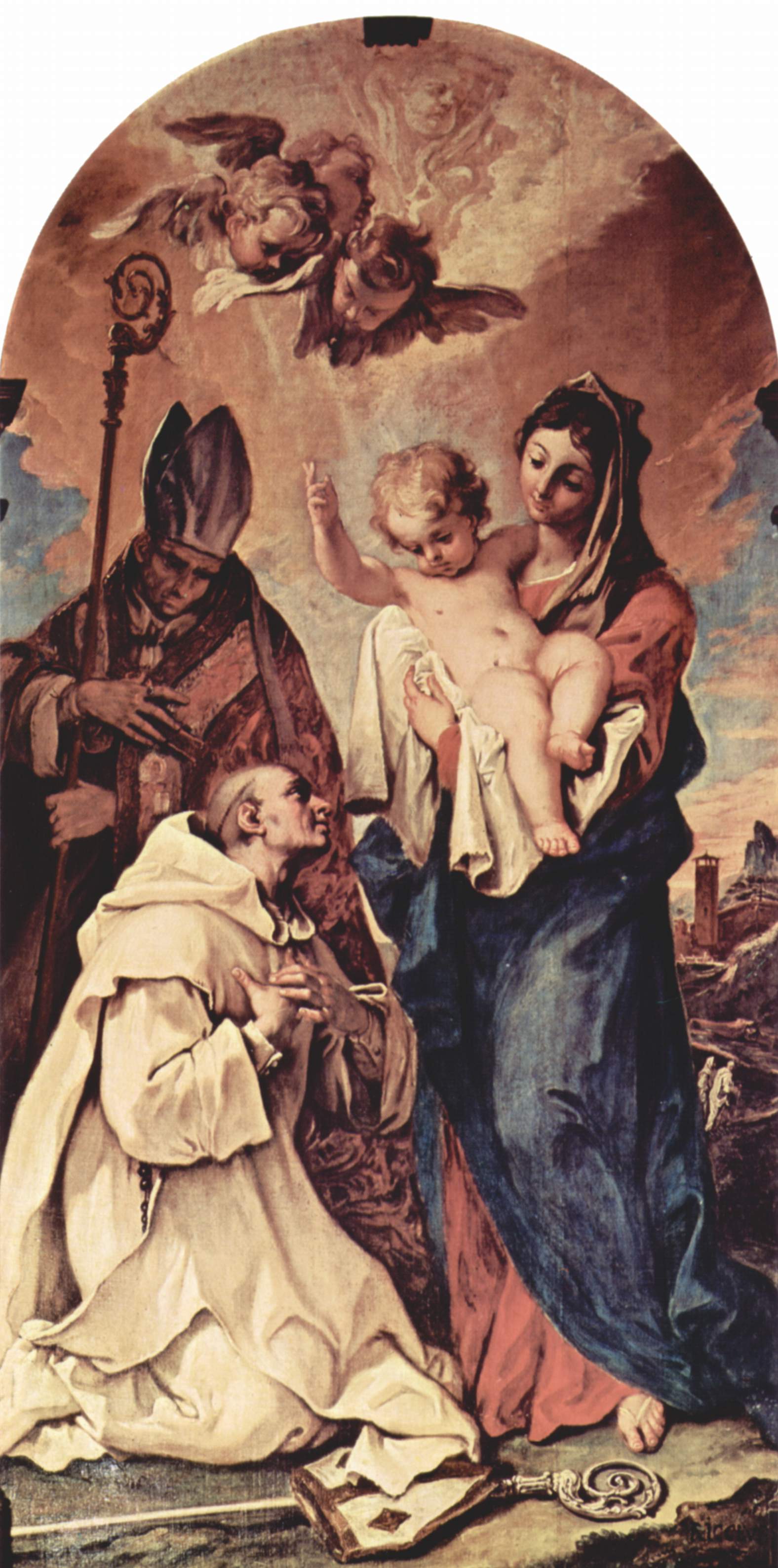
Today being the feast of St Bruno, founder of the Carthusians makes one's mind turn to thoughts and things Carthusian.

File:Sebastiano Ricci 024.jpg

The founder of the Carthusians, Bruno of Cologne (c1030-1101), adoring the Virgin and Child with Hugh of Lincoln (1135-1200) looking on in the background.
A painting by Sebastiano Ricci (1659-1734)

Image:Wikipedia

It was only when I read some of the writings of John Cassian (c.360-435) that I realised the extent to which St Bruno, following St Benedict's advice, had looked to that description of primitive Egyptian monasticism as a source for his monastic rule. That point is not, I think, one which is brought out adequately in the usual books on monastic life in the middle ages.

On the New Liturgical Movement there is a post
on The Sources and Shape of the Carthusian Liturgy which links to another piece by him from three years ago about the same subject - both are worth looking at.

The carthusians loom fairly large in the life of Bishop Richard Fleming. Not that that was unusual for a late-medieval member of the elite - this was one of the high points of Carthusian influence, when a Charterhouse was becoming a "must-have" for Kings and princes. There is, inter alia, King Henry V's foundation at Sheen, King James I of Scots foundation at Perth, the Castilian royal necropolis of King Juan II at Miraflores near Burgos and the Burgundian ducal one at Champmol in Dijon, and Thomas Duke of Surrey's Mount Grace here in England.

Fleming had links with at least three of the English houses. In his episcopal register
there are references to at least two stays at the house at Beauvale in Nottinghamshire. There is the VCH Nottinghamshire account of the house here, and one from Wikipedia here. There is also the website of the Beauvale Society, which has an excellent slide show of photographs of the existing remains of this tranquil and holy place. I have added that website to the sidebar for future reference.


The remains of Beauvale Priory
Image: Wikipedia


As Bishop of Lincoln Fleming was invited to consecrate a bell at the London Charterhouse, wjhich was not that far from his episcopal residence in the city, but it is a further indication of his links to the Carthusians.

Following his death in 1431 a Carthusian at Sheen, John Stone, wrote his Metrificatio around the lines Fleming wrote for his tomb at Lincoln. Stone clearly knew Fleming and this appears to confirm the presence of something of Carthusian spirituality in Fleming. Given his family connections and diocesan position I would not be surpised were I to discover a link with the house at Axholme, or indeed with the Yorkshire house at Mount Grace.

The house at Sheen - now Richmond in Surrey - is described by the VCH Surrey here and by Wikipedia here. The community was re-established in 1557 and went into exile inthe Netherlands following the death of Queen Mary I. There as Sheen Anglorum it survived until it was suppressed in 1783 by the Emperor Joseph II as part of his excess of zeal to regulate and interfere in church matters. Relics from it are held at Parkminster. There is an account of its history here.

Wednesday, 6 October 2010

Carthusian thoughts

Today being the feast of St Bruno is an opportunity to reflect upon the Carthusian order and its history. I was very struck when I read John Cassian by the way in which his description of early Egyptian monasticism is like the Carthusian model. This point is one that I had not seen brought out properly in more general books on medieval monasticism, and shows the influence of Cassian in the eleventh century - indeed is a reminder of his importance as a writer on monastic life for over a millenium.

More particularly my thoughts turn to that great flowering of Carthusian life in late medieval England and Europe. On several occasions I have visited the remains of Mount Grace Priory - or to give it its proper title that of the Assumption of Our Lady and St Nicholas of Mount Grace of Ingelby - and it is a moving and fascinating place to experience. Recent scholarship has shown how important it was in disseminating devotional texts in the fifteenth and early sixteenth centuries.


Mount Grace Priory

There is a good introduction to the priory here. After the dissolution the little chapel on the hill above the ruins remained as a recusant centre and has now been restored as a place of pilgrimage.

Mount Grace is the best preserved of the houses, but Beauvale in Nottinghamshire is an interesting ruin. The remains are now part of a farm and there are plans announced in 2009, to open it to the public. When I visited it in 1999 we had to view it from the road, but even from several hundred yards it is striking. There is an account of the priory here,and a series of articles from 1908 with other illustrations here, which is also well worth looking at. Both St John Houghton and St Robert Lawrence, two of the Carthusian martyrs of 1535, had served as Priors of Beauvale.

My particular interest in visiting the site, over and beyond my usual historical curiosity, was the fact that Bishop Fleming made at least two viists to stay at the Priory in the 1420s. He seems to have acted as an unofficial protector of the Carthusian order in England - perhaps inspired by the fact of being the latest sucessor of the Carthusian Saint Hugh (d.1200) at Lincoln. In 1428 Fleming is recorded as having consecrated the new bell of the London Charterhouse, where some parts of the monastic buildings survive in the current complex.


The ruins of Beauvale Priory in 2007