


The Pilgrimage begins at Glastonbury, that unique cradle of so many English traditions.
The amended post introducing the Glastonbury devotion to Our Lady can be seen at Marian Pilgrimage - Our Lady of Glastonbury
The statue in the Lady Chapel was claimed - time, circumstance and the catastrophic fire of 1184 notwithstanding - to be the work of St Joseph of Arimathea himself. According to Pynson’s ballad of 1520,
There Joseph lyved with other hermyttes twelfe
That were the chyfe of all the companye,
But Joseph was the chefe hym-selfe;
There led they an holy life and gostely.
Tyll, at the last, Jhesu the mighty,
He sent to Joseph thaungell gabryell,
Which bad hym, as the writing doth specify,
Of our Lady’s Assumpcyon to bylde a chapell
So Joseph dyd as the aungell hym bad,
And wrought there an ymage of our Lady;
For to serue her gret devocion he had,
And that same ymage is yet at Glastenbury,
In the same churche; there ye may it se
For it was the fyrst, as I vnderstande
That ever was sene in this countre;
For Joseph it made with his own hande
From Life of Joseph of Arimathea EETS xliv,43
Waterton, 280
Pynson was, of course, the man who preserved in another ballad the story of the foundation of the Walsingham shrine.
It was at about this time that the chapel of St Joseph was created beneath the twelfth century rebuilding of the “Old Church” or Lady Chapel, and that the penultimate Abbot, Richard Bere added a chapel of Our Lady of Loretto to the north transept. He had visited Loretto whilst in Italy and clearly sought to provide more for pilgrims to his abbey. It’s unusual position is indicative of the way the original house now at Loretto has only three walls in front of a cave. Nothing remains above ground of the Abbot’s chapel but its site is marked out in the turf.
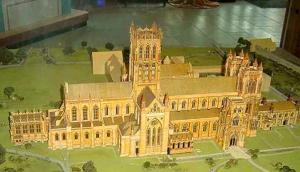
Model of Glastonbury Abbey on the eve of the dissolution in 1539.
The Lady Chapel is to the right, and the Loretto Chapel in the centre foreground extending west of the north transept.
Image: citydesert.wordpress.com
May Our Lady of Glastonbury pray for The King and all the Royal Family and for us all

Thank you, John, for your outstanding annual Marian Pilgrimage, starting at Glastonbury, today.
ReplyDeleteSuch a beautiful way to venerate The Blessed Virgin, and so necessary in today's World.
In addition, I am delighted to say that my local Church, at this Saturday morning's Mass, will be Crowning the statue of The Blessed Virgin in Her month of May.
And the Church will be packed, I can assure your readers.
Glastonbury must have been spectacular at its highpoint.🫤
ReplyDeleteThe ruins of Glastonbury Abbey, not to mention the martyrdom of Abbot Whiting and two of his monks in 1539, are as shocking a witness to the dissolution of the monasteries one could find.
ReplyDeleteDespite the scale and speed of the destruction - by the late seventeenth sentury nothing more remained than there does today of the abbey church - there survive a vast number of clues as to the appearance of the church in the still standing walls and in the scattered fragments of sculpture. From spending not a few hours pacing the ruins whilst staying at Glastonbury on retreat I came to the view that the great church could be reconstructed as a building up to the roof with something like 90-95% accuracy. Think of the before and after 1945 images of the Frauenkirke in Dresden, and what we see today. Drawing upon the not dissimilar work at Wells Cathedral and towers such as St John’s in Glastonbury would give a highly likely design for the central tower. The only doubt I have with the wonderful model is the three storied north pitch. Unless there is documentary evidence I have not seen I would imagine it as more like the north pitches of the cathedrals at Wells and Salisbury.
All we need to do now is raise the money and employ the masons….
Apologies for the typos - it should read as porch, not pitch, in the last few lines.
ReplyDeleteBlame the computer for being too clever by half ( or not )