Once I was a clever boy learning the arts of Oxford... is a quotation from the verses written by Bishop Richard Fleming (c.1385-1431) for his tomb in Lincoln Cathedral. Fleming, the founder of Lincoln College in Oxford, is the subject of my research for a D. Phil., and, like me, a son of the West Riding. I have remarked in the past that I have a deeply meaningful on-going relationship with a dead fifteenth century bishop... it was Fleming who, in effect, enabled me to come to Oxford and to learn its arts, and for that I am immensely grateful.


Wednesday, 8 March 2023

Evidence for Odin worship in fifth century Denmark


The NBC News website has a report about the analysis of a gold bracteate found in 2020 in a hoard at Vindelev in central Denmark. 

Not only is the hoard substantial and evidence for contact with the Roman Empire as it includes coins from there reworked as jewellery, but one of the bracteates by naming Odin as the patron of the ruler depicted on it in a sub-Roman style is the earliest tangible evidence for the cult of Odin in Scandinavia, and older than references on jewellery from the later sixth century in Germany. The piece is a very detailed piece of craftsmanship suggesting not only skill but an interest in copying Roman exemplars.

The bracteate is also an indicator of the position of the king or leader depicted on it and who was described as Odin’s man. It suggests a considerable degree of authority being exercised by the ruler under Odin’s guiding hand - a ruler who could successfully aspire to copying Roman imagery for himself.

The illustrated article can be seen at Viking treasure reveals oldest reference to Norse god Odin

Arkeonews also has an online article about the Odin reference on the bracteate and has more pictures. It can be seen at The Oldest Odin Inscription in the World Found in the Vindelev treasure


The Roman heritage of Leicester Cathedral


Excavation work in the churchyard of Leicester Cathedral in preparation for a new visitor centre has not only revealed many more skeletons than had been anticipated but also an important aspect of the life of the late Roman city and possible evidence of the direct replacement of a pagan shrine by an early Christian church. The cult to which the pagan shrine which lies in close proximity to the later church was dedicated is not clear, but the likelihood is that it was one of the eastern Mystery Religions that flourished in the Roman Empire alongside the emerging Christian Church. Like Christianity they offered believers insight into a hidden world and an apparent route to spiritual and physical rebirth. Unlike Christianity they were not seen as subversive of the political order and often appealed to the military.

The discovery is reported by the BBC News website at Roman shrine discovered near cathedral graveyard and by the Daily Telegraph at Legend proves true as Roman temple is found under Leicester Cathedral.

The iflscience website has another useful account of the excavation at Underground Chamber Found At Leicester Cathedral Suggests Folk Tale May Be True

The Leicester Mercury has a report on the discovery which also includes more about other finds from the site at Roman altar discovered underneath Leicester Cathedral

Leicester is known to have originated as a Roman city, and it still has important visible remains such as the Jewry Wall.

Nineteenth century legend had it that there were Roman remains under the church and thus has now been proved to be true. The church is partly medieval but was much altered in the nineteenth century, notably with the building of the tower and spire. It has served as a cathedral since 1926 and is dedicated to St Martin. This I think is important as a fact in so far as I have read a credible theory that churches dedicated to St Martin of Tours ( 316/336 - 397) may in many cases have originated as foundations made in the years following his death by clergy who looked to him as a patron and model. There is a Wikipedia life of St Martin at Martin of ToursGiven that he died before the military evacuation of Roman Britannia such churches in this country could indeed have a very late Roman or post-Roman origin.
 
His cult is thus often associated with early missionary activity - notably in Britain with the foundation of Whithorn Cathedral - or with late Roman sites, such as St Martin in the Fields in London, where recent excavations found such evidence. This argument can arguably be applied to St Martin’s in Canterbury, although opinion is divided as to its precise origin, as per Wikipedia at St Martin's Church, Canterbury There are other examples on urban sites that had definitely been occupied in the late Roman period such as York, and also, intriguingly, rural sites associated with late villas. The first canonised confessor saint, as opposed to being a martyr, he remained a very popular saint throughout the medieval period, and continued to be chosen as a patron of new churches, so not all of his churches can be credited with such an early origin.

This discovery can therefore seen as further evidence for continuity of occupation in the walled city and displacement of a pagan cult by the new, ever more Imperially supported, Christian Church. It may also be seen as an argument for an early Christian presence in Leicester about the turn of the fifth and sixth centuries. That all said it may well be that coincidence played a part and that direct continuity was not the case, but nevertheless the indicators would suggest in this case we more continuity and less rupture than was once thought.

I have only visited Leicester Cathedral once, and that was in particular to see the tomb of King Richard III. At that time the view was that the last Yorkist king had provided the cathedral and the city with a significant tourist attraction. Catering to that has led, I assume, to the building of the new visitor centre. That in turn has led to another significant archaeological discovery to put the cathedral on the visitor’s map. 


Tuesday, 7 March 2023

Conserving St Edward’s Chair


Several websites report the conservation work being done both on a continuing basis and also specifically in preparation for the Coronation on St Edward’s Chair in Westminster Abbey.

Every monarch crowned since 1399 has occupied it at their coronation except Queen Mary I in 1553, who had a new chair made for her, and Queen Mary II in 1689 who was seated in a replica alongside her husband sitting in the original at their joint ceremony.


The Daily Telegraph has additional detail in its account at Coronation Chair strengthened to take weight of King and ancient Stone of Scone

There are videos about the conservation of the Chair from Reuters at Britain's historic coronation throne gets a revamp and from The Independent at New details discovered on 700-year-old chair King Charles will sit on at coronation

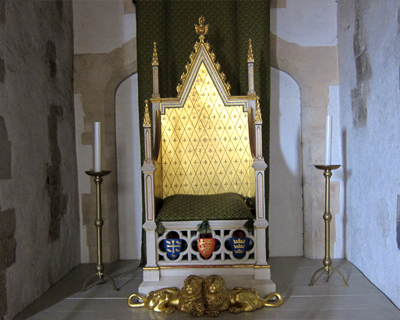
Thanks to centuries of not-so-benign neglect, and drastic treatment in the mid-nineteenth century, the Chair is a shadow of its original gilded and painted self. A recreation of what it might have looked like when first completed in 1300 can be seen in the recreated thirteenth century Royal apartments in the Wakefield Tower at the Tower of London: 

Image: travelforkids 

However there is a more accurate depiction of the design in a reconstruction showing the figure of St Edward on the back of the Chair in the excellent video by Allen Barton The Antiquary. This tells the story of the throne and of the Stone of Scone and places the Chair in the context both of Westminster Abbey and of the political and constitutional vision of King Edward I. I strongly recommend readers to watch it at St Edward's Chair - A History of the Medieval Coronation Chair and the Stone of Scone

There is a seperate history of the Stone of Scone from the BBC News website which can be seen at The disputed history of the Coronation Stone

Perhaps predictably the matter of the use of the Stone has been taken up by some Scottish Nationalists, as an be seen at King Charles coronation: SNP leadership contender backs calls to stop Stone of Destiny being used in London ceremony

This is an almost inevitable consequence of the return of the Stone to Scotland in 1996. I certainly believe it should return for the Coronation to Westminster but I can also certainly see the case for restoring the Scottish Coronation as a rite. Very different in form from the English ceremony at Westminster it could maybe take place at Scone as the essentially open air ceremony much of it was in the medieval period or in Edinburgh - after 1424 it took place at Scone only twice, in 1488 and 1651. Today there is a replica of the stone outside the post-reformation chapel on the Moot Hill at Scone. There is an account of the place of Scone in Scottish coronations and history from Wikipedia at Scone, Scotland


Monday, 6 March 2023

Roman Colchester


The oldest and also now one of the newest cities in the country, Colchester, continues to discover and interpret its very impressive Roman heritage.

Two recent online reports have drawn attention to the Colchester Vase, which is dated to the period 160-200, and is a high quality pottery vessel which depicts gladiators in combat. It was used to hold the ashes of a man who was apparently in his forties and who probably came from the continent. It is one of the few pieces of evidence for gladiatorial contests in Roman Britain. The Vase was discovered in the mid-nineteenth century and can be seen in the Castle Museum in Colchester when it reopens in July.

The BBC News website has an article about it which can be seen at Gladiators battled in Britain, evidence suggests

The History Blog has an account of the piece at Colchester Vase was gladiator sports memorabilia

Previous reports from the BBC News website indicate the scale of Roman Colchester - Camuludunum - as can be seen in a 2016 article at 'Largest Roman arcade' in Britain to go on show in Colchester and at Colchester Roman circus visitor centre a step closer from 2012.


Sunday, 5 March 2023

Ancient Sacred Places


The BBC News website has an interesting article about a new study of ancient sacred sites. The two examples highlighted are Alphamstone in Essex and Blick Mead in Wiltshire. The article can be read at Were these ice age rocks an ancient sacred place?

Alphamstone lies just to the south of the border of the county with Suffolk, and has a number of sarsen stones around the village, two of them in the churchyard and two more incorporated into the medieval church itself. This seeming continuity of worship from pagan belief to Christianity looks very similar to Stonor in Oxfordshire, Stanford Bishop in Herefordshire and the Rudston monolith in Yorkshire. In all four cases the historic church occupies and more or less incorporates the far more ancient standing stones. I was unaware of Alphamstone but the other three have definitely something of the numinous about them. The short, stub, Wikipedia article about the village does not mention the stones, but has some links to other websites can be seen at Alphamstone

Blick Mead is an early site where hunting and feasting occurred in the Stone Age. It lies very close to Stonehenge. The article links to a report about the excavations there in 2014. This can also be seen at Stonehenge dig finds 6,000-year-old encampment

One distinctive feature of the site is the fact that the water in the spring has the property of turning pieces of flint bright pink, which doubtless attracted the attention of early hunter-gatherers - possibly even more than that of the modern archaeologists.


Saturday, 4 March 2023

A thirteenth century hoard in Schleswig


Live Science reports the discovery in by a metal detector in Schleswig of a treasure hoard from the thirteenth century which contains Danish silver coins, which help date the hoard to sometime around or after 1234, Byzantine jewellery and an imitation Islamic coin.

The variety of the contents of the hoard point to trade in the post-Viking era as the medieval economy continued to flourish and expand. The fact of the discovery being made where it was points to the importance in such matters the position of Schleswig afforded to traders with links across Europe and the world beyond.


Friday, 3 March 2023

Ember Days


Today is the second of the three Lenten Ember Days which survive in the Traditional Mass and in the Ordinariate Rite, but which disappeared together with the other three sets of such days from the 1970 Novus Ordo. For an introduction as to how and why that happened see Fr Hunwick’s articles infra.

Wikipedia gives a good introduction to the  history of these centuries-old four seasonal fasting days at Ember days

I have posted about them myself in previous posts at September Ember Days, at More on Ember Days and in Ember Days

This week Fr Hunwicke, with his typical erudition, has commented on the origins in particular of the Lenten Ember Days and why they were added to the other three sets, as well as the post Vatican II removal of them from the Calendar at Ember Days? (1)at Ember Weeks (2)at So where have this week's Ember Masses disappeared to? and at Ember Sacerdotalism

Their very antiquity should have preserved  these days of fasting and discipline, as well as their customary use as the time for Ordinations. However in the 1960s the pursuit of simplicity and the desire to get away from ideas of fasting and discipline paid little or no heed to antiquity, nor to asking much of congregations in the way of penitential discipline.


Thursday, 2 March 2023

St Chad


Today is the Feast of St Chad, onetime Bishop of York during the absence of St Wilfrid, but better known as the missionary of Mercia who founded the See of Lichfield.

I have posted about him and about churches under his patronage in the past in articles such as Churches of St Chad from 2013, St Chad's Day from 2015, and St Chad, his relics and churches from 2021.

Last November one of his relics from his shrine in St Chad’s Cathedral in Birmingham was taken by the Archbishop and Chapter to its ancient home in Lichfield Cathedral where it was enshrined in a new altar on the site of the medieval shrine in the retrochoir and designed to be a focus of devotion to the saint.

There is a report about the ecumenical service, including the text of the homilies of the Archbishop and of the Bishop of Lichfield, from the Lichfield Cathedral website at The Reinstatement of the Shrine of St Chad, andfrom the Church Times at Relic of St Chad finds new home

May St Chad pray for his cathedrals and churches, his dioceses and all of us.