Once I was a clever boy learning the arts of Oxford... is a quotation from the verses written by Bishop Richard Fleming (c.1385-1431) for his tomb in Lincoln Cathedral. Fleming, the founder of Lincoln College in Oxford, is the subject of my research for a D. Phil., and, like me, a son of the West Riding. I have remarked in the past that I have a deeply meaningful on-going relationship with a dead fifteenth century bishop... it was Fleming who, in effect, enabled me to come to Oxford and to learn its arts, and for that I am immensely grateful.


Saturday, 18 December 2021

More on the Galloway Hoard


The Mail Online has an article with fine illustrations about the gold-mounted rock crystal vessel from the Galloway Hoard which I wrote about in my post earlier today concerning The latest revelation from the Galloway Hoard


Once again this brings out the importance of the discovery in terms of the insight it offers into the artistic and cultural achievements of ninth century lowland Britain and also the undoubted quality of the object itself. 


The latest revelation from the Galloway Hoard


The Guardian has a fascinating article about the cleaning and conservation of an item
from the Galloway Hosrd, about which I have posted previously in The Galloway Hoard revealed and in Unpacking the Galloway Hoard 

It is not clear if the hoard, buried it is thought about 900, was Viking loot or had been buried to protect it from suffering such a fate. The original provenance of the items that comprise the hoard may be either in what is now northern England or in southern Scotland or in some cases Ireland.

This newly publicised discovery is indeed remarkable, a small and exquisite carved rock crystal jar of Roman date which has been mounted in gold with a delicate mesh of wires enclosing the crystal.

This had been done at the behest of a Bishop Hyguald, who is otherwise unknown to history. The archaeologists appear to date the work to the late eighth or early ninth century, and the vase itself to being perhaps six centuries older. 

Such a reuse of an ancient vessel is strongly reminiscent of the collection amassed by Abbot Suger at St Denis in the early twelfth century.

Both on the basis of its delicacy and obviously special nature and that it was found enclosed in the remains of a silk lined leather pouch, as well as it being an epuscopal commission I would definitely think it was used  a Chrismatory. It is a comment on our times that the archaeologist describing it is given to  vagueness, or reluctance, to regard it as a specifically liturgical object.

Along with the great Northumbrian manuscript tradition and the treasures that have survived associated with St Cuthbert at Durham this is a further reminder that the Anglo-Saxon church was splendid in its sacred objects and liturgy. It was not the historically inaccurate idea beloved of trendy modernising ecclesiastics and designers or of uninformed filmmakers who see the era as one of homespun vestments and crude vessels


Friday, 17 December 2021

Restoring Tijou’s work at Hampton Court


The Art Newspaper recently had an article about the restoration of the ironwork screens created by the Huguenot exile Jean Tijou at the end of the seventeenth century for the newly laid out gardens at Hampton Court Palace. As the writer points out little is known with any certainty about Tijo, but his skill and artistry is unquestioned.


A medieval Norwegian falconer’s knife


A recent discovery in Norway of the bone handle of a knife carved to depict a regal figure with a falcon on their arm is reported by the Mail Online

The handle was found during excavations of part of medieval Oslo and it thought likely to be from the reign of King Haakon IV (1217-63) who was known to be interested in the royal, and expensive, sport of falconry. It is not clear if the carved figure is meant to be a king or a queen.

The illustrated article can be seen at Norwegian 13th century knife shows royal figure partaking in falconryIt includes at the end a link to a more detailed Norwegian account, in English, about the work involved in the discovery, the excavation and the importance of falconry in courtly society in the middle ages.


Music at Sutton Hoo and elsewhere


The Mail Online has an account of the identification of a fourth century lyre discovered in an archaeological dig in 1973 in Kazakhstan as being of the same type as that found at Sutton Hoo in 1939. Sutton Hoo is a seventh century site, but, along with other similar finds on the continent, the evidence suggests a common type of lyre whose use stretched much further than hitherto thought. Different from those of the Greek world this was a type that was apparently used from Britain across the North European Plainsnd east to Central Asia. I suppose this begs the question, probably unanswerable ( but then it is not my subject ) as to how much commonality there was to the music played upon these instruments.

Quite apart from the specifics of musicological history the general point is so important to note. The world of Sutton Hoo was a much wider one than just that of East Anglia or of the British isles or of Western Europe but of a world that stretched to the Mediterranean, Byzantium and further east.

The article about the Kazakh lyre can be read at Sutton Hoo lyre has a COUSIN 2,485 miles away, study reveals


Deacons and their stoles in the Ambrosian Rite


The Liturgical Arts Journal has another interesting post from Shawn Tribe about the Ambrosian Rite. This time he explains and illustrates the Ambrosian practice of the Deacon wearing his stole over the dalmatic rather than under it. He also demonstrates how this has preserved what was, in the first millennium, probably the universal practice.


Thursday, 16 December 2021

The French Coronation of King Henry VI and II


590 years ago on December 16th 1431 there took place the coronation in the cathedral of Notre Dame in Paris of King Henry VI of England as King Henry II of France.


Reims, the traditional place of coronation was inaccessible and had seen the coronation of King Charles VII more than two years earlier, so Paris was chosen for the celebration of King Henry’s sacré.

He left Rouen late in November and with a substantial military escort proceeded to Paris, entering the city to a lavish welcome with tableaux on December 2nd. Accompanying him were his great uncle Cardinal Beaufort, his uncle and Regent the Duke of Bedford, his cousin the Duke of York and the Earls of Suffolk, Salisbury, Warwick, Ormonde, Oxford and Huntingdon ( later Duke of Exeter ) together with the Cardinal’s nephew the Count of Mortain ( later Duke of Somerset ). Of these secular lords five were to die violent deaths in the Wars of the Roses, as did twelve of their sons. Such a possibility was doubtless very far indeed from their minds as they entered the city and awaited the coronation.

Although the Sainte Ampiule was unavailable being at the abbey St Remi in Reims, and had been used for the coronation of King Henry’s uncle and rival King Charles VII on July 17 1429, other pieces of the French coronation regalia were available. Held at the abbey of St Denis, just north of the city, the traditional symbols or French royal authority were used. So we can assume that King Henry received the so-called Crown of Charlemagne..,,,, and the royal sceptre made for his great-grandfather King Charles V.


The Crown of Charlemagne
The circlet appears to have dated from the time of King Charles the Bald and the lilies to have been added by King Philip II 1180-1223.
It was destroyed in 1794. It’s companion piece for the Queen had been destroyed in 1590.
There is more about this at ……

Image: Wikipedia 


Another picture of the Crown
One of the rubies enclosed what was held to be a spine from the Crown of Thorns.

Image: medart.pitt.edu

A reconstruction of the Crown as it may have appeared in the fourteenth and fifteenth centuries

Image: Pinterest

File:Sceptre de Charles V - Partie supérieure.jpg

The sceptre of King Charles V

Image: Wikimedia


The Coronation Sword Joyeuse
It was borne at French coronations between 1270 and 1825

Image:Wikipedia

Charlemagne's sword, the Louvre European History, Ancient History, Art History, Louvre Paris, Montmartre Paris, Vladimir Kush, Carolingian, Josephine Wall, Knights Templar
The hilt of Joyeuse

Image: 2careless on Flickr/Pinterest

The coronation was conducted and the Mass celebrated  by the King’s great-uncle Cardinal Henry Beaufort, the ‘Cardinal of England’. Just over two years earlier on 6 November 1429 the Cardinal sang the Mass at the Westminster coronation, but the rite of coronation itself was carried out, as of right, by Archbishop Henry Chichele of Canterbury. Now, in what was not the usual church or diocese for a French coronation any claims of the Bishop of Paris, Jacques du Chastelier, or Châtelier, who held the see from 1427 to 1438, were ignored, and there was no role for the metropolitan, the Archbishop of Sens, Jean Nanton, whose predecessor had blessed the marriage of the young King’s parents at Troyes in 1420. Cardinal Beaufort, as the most senior cleric present, and who was, by implication, representing the wider Church, officiated.

The French chronicler Monstrelet noted that the ceremony was more after the English than the French form, but does not give details. The two rites do share many features and it would be interesting to know what adaptations were made. When, for example, nine years earlier King Charles VI died the English administration had introduced elements of English royal obsequies for the procession to St Denis, notably the robed snd crowned effigy of the King on top of his coffin. This became a feature of later burials of French monarchs, as discussed by Kantorowicz  in The King’s Two Bodies

According to the later English writer Edward Hall in the sixteenth century at the feast, which I assume was held in the hall of the Royal Palace adjacent to the cathedral, and now known as the Conciergerie, which followed the Coronation everything “that might be bought for golde, nor nothing was forgotten that by mannes wish could be invented.” A contemporary French chronicler however thought the food poor - is that a leitmotif of Anglo-French relations? - and the tournament the following day was seen as unimpressive.

At the feast the Cardinal sat on the right hand of the young King to whom he gave as a keepsake a gold ring with a ruby. Fourteen years later King Henry was to have this remade as his wedding ring to give his bride Queen Margaret of Anjou.

That the events left a deep impression on the King is clear. In 1435 when the Duke of Burgundy renounced the English alliance and wrote to him as merely King of England the fourteen year old King wept and in his attempts to secure a negotiated peace in the late 1440s he refused to give up his title to France and his representatives declined to recognise King Charles VII as other than the King’s uncle in France.
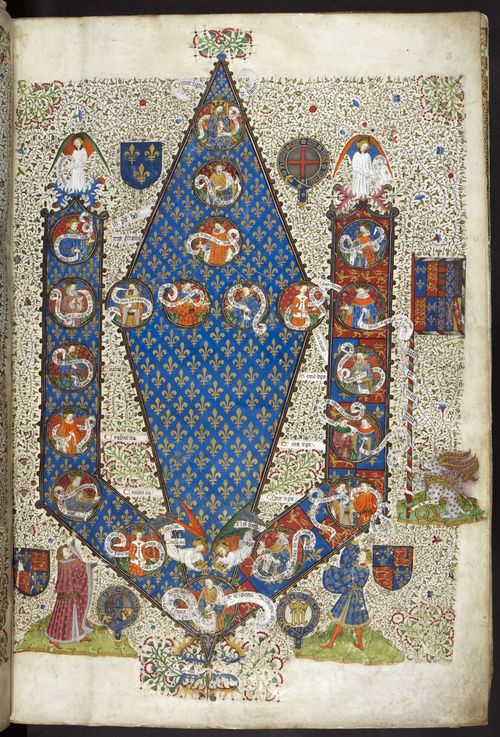
Royal_ms_15_e_vi_f003r


A celebration of the Lancastrian Dual Monarchy 

A genealogical table of the descendants of St Louis IX in the form of a fleur-de-lys, from Poems and Romances (the 'Talbot Shrewsbury book'), France (Rouen), c. 1445, Royal 15 E. vi, f. 3r

Image: British Library

For more about the manuscript see The Talbot Shrewsbury Book Goes Online


Tuesday, 14 December 2021

Sagrada Familia


There is a suitably Advent theme about the latest news from the long-running construction of Antonio Gaudi’s church of Sagrada Familia in Barcelona. This has now reached another milestone with the completion of the 452 foot high spire over the eastern end of the building. Dedicated to the Virgin Mary it is topped by an illuminated star of Bethlehem. This was lit for the first time on December 8th, the Feast of the Immaculate Conception.

Sagrada Familia was begun in 1882, and until his tragic death in 1926 was the principal project of Gaudi’s, a man of great personal piety and himself now a candidate for elevation to the altar as a beatus or saint. The history and design of the church is set out in Sagrada Família

This stage in the building is recorded in a piece on the Mail Online website and it includes pictures of the rest of this extraordinary church at The Mail gets a sneak peek at the new Sagrada Familia tower

It was hoped to complete Sagrada Familia in 2026, but the consequences of the pandemic appear to have delayed that. Nonetheless it does seem that in a few years this remarkable building will finally be completed. When that is so the central spire at 564 feet will outreach the 530 feet of that at the west end iof Ulm Minster, completed in 1890 and adding ten feet to the medieval plans. The story of the great church in Ulm can be read at Ulm Minster

I will add here the comment that although the claimed height of 584 feet for the fourteenth century timber and lead spire on the central tower of Lincoln cathedral which blew down in 1548 is now thought to be an exaggeration and not physically possible it is still thought to have been in the region of at least 525 feet tall, and to have been the tallest building in the world erected before the 1848 Washington Monument. No mean achievement for the early fourteenth century. By comparison the spire of Salisbury cathedral, also from the fourteenth century but in stone, is 404 feet high.

I only know Sagrada Familia from photographs and one can admire its exuberant and fantastic qualities without necessarily liking all of it or even all of its parts - and it is a building of many and complex parts. That is not to say I actually dislike it or that I fail to appreciate Gaudi’s vision of a stone forest stretching up from the earth in its yearning for God. It is a spectacular counterblast to secularism, indifferentism, atheism and the modern world. It is a strange irony of history that it is in a city which witnessed such horrors from the enemies of the Church in the late 1930s.

This is mysticism made material - or the material made mystical. Few, if any, ecclesiastical buildings of the past century snd a half do that, and none so spectacularly as Sagrada Familia. However I suppose the question lurking in my mind is on the lines of would I want to always go there for Mass? On this feast of that great Spanish mystic St John of the Cross this seems a thought to pose about mysticism - one can revere its fruits, one can admire its practitioners, but how comfortable with it do we more ordinary mortals feel?