Once I was a clever boy learning the arts of Oxford... is a quotation from the verses written by Bishop Richard Fleming (c.1385-1431) for his tomb in Lincoln Cathedral. Fleming, the founder of Lincoln College in Oxford, is the subject of my research for a D. Phil., and, like me, a son of the West Riding. I have remarked in the past that I have a deeply meaningful on-going relationship with a dead fifteenth century bishop... it was Fleming who, in effect, enabled me to come to Oxford and to learn its arts, and for that I am immensely grateful.


Friday, 2 September 2016

Ditchley Park


Today I had a wonderful day out with the Oxford University Heraldry Society. Their visits are always extremely civilised and informative, and this was no exception.
 Image result for Ditchley park

Ditchley Park

Image: The Ditchley Foundation

Our main destination was the early eighteenth century Ditchley Park near Charlbury, and we met up at Charlbury Station late in the morning. Before visiting Ditchley itself we went to Spelsbury Church, which contains the monuments of the Lee family, the builders of the house. The church is in origin medieval, but is now very much an eighteenth century reconstruction thereof. Within were the Lee family monuments and a group of coffin plates from the vaults, including that of one of their extended family, the Restoration rake John Wilmot Earl of Rochester. The monuments are a fine selection from the early-seventeenth century through to the mid-nineteenth century

 Image result for Spelsbury Church

Tomb of Sir Henry Lee (d.1631) and his wife in Spelsbury Church
Their children are grouped arond them on the tomb

Image: Church Monuments Society

After a sandwich lunch at a local pub we drove up to Ditchley - it takes its name from a prehistoric earthwortk in the Park - and wound along atree-line drive to find the house, which is both majestic and approachable, grand yet secreted away. Apart from Blenheim and Heythrop it is probably the most impressive Georgian country house in the historic county of Oxfordshire.

Ditchley Park is now owned by the Ditchley Foundation and I have somewhat adapted and edited the following few paragraphs fom their website:

Related image 

The South Front of Ditchley Park

Image:www.tvchp.com

The Ditchley estate was bought by Sir Henry Lee in 1580 when he was made the Ranger of the Wychwood Forest, the royal hunting forest based round the hunting-lodge at Woodstock. Queen Elizabeth I visited him at Ditchley in 1592, after he had an alliance with one of her Ladies-in-Waiting without her permission. Annoyed at this, so the story goes, the Queen stayed rather longer than she might otherwise have done, putting her host to considerable extra expense.  The visit is commemorated in the painting by Marcus Gheeraerts the Younger, “The Ditchley Elizabeth”, which shows Elizabeth with her foot on Oxfordshire and her toe on Ditchley.  This hung in the house until 1932 and is now in the National Portrait Gallery.


Image result for Ditchley park

The Ditchley Portrait of Queen Elizabeth I

Image:Thames Valley Country House Partnership

Four generations later Sir Henry’s heir, Edward Henry Lee, was created the 1st Earl of Litchfield (sic) in 1676 when he married Charlotte Fitzroy, the illegitimate daughter of King Charles II and Barbara Villiers, the Duchess of Cleveland, both of whose portraits hang in the White Drawing Room.
Image result for Ditchley park

The first Countess and Earl of Litchfield
Portraits in the White Drawing Room
 Image: The Ditchley Foundation

Their son, the 2nd Earl, built the present Ditchley Park in 1722, to a design by James Gibbs, architect of St Martins in the Fields and the Radcliffe Camera.  My reaction to the house was to see that despite its Palladian pavilions and curving links it still looked back to the style of the 1680s - the entrance floor is only slightlty raised, rather than being a piano nobile and the elevations are not those of Lord Burlington, Colen Cambell or James Paine. The interior was richly decorated by William Kent and Henry Flitcroft.
Image result for Ditchley park

The Entrance Hall

Image: The Ditchley Foundation

A somewhat curious feature are the misproportions of the staircases which suggest Gibbs was unsure as to how to make his design work out - it is an eccentric feature which mak s the house somehow more rather than less appealing.

In the grounds the fish pond was extended to form the lake in 1746.  After 1760 the Park was “naturalised”, with smooth lawns sweeping down to the lake, and the Great Temple or Rotunda was built in about 1760 by Stiff Leadbetter.

The 4th Earl died in 1776 without heir, and the estate passed to his niece, Lady Charlotte Lee, who had married the 11th Viscount Dillon, an Irish Peer. The Dillons had "Wild Geese" relatives in ancien regime France, some of whom were casualties of the Terror.

In 1807 the 12th Viscount employed Louden to build the Ha Ha, further extend the lake and plant tree avenues, many of which survive today. At that stage the family funds began to run short, so no alterations were made to the house in the subsequent century, when much modernisation altered the character of other country houses
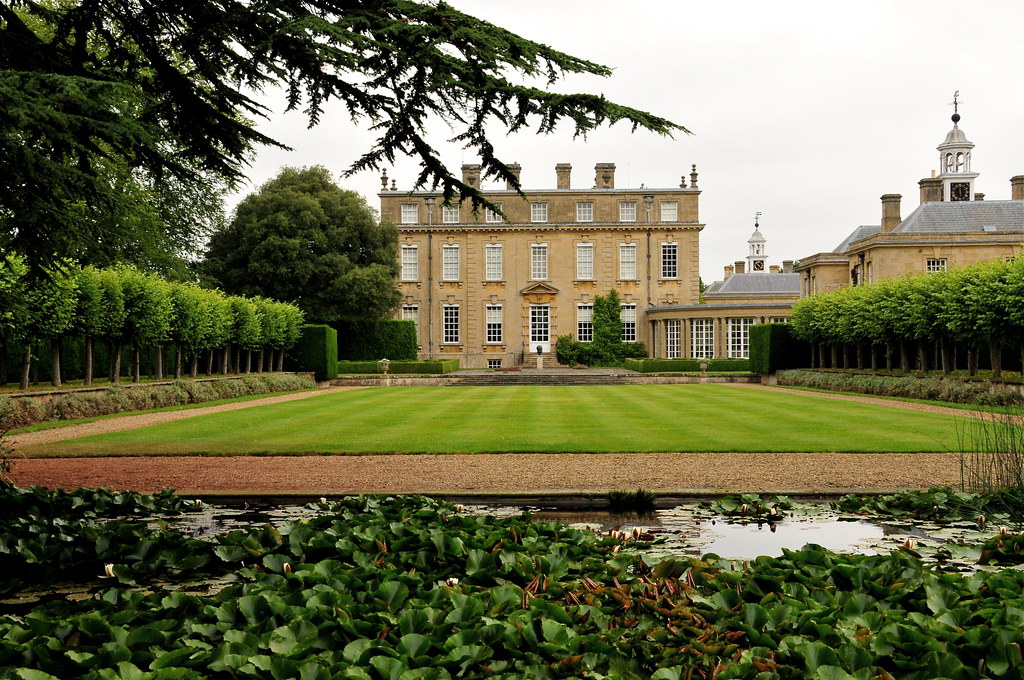

Image result for Ditchley park

 Ditchley Park from the west

Image: UltraPanavision on Flickr

The 17th Viscount Dillon died in 1932, leaving his family asset rich but cash poor when faced with the pernciousfact of death duties and the estate was sold to Ronald Tree, the Conservative MP for Market Harborough, a very wealthy Anglo-American (his description). Born here to American parents and educated in England he had returned to the US when his father died in 1914. He met and married Nancy and, after they returned to England, he was elected to Parliament and they bought Ditchley in 1933.  They restored the house sympathetically and with great taste.  Nancy subsequently married Colonel Lancaster, and as Nancy Lancaster became one of England’s premier interior designers as proprietor of Colefax and Fowler in the 1950’s and 60’s. Ronald and Nancy employed Geoffrey Jellicoe, then a relatively unknown young garden designer, to remodel the grounds. He laid out the Italian style sunken garden immediately west of the main house and resurrected the terrace to the north, part of the original Gibbs design. Under the Trees Ditchley regained some of its earlier social prominence, most notably through several visits there by Winston and Clementine Churchill.

Having visited Germany in the mid-1930s Ronald Tree sided with Anthony Eden and Winston Churchill against the more accommodating Government line and  made speeches in the House of Commons warning of Hitler’s intentions.

In 1937 Churchill and Eden visited Ditchley for a house party and clearly enjoyed the Tree's hospitality.  When the Battle of Britain started in 1940 Churchill was advised not to go to Chequers, the Prime Minister’s official country residence in Buckinghamshire, “when the moon was high” (the title of Ronald Tree’s autobiography), as German bombers were expected to attack it - the drive reflected the moonlight and this was thought to make it an easy target.  He invited himself (and members of his War Cabinet) to Ditchley for the weekend of 9-11 November 1940, and subsequently came for a further twelve weekends up to September 1942. Ronald Tree was at that time a Junior Minister in the Ministry of Information charged with fostering Anglo-American relations and invited many influential friends of Roosevelt, including Harry Hopkins, to meet Churchill during his Ditchley weekends.  The early stages of “Lend Lease” were negotiated at Ditchley.

In the general election in 1945 Ronald Tree lost his seat at Market Harborough and decided against a return to politics. He and Nancy divorced in 1948 and his second wife Marietta was disinclined to live in the English countryside.  He sold Ditchley in 1950 and returned to the US, living in New York and the Bahamas for the rest of his life. He returned to Ditchley posthumously and is buried in the churchyard at Spelsbury.


The estate was owned briefly by Lord Wilton, but he found it too large, and in 1953 it was bought by Sir David Wills, a member of the Wills tobacco family and a great philanthropist.  He donated the Mansion and 290 acres of parkland to the Ditchley Foundation, which was formed in 1958.  Sir David’s vision in creating the Foundation was to ensure that the UK and the United States had a venue for strengthening the transatlantic dialogue through discreet and relaxed discussions on matters of mutual concern - Chatham House Rules apply.  The first conference was held in 1962 and they have continued to be held regularly ever since.

The whole website can be seen at The Ditchley Foundation 

Ditchley is open to pre-booked parties, but not to individual visitors, so this was an opportunity less readily available to see the building. The house itself is very fine and the Nancy Tree redecoration sympathetic. Though it is run as a conference centre rather than being a family home it did not feel very "institutional" and one could easily imagine it as a house for entertainment on a grand and gracious scale.  We were given a very full and entertaining tour by the Administrator and he vividly recreated the world of Ditchley in the 1930s and 40s. 

As you leave you retain a sense of this house hidden away in the trees of the Oxfordshire countryside yet a place that deals in and keeps quiet about matters of public consequence.

This was another splendid OUHS day excursion and I am as always very grateful to all who made it possible. 


Thursday, 1 September 2016

Another new book on Queen Mary I


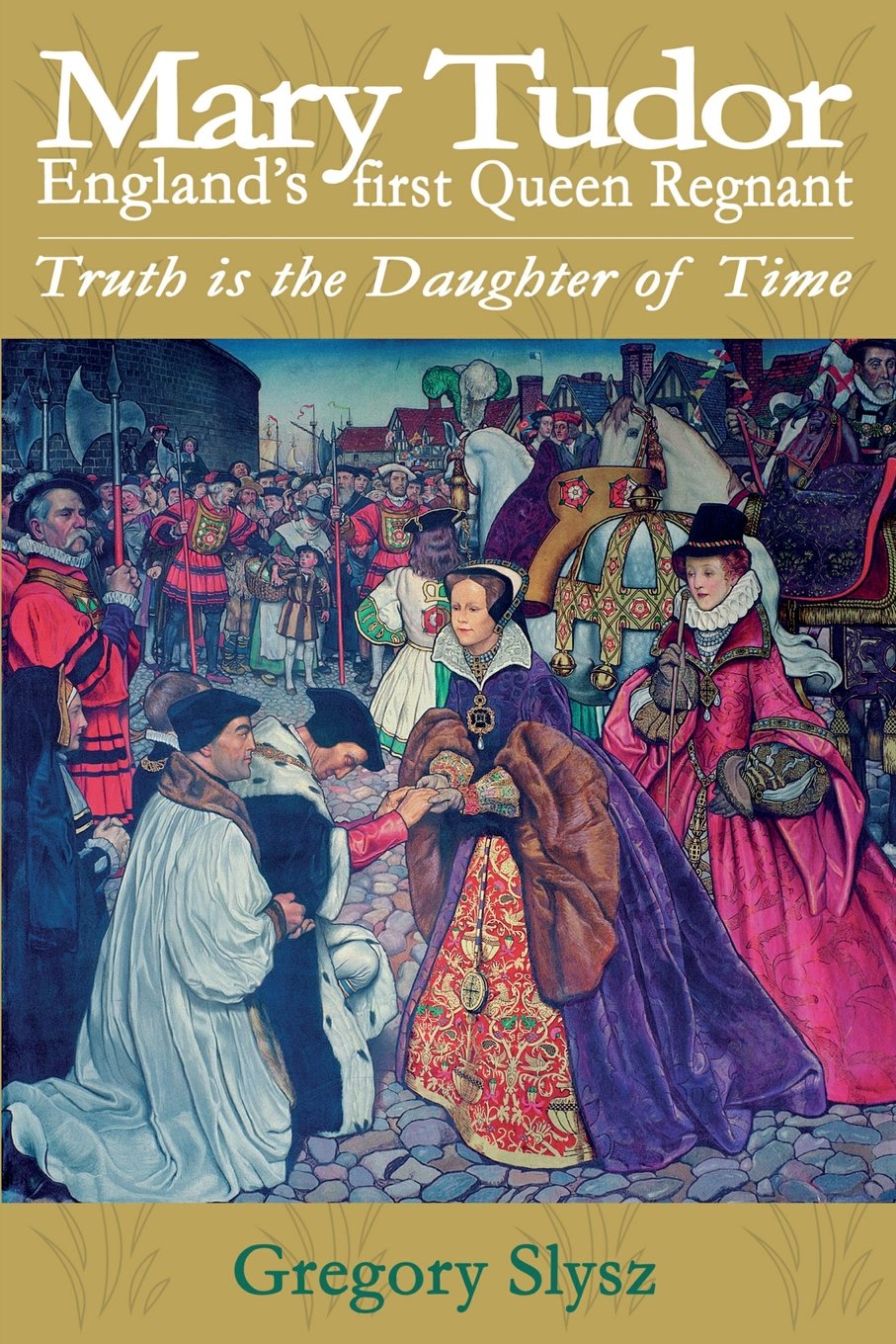
I came across another new book on the reign of Queen Mary I today. It is by Gregory Slysz and entitled Mary Tudor England's first Queen Regnant: Truth is the Daughter of Time and was published by Gracewing in 2015 ( ISBN: 978 0852448564 ) and costs £12.99.


Image: Amazon 
Part of the book's appeal is the interesting introductory section on the historiography of the reign as conveyed by near contemporaries and later generations. Indeed the influence of that historical perception of the reign is a theme which runs throught it. That widens the appeal of the book as more than an ainterpretation of the reign but also looking at issues of national identity and self-perception.

It looks to be a useful addition to the ever-expanding area of Marian studies.


Monday, 29 August 2016

Battle of Mohács 1526


Today is the 490th anniversary of the battle of Mohács. This was one of the most significant battles not only in Hungarian history but in that of Europe. If one consequence was the destruction of the medieval kingdom of Hungary and the advance of the Turks into the central Danuble plain where they remained until the end of the seventeenth century, another was the creation in consequence of that union of territories which constituted the birth of what was to become Austria Hungary.

In 1490 the death of King Matthias Corvinus led to the accession of the Polish Jagiellonian King Vladislaus II, under whom the central power of the monarchy in Hungary declined, aristocratic power increased, there was an increasing likelihood that the monarchy might become elctive as was to happen in Poland later on in the century, and meanwhile the Ottomans were gathering strength to the south. The political background is set out in the online account of the Battle of Mohács and in the related article on the leading nobleman John Zápolya.  As that points out it was the birth in 1506 of the future King Louis II that made the survival of the Hungarian Jagiellonians possible. In 1514 the  King Vladislaus II faced a major peasant rebellion led by György Dózsa - this had begun as a crusade against the Turks which then evolved into a jacquerie, which further weakened the realm.
King Louis II succeeded at the age of ten in 1516 to the thrones of both Hungary and Bohemia, and had been crowned in his father's lifetime in the case of each realm. He was taken up by the Emperor Maximilian who arranged adouble marraige, that of King Louis to the Emperor's grandaughter Mary, who was tens months oldere than him, and of Louis' sister Anne to Maximilian's second grandson the Archduke Ferdinand ( eventually the Emperor Ferdinand I ). As a dutiful Habsburg the Emperor did not pass up the chance of prudential and providential marriages for the next generation.

https://upload.wikimedia.org/wikipedia/commons/d/d4/Bernhard_Strigel_-_Emperor_Maximilian_I_with_His_Family_-_Google_Art_Project.jpg 

Emperor Maximilian I and his family in 1515
At the front the future Emperors Ferdinand I and Charles V and on the right King Louis II

Image: Wikimedia

http://media.gettyimages.com/photos/portrait-of-louis-ii-of-hungary-king-of-hungary-bohemia-and-croatia-picture-id164083896

King Louis II

Image:gettyimage.com 

 Image result for Louis II of Hungary

Queen Mary of Austria

Image: Pinterest 

 There is a biography of the young Hungarian king at Louis II of Hungary, who was just 20 when his army was crushed by the Ottomans at Mohács.


https://upload.wikimedia.org/wikipedia/commons/thumb/0/0a/Lajos_II.jpg/220px-Lajos_II.jpg

King Louis II

  A portrait by Titian

Image: Wikimedia

The King, fleeing from the battle was thrown by his horse and drowned. His body was recoverd and removed for burial elsewhere. A small gold hear badge he was wearing was returned to his Queen who wore it until her death in 1558, when her will directed it should be melted down and the proceeds given to the poor.

https://s-media-cache-ak0.pinimg.com/originals/f6/ee/95/f6ee950203042e2eecc204c0a04e32ff.jpg

The recovery of the body of King Louis II as shown in a nineteenth century painting

Image:Pinterest

  Image result for Louis II of Hungary 

King Louis II

Image: Pinterest

Tournament Sallet Made for Louis II, King of Hungary and Bohemia 

Tournament sallet made for King Louis II

Made in Augsburg and attributed to Kolman Helmschmid ~1525.

 Image:pinterest 

“May Allah be merciful to him, and punish those who misled his inexperience,” said Suleiman of his 20-year-old opposite number. “It was not my wish that he should thus be cut off, while he had scarcely tasted the sweets of life and royalty.”

The Sultan was less merciful to his prisoners - two days later came theie execution as recounted at  1526: 2000 Hungarian prisoners after the Battle of Mohacs

Mohács was decisive and disastrous - I gather a Hungarian proverb to set things in context of a disaster or failure is "Things were worse after Mohács." It marks the last of a series of late medieval battles which were major defeats for the Christian side in the conflict with the Ottomans - the Plain of Blackbirds ( Vivovdan) in 1389, Nicopolis in 1396, Varna in 1444, the loss of Constantinople in 1453 and finally Mohács in 1526. John Hunyadi's victory at Belgrade in 1456 merely helped to slow the Ottoman advance.

The death of King Louis marked the end of the legitimate male Jagiellonian line in Hungary and Bohemia. His sister Anne was married to Ferdinand of Austria who succeeded him, but Hungary came to be split between him as King Ferdinand I and John Zápolya who reigned as King John I  and who died in 1540. In 1541 Ottoman control over the centre of the realm. King John I's son succeeded him as a baby and was established as ruler in Transylvania, a position he more or less held with various titles until his death in 1570 - there is an account of him at John Sigismund

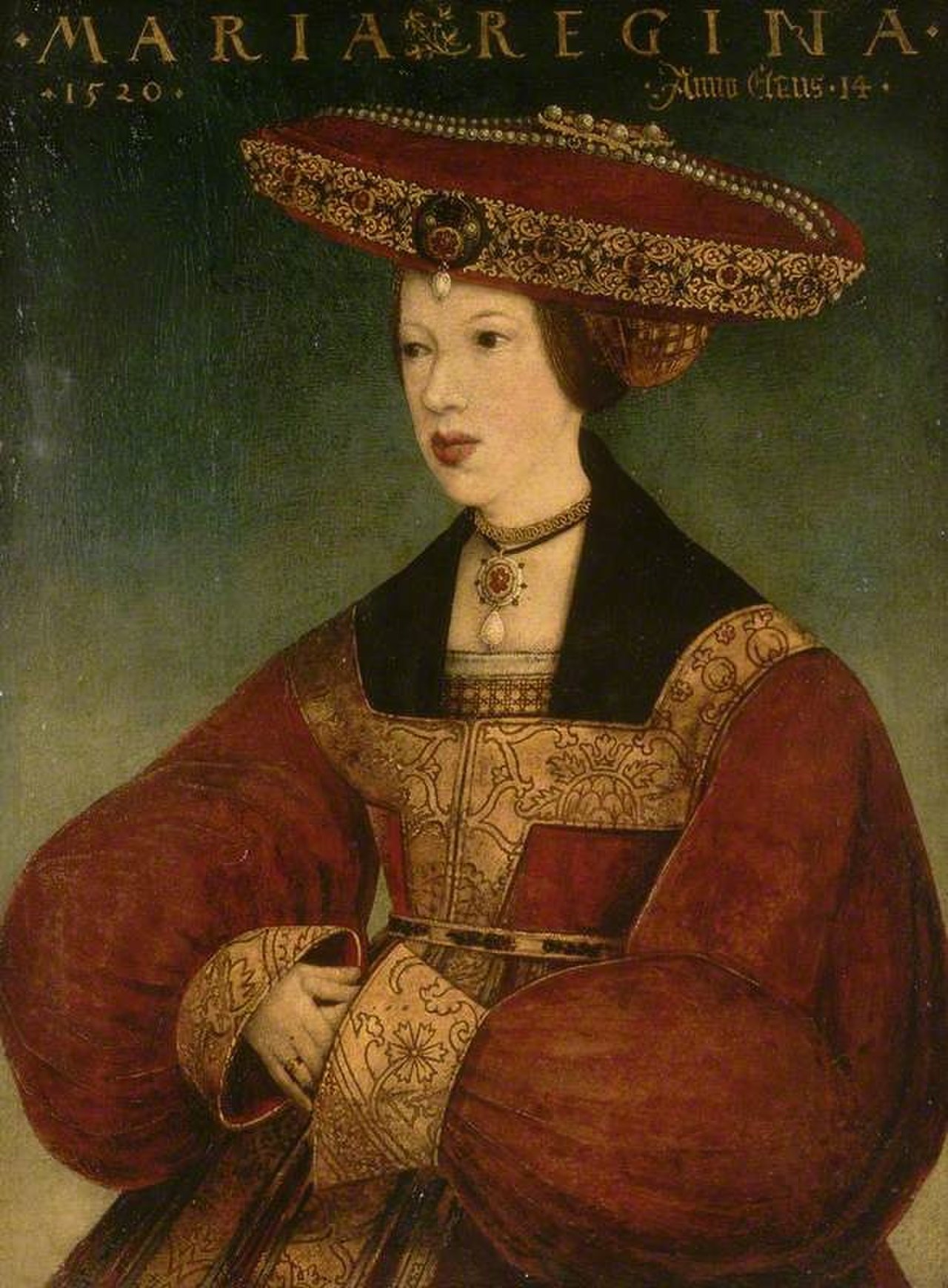
The portraits of King Louis and Queen Mary as well as his tournament sallet are a reminder that the late medieval Hungarian court was very much part of a wider European world, reinforced by Habsburg and Foix links to the west and by the early arrival in Jagiellonian Poland of renaissance culture.

 Queen Mary of Hungary in 1520

Hans Maler zu Schwaz

Image: Wikipedia

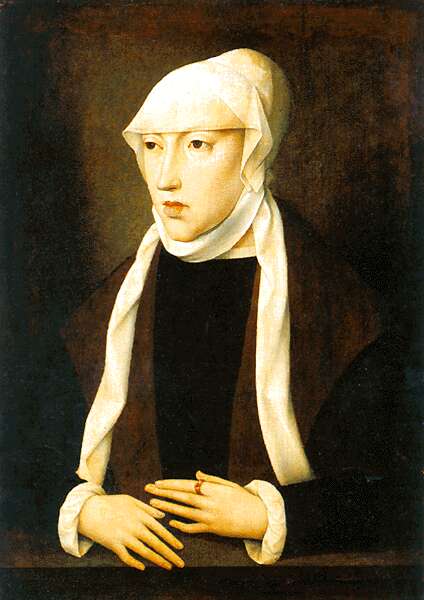
The widowed Queen declined to remarry and mourned her husband until her own death over thirty years later.  After a period as Regent for her brother of his part of Hungary Queen Mary served as Regent of Netherlands for her brother the Emperor Charles V. She appears to have been a capable and intelligent ruler, who then accompanied him in his retirement to Spain in 1556, but was preparing to return to the Netherlands as regent when she died in 1558. There is an illustrated account of her life and role as a patron in Mary of Hungary (governor of the Netherlands)

portrait of a thin woman in brown clothing and a tan head covering

  Queen Mary in 1531 - aged 26

Portrait by the Master of the Life of the Magdalen

 Image: Wikipedia

The ultimate succession in Hungary fell to Anne and Ferdinand - Holy Roman Emperor after his elder brother's abdication in 1556 - and thus the Habsburg Austro - Hungarian monarchy began to be a reality. Anticipated in other dynastic unions over the preceding two centuries it now took on aform it was to develop and expand over almost all the next four centuries.


Sunday, 28 August 2016

Queen Victoria's coronet


The following story turned up in the mailing from the agency site Royal Central:


Image result for Queen Victoria coronet 

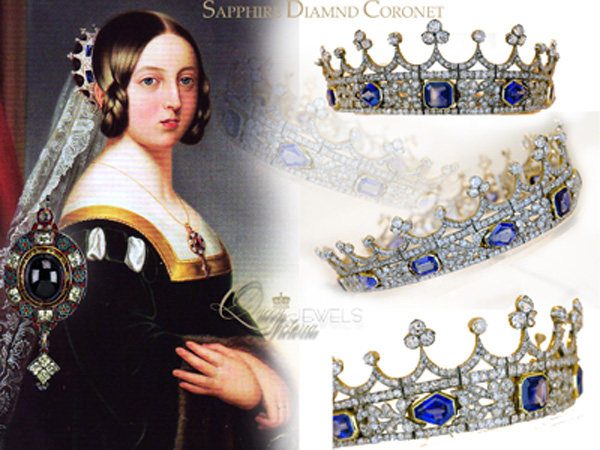
Queen Victoria's sapphire coronet

Image: The Natural Sapphire Company

The UK government have placed a temporary export ban on Queen Victoria’s coronet in an attempt to keep it in the country.
Queen Victoria’s sapphire and diamond coronet is at risk of being exported from UK soil unless a buyer can be found for the £5 million piece.
Designed by Prince Albert in 1840, the coronet is considered one of the most important jewels in Queen Victoria's reign. Goldsmith, James Kitching, was paid £415 to make the coronet.
Following Prince Albert’s death in 1861, Queen Victoria spent a great amount of time in mourning and did not attend the State Opening of Parliament five years later until 1866 where she wore the coronet instead of her coronation crown.
Culture Minister Matt Hancock said: "Queen Victoria’s coronet is stunning. It is one of the most iconic jewels from a pivotal period in our history and symbolises one of our nation’s most famous love stories. I hope that we are able to keep the coronet in the UK and on display for the public to enjoy for years to come."
The coronet was given as a present to Princess Mary upon her marriage to Viscount Lascelles in 1922 by King George V and Queen Mary. Years later it was sold to a dealer in London, who then sold it to the export licence applicant.
The export licence has however been deferred as a result of the coronet's close connection with our history and natural life, according to the Reviewing Committee on the Export of Works of Art and Objects of Cultural Interest (RCEWA).
RCEWA member Philippa Glanville said: "Key to the self-image of the young Victoria, this exquisite coronet was designed by her husband Prince Albert. Worn in her popular state portrait by Winterhalter of 1842, the year it was made, its combination of personal meaning and formality explains why she chose to wear it in 1866, emerging from mourning for the State Opening of Parliament.
"It evokes vividly the shared romantic taste of the time, and its form has become familiar through many reproductions. Its departure would be a great loss, given its beauty, its associations and its history."
The export of the Coronet has been deferred until 27 December 2016. This could be extended June 2017 if a serious intention of purchase can be found.
An illustrated version of the same report from the BBC News website can be seen at Export ban placed on Queen Victoria's wedding coronet


The history of the coronet and the apparent background story about its appearance on the market is set out in a post on the Royal Musings blog at The last time Queen Victoria's Coronet was worn -- so what's the story

I would agree with the writer of that post that the coronet shold, and probably will, stau in this country and share her implicit questioning of what the Harewood family have done in selling this piece rather than offering it in settlement or coming to some arrangement with the Royal Collection.


https://royal-magazin.de/wp-content/uploads/queen-victoria-coronet-sapp.jpg

  Queen Victoria wearing the coronet

Image: royal-magazin.de


Friday, 26 August 2016

Emperor Napoleon III in Chislehurst


Yesterday I travelled with a friend to the wedding of another friend at Chislehurst on the borders of greater London and Kent. As we arrived I recalled and commented upon the fact that Napoleon III lived in Chislehurst from his exile in 1871 until his death in January 1873, but thought no more of the fact.

When we were in the church of St Mary, which from the outside is a typical mid -nineteenth century suburban church in the early gothic style, and tucked away amidst suburban houses, we were sitting towards the back of the building and my eye noted an elaborate memorial on the south side of the nave just in front of the chancel step, complete with crowns on the finials. Opposite, on the north side of the church, was what appeared to be a rather elaborate chapel. After the ceremony as the photographers arranged and rearranged people into photographic order outside my travelling companion and I looked around the church.

Image result for chislehurst catholic church

St Mary's Chislehurst from the north east
The Imperial Chapel is in the foreground

Image: North West Kent Family History Society 

Image result for Chislehurst catholic church

The chancel of the church - but not yesterday

Image: Gateshead Revisited 

The Bonapartes had certainly been here. The monument I had spotted on the south was that of the Prince Imperial, who was killed in the Zulu War in 1879, whilst the chapel on the north had held the granite sarcophagus, donated by Queen Victoria, of  the Emperor Napoleon III from his death in 1873, until both were removed to her new foundation at Farnborough by the Empress Eugenie. The widowed Empress lived in Chislehurst until 1885, and when she died in 1920 was buried with her husband and son at Farnborough.

There is an illustrated account of the Emperor's funeral at the website of the Chislehurst Society at Funeral of Napoleon III and the Society also has a piece, again with pictures, about his son at The Prince Imperial. The Prince was well regarded in England and Queen Victoria erected a memorial to him in St George's Windsor. There is another account of him at  Napoléon, Prince Imperial

There is a video link to a guided tour of the church at St Mary's Catholic Church | Visit Chislehurst

Camden Place, where the Imperial exiles lived, is now Chilehurst Golf Club's club house.

  Image result for chislehurst catholic church Prince Imperial tomb

The Imperial Chapel

Image: Taking Stock

Image result for chislehurst catholic church Prince Imperial tomb 

The tomb of the Emperor whilst at Chislehurst

Image: Chislehurst Society

Image result for chislehurst catholic church Prince Imperial tomb 

The monument to the Prince Imperial

Image: Taking Stock 

In addition to attending a very enjoyable and happy wedding - which was why we were there at all of course - finding these historic connections was a fascinating bonus.


Wednesday, 24 August 2016

The return journey from Belmont


This morning we packed up and left Belmont after breakfast to make our return to Oxford. I gather that we as the Brothers from the Oratory had managed to impress the monks at Belmont by our assiduity in attending the Offices in church. I think we all wish to return at some time or anothe rto the peace and dignity of the abbey and its community.

https://upload.wikimedia.org/wikipedia/commons/6/6b/Belmont_Abbey_-_geograph.org.uk_-_945221.jpg

Belmont Abbey church from the south east

Image: Wikimedia/geograph.org.uk

Our first stop was in Hereford. Our time there was spent mainly in and around the cathedral, with Fr Jerome checking that all was well with the fine array of monumental brasses the cathedral still posseses despite the depredations of time, destruction and neglect. On ehe poined out to me is the  brass of a Dean from just before the reformation which has two represntations of the Holy Trinity - one being the standard late medieval enthroned father holding the Crucifix with the Holy Spirit hovering and the other, unique in his enormous experience of brass iconography, is the Orthodox equivalent, the Three Angels in the Hospitality of Abraham.

We also went into the Catholic church of St Francis Xavier, which is close by and holds the relic of St John Kemble I posted about in conecction with our pilgrimage to his grave.

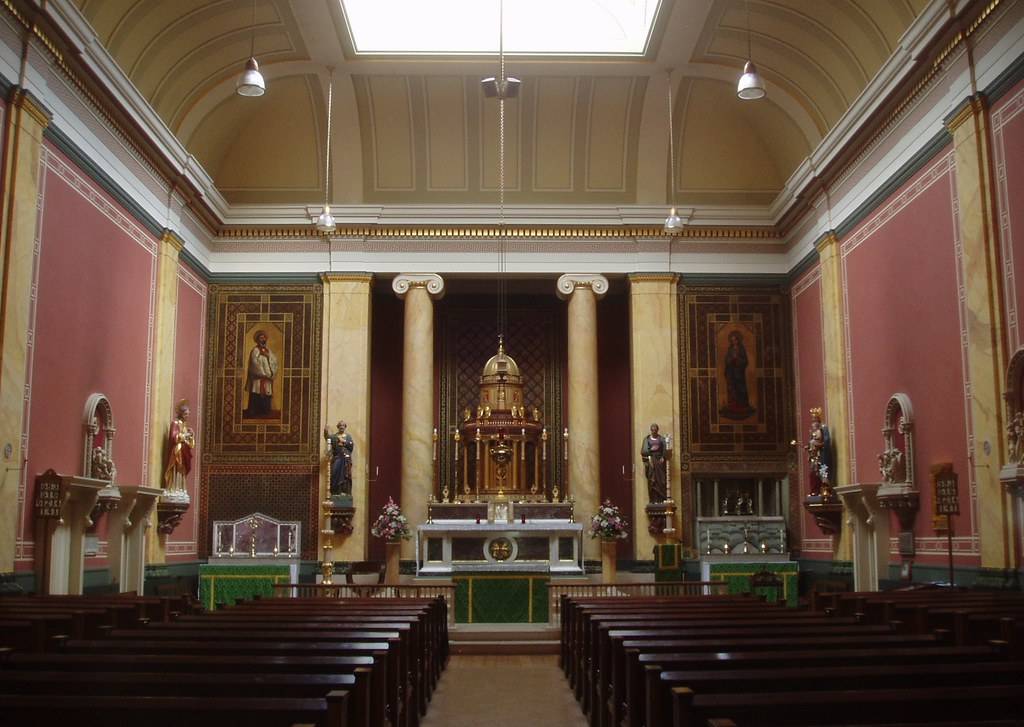
Image result for hereford catholic church

 The interior of St Francis Xavier Hereford
The relic of St John Kemble is at the altar on the right

Image: Flickr

I have visited the church before and it is beautifully appointed and cared for. It is in the care of the monks of belmont, one of whom occupies the Presbytery anmd is Pariah Priest
After a bit of shopping in the open market  we set off, past the remains of the Hereford Blackfriars and the unique survival of the Preaching Cross from their graveyard. This is not far from the site of St John Kemble's martyrdom. We did not stop at the Blackfriars and the following notes and illustrations are taken from an online source:

One of Hereford’s hidden gems is the Black Friars Rose Garden hidden down a passageway in Widemarsh Street.  The garden contains the remains of the friary of the Black Friars, once one of the city’s most important religious houses.  The Black Friars were given the site outside Widemarsh Gate in around 1246 and the monastic buildings were consecrated in around 1276.  The Black Friars were also known as ‘Friars Preachers’ and regularly gave sermons to the local populace from their preaching crosses.  The cross in the grounds is one of the few surviving examples in England and was considerably restored in the 19th century.

IMG_0428

In 1538 the Friary was dissolved by Henry VIII and the buildings were converted into a fine town house by Sir Thomas Coningby of Hampton Court near Dinmore.  This was badly damaged during the Civil War and later became a farm building.  The existing ruins are the Refectory and the Prior’s House dating from about 1322.

IMG_0436

In the 13th century the roadside site was occupied by a house of the Knight’s Hospitallers of St. John of Jerusalem, and parts of the hall and chapel dating from this period are now incorporated into the almshouses built by Sir Thomas Coningsby in 1614.  Grouped around a quiet quadrangle, the twelve separate lodgings were formerly used to accommodate a chaplain and eleven retired soldiers, seamen or servants who were known as ‘The Coningsby Servilors’.

IMG_0429

The preaching cross and monastic ruins are now set in an attractive rose garden

Text and images;shawsseasonalliving.

We called in at a pub for lunch, before our final stop at the church at Stanford Bishop near Bromyard.


Image result for Stanford Bishop church

 Stanford Bishop church

Image: Birmingham Post

This is an intriguing place and raises all manner of historical and archaeological questions. The parish is a scattered community and the church stands by itself on a low eminence. Dedicated to St James it  is not mentioned in Domesday Book, and the present, rather plain structure is mid- to late-twelfth century, when the cult of St James was at its height. There is more about work of that period at St James, Stanford Bishop, Herefordshire · The Corpus of Romanesque Sculpture

However what we had come to see is claimed to be much older - the chair of St Augustine, in which he sat - and continued to sit rather than rise - at his fateful and futile meeting with the British bishops in 603.

http://www.catexpert.co.uk/wp-content/uploads/2012/12/herts-st-augs-chair.jpg 

The reputed Chair of St Augustine

Image: catexpert.co.uk

The story of the chair can be read in an article from the Birmingham Post from 2014 at The battle over a chair once thought to be the oldest in Britain, and from which I quote "The earliest claim for its importance was made in the 1840s. Some years afterwards, the chair was discovered in the church tower, when a restoration of the church was taking place, probably in the 1890s. Later on it was turfed out, and served the church sexton as a piece of garden furniture. Later still (in 1899), when it was recognised that the chair might be of major importance, the church authorities presented it to the Beaney Institute or Royal Museum in Canterbury"

In 1943 it was returned to the church and scholarly opinion at the time thought it might be no earlier than eighteenth century in date.  

This is clearly an ancient site.  There is a prehistoric standing stone by the gate into the churchyard and within an ancient yew - there is more about these at  Stanford Bishop Church Stone Standing Stone (Menhir) It may have once been the site of circle, or perhaps a place of assembly. It lies close to the county boundary with Worcestershirewhich is essesntially the same as that between the seventh century sub-Kingdoms of the Hwicce ( represented by Worcestershire, Gloucestershire and part at lease of Oxfordshire - Hwicce as in Wychwood ) and the Magonsaeten ( the medieval diocese of Hereford ). If the ill-fated meeting did not take place at Aust on the banks of the Bristol Channel, as is usually claimed, could it have taken place ata  recognised place of meeting near the borders of two tribal units? looking around from the slightly raised site occupied by the church it is a tempting hypothesis. Time to get the a dendrochronologists to work I suspect.

We travelled back across Worcestershire - a subtly different landscape from that of Herefordshire - and had time to look slightly wistfully as we drove past at the remains of Pershore Abbey in the middle of that attractive town, but had not the time to stop. Pershore was Benedictine, and today just the choir, south transept and central tower of the monastic church survive:

Image result for Pershore abbey

Pershore Abbey from the south east

Image: Wikimedia

Image result for Pershore abbey

 Pershore Abbey from the south west

Image:pershoreabbey.org.uk

Then we continued our journey ascending Broadway Hill with its panoramic view of the county and on home across the edge of the Cotswolds to the Oratory and Oxford - and the chance to collect my mobile phone which has been in for repair, of which I have been physically and emotionally bereft.

This has been a wonderful break both spiritually and recreationally and I am immensely grateful to all who made it possible, Fr Jerome, the community at Belmont, my fellow Brothers and others besides.

Tuesday, 23 August 2016

More Exploring in Herefordshire and Monmouthshire


Today we were blessed with even better weather than yesterday for our second day of exploration of the Herefordshire and Monmouthshire borderlands.

We began with a visit to probably the most famous church in Herefordshire, that of St Mary and St David at Kilpeck. Dated to c.1135 it is a spectacular display of sculpture from the Herefordshire school or workshop that has survived almost nine centuries due to the quality of the stone.  The church is in reality smaller than I had imagined from photographs, but in all other respects more than lived up to expectations.


Image result for Kilpeck Church

Kilpeck Church
The bell cote is a skillful nineteenth century addition

Image: The Sheela Na Gig Project 

 
Image result for Kilpeck Church


The south door of Kilpeck Church

Image: kilpeckchurch.org.uk 

One point that occurred to me was whether the church was originally externally rendered on the plain wall surfaces and painted probably white and the external carving picked out in colour.

On the corbel table of the chancel is one of the best known examples of a Sheela na gig ( not, of course, something one would illustrate on a family-minded blog like this ) but about which there is information at Sheela na gig, at The Sheela Na Gig Project and at Theories – The Sheela Na Gig Project. The Kilpeck example is discussed and illustrated at Kilpeck – The Sheela Na Gig Project

Adjoining the church to the west are the remains of the motte, with the remains of a shell keep, and bailey of Kilpeck castle and to the east earthworks of an abandoned part of the medieval settlement.

We then drove down and crossed over into Wales, the  hills to the side of the road sculptured by nature into sugarloaf shapes that looked almost too good to be true. Our destination was the historic town of Abergavenny.

Our first visit was to Abergavenny Priory. I suppose because it is just in Wales it fails to make an appearance in books on English churches. This is a pity as St Mary's Priory deserves to be better known than I suspect it is. There is an account of it at Priory Church of St Mary, Abergavenny

Image result for abergavenny priory

  Abergavenny Priory from the north

Image: Wikimedia

Image result for abergavenny priory

Abergavenny priory from the south-west

Image; The churches of Britain and Ireland

  http://gb.fotolibra.com/images/previews/649097-interior-st-marys-priory-abergavenny.jpeg

The choir of Abergavenny Priory

Image:fotolibra.com

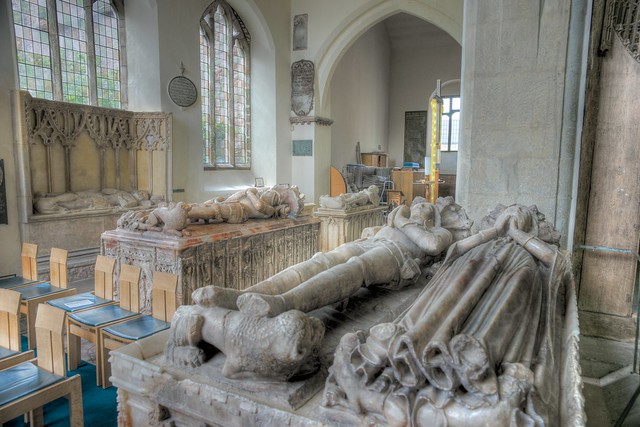
I knew it possessed a fine set of late medieval monuments, but only a visit can do justice to the array in the south aisle or Herbert chapel of the choir. The monuments have recently undergone an extensive and careful restoration.

https://c1.staticflickr.com/4/3132/5748423386_e92d254e4b_z.jpg

 The view across the Herbert Chapel

Image:stacticflickr.com

Image result for abergavenny priory

 Tomb of Sir William ap Thomas and his wife Gwaladys

He fought at Agincourt

Image abarothsworld.com

 Image result for abergavenny priory

Sir Richard Herbert of Coldbrook, 1440-69, and his wife

He was beheaded after the battle of Edgecote

Image: HumphrysFamilyTree.com

  http://www.britainexpress.com/images/attractions/editor/Abergavenny-Priory-6991.jpg

The tomb of Richard Herbert of Ewyas 

His family can be seen kneeling either side of Our Lady at the back. We speculated that her figure survived undamaged because vandals mistook her for his wife

Image: BritainExpress

A significant discovery during the restotation work was a small figure of a bedesman at the feet of one of the effigies, that of Richard Herbert of Ewyas, but concealed by the arch of the tomb recess from normal view. A copy of this is now displayed alongside the tomb.

  Image result for abergavenny priory

The Bedesman

Image: Flickr Hive Mind

In addition the church possesses a remarkable and very large wooden carving of a reclining figure of Jesse, all that remains of a reredos with the theme of the Tree of Jesse. I have seen the same idea in the stone example in St Cuthbert's Wells, but had not even heard of this sculpture, let alone seen it reproduced. Once again it is areminder of what has not only been destroyed but in so many cases has also failed to leave a trace.

Image result for abergavenny priory 

The figure of Jesse carved from a single trunk

 Image: History Today

We then walked round to the remains of Abergavenny castle - one which I had no knowledge of - but which turned out to have substantial and interesting remains of a motte and bailey with handsome later medieval apartments in the tower of which about half survives. There is more about its history and remains at Abergavenny Castle.

Having hosted the Royal National Eisteddfod this year the town was somewhat en fete and we also managed to see where priests such as St John Kemble had celebrated Mass in the penal period.

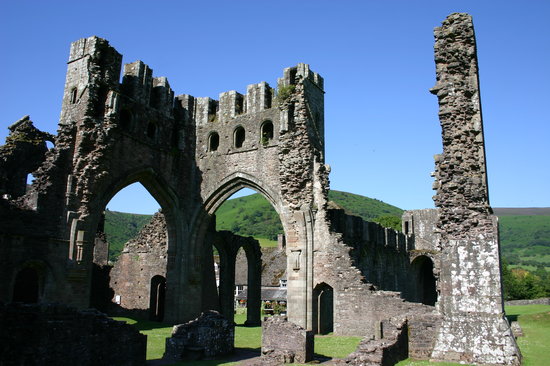
We then drove out to the remains of  Llantony Abbey - which was in fact an Augustinian priory. This is, of course, a very well known image of the dissolution of the monasteries and the day was an ideal one upon which to visit the remsains - a clear rich blue sky, warm sun, and a sense of holiday beneath the Black Mountain. There is an illustrated account of its history at Llanthony Priory

We had lunch in the pub which occupies part of the south west tower of the abbey church and the west range before exploring these striking remains of what was once a very handsome building. 

Image result for Llanthony Abbey 

Where we lunched

Image: Let's Tour England 

http://www.jlb2011.co.uk/walespic/churches/images1/llanthony1d.jpg

The church from the north-west

Image:jlb2011.co.uk

https://backpackbrewer.files.wordpress.com/2011/04/llanthony-priory.jpg

Looking east along the nave to the central tower of Llantony Priory

 Image: Backpackbrewer

Image result for Llanthony Abbey

The crossing from the north-east

Image: TripAdvisor

Looking around I began to wonder how much or how little the landscape had changed since the middle ages. Here too we encountered a real Archbishop, but that is another story...

After an ice cream to finish off our lunch in the ruins we set off north westwards up the valley. The road gets progressivly narrower and more twisting and on two occasions at least we had to reverse to allow very substantial farm vehicles through. The sheep were not so much curious as posing for photographs on the steep banks of the roadside as this wonderful twisting narrow road led us through Capel y Fin, with its memories of Eric Gill and David Jones, up eventually to the head of the valley with a spectaular view into into mid-Wales. We paused for a stroll on the hill crest before driving down towards Hay on Wye - though we avoided the potential snare of a town full of bookshops  - and headed back towards Hereford along the eastern flank of the Balck Mountain.


Image result for Longtown castle

Longtown Castle

Image:ecastles.co.uk

This took us past Longtown castle, with its early thirteenth century circular keep ( so often cited in books on castles ) and then down to Clodock.
  Image result for Clodock church

Clodock Church

Image:PBase.com
St Clydog, a local King from c.500 acclaimed as a martyr in on eof those distinctive Mercian pieces of hagiography, is the patron saint of the church, which has some fine Laudian type wooden fittings for its pews and a very fine ninth century stone inscription to the virtuous wife of a local man 'This tomb holds the remains of the faithful and dear wife of Guinnidas, who was herself a native of this place.'

Image result for Clodock church

Guinnidas' memorial to his wife

Image: Britain Express

There is an illustrated account of this attractive and very intersting church and a note about the martyred King Clydog at Clodock, St Clydog's Church. The early carvings are recorded in St Clydog, Clodock, Herefordshire · The Corpus of Romanesque Sculpture

Image result for Clodock church
 
The interior of Clodock Church

Image: Tristan Forward on Geograph

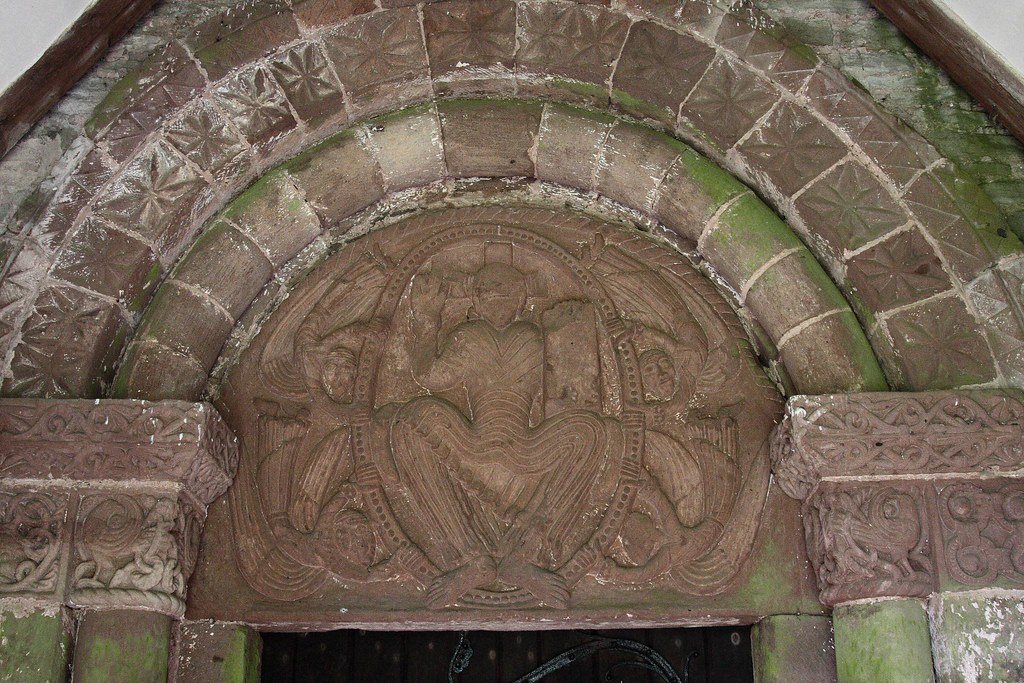
The other car went ahead but Fr Jerome and I stopped to look at the church of St Peter at Rowlstone which is dated to c.1150. This has a fine selection of carving s by the Herefordshire atelier, most notably the tympanum over the south door of Christ in Majesty.

Image result for Rowlstone church

Christ in Majesty on the Rowlstone tympanum

Image: Eric Hardy on Flickr

There are illustrated accounts of the church and sculpture at St Peter's, Rowlstone and at Rowlstone, St Peter's Church, History, Photos. There is an illustrated survey of the important carvings at St Peter, Rowlestone, Herefordshire · The Corpus of Romanesque Sculpture

We just managed to get back to Belmont for the beginning of Vespers.

Another truly splendid day out, good company, good humour, good food and a wonderfully rich assortment of medieval art and architecture.