Once I was a clever boy learning the arts of Oxford... is a quotation from the verses written by Bishop Richard Fleming (c.1385-1431) for his tomb in Lincoln Cathedral. Fleming, the founder of Lincoln College in Oxford, is the subject of my research for a D. Phil., and, like me, a son of the West Riding. I have remarked in the past that I have a deeply meaningful on-going relationship with a dead fifteenth century bishop... it was Fleming who, in effect, enabled me to come to Oxford and to learn its arts, and for that I am immensely grateful.


Saturday, 7 February 2015

A True Son of the Raj


A friend has sent me the link to an account of the life of the late Maharaja of Dhrangadra-Halvad who died in 2010.

His biography encapsulates much of the life of the last reigning Indian Princes under the Raj and in subsequent decades.

The English educated and Anglophile Maharaja was clearly a man committed to the concept of public service both as an independent ruler before 1947 and in the years that followed.


Friday, 6 February 2015

Accession Day


Today is the sixty third anniversary of H.M.The Queen ascending the throne in 1952, and it is an ideal opportunity to express loyal good wishes to the Sovereign.

As we enter 64 Elizabeth II we are also reminded that by early September The Queen will have reigned longer than her great great grandmother Queen Victoria. Within a year of that she will have also exceeded the putative reign of the Jacobite King James III and VIII.

Long may she reign!


Thursday, 5 February 2015

St Agatha in art


Today is the feast of St Agatha (d. 250 or 251, supposedly).

John Dillon posted the following piece about her cult on the Medieval Religion discussion group:

The virgin martyr Agatha, co-patron of this honourable list, is said legendarily to have perished at Catania at the age of fifteen in the Decian persecution. She has a rich hagiographic dossier that appears to begin early in the sixth century. Agatha's cult is attested in Rome from the later fifth century onward. Her basilica at Ravenna (Sant'Agata Maggiore) dates from the end of that century.

Some medieval images of Agatha:

a) Agatha as depicted in the earlier to mid-sixth-century mosaics of the presbytery arch (carefully restored, 1890-1900) in the Basilica Eufrasiana at Poreč:
Context on the arch (betw. the Agnus Dei and St. Agatha):

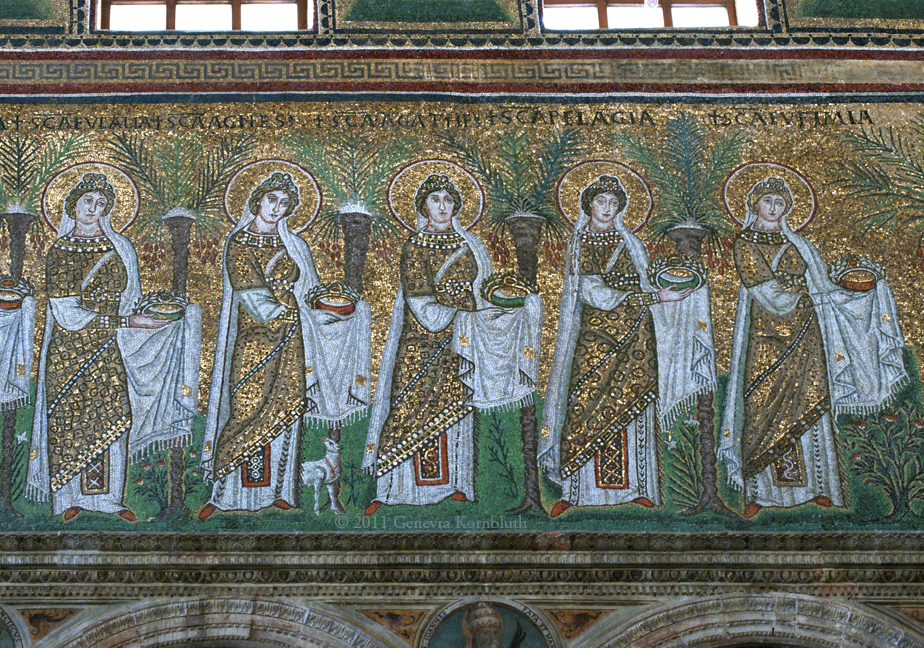
b) Agatha as depicted in the heavily restored, later sixth-century mosaics (ca. 560) in the nave of Ravenna's basilica di Sant'Apollinare Nuovo (photograph courtesy of Genevra Kornbluth):

c) Agatha as depicted in the late eighth-century sacramentary of Gellone (Paris, BnF, ms. Latin 12048, fol. 17v):

d) Agatha's torture and her death as depicted in the later tenth- or very early eleventh-century so-called Menologion of Basil II (Città del Vaticano, BAV, cod. Vat. gr. 1613, p. 373):

e) Agatha (upper register at right) as depicted in the earlier eleventh-century mosaics (restored between 1953 and 1962) in the katholikon of the monastery of Hosios Loukas near Distomo in Phokis:
A closer view:

f) Agatha as depicted in the late twelfth-century apse mosaics of the basilica cattedrale di Santa Maria Nuova in Monreale:

g) Agatha's torture as depicted in a late thirteenth-century copy of French origin of the _Legenda aurea_ (San Marino, CA, Huntington Library, ms. HM 3027, fol. 30r; image greatly expandable):
NB: We discussed gory representations of Agatha's torture last September (SUBJECT beginning "Photos of Sant'Angelo in Perugia"). Those wishing to see other examples will find some at the following sites:

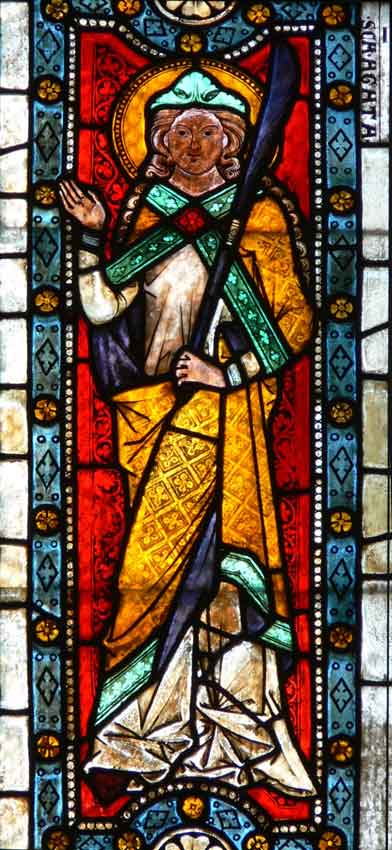
h) Agatha as depicted as depicted in a late thirteenth-century glass window (ca. 1295) in the Walburgiskirche in St. Michael in Obersteiermark (Land Steiermark):
http://www.burgenseite.com/glas/walb_agatha_glas_1.jpg

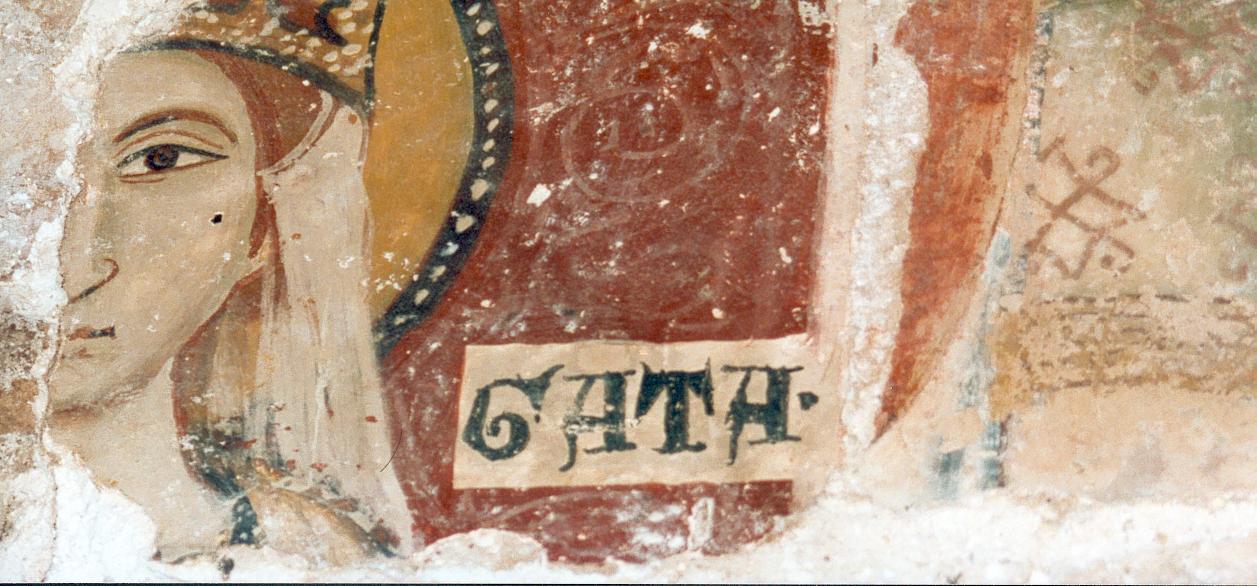
i) Agatha as depicted in a partly preserved later thirteenth- or fourteenth-century fresco portrait in the rupestrian church of Santa Lucia alle Malve (also dedicated to Agatha) in Matera (MT) in Basilicata:
http://tinyurl.com/amlyvyl
http://www.santaluciamatera.it/sagata.jpg

j) Agatha as depicted in the earlier fourteenth-century frescoes (betw. 1313 and 1318; conservation work in 1968) by Michael Astrapas and Eutychios in the church of St. George at Staro Nagoričane in the Former Yugoslav Republic of Macedonia:
http://tinyurl.com/kcedrck
Context in the church (in the narthex, among other saints of January and February; in this view, in the third register from top on the arch):
http://tinyurl.com/nah47cd

k) Agatha's martyrdom as depicted in an earlier fourteenth-century (second quarter) collection of French-language saint's lives (Paris, BnF, ms. Français 185, fol. 222r):
http://tinyurl.com/y8re7hv

l) Agatha as portrayed in her later fourteenth-century reliquary bust by the Sienese master Giovanni di Bartolo (completed, 1376) kept in the basilica cattedrale Sant'Agata Vergine e Martire in Catania:
http://www.luigiminio.it/sites/default/files/busto.jpg
http://tinyurl.com/oxntpvz
The base is early modern and most of the jewelry with which the bust is bedecked is also post-medieval adornment. The metal plaque carried by Agatha in her left hand represents the inscribed marble one that in her Passio (both in Latin and in translation into Greek) was brought by an angel at her funeral and laid in her tomb by her head. The plaque's traditional Latin text reads MENTEM SANCTAM SPONTANEAM HONOREM DEO ET PATRIAE LIBERATIONEM ("A holy mind, a voluntary honor to God, and her home town's liberation"). Still according to the Passio, about a year later the citizens of Catania experienced the liberation part of this characterization of the saint when through the power of her veil taken from her tomb the city was protected from a lava flow emanating from nearby Mt. Etna. Whereupon they converted en masse to Christianity.

m) Agatha as portrayed in a sixteenth-century statue from her originally fourteenth-century church (demolished in the 1930s) in Piazza Armerina (EN) in Sicily and now in that town's Pinacoteca comunale:
http://tinyurl.com/py7ku6t
Here the inscription on Agatha's plaque is rendered, also traditionally, by the initial letters of each word (except for _et_, reproduced in full): MSS / HD / ET PL.

In addition the Rev. Gordon Plumb posted the following note and images:

Her early cult is attested by her inclusion in Jerome's Martyrology, the Roman Canon and the Calendar of Carthage of c.530. She is depicted in the mosaics of St Apolonaire Nuovo, Ravenna. Her Acts are late and fictitious and tell of her attempted seduction by the consul Quintinian, he invoking edicts against Christianity to do so. Then kept in a brothel, tortured by rods, rack and fire. Lastly her breasts were cut off - but she was apparently miraculously cured by a vision of St Peter. She died in prison. Invoked against fire and for diseases of the breast. She is also patron the patron saint of bell-founders.

Winchester Cathedral, north choir aisle, nX, A3, Agatha holding breast in tongs:
https://www.flickr.com/photos/22274117@N08/4438717456

Shrewsbury, St Mary, Shropshire, north aisle, glass from Trier:
https://www.flickr.com/photos/22274117@N08/3167207817

Mells, St Andrew, Somerset, nVI, A2, a figure labelled 'St Agatha' but holding a sword and a saw - surely some mistake:
https://www.flickr.com/photos/22274117@N08/3486637550


The decline in Church life in the Netherlands


Rorate Caeli has a post today about the state of religious belief and practice in the Netherlands that makes sobering reading for Christians and indeed anyone who values religious belief and practice in society. It is acopy of an article in the Italian journal Il Foglio.

The fact of decline in religious life in the Netherlands is not news - it has been reported for many years now - but this article draws the story together, looking across the religious spectrum to present a depressing picture, and pointing to that fact that this is not a recent trend.

Cosidering the religious fervour and vitality of the country in past centuries it certainly invites not only sadness but questions as to what has created this climate of opinion - it is not just Vatican II (however important that may have been in this respect) before anyone comments to that effect. 

I should add by way of some contrast that one priest friend recently visited the Netherlands and was pleasantly surprised by the life he did find in Catholic churches there.

The article, which is of considerable length, can be seen at The Church of Vatican II: The Netherlands Without Christ - a major article for Il Foglio

Wednesday, 4 February 2015

St Blaise in stained glass and in the blessing of throats


Yesterday was the feast of St Blaise, and about whom there is an online account here. To mark the feast of this popular medieval saint of Armenian origin here are a few images as posted on the Medieval Religion discussion group by Rev. Gordon Plumb:

Poitiers, Cathédrale Saint-Pierre, Bay 113b, some scenes from the story of Blaise:
and:
Another set of images of this window, taken more recently, with details of individual panels:

Wells Cathedral, Somerset, NII, 2a-3a:

Wells Cathedral, nV, A2:

Oxford, Christ Church Cathedral, sVII, A2:

Doddiscombsleigh, St Michael, Devon, nII, B4:

Harpley, St Lawrence, Norfolk, wI, A9:

There is an online account of the Blessing of Throats associated with the feast of St Blaise at Blessing of the Throats 

12hp0062 

The Blessing of Throats at St Wilfrid's in York
 
Image; stwilfridsyork.org.uk


Ford Lectures 2015


Last Friday afternoon I attended the first of this year's Ford Lectures. This year the series is on " The English People at War in the age of Henry VIII" and the lectures are being given by Dr Steven Gunn of Merton.


King Henry VIII in a German print of 1545

The king fought many wars, but how did they affect his subjects? How much did they think about war or talk about war? How did communities cope with the pressures war placed upon them? How did military service relate to the social power and self-image of the landed elite? How did war affect the economy? What weapons did people own, did they know how to use them, were they ready to kill and how many of them died? And how did engagement in war shape his subjects’ relationship with the king and their sense of being English? This year’s Ford lectures will ask all these questions in the context of the century of military, political and social change that lay between Henry’s grandfather Edward IV’s invasion of France in 1475 in the afterglow of the Hundred Years War and his daughter Elizabeth’s attempts to shape a trained militia and a powerful navy to defend England in a Europe increasingly polarised by religion.

30 January – Wars and rumours of wars
6 February – Towns and villages
13 February – Noblemen and gentlemen
20 February – Trade and tillage
27 February – Killing and dying
6 March – Kings and peoples

Fridays of Weeks 2 – 7 of Hilary Term
5pm Examination Schools, South School
 
Image and text: Oxford History Faculty website

His chosen era is rather longer than the King's reign, being the period from 1475 through to the 1570s. This was indeed a time of wars, but they tens to be ones which are not well remembered or studied in the way that the earlier and later campaigns of the Hundred Years War or of the Spanish War and the Civil Wars respectively are.

As Dr Gunn pointed out in his introductory lecture there are detailed studies of individual aspects of campaigns and of military procurement and provisioning, but as yet there is no synthesis of the place and contribution of war in and to English life in the period comparable to the continuing reassessment of the impact of the reformation on national life.

In his first lecture he explored the popular, at various levels of society, awareness of war and rumours of wars, of conflict and its consequences, through news reports and private correspondence. From the surviving evidence people were indeed interested in what was happening in military matters and information was to hand for the English as to what was happening in France, Flanders and Scotland.

I look forward to attending the rest of the series.


Tuesday, 3 February 2015

An Interview with King Constantine


In The Times last Saturday there was a two page interview by Alice Thomson with King Constantine of the Hellenes about his life and his reaction to the recent general election in Greece. I posted something on these matters the other week in Greek General Election.

The King now lives in the country as a private citizen and the article had insightful and reflective thoughts from the King, indicating a stoical assessment of the country's situation and his own position - he was not hopeful of restoration to his throne. His Majesty speaks with openness and a certain wry humour, but also with a real concern for the country and its people in their continuing economic crisis.

I would link to the article if I could, but The Times is only available online to subscribers. So iof you subscribe or can find a hard copy of the newspaper I recommend the article to you.

To my mind it is, to say the very least, a great pity that the King has not been able to exercise his proper place as constitutional monarch in Greece since 1967. His dignity and concern was evidenced by this interview and would have served his subjects well.


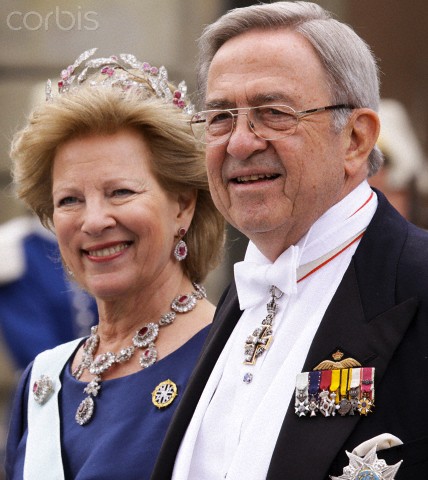
Queen Anne-Marie and King Constantine II at the wedding of Crown Princess Victoria of Sweden, June 2010 

Image:juliapgelardi.wordpress.com/photo: Albert Nieboer/dpa/Corbis


Monday, 2 February 2015

Medieval Images of Candlemas


Here, thanks to the post by the Rev. Gordon Plumb on the Medieval Religion discussion group, are some medieval images of Candlemas in stained glass and in other artists' mediums:


Canterbury Cathedral, nXV, c.1178-80:
https://www.flickr.com/photos/22274117@N08/13202500733

Ashbourne, St Oswald, Derbyshire, nXVII, 4a, c.1240:
https://www.flickr.com/photos/22274117@N08/15959572071

York Minster, nXXVIII, 2b-3b, c.1335 :
https://www.flickr.com/photos/22274117@N08/5036457663/in

East Harling, St Peter & St Paul, Norfolk, East window, 3b, c.1463-80:
https://www.flickr.com/photos/22274117@N08/2480753195
and detail:
https://www.flickr.com/photos/22274117@N08/2480750319

Leicester, Jewry Wall Museum, roundel, late 15th century:
https://www.flickr.com/photos/22274117@N08/2480750319

Apse of Santa Maria Maggiore,Rome, mosaic of 13th century.
http://www.christianiconography.info/staMariaMaggiore/presentationMosaic.html

Bodleian Library, Oxford, manuscript leaves from Franciscan Antiphoners, Pisa,
mid to late 14th century:
http://www.bodley.ox.ac.uk/dept/scwmss/wmss/medieval/jpegs/don/a/011/1500/01100346.jpg

Pierpont Morgan Library,New York,  MS M.302., f.2r, English, c1300-10:
http://utu.morganlibrary.org/medren/single_image2.cfm?imagename=m302.002r.jpg&page=ICA000107021#A3

Metropolitan Museum of Art,New York, Byzantine icon, c.1400-1500:
http://www.metmuseum.org/toah.67.8