Once I was a clever boy learning the arts of Oxford... is a quotation from the verses written by Bishop Richard Fleming (c.1385-1431) for his tomb in Lincoln Cathedral. Fleming, the founder of Lincoln College in Oxford, is the subject of my research for a D. Phil., and, like me, a son of the West Riding. I have remarked in the past that I have a deeply meaningful on-going relationship with a dead fifteenth century bishop... it was Fleming who, in effect, enabled me to come to Oxford and to learn its arts, and for that I am immensely grateful.


Saturday, 30 November 2013

The Ordinariate Use


Earlier this evening I attended the Mass in the Ordinariate use celebrated at Holy Rood here in Oxford. This was the first opportunity I have had to attend this liturgy, and the first time it had been celebrated in Oxford as a Missa cantata.

My first reaction to the liturgy was to see it as a reinvention of the English Missal - I understood a  while ago there was hope that this might, at some future date, be authorised as an Extraordinary Form for the Ordinariate - and others commented afterwards on its resemblances to the Interim Rite of 1965. The source for those aspects doubtless is in Rome itself.

Looked at in these respects the Use should be seen in the context of the Reform of the Reform. It is centred on the Roman Canon, used elevated language and restores the prayers at the foot of altar, the last Gospel and threefold prayers with elements such as the "Lord I am not worthy..."

This was augmented by the liturgical style that former Anglo-Catholics have brought to the Ordinariate that serious concern to offer Mass worthily and with appropriate vesture - the maniple had reappeared on Fr Lloyd's wrist I noticed - and that very real concern, in my opinion, may well be the most important part of Anglican patrimony that the Ordinariate has to offer to the wider Church.

For these reasons I know it appeals to some cradle Catholics who like the return to greater dignity and a more traditional tone. It should on that basis appeal to a considerable number outside the formal; structure of the Ordinariate.

The use of familiar prayers and phrases from the pen of Cranmer did at times seem odd in an emphatically Catholic liturgy - you are somewhat surprised to suddenly have the Comfortable Words addressed to you in a Catholic Mass. Yes they were from Cranmer's better effort with scissors and paste in 1549 rather than 1552, and they certainly are in dignified English (as, of course, Cranmer consciously intended himself) but they can seem like odd interpolations in the adapted/restored Novus Ordo. At times the links seemed awkward, causing jerks in the tempo - yet the texts are, and have been approved as being, theologically eminently orthodox, and the phraseology is very much that of Transubstantiation.

The congregational Confession is before the Offertory - I suspect that most Anglo-Catholics have got used as I did to having that moved to the beginning of the service - and the use of the old General Confession sits a little oddly alongside the introductory prayers for the priest and servers, or if you interpolate yourself the traditional Confiteor immediately before Communion.


Those points made this is a dignified serious liturgy, accessible for former Anglicans and lifelong Catholics alike. It ought to attract, but I suspect many ex-Anglicans have probably become used to the latest version of the current Roman Missal, or have tended towards the Extraordinary Form. I suspect that the Use may prove to be maybe more important in the US or Australia with the Ordinariates there than it will in England.

For Catholics interested in the Reform of the Reform it is an important example, indeed proof of what can be achieved under the auspices of the Holy See. It is, in its significant points of obvious restoration, a heartening example of what can and will be permitted. In that sense it is a real tribute to Pope Benedict XVI's vision both for the liturgy and for the Ordinariates.

One friend, who had not been present, opined that Newman himself would not liked such a mixed rite, and that may indeed be true, but that is not the point about this newly authorised Use

It ought to be sampled by those interested in vernacular liturgical developments in the English speaking world, and judged on its own merits.

The Oxford group are intending to use the Use in Advent at least for the Sunday Vigil Mass  - so if you are interested or intrigued come along to Holy Rood at 6pm on Saturdays and see for yourselves.


Friday, 29 November 2013

Holy Roman Emperor Charles IV


Today is the 635th anniversary of the death in 1378 of the Holy Roman Emperor Charles IV, of whom there is an illustrated online biography here. There is another online account here, also with illustrations, but in occasionally quaint English  and a third one, with links to accounts of other aspects of Bohemian history and places of interest, can be accessed here.

http://www.oocities.org/theodoricus/charlesiv.jpg

Emperor Charles IV kneeling before the Virgin and Child
The Emperor, who is sponsored by St Sigismund, wears the Imperial Crown with the white mitre which was worn with it until the sixteenth century, and inspired the form of the crown of Emperor Rudolf II - the later Austrian crown

From the votive painting of Archbishop Jan Ocko (from the atelier of Master Theodoric), before 1371

Image:oocities.org 


As those accounts all show it is with his kingdom of Bohemia that the Emperor Charles and his artistic patronage is always particularly associated. He encouraged the building of St. Vitus Cathedral in Prague, which had been begun in 1344, two years before his accession, with its shrine chapel of the national patron St Wenceslas, to whom Charles, whose own original name was indeed Wenceslas, a name he also gave to at least two of his sons, was devoted. He commisioned the Crown of St Wenceslas  in 1347,  founded the Charles University, the first within the Holy Roman Empire, built the Charles Bridge with its great ceremonial gateway, redolent of Imperial glory, and created the palace fortress of Karlštejn, south west of Prague.Under his influence and encouragement mid-fourteenth century Bohemia had a rich and vibrant court culture, with a wonderful legacy in art and architecture. The religious revival encouraged by the Emperor was to bear fruit in these aspects as well as eventually leading to the rise of Hussitism - a legacy that would no doubt have horrified him.

Within the wider Empire he is best remembered for the Golden Bull of 1356 which regulated the election of subsequent Kings of the Romans and Holy Roman Emperors down to 1806.

One of his daughters by his fourth marriage was Anne of Bohemia, who married King Richard II in 1382, and there were clear and important links between the two courts and countries - one can see obvious parallels between the courts of the Emperor Charles and of King Richard, as well, of course, as the Wyclif-Hus nexus.

Nicolas Wurmser of Strasbourg.Emperor Charles IV and his wife Anne of Swidnica adore the cross.1350s.KarlstejnCastle,Ch. of Relics of Suffering of the Lord.W.wall 

Emperor Charles IV and his third wife Anne of Swidnica (Schweidnitz) - who died in 1362 - adore the Cross 
Karlstejn Castle, on the west wall of the Chapel of Relics of the Suffering of the Lord 
Nicholas Wurmser of Strasbourg, late 1350s.

Image: 'German 1' by arthistory390 on Flickriver 


Thinking and writing about the Emperor and his life and times has inspired me to go and hunt down a copy of Fr Bede Jarrett's biography of him.

Thursday, 28 November 2013

Bidding farewell to a Carthusian postulant


Yesterday evening I went up to north Oxford to SS Gregory and Augustine to the celebration of a votive EF Mass of St Bruno, the founder of the Carthusian Order.

The intention of the Mass offered by Fr John Saward was for a young man who has been living in the parish for almost a year and who has been assisting in serving and in the sacristy. A former monk of the Anglican Benedictine house at Alton in Hampshire he was received as a Catholic earlier this year and is going to try his vocation as a Carthusian monk. His clothing as a novice will be on Saturday at Parkminster in Sussex. The website of this, the only functioning Charterhouse in Britain, which was established in 1873, can be viewed at St.Hugh's Charterhouse Parkminster, UK, and it has links to pages about the Order.

In his homily Fr Saward stressed the continuity of the Order, faithful to St Bruno's eleventh century vision. He also held before us the fact that the Carthusians would be praying when we are either  asleep or lying in bed sleepless - and that they would be praying for us and on our behalf.

Following the Mass there was abrng and share parish party and achance to did farewell to the Finnish born candidate and to wish him every belssing in his vocation. it was clear that he was widely respected by the congregation and held in real and genuine affection.

We followed this with fireworks on the lawn outside - Fr Saward in cassock, capa nigra and biretta was to be seen enthusiastically setting off rockets, Roman candles and flower bursts of pyrotechnics, with gunpowder rather than incense as the prevailing scent.

I will preserve the candidate's Carthusian anonymity but will aim to keep him in my prayers, and commend him and his new community to those of my readers. 


St Hugh's Charterhouse, Parkminster
Image:forums.catholic.com


Colouring in the medieval church


A post on the Medieval Religion discussion group pointed me to an article in last weekend's Observer about the use in this country at Norton priory in Cheshire of laser projections to supply the colour to medieval sculpture that time and neglect have destroyed. The article can be read here.

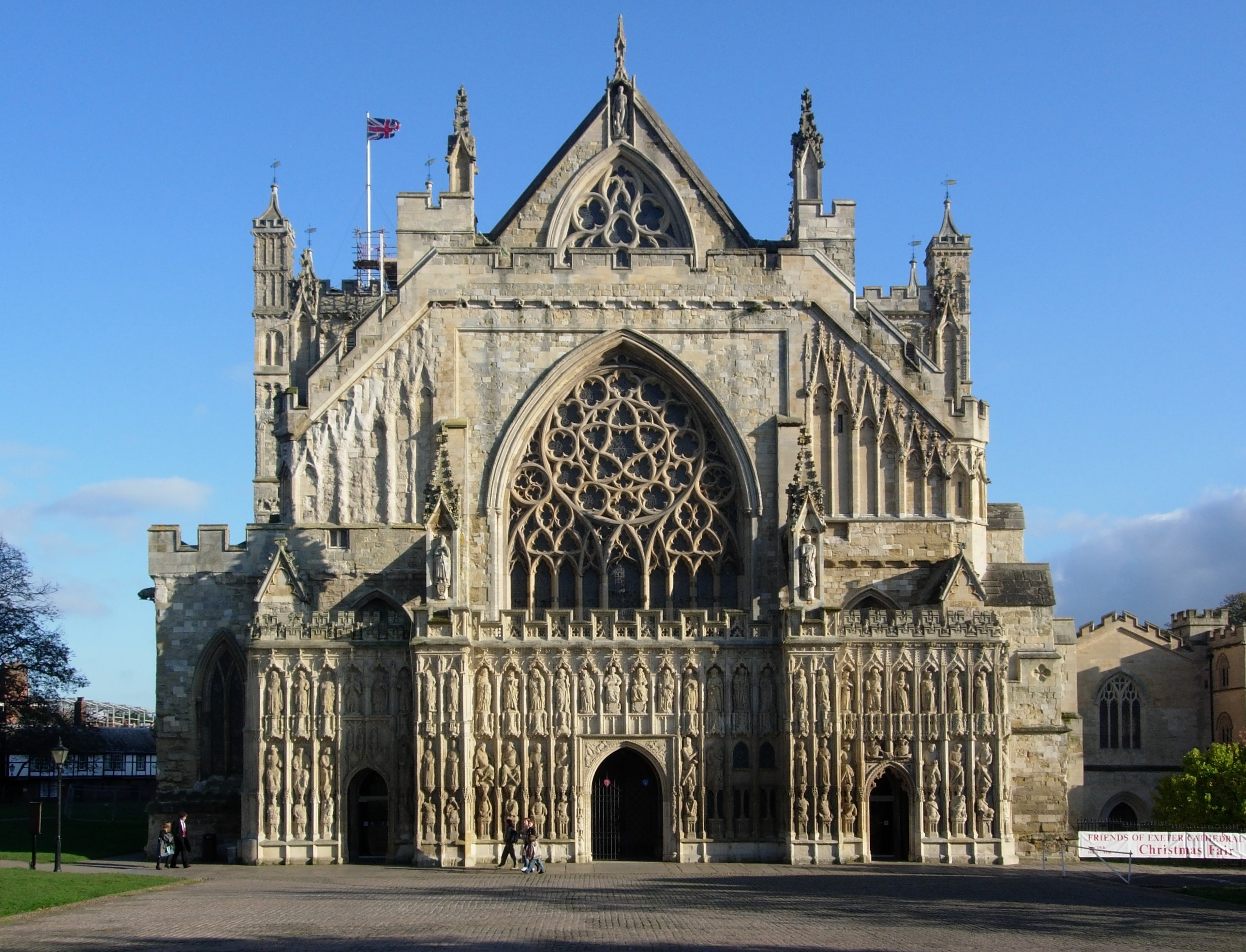
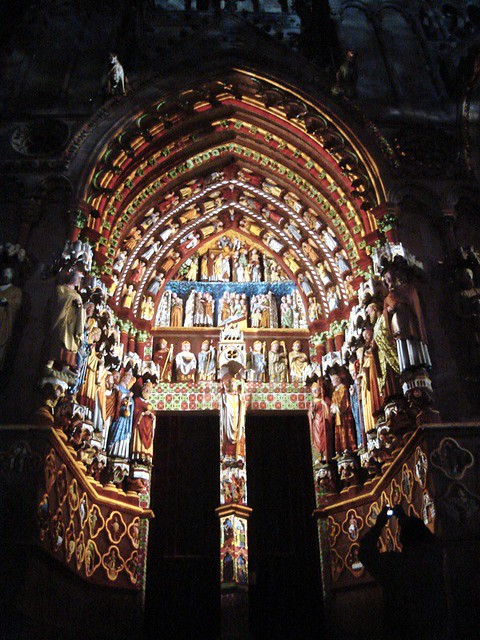
The technology to do these recreations of medieval splendour was developed for the cathedral in Amiens, and I have posted about this before. However I have no scruples about making the point again, that medieval cathedrals were splendidly painted on the outside as well as the inside. At Exeter cathedral you can buy a guide leaflet which indicates with what splendour and sophistication the statues late-fourteenth century screen of the west front were painted. This is the result of careful study of the surviving fragments of pigment.


File:Cathedral of Exeter edit.jpg

The west front of Exeter cathedral

Image:Wikipedia
As the Observer article suggest this is not an expensive technique maybe we can hope to see such spectacular effects as are achieved at Amiens this side of the Channel.

The loss of the polychrome decoration of the walls and statues of medieval churches whether romanesque or gothic both in the interior and on the exterior is an impoverishment of the original concept and of our appreciation of what the patrons and builders intended.

These magnificent buildings retain their physical grandeur, but their walls, now usually plain stone, would appear incomplete or "bare ruined choirs" to a medieval worshipper or visitor. Too often even those knowlegeable about the middle ages do not give thought to what is missing, or, if they do, they dismiss it as having been crude and gaudy. There really is no case for that view when you look at surviving examples - such as the restored scheme at Issoire in central France - or at medieval manuscripts or glass, or indeed at serious reconstructions, as by Pugin and others. At the basilica in Maastricht there is an external doorway still painted as it would have been originally:


Image: churchmousewebsite.co

Once you realise the colour should be there you become ever more concious of its absence.


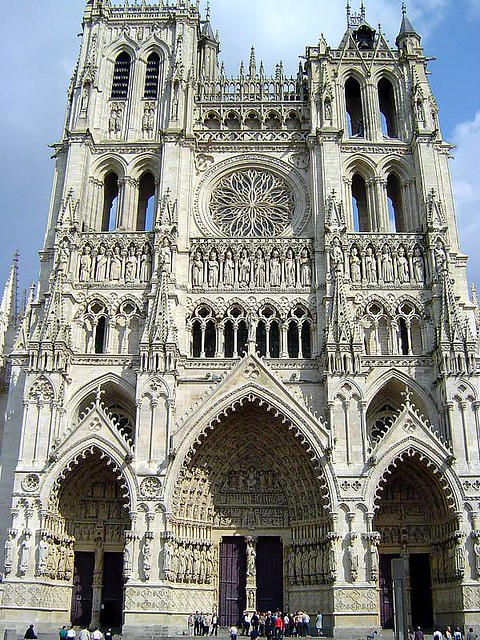
The west front of Amiens cathedral by day

Image: Daniel Mitsui

None of the great thirteenth century French Cathedrals have had their exterior repainted, but Amiens cathedral can offer visitors an idea of its original scheme. On summer nights and special occasions, spotlights and lasers are projected at the façade, bathing the ornaments and statuary in bright colours and creating the illusion of what was once for all to see. 


photo

Amiens cathedral by night - medieval splendour recreated through modern technology

Image:amyinberlin on Flickr


One of the western portals of Amiens at night with the colour projected on to the sculpture

Image:amyinberlin on Flickr


Fr Hunwicke's reflections on Pope Pius XII


My friend Fr John Hunwicke is blogging again, under a slightly new title at Fr Hunwicke's Mutual Enrichment , and he has an interesting post about Pope Pius XII and the revision of the liturgy. This seeks to understand that process not so much in the context of what Vatican II did or did not mandate or think butrather in what was already happeningby the early 1950s. It can be read here.

The idea that it was Pope Pius XII who laid the foundations for radical liturgical reform with the revised Easter liturgy is not, of course, new, but Fr Hunwicke gives a clear exposition of how he thinks the process came about and how it should be understood historically.


Tuesday, 26 November 2013

St John's College Oxford vestments on display on November 30th


On Saturday November 30th St John's College here in Oxford is once again holding its termly public exhibition of its remarkable collection of medieval and Laudian vestments. These include two banners used at the dedication of the college chapel at the foundation in the reign of Queen Mary I and the scull cap worn by Archbiship Laud to the scaffold in 1645.

The vestments are on show from 2pm until 5pm. The collection is housed in a display room in the Garden Quadrangle - itself worth seeing as a fine example of skillful and inventive 1990s collegiate architecture - and entrance, free of charge, will be via the Main Lodge on St Giles.

If you are able to go to this exhibition I would recommend it, as the vestments are rare survivals of great historic interest.


Monday, 25 November 2013

The Pope on the Council of Trent


Rorate Coeli had an interesting post yesterday where it publishes the text of the letter from the Pope appointing Cardinal Walter Brandmuller as his representitive at the ceremonies to mark the 450th anniversay of the closing of the Council of Trent in 1563. In it the Pope reaffirms for Trent the key point made by Pope Benedict XVI in 2005 about the Hermeneutic of Continuity and Conciliar authority. The post can be read at  Francis, writing on the Council of Trent, explicitly affirms the authority of the 'hermeneutic of reform in continuity'.

Blessed by St Peter


Yesterday in Rome to mark the end of the Year of Faith the Pope had the major relics of St Peter displayed for the first time on the High Altar of St Peter's for public veneration.


St Peter

Image: St Peter's Basilica website

"Not to be outdone" as Fr Dominic put it, the Oxford Oratory marked the day by offering to the congregation the blessing of their own, miniscule, relic of St Peter, following the celebration of Mass. Along with many of the congregation I availed myself of this opportunity.

During Mass the relic, was on an altarino on the sanctuary and under the bust of St Peter - all that now remains of the church's copy of the statue in the Vatican basilica of the Apostle attributed to Arnolfo di Cambio (1243-1302) that was regrettably destroyed long before the Oratorians took over the care of the church.