Once I was a clever boy learning the arts of Oxford... is a quotation from the verses written by Bishop Richard Fleming (c.1385-1431) for his tomb in Lincoln Cathedral. Fleming, the founder of Lincoln College in Oxford, is the subject of my research for a D. Phil., and, like me, a son of the West Riding. I have remarked in the past that I have a deeply meaningful on-going relationship with a dead fifteenth century bishop... it was Fleming who, in effect, enabled me to come to Oxford and to learn its arts, and for that I am immensely grateful.


Showing posts with label Polychrome. Show all posts

Saturday, 7 December 2013

Medieval Wall paintings uncovered in Wales


There has been quite a lot on the Medieval Religion discussion group today about the rediscovery of a significant series of wall paintings in the church of St Cadoc in Llancarfan in the Vale of Glamorgan in Wales. Dated by those working on the project to the 1480s these very impressive paintings which feature a very striking figure of St George slaying the dragon, as well as depictions of the Seven Deadly Sins can be seen in this BBC news story, with its accompanying video, here


St George and the Dragon from Llancarfan

 Image:stuartsworkbench.blogspot.co.uk

There is another illustrated recent BBC News post about the figures of the Seven Deadly Sins here.


Medieval painting of Lust at St Cadoc's Church, Llancarfan 

The Devil promotes Lust in one of the uncovered paintings

Image:BBC

I understand from a post by Dr Madeleine Gray who has worked as a historian alongside this important conservation scheme that the church has nave and a substantial south aisle with south chapel at the east end. The St George painting occupies most of the south wall, the Deadly Sins go round the west end of the south wall and onto the west wall. There is clearly undamaged paintwork remaining under the limewash on the west wall of the aisle north of the window and round to the north wall of the aisle. At present the view is that these paintings depict the Acts of Mercy. There are traces of paint elsewhere in the church, including over the chancel arch, but the conservator says the smooth plaster elsewhere in the building suggests it has been renewed in the post-medieval period and therefore will not have any surviving decoration. In addition there are also some post-medieval texts ( part of one which has been left covers the castle and princess in the St George painting) which may make it difficult to justify exploring further. However I would imagine it would not be impossible to remove those later layers to presreve them and to reveal the medieval worlk underneath.

In a related story, the fine work of the fifteenth century polychromed altar reredos screen in the church has been restored, and there is an illustrated article about that here. I was somewhat surprised and disappointed to see yet again the idea that such ascreen must have been brought fromelsewhere after the reformation - why do so many people still fail to realise how splendidly even small communities decorated their parish churches in the middle ages? There is a piece by the conservators with illustrations  at St Cadoc’s Church, Llancarfan, Glamorgan: Survey of Reredos


St Cadoc's definitely looks to be a church very well worth visiting - another one to go on the list of visits to make.

Thursday, 28 November 2013

Colouring in the medieval church


A post on the Medieval Religion discussion group pointed me to an article in last weekend's Observer about the use in this country at Norton priory in Cheshire of laser projections to supply the colour to medieval sculpture that time and neglect have destroyed. The article can be read here.

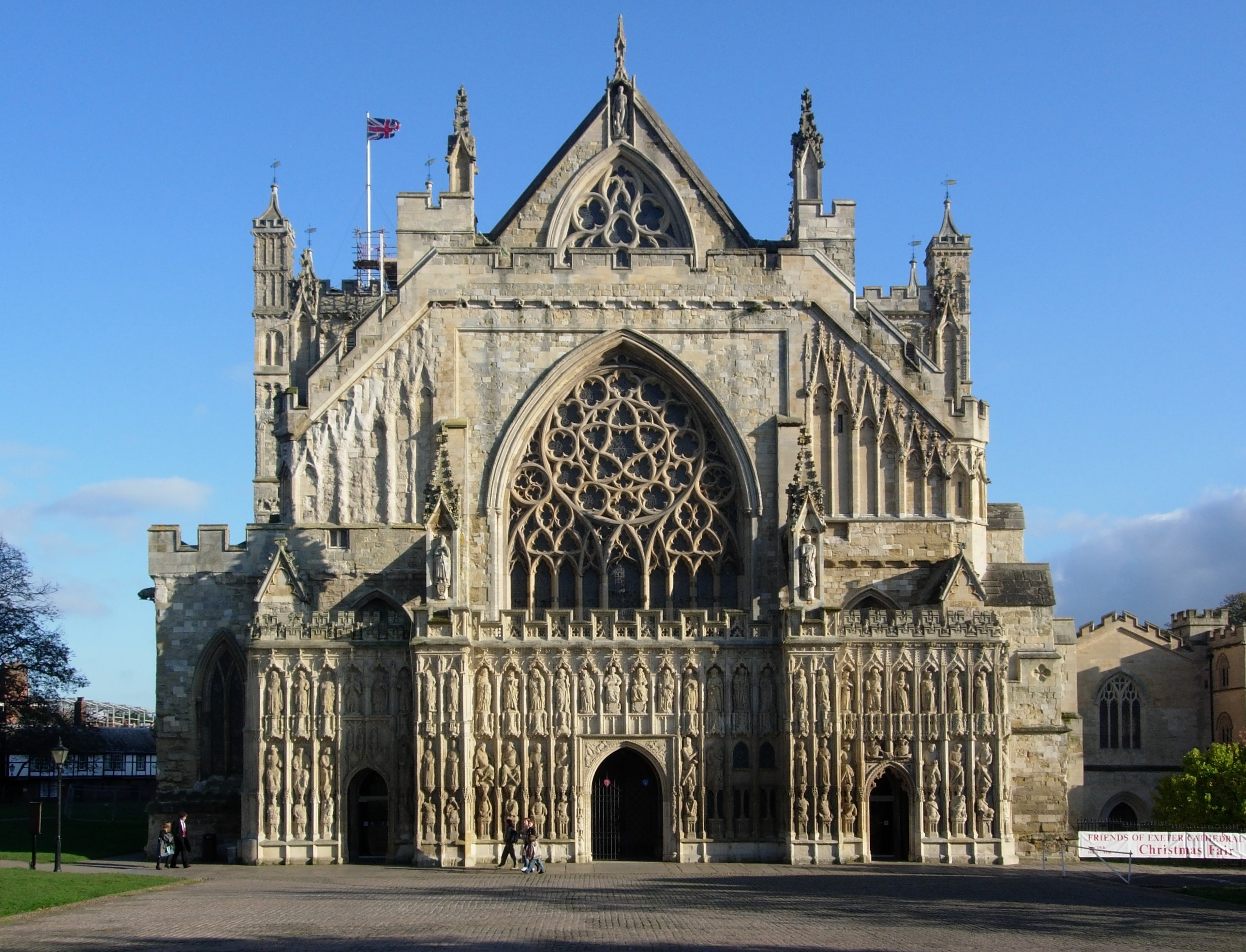
The technology to do these recreations of medieval splendour was developed for the cathedral in Amiens, and I have posted about this before. However I have no scruples about making the point again, that medieval cathedrals were splendidly painted on the outside as well as the inside. At Exeter cathedral you can buy a guide leaflet which indicates with what splendour and sophistication the statues late-fourteenth century screen of the west front were painted. This is the result of careful study of the surviving fragments of pigment.


File:Cathedral of Exeter edit.jpg

The west front of Exeter cathedral

Image:Wikipedia
As the Observer article suggest this is not an expensive technique maybe we can hope to see such spectacular effects as are achieved at Amiens this side of the Channel.

The loss of the polychrome decoration of the walls and statues of medieval churches whether romanesque or gothic both in the interior and on the exterior is an impoverishment of the original concept and of our appreciation of what the patrons and builders intended.

These magnificent buildings retain their physical grandeur, but their walls, now usually plain stone, would appear incomplete or "bare ruined choirs" to a medieval worshipper or visitor. Too often even those knowlegeable about the middle ages do not give thought to what is missing, or, if they do, they dismiss it as having been crude and gaudy. There really is no case for that view when you look at surviving examples - such as the restored scheme at Issoire in central France - or at medieval manuscripts or glass, or indeed at serious reconstructions, as by Pugin and others. At the basilica in Maastricht there is an external doorway still painted as it would have been originally:


Image: churchmousewebsite.co

Once you realise the colour should be there you become ever more concious of its absence.


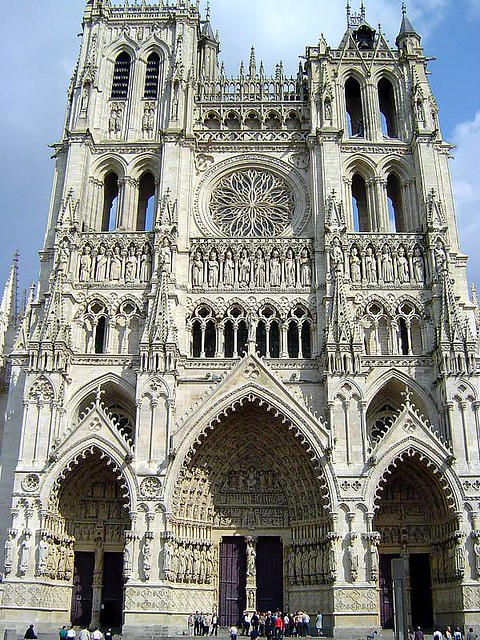
The west front of Amiens cathedral by day

Image: Daniel Mitsui

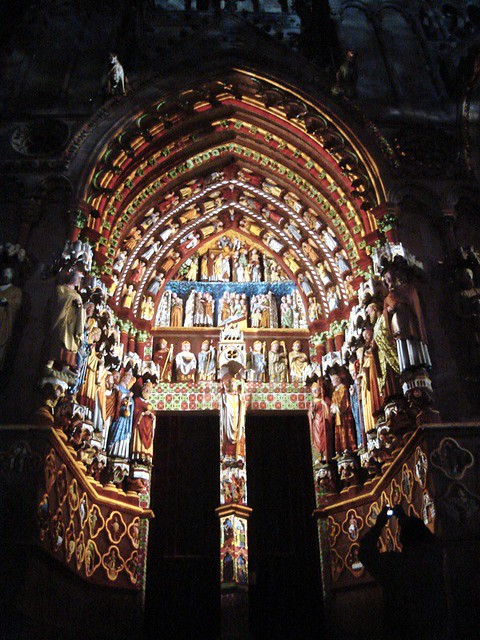
None of the great thirteenth century French Cathedrals have had their exterior repainted, but Amiens cathedral can offer visitors an idea of its original scheme. On summer nights and special occasions, spotlights and lasers are projected at the façade, bathing the ornaments and statuary in bright colours and creating the illusion of what was once for all to see. 


photo

Amiens cathedral by night - medieval splendour recreated through modern technology

Image:amyinberlin on Flickr


One of the western portals of Amiens at night with the colour projected on to the sculpture

Image:amyinberlin on Flickr


Tuesday, 25 September 2012

Amiens at night


Writing about Amiens cathedral earlier reminded me that I had on file these pictures of the west front as it can be seen at night, when an idea of the original colour scheme of its painted statuary can be re-created by modern technology.


None of the great thirteenth century French Cathedrals has been repainted, but Amiens Cathedral offers its visitors a hint of its original beauty. On summer nights and special occasions, spotlights and lasers are projected at the façade, bathing the ornaments and statuary in bright colours.


Images amyinberlin
I also found on YouTube two short film sequences that give an idea of the spectacle Amiens affords on these occasions, and a reminder of just what medieval worshippers and pilgrims saw as they approached and entered the cathedral of Notre Dame:


St Firmin and his relics at Amiens - a late medieval view


Today is the feast of St Fermin (also spelt Firmin). There is an informative account of his life and cult here with expandable illustrations of the polychrome panels about his life, death and miracles in Amiens cathedral which are featured below.

According to legend St. Fermin, a native of Pamplona and a disciple of St. Saturninus of Toulouse, founded the first church in Amiens in the third century and was martyred there on September 25th 303. Not much is known about him and his biography considered to be mostly an invention of the eighth century.

The legend as it developed from the eighth century onwards the life of St. Fermin is told in these late Gothic polychromatic reliefs made between 1490 and 1530 and which ornament the tomb of Adrien de Henencourt, formerly Dean of the cathedral, in the south ambulatory.  They depict his story in terms of contemporary late medieval life, and with wonderful vigour and detail. The following series of photographs are, I think, considerably better than those attached to the online account I have linked to above.


Fermin being desperate to achieve martyrdom travelled from the south of France to the pagan areas of Gaul (northern France). He was arrested by the Roman authorities in Lisieux but for some reason the governor died and he was released. He then travelled to Amiens.

Saint Firmin PreachingSaint Firmin Preaching


Detail Saint Firmin Preaching

Detail of the scene above

Baptising the People of AmiensBaptising the People of Amiens

where he established a large church, and where he converted and baptised many of the inhabitants.


Arrest and BeheadingArrest and Beheading

The pagan priests are then supposed to have reported Fermin to visiting Roman officials, who had him arrested and beheaded.

File:St Firmin decapitated.jpg
The martyrdom of St Fermin
Image: Wikipedia

Exhumation of the RemainsExhumation of the Remains

At the begining of the seventh century the then bishop of Amiens, St Salve, got the people and clergy to pray for a sign as to where Fermin's body was buried. On the third day God sent a ray of the sun, which pierced the wall of the monastery where the body lay. When the faithful dig there they find the body of St Fermin. A sweet odour arose from the grave

Bringing the Relics To AmiensBringing the Relics To Amiens

As the body was carried through the streets of Amiens a number of miracles happen: the sweet odour from the relics causes ice ans snow to melt, trees and meadows flowered and came into leaf, trees inclined reverently towards the saint, the sick were healed, and the rich released their servants and serfs from servitude.


Unless otherwise indicated the images are from professor-moriarty.com, and I am very grateful  to Christopher Crockett of the Medieval Religion Discussion group for the link.