Once I was a clever boy learning the arts of Oxford... is a quotation from the verses written by Bishop Richard Fleming (c.1385-1431) for his tomb in Lincoln Cathedral. Fleming, the founder of Lincoln College in Oxford, is the subject of my research for a D. Phil., and, like me, a son of the West Riding. I have remarked in the past that I have a deeply meaningful on-going relationship with a dead fifteenth century bishop... it was Fleming who, in effect, enabled me to come to Oxford and to learn its arts, and for that I am immensely grateful.


Saturday, 10 December 2011

St Edmund Gennings and St Swithun Wells


On December 1oth 1591, fifty years to the day after Thomas Culpeper and Francis Dereham were executed, Londoners were able to witness another set of executions, those of a priest, St Edmund Gennings and of a layman, St Swithun Wells, who had made his house at Grays Inn available for St Edmund to celebrate Mass.

Arrested at the altar St Edmund was led away to prison still in his vestments and St Swithun. who had not been present, was arrested upon his return home. Both were executed outside the house, the priest being hanged drawn and quartered, the householder being hanged.

http://farm4.static.flickr.com/3052/2983627445_2c71971e46_z.jpg

St Edmund Gennings
Modern statue in St Etheldreda's Holborn

Image: Lawrence Lew on Flickr


https://blogger.googleusercontent.com/img/b/R29vZ2xl/AVvXsEgg9e8XYfXvve7sKteiyPPZrBDl8oy8HdZFFHknPd5C-6A38Wz5VGlDpFJtYpKlyQ_5KXPy8huXsbyLTXSo_zVugOQ5cM2pylKXCi6xmK8mbXjctTAP9Zo5BCH0V-4_J0ciiQKcrhnvzT4/s1600/Swithun.jpg
St Swithun Wells
Modern statue in St Etheldreda's Holborn

Image: Mary's Dowry Productions

There is piece about both of them from Mary' Dowry Films in connection with two films about the two martyrs here.

There is an online life of St Swithun Wells here. He had been born in Hampshire in 1536 and his name suggests devotion on the part of his parents to the local saint, St Swithun, whose shrine was in Winchester cathedral.

St Edmund Gennings was born in Lichfield in 1567, and his martyrdonm had a profound effect on recalling his brother to the Catholic faith and to discover his own vocation. The Oxford DNB life of St Edmund, with a link to that of his brother can be read here and there is another online life of him, with an early portrait, here.


A gentleman of the bedchamber


December 10th is the 470th anniversary of the execution in 1541 at Tyburn of Thomas Culpeper and Francis Dereham for adultery with Catherine Howard, whose marriage to King Henry VIII had been annulled a few days previously.

Retha M. Warnicke's Oxford DNB life of the Queen includes biographies of both these two men and can be read here.
There is also an online life of Culpeper here, and one of Queen Catherine here. *


Queen Catherine Howard
Minaiture by Hans Holbein the Younger
The portrait has been persuasively identified through the jewels on her dress, which match those in her inventory.

Image Wikipedia, from the Royal collection

Quite apart from its interest as one of the more sensational episodes in an era of court sensations this story has always had the added interest of a connection with my home town of Pontefract. It had been during the King and Queen's progress to the north in the late summer of 1541 that the affair between Catherine and Culpeper flourished.

The one surviving letter from Catherine to Culpeper probably belongs to the earlier stages of the tour, being thought to have been written at Liddington or Lincoln. It can be seen and read both in the original and in transcript on this link to the National Archives website or by clicking on the red arrow under the photograph.


"Yours as long as life endures, Katherine"

The royal party arrived at Pontefract Castle on August 23 1541, and it was at Pontefract that four days later the Queen appointed Dereham, to whom was technically married, as her secretary. Whilst the King went on alone to visit Hull before he entered York in state with his Queen, and whilst the Privy Council were, amongst other things, confirming in meetings at Pontefract the new statutes of the King's new cathedral foundations at Gloucester and Peterborough, as well as those for the new secular chapter for that at Ely, elsewhere in the castle less salubrious activities were apparently taking place...

File:Pontefract Castle.jpg

Pontefract Castle
A painting of circa 1630 now in Pontefract Museum.
In 1541 the castle would have appeared much the same, although possibly better maintained.

Image: Wakefield MDC Museums

On the internet I found an account of Thomas' father Sir Alexander Culpeper of Hardreshull and Bedgebury in Kent who had died the previous summer - probate on his will being granted on June 21st 1541. Thomas, the lover of Queen Catherine, was the son of his father's third marriage, and appears to have been about ten to fifteen years younger than his elder siblings. His mother died in 1542.

Details of his father's life, and those of his family, including the text of his will, which is interesting in itself with its extensive religious provisions, offering an insight into the spirituality of the gentry in the period, can be read here.

Sir Alexander and Lady Culpeper's tomb is in Goudhurst church:

http://i1012.photobucket.com/albums/af246/stephenwc/Rideouts/Goudhurst%2021%20Nov%2010/024-SirAlexanderCulpeperTombP1080054.jpg

Tomb of Sir Alexander Culpeper and his wife Constance in Goudhurst church, Kent

Image:pashnit.com

Stone relief of 'Old Sir Alexander' Culpeper and his family.
In the jamb of the bay window above the effigies of Sir Alexander and his wife is asmall stone relief dated 1537. It depicts God in Majesty, the Virgin and child, St George slaying the dragon, and kneeling figures of the Culpeper family.

Image: gen.culpepper.com

* The only episode of the recent televison series The Tudors I have seen was about the affair of Catherine Howard and Thomas Culpeper.The episode lived up to all I had been led to expect - serious or bizarre historical inaccuracies, anachronistic costuming and sets, indifferent acting, and some fairly pornographic scenes - but also, as others had indicated, there were the occasional flahes of insight. A curious production.


Friday, 9 December 2011

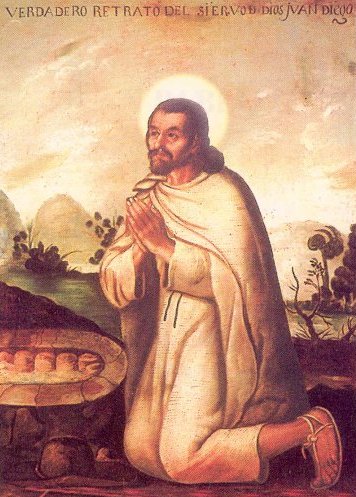
The Visionary of Tepeyac


Last year I posted this piece about Our Lady of Guadalupe and St Juan Diego Cuatitiatoatzin. This is an opportunity to make it available again.

This year Our Lady's feast is not subsumed by Sunday, so both the apparition and St Juan Diego will be commemorated. St Juan Diego's commemoration falls today, the anniversary of Our Lady appearing to him on the hill of Tepeyac 480 years ago. There is an online life of him and the story of the reception of his story here.


St Juan Diego Cuahtlatoatzin

Image : Wikipedia

Not only is this a day to give thanks for Our Lady's appearance to St Juan Diego and its impact on the life of the Church in New Spain, but also to pray with and for the Church in Mexico which has witnessed bouts of terrible persecution within the last century and a half from anti-clerical and anti-Christian forces.


Immaculate Conception - an Antolinez in England


I have now found an image of the other version by José Antolinez of the Immaculate Conception.

It is in the Bowes Museum at Barnard Castle in county Durham, which has the largest number of Spanish paintings in Britain outside London in addition to its other collections - notably of French eighteenth and nineteenth century art and furnishings. The Bowes is very well worth visiting if you are in the area - it is quite a surprise to find a collection similar in nature to the Wallace Collection in London on the edge of a small northern market town. The website of the museum is here.

File:Antolinez-inmaculada-bowes.jpg

Image: Wikimedia

The painting is, in my opinion, quite lovely - one that stays in the memory with its charm and delicacy and joyful exhuberance. Worth a visit to the Museum for that alone.

José Claudio Antolinez (1635-75) spent most of his painting career working in his home city of Madrid. He commonly painted depictions of the Immaculate Conception, done in a colourful and gentle style. By contrast, Antonlinez himself was known for having a bad temper and a considerable ego. His '"haughty character and sarcastic personality gained him many enemies among his contemporaries", and he played maddening jokes on his colleagues. In addition to religious paintings, he also produced several portraits and genre scenes. He died in Madrid from a fever in 1675 after suffering a number of wounds during a fencing match.


Thursday, 8 December 2011

Immaculate Conception


We have been preparing for today's Solemnity of the Immaculate Conception here at the Oxford Oratory with the usual Novena in church - I have managed to attend most days, but not, alas, all - and had Solemn Vespers and Benediction yesterday evening. This evening there will be a Solemn Mass. Not only is the Oratory under the patronage of the Immaculate Conception of Our Lady but also the Archdiocese of Birmingham, so it has a double significance for us.

There is a useful account of the historical development of this dogma here.


http://catholicismpure.files.wordpress.com/2010/12/immaculb.jpg

The Immaculate Conception
by José Claudio Antolinez (1635-1675)

Image: Catholicism Pure and Simple blog


There is another version of this painting by Antolinez at The Bowes Museum in Barnard Castle, and is quite breath-taking to see.


Deep night hath come down on this rough-spoken world
And the banners of darkness are boldly unfurled;
And the tempest-tossed Church - all her eyes are on thee,
They look to thy shining, Sweet Star of the Sea.

Fr Faber


Wednesday, 7 December 2011

St Ambrose


In my post St Ambrose in Milan last year I looked at what St Ambrose may have looked like, and what he looks like now. This year I thought I would share this early fourteenth century view of him, simply because it is a beautiful painting.

http://upload.wikimedia.org/wikipedia/commons/thumb/c/ce/Simone_Martini_040.jpg/489px-Simone_Martini_040.jpg

From the cycle by Simone Martini of 1313-18 in St Martin Chapel in the Lower Church at Assisi. A detail from the Dream of St Ambrose as depicted by Simone Martini

Image: yet-another-fashion-blog

Of course it could be a comment on so many synodical and such like meetings.

Tuesday, 6 December 2011

Understanding the response of SSPX


There was a post from last week on New Liturgical Movement about the SSPX's response to the CDF and particularly the Doctrinal Preamble. It is by the well-respected Vatican journalist Andrea Tornielli. Although it does not tell us more that we already knew, it does provide more in the way of informed interpretation. The discussions are clearly not easy going, but they are not over yet. It can be read at Fellay: “We cannot accept the Preamble as it is”

Celebrating St Nicholas


The other evening an acquaintance who was born as a Catholic in Italy, but who despite ( or because of?) a Jesuit education and following settling here in England and research in Germany lapsed into Anglicanism, and a great devotion to Martin Luther ( he carries a copy of the Ninety Five Theses in his pocket) asked me why we did not celebrate St Nicholas in England as is done on the continent. I did not forbear to point out that this was a legacy of the baleful effects of the Protestantism into which he had fallen.

There is a wonderful array of information about the cult of St Nicholas and links to a huge selection of images of him created over the centuries on the website of the St Nicholas Center which I would recommend this as a resource to anyone interested in his cult. Here is a painting which I particularly liked, with iths wonderful detail, from the 125 paintings they feature, not to mention icons, sculptures, illuminations and stained glass:

Click!

St Nicholas
The master of St Lucy, 1486-93
Groeninge Museum Bruges

The saint sits frontally on a vaulted stone throne which stands in an open gallery. He is blessing the spectator. The handle of his staff is adorned with the images of St Lawrence (with the grid), St Mary Magdalene (vase) and St James the Less (fuller's club). On each side of the throne can be seen a piece of the arcade which opens out onto a landscape with the panorama of Bruges. From left to right we can recognize the towers of Our Lady's, St Saviour's, the Oosterlingenhuis (house of the German hanza), the belfry, the Poorters' Lodge, and to the right of the canopy the Jerusalem Church. Scholars in the 1950s made out the panel to be the centrepiece of a St Nicholas retable with fixed wings which each contained two scenes from the life of this saint on top of one another. In this manner it was possible to identify the enthroned bishop as St Nicholas. The scenes portray to the left the charity of St Nicholas and the miracle of the grain, and to the right the murder of the three children and their resurrection from the salt-tub.

Donated as a Van Eyck, the central panel was very soon ascribed to the Master of the Legend of St Lucy. As with another series of panels by this master, as well as by his contemporary and fellow-citizen the Master of the Legend of St Ursula, a date has been suggested on the basis of the stage of building of the carefully portrayed Bruges belfry. Seeing that the octagonal crown with the wooden steeple was built between 1482 and 1486 and, after the fire of 1493, rebuilt from 1499 to 1502, a painting in which the belfry has this superstructure could have been made between 1486 and 1493 or after 1502. The former dating seems to be more probable.

There is a remarkable similarity in composition and conception between the enthroned St Nicholas by the Lucy Master and the panel with Santo Domingo de Silos, painted between 1477 and 1477 for the church of that name in Daroca (Spain) by Bartolomé Bermejo (now Madrid, Museo del Prado). This Santo Domingo de Silos retable was also originally flanked by two horizontally split panels. It could be assumed that the St Nicholas altarpiece was a Spanish commission in which Bermejo's retable in Daroca was recommended as a model.

Image:Web Gallery of Art

Last year I posted about the Relics of St Nicholas and this year I thought I would link to a site about one of the finest medieval churches dedicated to St Nicholas in England - indeed one of the 'must see' parish churches of the country - St Nicholas Stanford on Avon in Northamptonshire. There is a fine set of expandable images of the church here. The church contains a rich array of tombs from the fourteenth to the nineteenth century, fine medieval glass, screenwork and a seventeenth century pipe-organ. One previous incumbent was William Laud, the future Archbishop of Canterbury.

When I first visited it I found a connection to my home area. In the middle ages the manor and advowson was held by Selby Abbey in Yorkshire and in 1430 the newly elected Abbot John Cave (1429-36) leased the manor to his nephew, who like the Abbot, came from South Cave in the East Riding. The Cave family descendents went on to buy the manor at the dissolution and still live at Stanford Hall - they now hold the revived Braye barony created by King Henry VII.

Stanford is a small village supporting a great treasure in its parish church - I recall a television appeal years ago to raise money for its restoration. Sadly it is now in a union of parishes, and only has a service once a month on the first Sunday plus ones at Christmas and Easter.

Together with a visit to the delightful late seventeenth century Stanford Hall, with a fine collection of Jacobite portraits and adisplay about the first modern attempts to produce powered flight in England in 1898, is an ideal place for an afternoon out exploring the treasures still to be found in the countryside. On a winter day something to look forward to for next summer perhaps?