Wednesday, 10 August 2011
Recommended reading
Fr Blake in his blog has two good pieces which I think are worth sharing with others - not, mind you, that his blog is not always worth reading.
Looters is about the recent troubles in some inner city areas, and finds him in strange company.
Pell on rejecting cafeteria Catholicism is an extract from an address by the Cardinal Archbishop of Sydney, with a link to the whole text. In the piece quoted on the blog the Cardinal addresses the issue of priestly formation.
Relics of St Lawrence
Today is the feast of St Lawrence, arguably the greatest martyr of the Roman church after SS Peter and Paul. Tradition asserts that he died by being roasted alive on a grill in 258, although some historians doubt if such was a method of execution that would have been used at the time. Maybe it was its exceptional nature which caused it and its victim to be remembered. He was to be a popular saint, with many ancient churches dedicated to him, and he is frequently depicted in art, and having a long tradition of liturgical commemoration
The collegiate church of the Blessed Virgin Mary at Amaseno in southern Lazio, a twelfth-century structure with later additions, has a blood relic of Lawrence that is said to liquefy every year on this day. There is an Italian-language account with a rather different photograph of the relic here. That page also has views of, and an excerpt from, the church's foundation document of 1177 (or from a later copy?), whose listing of its relics includes one of Lawrence's fat. As there are no reports of the liquefaction prior to the seventeenth century (also the date of the present reliquary), the suspicion has been voiced that the present relic may be an early modern substitution. On this see the following scientific account by Luigi Garlasecchi, the leading investigator today of such blood relics, and there is another proposed explanation (by Marcello Guidotti, in Italian) is here.
There is a whole gallery of photographs of the relic here.
Photo by Genevra Kornbluth:http://www.kornbluthphoto.com/images/LawrenceRel.jpg
Tuesday, 9 August 2011
Sixty not out
Today has been my sixtieth birthday, which I am fortunate enough to be able to celebrate with friends in a series of lunches and dinners which are amounting to an octave, or indeed rather more than that. I am extremely grateful for their friendship and generosity, and it is always good to meet up with them and share thoughts and ideas, and, happily, humour.
I am tempted to say that I do not feel sixty, but then, as I have never been sixty before, I obviously don't know what it is to be sixty...
It has been a day to give thanks to God for my parents and all that has contributed positively to making me what I am, and seeking guidance as to what else I am called to do. Certainly the last twenty years have brought possibilities and rewards, friendships and experiences way beyond anything I could have imagined when I was forty. I look forward to seeing what is in store.
Monday, 8 August 2011
St Dominic in art and faith
Today is the feast of St Dominic, who died in 1221 and was canonized in 1234.
His shrine tomb is in Bologna, and there is an article about it and about the reliquary of his skull here. The Arca is piece made in two stages, in the thirteenth and fifteenth centuries. Here is acontemporary photograph:
Image: Wikipedia
An older photograph showing the altar with a fine display of candles
Image: www.artand architecture.org.uk
This is a photograph of his head reliquary, made by the Bolognese goldsmith Jacopo Roseto in 1383
In England the Thornham Parva retable from the early fourteenth century survives in a small Suffolk parish church, but is thought that, together with afrontal now in the Musee de Cluny in paris, originally belonged to the Dominican friary in Thetford. On the left is St Dominic, and on the right the first Dominican martyr, St Peter Martyr:
The Thornham Parva retable
Image:inkoosmill.co.uk
There is more about the retable with details of the figures here.
Also in Suffolk there is this later fifteenth century English stained glass representation of St Dominic, from the remains of the beautiful glazing of Holy Trinity church at Long Melford:
A figure of St Dominic with at his feet either Henry Hardman or William Thwaytes.
Window nXIX,2a
St Dominic is shown in blue rather than the black of his Order as the latter colour would only be used for details in glass due to its opacity.
Image: Gordon Plumb's photostream of Flickr,
This is a day upon which to give thanks for St Dominic and his Order, which is certainly present and active in Oxford - "Gods Dogs" are a very positive part of Catholic life here. It is also a day upon which I try to remember in my prayers the deceased Dominicans of the medieval house in Pontefract, about which I posted recently.
Saturday, 6 August 2011
Undiplomatic language
Last night I put on the radio for the news at midnight and heard of the attack by a polar bear on a party of English school pupils on an expedition to Svalbad. One young man was killed and four seriously injured. This is clearly a sad event for all those connected to it. However what struck me was a comment by the British ambassador to Norway. She had flown north to Tromso to visit the injured survivors in hospital and being asked about them said, and I quote her phrasing exactly, that they were "bearing up"...
Friday, 5 August 2011
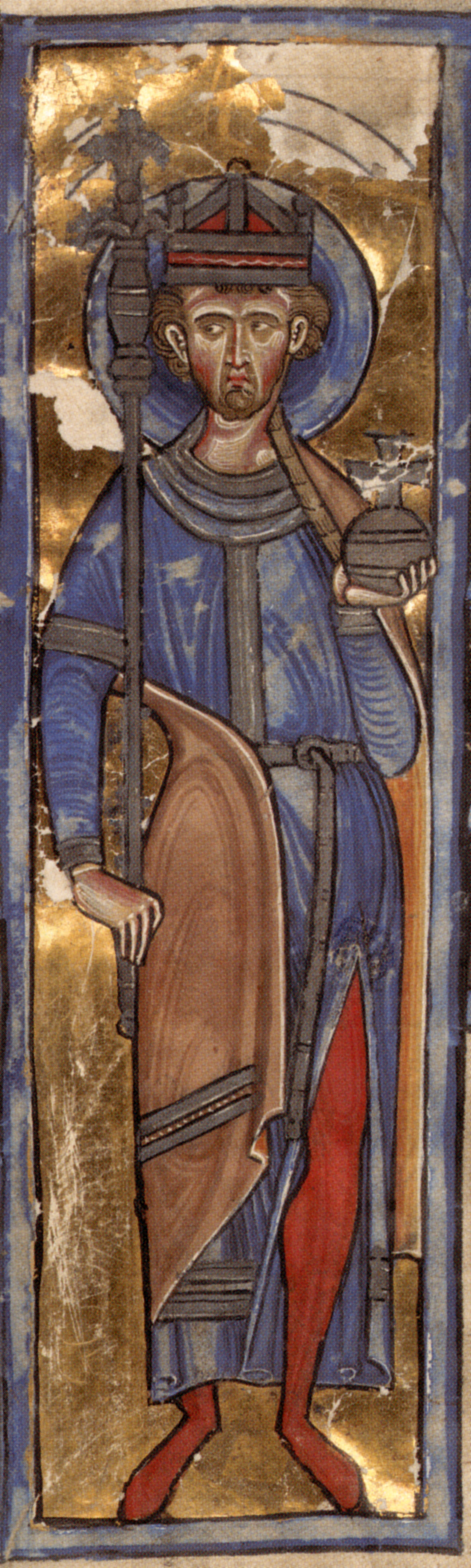
St Oswald
Amongst the other feasts that occur today is that of the Northumbrian Saint-King Oswald (d.641). Last August I posted something about him and in particular his holy arm which was once preserved and venerated in the abbey at Peterborough.
My home area in Yorkshire had a long-standing tradition of devotion to him, with several ancient church dedications, the early twelfth century Augustinian priory of St Oswald at Nostell near Pontefract, and, once, a cross to his honour in the centre of my home town, which served as the meeting place of the wapentake of Osgoldcross. Other centres of devotion were at Bamburgh in Northumberland, Bardney in Lincolnshire, Durham, Peterborough and St Oswald's Priory in Gloucester.
There is an online article about him and his cult here. The following paragraphs are initially based upon Dillon's Medieval Religion Saints of the day entry, with a number of my own additional comments and reflections:
of French-language saint's Lives (Paris, BnF, ms. Français 183, fol. 78v)
Oswald was killed in battle, at what is now Oswestry in Shropshire, against an old enemy, the pagan King Penda of Mercia, although historians have suggested, quite reasonably, that, despite what Bede wrote, the conflict may have been political rather than religious. Penda had his fallen opponant's head, arms, and hands shown publicly on stakes. These relics were later recovered by Oswald's brother and successor Oswiu, who donated the head to Lindisfarne.
Miracles were attributed to Oswald, and a cult arose. One of Oswald's hands was said to be undecayed; in the late eighth century it was still displayed in a silver reliquary in the palace church at Bamburgh. This was the relic which later went to Peterborough, and Bamburgh became a cell of Nostell in the twelfth century.
Other of Oswald's relics later were dispersed still further. In the early tenth century some wound up at St Peter's Priory in Gloucester, which soon became St Oswald's Priory instead. A page on that site is here; the site lies just north-west of what is now Gloucester cathedral. There is more here on Oswald's posthumous journeys. Devotion to him was extensive, spreading to the continent, and he remained popular in England down to the reformation, and, probably thanks to the account in Bede, it has revived in the last century or so.
St Oswald.
Manuscript illumination of c.1220
New York Public Library MS Spencer 1, f.89v
Image: Wikipedia
Both Durham Cathedral and that of Hildesheim have heads said to be those of St Oswald. Polycephalous saints are not unknown - and the Clever Boy would not be too cynical about that - they may well all be parts of the same skull.
The window was the gift of Bishop Thomas Langley of Durham, d.1437.
(window sVII in the CVMA notation)
Photograph by Gordon Plumb
There is a view of his late twelfth-century head reliquary at Hildesheim, dated to 1185-89 here.
Devotion to him on the continent also resulted in St Oswald becoming the patron of the Swiss canton of Zug, and at least one church in Carinthia is dedicated to him. This is doubtless an indication of the activities of Northumbrian missionaries working within German speaking-lands in the centuries following his life and martyrdom.
The eleventh-century Fleming Drogo of Saint-Winnoc penned three sermons on Oswald. (BHL 6362-6234), treating him not only as a Christian hero but also explicitly as a martyr. As a saint of Durham, Oswald has an impressive Vita in three books by Reginald of Durham (BHL 6365). In the 1220s the poet Henry of Avranches produced a Vita of Oswald. in hexameters (BHL 6365d).
All of which points to the vitality of devotion to him and of the Northumbrian church over many centuries. May St Oswald continue to pray for all committed to his patronage and for us all.
True Devotion to Mary
Today being the feast of Our Lady of the Snows and thus a the Blessed Virgin Mary prompts me to post something about St Louis de Montfort's True Devotion to Mary. There is an account of St Louis (1673-1716) and of his spiritual legacy which can be read here.
I have known of the book for a while but only recently got round to reading this classic work on Marian devotion, in the translation by another great devotee of Our Lady, Fr Faber C.O.
An Anglican friend grimaced somehat upon finding me with the book, but I can apprecaite its richness as a spiritual direction finder. One has initially to get used to St Louis' style, and it is, in one way, of its time, yet still highly pertinent. I was struck how, at times, St Louis writes as someone formed in the same culture, but giving very different answers, which produced Jansenism. He has a strong sense of mankind's fallen nature - but he has a very positive answer: the True Devotion he outlines.
From reading it I am aware of how it has encouraged my own prayers to Our Lady and already modified, and indeed expanded, my understanding of Marian devotion.
St Louis de Montfort
Image:www.michaeljournal.org
Our Lady of the Snows
Today is the feast of Our Lady of the Snows, the feast of the dedication of the Papal Basilica of Sta Maria Maggiore. The following piece is slightly adapted and edited from John Dillon's post on 'Saints of the day ' on the Medieval Religion discussion group:
The Dedication of the Basilica of St. Mary Major (Santa Maria Maggiore) in Rome (ca. 435). In 431 the Council of Ephesus in the course of its condemnation of Nestorianism asserted the Blessed Virgin Mary's role as Theotokos ('Mother of God'). This newly enunciated title was underscored shortly thereafter by Pope St. Sixtus III (432-40), who built and dedicated to Mary the Roman basilica now known as Santa Maria Maggiore. Since at least the time of Francesco Maria Fiorentini's Vetustius occidentalis ecclesiae martyrologium (1668), this has been considered the first church in the West to be dedicated to Mary.
The Clever Boy would add to that the claim made for the Old Church at Glastonbury, the building of which which some indeed ascribe to Our Lord whilst visiting Britain with Joseph of Aramethea ... but to return to John Dillon:
The feast is entered for today in the (pseudo-)Hieronymian Martyrology with an entry that reads as follows: Romae dedicatio basilicae sanctae Mariae. Santa Maria Maggiore was either a replacement for or a rebuilding of an earlier basilica erected on the same spot by Pope Liberius (352-66). In later legend it was claimed that Mary had appeared to Liberius and to others in a dream on the night of 4th-5th August saying that she would mark out in snow the outline of a space where a church should be built in her honour. On the following day the outline was discovered on the Esquiline and there Liberius built his basilica, which in this account was then already dedicated to Our Lady close to a century before Sixtus' creation of Santa Maria Maggiore.
In accordance with the legend, Santa Maria Maggiore came also to be called Santa Maria ad Nives ('Our Lady of the Snows') and in the general Roman Calendar from 1568 until its revision of 1969 the feast was called this as well. As, in Italian, at least, it still is at the Basilica itself.
Modified several times over the centuries, Rome's Santa Maria Maggiore retains much of its original basilican form and indeed some of its late antique decoration. The English-language version of the basilica's illustrated website is here, and a page of expandable views is here.
In this view of the interior, note the columns, capitals, and the mosaic panels above them,which are all early, and here is another view, showing the triumphal arch as well and a portion of the apse mosaic. There are more views from Paradoxplace; Sacred Destinations here, here and here.
There are also some expandable views of sculpture surviving from Arnolfo di Cambio's late thirteenth-century crèche for the Basilica:
Our Lady and the Christ Child above the Miracle of the Snow as depicted in a late fourteenth-century missal for the Use of Saint-Didier at Avignon (Avignon, Bibliothèque-Médiathèque Municipale Ceccano, ms. 138, fol. 254r) can be seen here.
Christ and the Blessed Virgin Mary appear above Pope Liberius breaking ground for Santa Maria Maggiore as depicted in an early fifteenth-century panel painting (1420s) by Masolino da Panicale, now in Museo Nazionale di Capodimonte, Naples.
The Virgin and the construction of Santa Maria Maggiore as depicted in an early fifteenth-century Franciscan breviary (Chambéry, Bibliothèque municipale, ms. 4, fol. 556v) can be viewed here.
Pope Liberius breaking ground for Santa Maria Maggiore as depicted by Matthias Grünewald in an earlier sixteenth-century panel painting (1517-1519) on a wing of his altar for the Maria-Schnee-Kapelle in the Stiftskirche (now Stiftsbasilika) St. Peter und Alexander in Aschaffenburg (painting now in the Städtische Museen, Freiburg im Breisgau) can be seen here and here, with details here, here and here.