Once I was a clever boy learning the arts of Oxford... is a quotation from the verses written by Bishop Richard Fleming (c.1385-1431) for his tomb in Lincoln Cathedral. Fleming, the founder of Lincoln College in Oxford, is the subject of my research for a D. Phil., and, like me, a son of the West Riding. I have remarked in the past that I have a deeply meaningful on-going relationship with a dead fifteenth century bishop... it was Fleming who, in effect, enabled me to come to Oxford and to learn its arts, and for that I am immensely grateful.


Showing posts with label St Dominic. Show all posts

Saturday, 8 August 2015

More medieval images of St Dominic


Before we leave St Dominic's current feast day I will share some further medieval images of  St Dominic which have been posted on the Medieval Religion discussion group site by John Dillon. I have opened some of the links:

a) as portrayed in an originally earlier thirteenth-century panel painting of Sienese origin (ca. 1235-1240; head reworked in its present form ca. 1280-1285) in the Fogg Art Museum, Harvard University, Cambridge, MA:


Saint Dominic


b) as portrayed in relief by Nicola Pisano on panels for Dominic's sarcophagus (betw. 1264 and 1267) in what is now the central portion of the Arca di San Domenico in the basilica di San Domenico in Bologna:
1) (lower register at right) miracle of the unburnt book: 
http://tinyurl.com/qzf2djk
2) (central register, holding up the resuscitated Napoleone Orsini; this panel thought to be largely the work of Arnolfo di Cambio):
http://tinyurl.com/nrjo3po

c) as depicted (at right; at left, the martyrdom of St. Peter Martyr) in the late thirteenth-century Livre d'images de Madame Marie (ca. 1285-1290; Paris, BnF, ms. Nouvelle acquisition française 16251, fol. 93r):
http://tinyurl.com/ylfo3wn

d) as depicted (being blessed, along with the brethren, by Honorius III) in a late thirteenth-century copy of French origin of the Legenda aurea (San Marino, CA, Huntington Library, ms. HM 3027, fol. 91v; image greatly expandable):
http://digitalassets.lib.berkeley.edu/ds/huntington/images//000941A.jpg

e) as depicted (at left; at right, St. Francis of Assisi) in the frontispiece to an late thirteenth- or early fourteenth-century hymnal of German origin (New York, Pierpont Morgan Library, MS W.24, fol. 1v):


f) as depicted (full length; scenes) in the front panel of an early fourteenth-century altarpiece (ca. 1300-1320) from Tamarit de Llitera (Huesca) now in the Museu Nacional d'Art de Catalunya, Barcelona:


g) as depicted (scenes) in a leaf from the earlier fourteenth-century Hungarian Angevin Legendary. Made in Bologna, Italy or Hungary.
Perhaps commissioned by King Charles Robert of Anjou, King of Hungary (1292-1342) ;other suggested patrons are Csanád Telegdi, a bishop in Hungary, and Jacob of Piacenza, a royal doctor and bishop of Csanád.  (ca. 1325-1345; New York, Pierpont Morgan Library, MS M.360.26):


Zone 1:
1) Dominic of Bologna: Scene, Self-Punishment -- Dominic of Bologna, nimbed, tonsured, nude, bleeding, kneels before bed and whips himself with scourge in both hands (flagellation), before robes laid out before him. Two lamps hang from ceiling.

2) Dominic of Bologna: Scene, addressing Monks (?) -- Dominic of Bologna, nimbed, tonsured, in Dominican habit, sits with book in lap and right hand raised in blessing before three kneeling tonsured Dominicans. Nimbed angel, with object in right hand, looks down on them from window.

Zone 2:
3) Dominic of Bologna: Scene, Miracle of Three Candles -- In portal, veiled woman kneels with joined hands raised in prayer, before basket containing white towel wound around three burning candles.

4) Dominic of Bologna: Scene, unidentified -- Tonsured cleric, possibly Dominican, in blue and white robes raises hands before woman, possibly personification of Mercy, veiled, standing in portal, with right arm raised indicating image of Christ of Sorrows, cross-nimbed, with arms crossed, above.
Scenes in frames decorated with foliate ornament.


h) as depicted in an earlier fourteenth-century copy (betw. 1326 and 1350) of the _Legenda aurea_ in its French-language version by Jean de Vignay (Paris, BnF, ms. Français 185, fol. 240v):
http://tinyurl.com/2cjhg62

i) as depicted in a mid-fourteenth-century copy (1348; from the workshop of Richard and Jeanne de Montbaston) of the Legenda aurea in its French-language version by Jean de Vignay (Paris, BnF, ms. Français 241, fol. 188v):
http://tinyurl.com/28j4yv9

j) as depicted in fresco (lower register at right, preaching; at left, two other Dominican saints; below them other Dominicans represented punningly as black-and-white dogs, Dominici canes) by Andrea da Firenze (Andrea di Bonaiuto) and assistants in a detail of their later fourteenth-centuryThe Way of Salvation (ca. 1365-1368) in the Cappellone degli Spagnoli in the basilica di Santa Maria Novella in Florence:


k) as depicted (various scenes) by Beato Angelico in the predella of his earlier fifteenth-century Coronation of the Virgin in the Musée du Louvre in Paris (earlier 1430s or perhaps 1450; individual predella images expandable from menu below the view of the painting as a whole):
http://cartelfr.louvre.fr/cartelfr/visite?srv=car_not_frame&idNotice=1197

l) as depicted (at right, flanking the BVM and Christ Child; at left, St. Zenobius of Florence) by Beato Angelico in an earlier fifteenth-century fresco (ca. 1437-46) in the Museo nazionale di San Marco in Florence:


m) as depicted (his celestial vision; his meeting with St. Francis of Assisi) by Benozzo Gozzoli in a mid-fifteenth-century fresco (1452) in the apsidal chapel of the chiesa di San Francesco in Montefalco:


n) as depicted (resuscitating Napoleone Orsini) by Bartolomeo degli Erri in a later fifteenth-century panel painting (betw. 1467 and 1474) in the Metropolitan Museum of Art in New York:
http://www.metmuseum.org/collection/the-collection-online/search/435616

o) as depicted (miracle of the unburnt book; his vision of heaven) in a later fifteenth-century copy (ca. 1480-1490) of the Legenda aurea in its French-language version by Jean de Vignay (Paris, BnF, ms. Français 245, fol. 23r):
http://tinyurl.com/3gx7okf


St Dominic - images and reflections


To mark St Dominic's feast Gordon Plumb has posted a photograph of the saint on the Medieval Religion discussion group. It comes from the surviving stained glass in Long Melford church in Suffolk, and can be viewed at :

https://www.flickr.com/photos/22274117@N08/2226559836

In the panel St Dominic is shown wearing blue because the black of the Dominican habit would be counter-productive in stained glass, and is usually replaced therefore with blue glass.

By following the links underneath the figure readers can access the whole of  Gordon Plumb's archive of photographs of the glass in Holy Trinity Long Melford. Though only some of the glazing survived the activities of enthusiastic reformers what does survive, both devotional and the remarkable portraits of fifteenth century donors is of very high quality and an indication of what once filled the windows not only at Long Melford but across East Anglia.

Even in a county rich in late medieval churches Long Melford is exceptional in its quality and contents, and its liturgical life before the disruptive changes of the sixteenth century is cited by Eamon Duffy in The Stripping of the Altars.


St Dominic
This painting preserves the tradition of his auburn hair, and that as he grew older he retained a complete tonsure.

Image; dominicains.ca


St Dominic
His hair may be depicted less accurately, but he has his distinctive emblems of the star and the lily, indicating his purity of life.

Image: parish.rcdow.org.uk

Stephanie Mann also has a post on Supremacy and Survival about St Dominic and the history of the Order of Preachers in the British Isles, and with a link at the conclusion to another related post. These can be viewed at  Happy Feast of St. Dominic


St Dominic.

Image: CatholicCulture.org


St Dominic


Today is the novus ordo feast of St Dominic. I have recently completed reading a biography of him. This is not a new work, having originally been published in 1857, and reprinted in 1988 by TAN. It is The Life of St Dominic by Augusta Theodosia Drane ( Mother Frances Raphael )


Image: Amazon

Despite being more than a century and a half old as a book it remains readable and informative. The author has collected together many of the early reports of St Dominic's sanctity and the lives and reported miracles of not only him but other early Dominicans. As next year is the eighth centenary of the foundation of their Order of Preachers this is a good preparation for that, and in recounting medieval stories about the life of the founder of the Order a valuable insight into medieval life and attitudes.


Thursday, 7 August 2014

Liturgical Notes for early August


The New Liturgical Movement has two interesting pieces about liturgical customs for these first days of August. One refers to yesterday's lovely feast of the Transfiguration and a particular custom associated with it, which can be seen in Transfiguration of the Lord: Blessing of the Grapes.

The other refers to the forthcoming feast (if you are on the Novus Ordo calendar) or recent one (if you follow older practice) of the founder of the Dominicans, and can be read at Liturgical Notes on the Feast of Saint Dominic.


Friday, 31 January 2014

The Dominican Spirituality of preaching


The Anglican parish church of St Giles here in Oxford has an establishe dtradition of offering a series of talks each Thursday lunchtime during the University term which look at religious themes and usually draw upon the academic community in the city to give these addresses, so they are usually of a high standard.  The other year they gave term over to considering with monks from Belmont abbey the Benedictine tradition and this term they are looking at the Dominicans with lectures by members of the Oxford Blackfriars community.

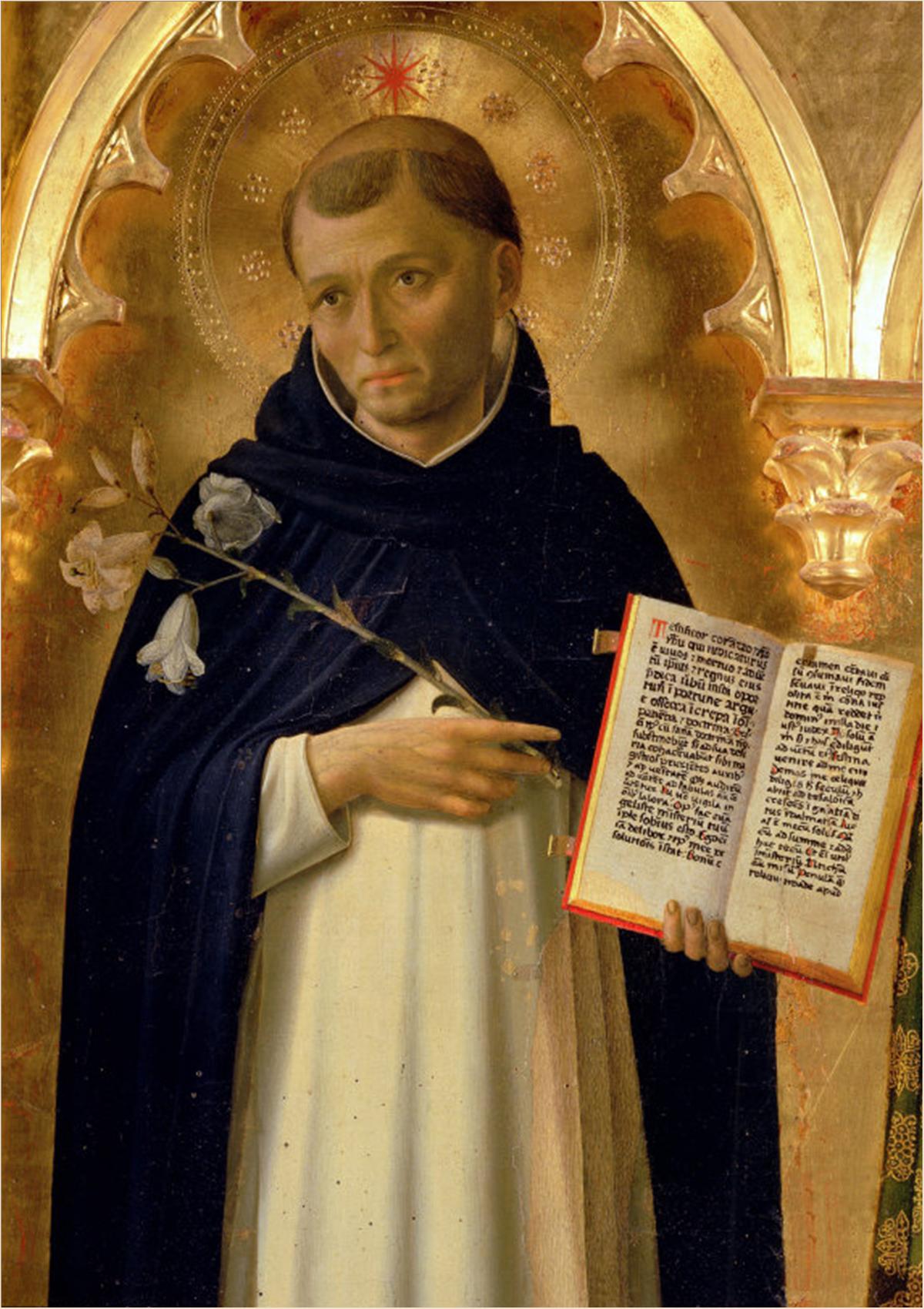
The Perugia Altarpiece, Side Panel Depicting St. Dominic.jpg

St Dominic
As depicted in the Perugia Altarpiece of 1437 or 1438 by Fra Angelico

Image:Wikipedia

Last week the first talk in the series was an illustrated one given by Dr Nicholas Gendle on Fra Angelico, but unfortunately I had to miss that.

Yesterday the speaker was Fr Simon Gaine O.P., Regent of Studies at Blackfriars in Oxford. As one would expect it was a clear, cogent and insightful talk on the Dominican spirituality of preaching. He defined spirituality as one of the ways by which the individual make stheir way to God, and that for Dominicans, the Order of Preachers, preaching was at the centre of this process.

When the Order was established, about 1216 this was novelty - preaching was seen as the responsibility of Bishops, and not of the parochial clergy. It had been about 1203 when travelling with his Bishop, Diego, through southern France on a diplomatic mission to Scandinavia, that Dominic, a canon of Osma, encountered the Albigensians with their Cathar beliefs. Realising the need to proclaim a view of the world as essentially good and created by God, a God who had become Incarnate, Dominic began to seek to convert them. Hi sown prayer is recorded as involving his own material nature, bowing, kneeling, genuflection and prostration.

In his mission Dominic saw the need to assert the Truth against error , not to stir up debate in itself but to discover it and set people free from falsehood.

This search for Truth was linked to compassion - it is after all an action of mercy to share the Truth. Dominic's own compassion can be seen in his sale of his books as astudent to provide food for the hungry during afamine and in his wish at one point to sell himself into slavery to redeem other Christians captured by Muslim slavers.

The Order was conciously founded for others, not to establish a safe place for its members to live and pray as with enclosed orders, but to be useful for others. In a dream St Dominic saw other monastics crossing a river on boats whilst the Dominican had to swim across turbulent waters dragging a boat with others in it.

By now Dominic was aware not only of  the heretics in southern France nut also ofpeoples such as the Tartars who had not heard of Christ. By about 1215 he and his recruits had a house in Toulouse, but from 1216 they were recognised as an Order by the Papacy and the founder had a vision when in Rome of St Peter and St Paul which made clear the need for a universal mission for his community, and taht this required mobility. In the light of the regulations enacyed by Lateran IV the community adopted the Rule of St Augustine for Canons - something Dominic himself was - and as it was the shortest of the Rules, they were able to add on to it their own constitutions.

Preaching was not just to be homiletics but also study and debate in the quest for Truth. Engaging in debate with the Cathars St Dominic and his opponants on one occasion could find no means of agreement but resorted to a trial of their books by fire - and Dominic's books leapt out of the flames:

File:Pedro Berruguete - St Dominic and the Albigenses - WGA02083.jpg

St Dominic and the testing of books by fire with the Albigensians
Pedro Berruguete (1450-1504) circa 1495

Note in the upper centre the orthodox book flying up out of the fire

Image: Wikimedia.commons

Fr Gaine added that he had seen depictions of this story captioned as St Dominic burning heretical books rather than the actual story of resolving by extraordinary means a scholarly debate.

The tradition of debating to ascertain the Truth attracted Dominicans to the universities of medieval Europe - Bologna, Paris and in 1221, just at the time of Dominic's death, to Oxford. In these scholastic debates points were refined to determine the genuine differences of opinion and to seek agreement. In later centuries the Dominicans developed a tradition of public debate between members to elucidate points of doctrine.

At the time of the oundation of the Order the call to an Apostolic life of poverty was strong and this was adopted by St Dominic - the Albigensian perfecti attracted followers by their own austere lifestyle an dthis had to be matched by their opponants. A group of Cistercian abbots who preached against th heresy found they made no impact in that they were seen as too remote and who having onc epreached rode away. Dominic and his followers engaged with individuals and travelled on foot. From the perfecti
Dominic took over the distinctive black cappa, which gave the order its appellation of Blackfriars. However  the issue of a mendicant lifestyle did not pose the problems for the Dominicans that it was to do for the Franciscans and their concern for absolute poverty. St Dominic had no problem with the friars owning their own priory, but insisted there should be no rental income, and in 1217 they renounced receiving tithe payments, and further consolidated their position in 1219. This system had to be adapted after the Black Death, but they still essentially subsist on offerings.

In the thirteenth century the Order attracted such luminaries as St Albert the Great and St Thomas Aquinas, whose Summa Theologica was intended as a guide  for the central task of preaching. This saw all knowledge as a unity, an indication of that Truth which the Order exists to serve.

This was a really very fine talk by Fr Gaine, and one which I hope served to introduce the Dominican tradition and ideal to members of other Christian traditions.


Thursday, 12 September 2013

Battle of Muret


Today is the 800th anniversaryof the battle of Muret when the army commanded by Simon de Montfort the elder (the father of King Henry III's brother-in-law from Hell) defeated the army of King Peter II of Aragon, who was killed in the battle, and Count Raymond VI of Toulouse in the Albigensian Crusade. It is claimed that Montfort and his 700 knights sweptaside up to 50,000 albigensian forces. Whatever the exact figures the loss of King peter in the first charge by the Catholic forces appears to have demoralised the Cathars and their allies. To the Catholics the victory was seen as miraculous. The site of the battle, which now lies in the outer suburbs of Toulouse, is now largely built over. There is an online account of the battle, with links to related sites, here.

Along with Las Navas de Tolosa in 1212 and Bouvines in 1214 Muret was one of this group of battles which determined the political contours of western Europe in the thirteenth century.

Tradition - perhaps not always entirely reliable in such matters, but nonetheless significant - has long asserted the link between St Dominic's preaching against the Albigensians and the use of the rosary. Some accouns, as here , date the gift of the rosary to 1208, and that it was used by the Catholic forces before the battle, and that, as Nicholas Trivet OP wrote, Simon de Montfort built the first chapel dedicated to the Rosary as an act of thanksgiving for his victory in Muret. 

The Lay Dominicans website has this about the battle of Muret and the Rosary:


Just before the battle of Muret, September 12, 1213, Saint Dominic was again found in the council that preceded the battle. During the conflict, he knelt before the altar in the church of Saint-Jacques, praying for the triumph of the Catholic arms. So remarkable was the victory of the crusaders at Muret that Simon de Montfort regarded it as altogether miraculous, and piously attributed the victory to the prayers of Saint Dominic. In gratitude to God for this decisive victory, the crusader erected a chapel in the church of Saint-Jacques, which it is said he dedicated to Our Lady of the Rosary. (It would appear, therefore, that the devotion of the rosary, which tradition says was revealed to Saint Dominic, had come into general use about this time.)

The whole artcicle from their website can be seen here.
 
However other writers give 1214 as the date of the first use of the Rosary. There is more about the evolution of the devotion and referring to these events here.


Wednesday, 8 August 2012

St Dominic - image and inspiration


My Bavarian friend Dominic Wanner from CBL International has been celebrating his namenstag today, and earlier this evening had a small dinner party in Oriel for some of his family who are in Oxford, and also invited me, both as a friend and as someone who could talk about St Dominic.There are two on-line lives of him here.   I  posted about St Dominic last year in  St Dominic and St Philip  and in St Dominic in art and faith .

As I thought about it the notion came to me that one can think of St Dominic as a man on a number of frontiers. Like all Christians he stood on the frontier of the temporal and the spiritual, and of this life and of  the life of eternity. In addition he came from what had been formed as a frontier region in northern castle, although by his time the actual frontier with Islam lay south of Toledo.Through his home region runs the Camino that took pilgrims, then as perhaps never before or since, to the finis terrae of Santiago
in Galicia, and along which ran so many rich and vacultural contacts. The Pyrennes were another frontier, leading to the frontier zone between Catholicism and Catharism which was to form St Dominic's mission in the years after 1200 and to lead to the foundation of the Dominican Order. As an intellectual who chose to preach to the general public he stood, as does his Order, on that frontier or interface of communicating faithfully and with complete orthodoxy the Christian Gospel.

As a saint he is reminiscent of that other great missionising Spanish-born founder of an intellectual Order, St Ignatius Loyola, and in his recollected cheerfulness and tranquility of St Philip Neri, as I argue in the post I link to above.

A description
by a contemporary gives a good description of his appearance:

Dominic was of middling height and slender build. His face was beautiful and slightly rudduy, and his hair and beard were reddish. He had beautiful eyes. A kind of radiance shone from his forehead and between his eyebrows, which drew everyone to venerate and love him. He always appeared cheerful and happy, except when he was moved by compassion for any trouble which was afflicting his neighbour. He had long beautiful hands, and a powerful, beautiful, resonant voice. He was not bald anywhere, but had a complete ring of hair round his tonsure, fglecked with a little grey


The reference to the radiance of his forehead between his eyebrows may link to the story of his godmother seeing a star on his forehead whn he was an infant.

The tradition of his having reddish hair is continued in these paintings from the mid-fifteenth century by Fra Angelico


Image: dominicansdunlaoghair

St Dominic
Fra Angelico 1437 Perugia altarpice

Image: Wikipedia Commons


In later centuries the tradition was lost as inthis painting by the seventeenth century artist  Claudio Coello , where St Dominic has become architypically Spanish in appearance:

St Dominic
Claudio Coello, c.1685
Prado Museum

 Image: Wikipedia Commons

Thanks to the modern technologies of computer photo-shopping some modern Dominicans have produced this image of their founder, the patron saint of astronomers, to express the continuing Dominican mission in the age of the computer and the internet:


:


Thursday, 10 November 2011

St Dominic and St Philip


Amongst the books I am currently reading is Augusta Theodosia Drane's The Life of Saint Dominic. This was originally published in London in 1857, and, having stood the test of time, was reprinted by TAN in 1988. It appears, particularly given its date and that it was written by a religious, a balanced and fair account, and drawing together what is known of the life of St Dominic (1170-1221).

File:The Perugia Altarpiece, Side Panel Depicting St. Dominic.jpg

St Dominic
From The Perugia altarpiece of 1437 by Fra Angelico

Image: Wikipedia

One thing which particularly struck me was the similarity in the accounts of miracles attributed to St Dominic, especially those performed in Rome, to the accounts in Antonio Gallonio's Life of St Philip Neri.

In one way one should not be surprised that two saints should act in a similar way, and the Dominicans were a not inconsiderable influence on St Philip - not least the memory of Savanarola. The concept of an Oratory with preaching and penance at the heart of its ministry is very similar to the model proposed by St Dominic for his community.

Some of the incidents recorded are very similar - both are believed to have raised men from the dead at their intercession, and both are recorded as being seen to leviate whilst celebrating Mass. Like St Philip St Dominic appears to have had a rather matter of fact, almost disengaged, approach when dealing with situations that resulted in either a miracle or spiritual enlightenment and the bestowal of grace.

The historian in me wondered if Gallonio conciously modelled his hagiography of St Philip upon that which would have been available of the thirteenth century founder of the Dominicans, or if there is just a genuine coincidence between their two not dissimilar lives.


Monday, 8 August 2011

St Dominic in art and faith


Today is the feast of St Dominic, who died in 1221 and was canonized in 1234.

His shrine tomb is in Bologna, and there is an article about it and about the reliquary of his skull here. The Arca is piece made in two stages, in the thirteenth and fifteenth centuries. Here is acontemporary photograph:


http://upload.wikimedia.org/wikipedia/commons/6/65/Shrine_of_Saint_Dominic,.JPG

Image: Wikipedia

Arca di San Domenico

An older photograph showing the altar with a fine display of candles

Image: www.artand architecture.org.uk

This is a photograph of his head reliquary, made by the Bolognese goldsmith Jacopo Roseto in 1383


In England the Thornham Parva retable from the early fourteenth century survives in a small Suffolk parish church, but is thought that, together with afrontal now in the Musee de Cluny in paris, originally belonged to the Dominican friary in Thetford. On the left is St Dominic, and on the right the first Dominican martyr, St Peter Martyr:

http://www.inkoosmill.co.uk/images/retable02.jpg

The Thornham Parva retable

Image:inkoosmill.co.uk

There is more about the retable with details of the figures here.

Also in Suffolk there is this later fifteenth century English stained glass representation of St Dominic, from the remains of the beautiful glazing of Holy Trinity church at Long Melford:

photo

A figure of St Dominic with at his feet either Henry Hardman or William Thwaytes.

Window nXIX,2a

St Dominic is shown in blue rather than the black of his Order as the latter colour would only be used for details in glass due to its opacity.

Image: Gordon Plumb's photostream of Flickr,


This is a day upon which to give thanks for St Dominic and his Order, which is certainly present and active in Oxford - "Gods Dogs" are a very positive part of Catholic life here. It is also a day upon which I try to remember in my prayers the deceased Dominicans of the medieval house in Pontefract, about which I posted recently.