Once I was a clever boy learning the arts of Oxford... is a quotation from the verses written by Bishop Richard Fleming (c.1385-1431) for his tomb in Lincoln Cathedral. Fleming, the founder of Lincoln College in Oxford, is the subject of my research for a D. Phil., and, like me, a son of the West Riding. I have remarked in the past that I have a deeply meaningful on-going relationship with a dead fifteenth century bishop... it was Fleming who, in effect, enabled me to come to Oxford and to learn its arts, and for that I am immensely grateful.


Showing posts with label Wilton Diptych. Show all posts

Friday, 6 January 2017

Birth of King Richard II


On January 6th 1367, 650 years ago, the future King Richard II was born in Bordeaux. He was the second son of Edward Prince of Wales and his wife Joan of Kent.

Their elder son, Edward of Angoulême, born in 1365 died in 1370, and thus Richard became heir to the throne after his father. There is a useful online account of the elder brother at Edward of Angoulême ( though I think few now believe the idea that he is depicted in the Wilton Diptych as the Christ Child ) and more about his date of death at Edward of Angoulême.

Image result for Wilton Diptych

King Richard II from the Wilton Diptych

Image:ReedDesign

This day is, of course the feast of the Epiphany and imagery of the Magi figured in later orations to Richard as well, by implication, in the Wilton Diptych of 1397 (or thereabouts) which shows him with St Edward the Confessor and St Edmund in adoration of the Christ Child.

 http://reeddesign.co.uk/inspiration/images/wilton.jpg

The Wilton Diptych

Image:ReedDesign

The connotation of the link with the Magi was further brought out by the fact or tradition that three kings were present at Richard's baptism - those of Majorca, Armenia and the exiled ruler of Castile.
 
The presence of St John the Baptist in the Wilton Diptych and a saint to whom Richard showed especial devotion - as he records on the inscription he prepared for his tomb - is another link to the future king's birth and baptism. As his birth he was first named John by the midwives and only received the name Richard at his formal baptism, and the Epiphany is also the traditonal day on which the Baptism of Christ was recalled as well as the visit of the Magi and the miracle at Cana.

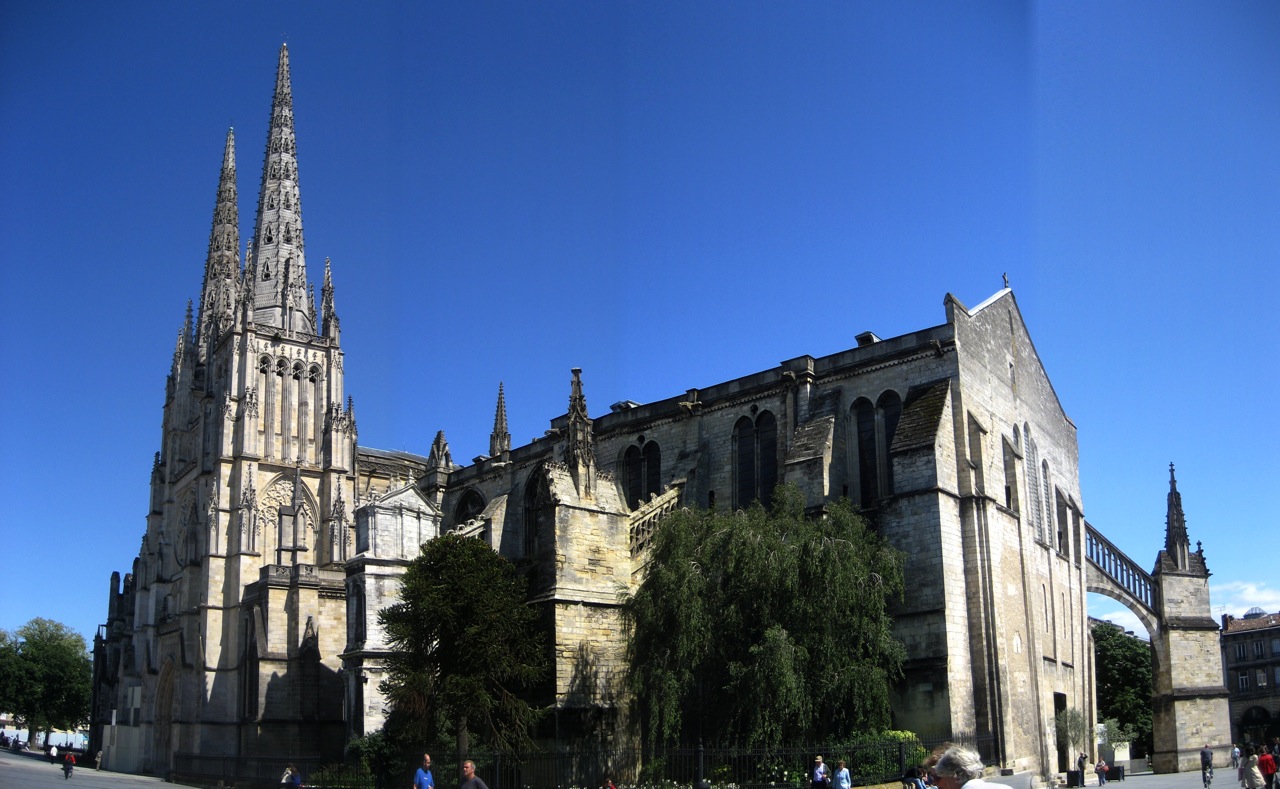
Richard was baptised in the cathedral of St Andre in Bordeaux

http://cdn.touropia.com/gfx/d/things-to-do-in-bordeaux/bordeaux_cathedral.jpg?v=1 

Bordeaux Cathedral from the north-east

Image: touropia.com 
 https://alllinedwithtrees.files.wordpress.com/2008/06/bordeaux_03.jpg
Bordeaux Cathedral from the north-west

Image: linedwithtrees.wordpress.com


The interior looking east


Image:Wikipedia


The interior looking west

 Image:Wikipedia 


There is an online account of the history and architecture of the cathedral, with a plan and photographs, here.

There are illustrated online accounts of the Ombrière, the administrative centre of English rule in Aquitaine - Guienne, at The Ombrière Palace and, in French, at Palais de l'Ombrière.

Thursday, 13 October 2011

St Edward the Confessor


Today is the feast of St Edward the Confessor. The anniversary is not that of his death, January 5th, but rather that of the translation of his relics to a new shrine in Westminster Abbey in 1163. I wonder if the date, a day before the anniversary of the battle of Hastings, was chosen deliberately for that reason - a hermeneutic of continuity perhaps.

St Edward was born at Islip, near Oxford, so he can be accounted as a local as well as a national saint.

The Oxford DNB life by Frank Barlow, who has written the standard biography of the King, and who stresses that St Edward was much more than the possibly rather colourless figure he often appears to be presented as, can be read here.

Last year I posted St Edward and St Edward's Crown to mark this feast, and I think it is worth reading again.

http://www.stedmundsbury.gov.uk/sebc/visit/images/Edconf.jpg

St Edward the Confessor from the Bayeux Tapestry

Image: stedmundsbury.gov.uk

His cult has remained central to the monarchy and hence the survival of his shrine, as well as the designation of the Crown of St Edward, and the centuries-long notion of the good laws of King Edward which were to be upheld by his successors. His cult was promoted by successive monarchs, notably King Henry III who initiated the rebuilding of Westminster abbey and King Richard II. It remained essentially one for the court rather than being a popular devotion, but it underpinned the sacrality of the monarchy.

May St Edward continue to pray for The Queen and the Royal Family, and for the realm.