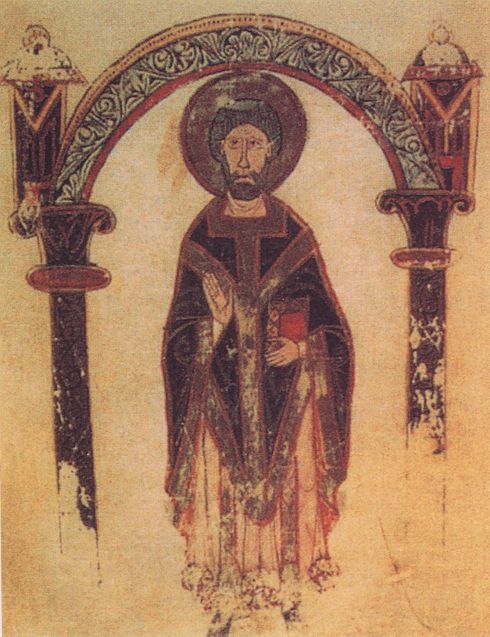
Following on from my recent post here are some more medieval images of St Hilary of Poitiers, courtesy of John Dillon from the Medieval Religion discussion group. Click on the links to view the pictures:
a) Hilary of Poitiers as depicted in an eleventh-century copy of his Vita by St. Venantius Fortunatus (Montpellier, Faculté de Médecine, ms. 48, fol. 31v):
b) Hilary of Poitiers' soul received by angels as portrayed on a later eleventh- or early twelfth-century capital in the église Saint-Hilaire-le-Grand in Poitiers:
c) Hilary of Poitiers (at right) blessing St. Troecia / Troesia (Ste. Triaise) as portrayed on an earlier twelfth-century relief now in the Musée Sainte-Croix in Poitiers:
d) Hilary of Poitiers' soul received by an angel as portrayed on the surviving fragment of his mid-to-later twelfth-century cenotaph in the église Saint-Hilaire-le-Grand in Poitiers:
Detailed views, at different resolutions, of a cast of this sculpture belonging to the Musées de Poitiers are available here:
e) Hilary of Poitiers (at left) at the Council of Seleucia and devils inspiring and tormenting the non-Nicene (heretical) bishops as portrayed on the later twelfth-century lintel of the west portal of the église (ancienne collégiale) Saint-Hilaire in Sémur-en-Brionnais (Saône-et-Loire):
Detailed views:
f) Hilary of Poitiers treading on the dragon of heresy as depicted by Savalo of Saint-Amand in a later twelfth-century (third quarter) copy of his De Trinitate, De synodis, and Liber in Constantium imperatorem (Paris, BnF, ms. Latin. 166, fol. 3v):
g) Hilary of Poitiers as depicted (four scenes) in the late twelfth-century Navarre Picture Bible from Pamplona (Amiens, Bibliothèques d'Amiens Métropole, ms. 108, fol. 214v):
Detail (Hilary instructing heretics):
h) Hilary of Poitiers blessing St. Martin of Tours as depicted in a panel of the earlier thirteenth-century St. Martin window (ca. 1215-1225) in the ambulatory of the basilique cathédrale Notre-Dame in Chartres:
i) Hilary of Poitiers' soul received by an angel as depicted in a later thirteenth-century gradual (ca. 1250-1260) for the Use of the abbey of Notre-Dame at Fontevrault
(Limoges, Bibliothèque municipale, ms. 2, fol. 54r):
j) Hilary of Poitiers (at centre) at a council as depicted in a late thirteenth-century copy of French origin of the Legenda aurea (San Marino, CA, Huntington Library, ms. HM 3027, fol. 20v; image greatly expandable):
k) Hilary of Poitiers (at right) consecrating St. Martin of Tours bishop as depicted in a panel of the late thirteenth- or early fourteenth-century St. Martin window in the cathédrale Saint-Gatien in Tours:
l) Hilary of Poitiers' consecration as depicted in an earlier fourteenth-century (second quarter) French-language collection of saint's lives (Paris, BnF, ms. Français 185, fol. 211r):
m) Hilary of Poitiers and other bishops fighting heretics as depicted in an earlier fourteenth-century copy (1348) of the Legenda aurea in its French-language version by Jean de Vignay (Paris, BnF, ms. Français 241, fol. 38v):
n) Hilary of Poitiers as depicted by Jean Bandini in a late fourteenth-century book of prayers (payments recorded, 1385 and 1386) made for the Avignonese Pope Clement VII (Avignon, Bibliothèque-Médiathèque Municipale Ceccano, ms. 6733, fol. 30r):
o) Hilary of Poitiers driving out the serpents as depicted in an early fifteenth-century copy of the Legenda aurea in its French-language version by Jean de Vignay (Paris, BnF, ms. Français 242, fol. 32v):
p) Hilary of Poitiers at a council as depicted by Jean Fouquet in his now dismembered mid-fifteenth-century Hours of Étienne Chevalier (1450s; this folio in the Musée Condé, Chantilly [Oise], ms. 71, fol. 36r):
q) Hilary of Poitiers (at centre in the image at left) at the Council of Seleucia as depicted in a later fifteenth-century copy (1463) of Vincent of Beauvais' Speculum historiale in its French-language version by Jean de Vignay (Paris, BnF, ms. Français 51, fol. 138v):
r) Hilary of Poitiers as depicted in a late fifteenth-century Book of Hours (ca. 1490) for the Use of Tours (Paris, Bibliothèque Mazarine, ms. 507, fol. 174r):
s) Hilary of Poitiers (at left, lower half of the page) as depicted in a hand-colored woodcut in the Beloit College copy of Hartmann Schedel's Nuremberg Chronicle (1493) at fol. CXXXIr:
Another list member, Genevra Kornbluth, added the following image of St Hilary with St Martin, a fourteenth century embroidery (second photo):