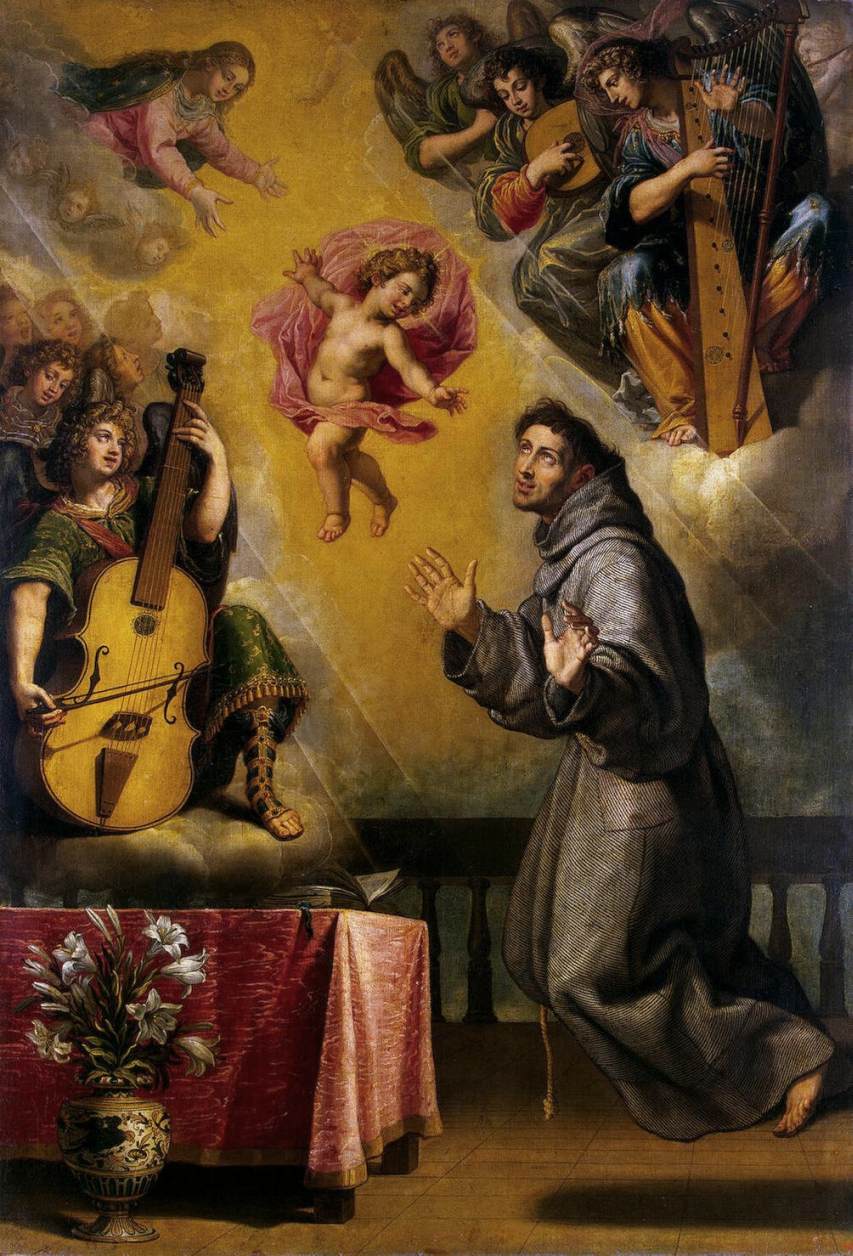
Today is the feast day of St Anthony of Padua, 1195-1231. There is an account of the life of this noted Franciscan preacher and teacher and of his continuing role in the life of the Church
here.
St Anthony of Padua
Metropolitan Museum New Yotk
Image:
aug.edu
From
the website which provided this fourteenth century image of the saint, which is more forceful than so many recent and modern ones which are often very sentimental, I
found this piece about his iconography, which I have adapted for this
post:
Those who have visited any number of Catholic churches
will be familiar with the representation of St. Anthony of
Padua as a young Franciscan holding the Christ Child on
one arm
This tradition is based on a vision of the Christ Child
that the saint is said to have had while staying with a
nobleman. The man looked into the room he had provided for
Anthony and saw him holding the Child in his arms.
This account did not enter the iconography until the 16th
century, and even then the Child is shown standing upon
the book that had until then always been Anthony's most
common attribute.
The book refers to Anthony's standing as the most famous
preacher of his time and the Franciscan order's first
Lector in Theology.
The earliest images of him have the saint holding a closed
book in his left hand and wearing the tonsure and habit of
the Franciscan order, as above.
After the Child became a common feature, many painters put
him on the opened pages of the book, as if he had appeared
to Anthony while the saint was meditating on the
scriptures .
The Child is variously portrayed as a toddler, a
boy ,
or even a small-scale man .
Because of the
legend that he had once preached to the fish,
these were sometimes used as his attribute. He is also often seen
with a lily stalk .
Another convention denotes St. Anthony's visionary fervor
by means of a red heart held up in the right hand ,
sometimes aflame .
In former Venetian areas Anthony often figures in group
paintings – anachronistically welcoming into Heaven
martyrs from ancient times (examples: St.
Anthony of Antioch, St.
Eugene) and assisting at the Invention of the True
Cross .
He is also shown interceding with Mary and the Christ
Child for souls in Purgatory .
This subject is possibly related to the story, briefly
mentioned in his Vita, of a nun who feared
Purgatory but who through the prayers of Anthony was able
to be cleansed in this life, or perhaps to the more
numerous and fully detailed accounts of the saint coming
from Heaven to counsel women in despair of their
salvation.
Given the large number of portraits and statues of Anthony in
Italy and worldwide , there are surprisingly few narrative
images. One of the more popular types represents the
"Miracle of the Mule": A Catharist said he would believe
in the Real Presence only if a dumb animal were to prefer
the consecrated host to a bundle of feed. Anthony arranged
for a mule to be brought forward and given that choice - the mule went to the Host and knelt down in
adoration.
Here is an extract from a sermon by St Anthony of Padua used in the Office of Readings for today:
We should speak, then, as the Holy Spirit gives us the gift of speech.
Our humble and sincere request to the Spirit for ourselves should be
that we may bring the day of Pentecost to fulfilment, insofar as he
infuses us with his grace, by using our bodily senses in a perfect
manner and by keeping the commandments. Likewise we shall request that
we may be filled with a keen sense of sorrow and with fiery tongues for
confessing the faith, so that our deserved reward may be to stand in the
blazing splendour of the saints and to look upon the triune God.
St Anthony, the Christ Child and a pot of lilies
Image:communio.stglogs.org
The text for traditional blessing of lilies for the feast of Saint Anthony of Padua is available
here.