Once I was a clever boy learning the arts of Oxford... is a quotation from the verses written by Bishop Richard Fleming (c.1385-1431) for his tomb in Lincoln Cathedral. Fleming, the founder of Lincoln College in Oxford, is the subject of my research for a D. Phil., and, like me, a son of the West Riding. I have remarked in the past that I have a deeply meaningful on-going relationship with a dead fifteenth century bishop... it was Fleming who, in effect, enabled me to come to Oxford and to learn its arts, and for that I am immensely grateful.


Showing posts with label Oscott College. Show all posts

Tuesday, 19 May 2015

Conference on the Stuarts in Exile - June 11th


I was alerted by an advertisement in the latest edition of the Birmingham Archdiocesan newspaper Catholic Today to this forthcoming conference at Oscott College. It promises to be a very interesting day:

Nationality, Religion and Music:  the Stuarts in exile

Thursday 11th June 2015


Cardinal York - King Henry IX

10.30 Arrivals and coffee
11.00 – 12.30 Lecture: Dr Gabriel Glickman, University of Warwick, author of The English Catholic Community 1688-1745 :

               Jacobitism and Catholics in the Three British Kingdoms


12.45 Lunch
Special Exhibition open. College chapel and museum open to visitors.
 
2.00 – 3.30 Lecture: Dr Edward Corp, University of Toulouse, author of The Stuarts in Italy 1719-66: a Royal Court in permanent exile, and other works on the exiled Stuarts:

 
      Religion, Nationality and Music at the exiled Stuart Courts


3.30 – 4.00 Tea 

 
4.30-5.30 Abbot Geoffrey Scott (Douai Abbey), co-editor of Catholic Gentry in English Society: the Throckmortons of Coughton, and author of Gothic Rage Undone: English Monks in the Age of Enlightenment:


         Illustrated Lecture: ‘Stuart images and a Chapel in exile’ (the private chapel of Queen Maria Clementina in Rome)


6.00 Buffet Supper
 
7.30  Concert by Cappella Fede and Harmonia Sacra directed by Peter Leech:


     The Cardinal King: rediscovered music composed for Henry Benedict Stuart in Rome 1740-90

Various booking packages available for the day and/or evening. For all further information and bookings, please contact Mrs Maggie Wilson.

Tel: 0121 321 5026 
Email: maggie.wilson@oscott.org                                                                                                                                                        


Tuesday, 20 May 2014

More photographs of Bishop Byrne's Episcopal Ordination


My friend Irim posted some links to other photographs of last week's episcopal consecration of Bishop Byrne in the comments section of my post about the day. In case other readers have not seen that the links are, firstly, to the cathedral website which has 216 photographs of the ceremonial, and can be viewed here. 


photo

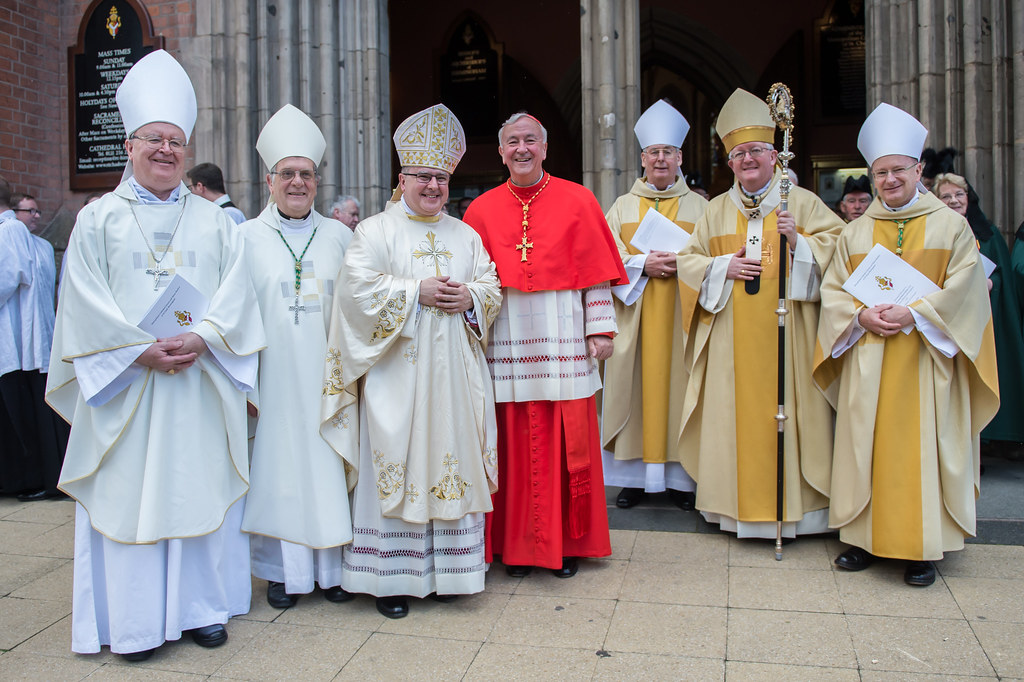
Episcopal line-up:
Left to right, Bishop William Kenney, Bishop David McGough, Bishop Byrne, Cardinal Nichols, Bishop Philip Pargeter, Archbishop Longley, Bishop Michael Barber

Image: mazur/catholicnews.org.uk.on Flickr

In addition she found some photographs of the reception at Oscott on the website of the Washington DC Oratorians which can be viewed here. She says she was particularly taken with one of the new Bishop checking his watch, which can be seen here, and one with his family - as was pointed out during the service in the cathedral it is quite unusual for a new bishop to have both his parents present at his consecration - and which can be seen here.

Wednesday, 14 May 2014

Oscott


My visit to Oscott College yesterday was my first to this famous seminary, of which there is a history here.

St Mary's College, Oscott (Photo: papalvisit.org)

St Mary's College, Oscott 

Image: papalvisit.org/blogs.telegraph.co.uk


The buildings date from 1838, when the college moved to the present site from Old Oscott - now Maryvale. The buildings are the work of Augustus Pugin and Joseph Potter. The college was so impressed with Pugin’s work they appointed him as Professor of Ecclesiastical Art and Architecture, at the age of twenty five.

It was conciously conceived and designed as an evocation of what English schools and university colleges might have been like if there had been no reformation. The main entrance front is very much in the style of an Oxford college - indeed it displays close parallels  with Oriel in particular - and the cloister which links the rooms behind around their central quadarngle is reminiscent of that at Magdalen. The refrectory is a handsome room clearly owing quite alot in design to medieval precedents.

It is, of course, in the chapel Pugin really was able to rise to the challenge. The walls, ceiling and chancel arch are all lavishly decorated in later medieval style colours and patterns. The stained glass, based on fourteenth century work, is designed by Pugin. Interstingly, unlike later nineteenth century revivala rchitects and restorers he did not despise the perpendicular style, and the windows and overall style are of that period. The apse of the chapel reflects the not infrequent late medieval apses of churches in the ancient diocese of Coventry and Lichfield.

His Rood screen gone from the chapel, but otherwise it is much as Pugin planned it, from the encaustic tiles to the stellar pattern on the vaulting. 

We were given a tour by Fr Anton of the Birmingham Oratory who pointed out genuine medieval portions of the choir stalls, collected by Pugin, and extended by him to form afull set of seating,fifteenth century Flemish retables, a very impressive seventeenth century confessional from Louvain and an exceptional 1500 lectern, made in Maastricht. I am not quite clear whether it was from the pulpit to the left of the chancel arch or from this lectern that Newman delivered his "Second Spring" sermon in 1852.


File:OscottChapel.jpg

The Chapel

Image:Wikipedia


Detail of the reredos and apse of the chapel at Oscott College

Image:transformingcities.co.uk


Fr Anton also pointed out in the series of chapels at the south-west end a large alabaster statue of the Virgin and Child enthroned known to the students as "Queen Victoria." The story is that it was originally made for the 1851 exhibition as a statue of Queen Victoria, who disliked it, and sold off it was altered by removing the sceptre and the substitution a figure of the Christ Child for the orb. Well, that's the story...


DC Oratorians in Formation's photo.

The statue of the Virgin and Child at Oscott
The brasses on the wall behind commemorate old members and were originally on a painted background of the Tree of Life

Image: Washington Oratory in formation on facebook