Once I was a clever boy learning the arts of Oxford... is a quotation from the verses written by Bishop Richard Fleming (c.1385-1431) for his tomb in Lincoln Cathedral. Fleming, the founder of Lincoln College in Oxford, is the subject of my research for a D. Phil., and, like me, a son of the West Riding. I have remarked in the past that I have a deeply meaningful on-going relationship with a dead fifteenth century bishop... it was Fleming who, in effect, enabled me to come to Oxford and to learn its arts, and for that I am immensely grateful.


Showing posts with label Holywell Pilgrimage. Show all posts

Monday, 4 July 2016

Pilgrimage to Pantasaph and Holywell


Yesterday I travelled with my friend David Forster for the fouth time to the annual LMS Pilgrimage to Holywell in Flintshire.

Before we went to Holywell we made a detour to the nearby Franciscan Capuchin house at Pantasaph.

This was founded by a late nineteenth century Earl and Countess of Denbigh and is dedicated to St David. Originally started when the couple were Anglican they took the church with them into the Catholic Church and added the Capuchin foundation.

Pantasaph Priory

Image:pantasaph.org.uk

There is an article on its history at Pantasaph and the Priory's own website with both history and other information can be seen at Retreat Centre - Pantasaph Friary. It is also now a major centre of devotion to Padre Pio

The buildings of the church and priory, together with those of a former orphanage are very fine   Gothic-revival work, but the church suffered to some extent in the wake of Vatican II - which Catholic church did not?however most of the decoration survives, and in recent years some has been restored.


The view from the entrance of the Church

 Image:pantasaph.org.uk


The view of the interior from the west

Image:hdrcreme.com

The main casualty of the changes is the loss of the reredos which sperated teh altar from the Friars choir beyond. Here the altar has not been brought forward but the dividing feature removed. This is agreat pity, as can be seen from the photograph showing the original arrangement.


http://photos.francisfrith.com/frith/pantasaph-the-high-altar-st-david-s-church-c1955_p193080.jpg

The High Altar as it was at Pantrasaph

 Image: francisfrith.com

That feature was still in polace when I last visited Pantasaph, but that was in 1958 when the Pope then gloriously reigning was Pope Pius XII, and I have a slight memory of the altar as it was.

Apart from such nostalgia a second reason for visiting the Priory was to pray at the grave of Fr Mark Elvins O.F.M., who I knew in Oxford and who his buried with his Capuchin brethren in the graveyard. 

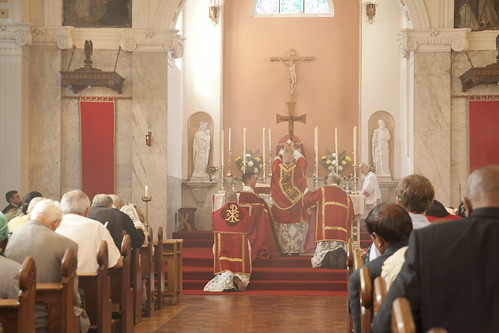
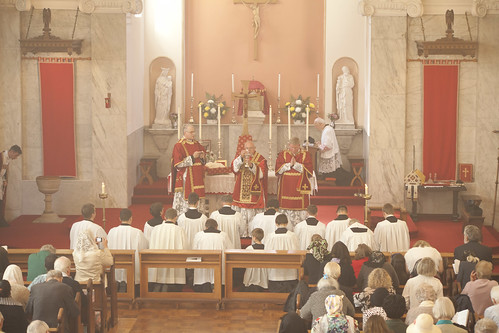
We then went on to Holywell for the Pilgrimage Mass in the parish church. This was celebrated by
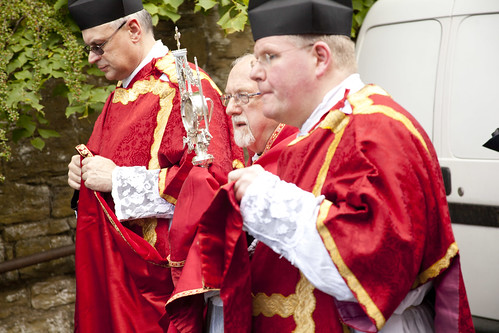
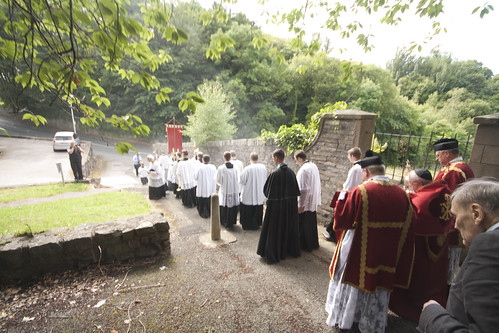
Fr Richard Tanner of the Institute of Christ the King with Canon Altiere as deacon and Father Francis Wadsworth as sub deacon.Following this we processed down the old road to the Shrine and Well Chapel reciting the Rosary, to be venerate and be blessed by the Relic of St Winefride, to light candles ( rather a lot for me to do this year ) and to duip my rosary in the pool of the Holy Well.

David and I sped back ( when traffic allowed) on the M6, listening to Gregorian Chant, Classic FM and talking about Brexit - well we would would n't we?

We had good weather for the day and it was, as ever, spiritually as well as physically refreshing.


Monday, 20 July 2015

Pictures of the Holywell Pilgrimage


In my recent post Another Pilgrimage to Holywell I described participating in this year's LMS pilgrimage to Holywell and this week's Catholic Herald has a report about the day, complete with a photograph, in which the trained eye can see my face in the background. I cannot find this image on the internet - possibly mercifully - but here is a fine set of pictures with an account of the pilgrimage from Fr Simon Henry's blog Offerimus Tibi Domine - Fr Simon was the Sub Deacon of the Mass - and which I have copied in extenso  from his site:


I was at the LMS annual Pilgrimage to St Winifride's Well in North Wales yesterday, acting as subdeacon, along with Fr Edmund Montgomery from Shrewsbury Cathedral (deacon) and Fr Richard Bailey (celebrant) from the Oratorian Community at St Chad's in Manchester. The Well is a wonderful shrine, not least because of how ancient it is.  The Brigittine Sisters at the now very smart Guest House supplied us with a much needed High Tea afterwards. Lovely music that lifted the heart. A splendid sermon from Fr Bailey on the virgines fatuae and the virgines prudentes, encouraging us to be among the prudent rather than the fatuous, of course.

My thanks for the many photographs courtesy (and copyright) of Mike Barnsdall, showing the Mass and the Procession to the Well, along with the Veneration of the Relic.


Images: Mike Barndall/Offerimus Tibi Domine

Monday, 6 July 2015

Another Pilgrimage to Holywell


Yesterday I went again on the annual LMS pilgrimage to Holywell. This was my third such pilgrimage, having done so in 2012, and about which I posted in Pilgrimage to Holywell and in Pictures of the Holywell Pilgrimage, and last year, which I wrote about in A Pilgrimage to Holywell.

I travelled up with a friend who drove us, his Mini filled for much of the journey with the sound of Gregorian chant from his CD player.

We arrived in a heavy rain storm, with part of the Irish Sea being dumped upon us as we climbed up by ourselves from the car park to the church - but, well, when it comes to stereotypical images what better represents Wales on a Sunday afternoon - a viewpoint which is, I know from past experience of holidays in the Principality, grossly unfair.

The celebrant at the High Mass in the very handsome and beautifully cared for parish church was Fr Richard Bailey Cong.Orat. from Manchester. I was particularly struck by the beauty of the liturgy and the calm efficiency with which it was performed.

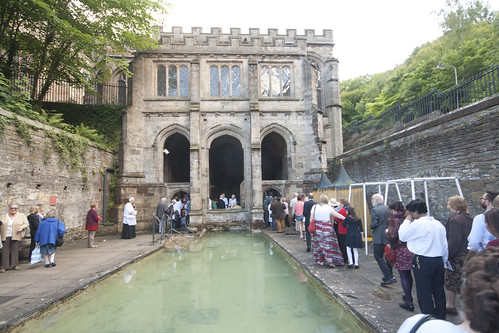
Following the Mass there was the usual procession saying the rosary down to the eponymous Holy Well of St Winefride itself. This lies at the bottom of the hill on which the church and town centre stands. It is a quite remarkable place, set in the complex and exquisite well chamber built about 1500. It is striking to think that the site has been a place of pilgrimage since, apparently, the seventh century. Amongst famous pilgrims of the past there was, almost exactly six centuries ago in 1415 King Henry V on the eve of the Agincourt campaign.

We stood around the Well, recited the litany of St Winefride, venerated the relic of her, lit candles, and I dipped my rosary in the pool.

There was, inevitably, a trip to the sizeable Shrine shop to buy cards and medals for oneself and for friends in my prayers

For our return - and now the weather was warm and sunny - we had Mozart's Vespers on the CD player, though I felt we should be in a great Austrian Baroque church rather than my friend's mini to get the full effect.

We cam back through Hope (nice looking late medieval church tower), the edge of Wrexham, with a distant view of the great tower of the church there, round the edge of Oswestry with its memories of the death of St Oswald and the edge of Shrewsbury, with its signs to the Battlefield Enterpise Park, recalling the battle of 1403.

The traffic was snarling up, so we re-routed and ate fish and chips, washed down with a mug of Yorkshire tea from a Harry Ramsden's at a service station - very ethnic cuisine.

A splendid and holy day out, and a spiritual and physical tonic.


Monday, 7 July 2014

A Pilgrimage to Holywell


Yesterday I went with a friend to the Latin Mass Society's annual Pilgrimage to Holywell in North Wales. The two of us made the same excursion in 2012, as I recounted in Pilgrimage to Holywell and there are links to pictures of that occasion in Pictures of the Holywell Pilgrimage. I have also written about the shrine in my post St Winefride from 2010.

The journey to and from Holywell necessitated a twelve hours round trip, with a lot of driving for my friend, but leabving Oxford at about 9.30 in the morning we managed very well. We looped round and through Chester before getting over the river Dee and onto the road into North Wales - the landscape of the Dee estuary is now very much a casualty of refining and related industries, and the roads misled us at one point so we had to backtrack to get on back the right road. Nonetheless we got to Holywell in decent time for the Mass which was celebrated at 2.30 in the nineteenth century Catholic parish church. Outside it is a somewhat austere and awkward looking building, but the interior is handsome and well furnished and decorated. There is an account of the church here, and of Fr Beauclerk (a descendent of King Charles II), the parish priest who in the 1890s particularly developed the pilgrimage tradition at Holywell, here. There is an online account of the focus of the pilgrimage, St Winefride's Well here.

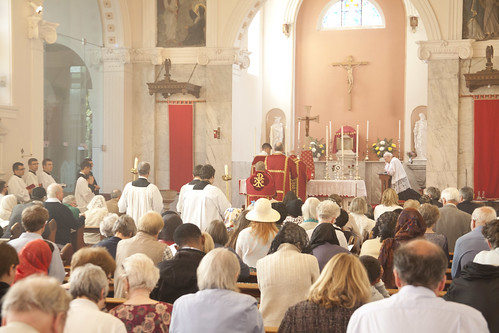
The Mass was celebrated by the Abbot of Belmont, the Rt. Rev. Paul Stonham OSB. He entered the church in rochet and mantelleta, and was vested at the faldstool, and similarly divested, after the celebration. In his sermon he drew attention to that fact that in aland of so many saints, St Winefride was unusual amongst Welsh saints in having sucha widespread devotion, far beyond the Principality.


IMG_8809


IMG_8822

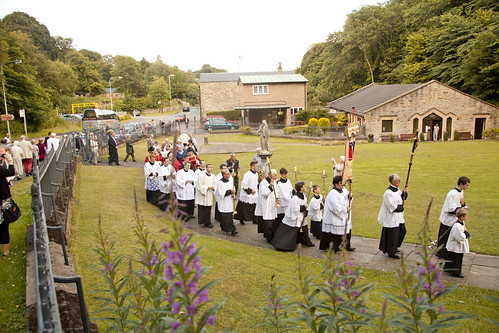
Following the Mass there was a Rosary procession along the old route down to the well. This path goes to the historic parish church and then to the well house which lies to one side and further down the slope.  The Abbot led us , bearing a relic of St Winefride - one of the few to survive the destruction of her shrine at Shrewsbury abbey at the dissolution, and we were able to venerate it individually in the well chamber:

IMG_8859

The procession turns down to New Road, the eighteenth or nineteenth century by-pass:

IMG_8634

Here it can be seen approaching the well:

IMG_8862

Pilgrims gather outside the Well and its chapel:

IMG_8644
Once again I was struck by the exquisite delicacy of the design of the Well house, dating to round about 1500. It is renminiscent of structures like King Henry VII's chapel at Westminster in its uses of angles, and relate to other structures of the period in north-east Wales, such as the churches at Wrexham and Gresford.
 This was followed by Benediction back in the church, although many of us did not get back to that final part of the devotions.

IMG_8804
Images; lmschairman.org

There are more photographs of the pilgrimage in an album on Flickr here.

Whilst at the Well I dipped my new rosary in the pool to take something of this holy place with me. Holywell has been a place of pilgrimage for over a thousand years, if not in fact since the mid-seventh century and the times of St Winefride and her uncle St Beuno.

Before we left we looked in the old parish church of St James, which adjoins the Well chapel. Apard from its plain late-medieval tower from the outside it appears a rather dour eighteenth century building, but onc einsdie we found it has a fine interior, with very handsome collanaded galleries  from when the town was a growing industrial town with metalworking industries. This was an extra treat for us, as well as looking at the outside of the upper part of the Well chapel, now in the care of Cadw.

Our return journey took us back round the outskirts of Chester and then across Shropshire. This is not a county I know well, and I was intriguesd to skirt the edge of Newport. That was because I have Oxgord friend s who come from it, and from their description of the town some of us are incline dto wonder if it really exists. I can now say I have seen the sign posts, but not yet been into it. Does it really exist - or is it apolite fantasy? The question remains. We also passed the signs for  Lilleshall abbey and Boscobel,of Royal Oak fame, and I had aglimpse of the splendid medieval church at Tong, which I have visited many years ago, just before we joined the M56. using that and other motorwatys we were back in Oxford for supper.

I am very grateful to my friend for taking me to Holywell again, and for providing such an excellent day out. I would urge anyone intersted to go to Holywell - a rare and precious survival, a living link to the past, a living place of pilgrimage today.


Friday, 6 July 2012

Pictures of the Holywell Pilgrimage


There are some pictures of the Latin Mass Society's Holywell Pilgrimage, about which I posted recently, on the LMS Chairman's blog at the following two posts Bishop Rifan in Holywell and Bishop Rifan in Holywell: more pictures.