Once I was a clever boy learning the arts of Oxford... is a quotation from the verses written by Bishop Richard Fleming (c.1385-1431) for his tomb in Lincoln Cathedral. Fleming, the founder of Lincoln College in Oxford, is the subject of my research for a D. Phil., and, like me, a son of the West Riding. I have remarked in the past that I have a deeply meaningful on-going relationship with a dead fifteenth century bishop... it was Fleming who, in effect, enabled me to come to Oxford and to learn its arts, and for that I am immensely grateful.


Showing posts with label Greenwich Palace. Show all posts

Friday, 13 September 2024

The Observant Franciscans of Greenwich


Just over 490 years ago in August 1534 King Henry VIII finally lost patience with the community of Observant Franciscans who lived adjacent to his palace at Greenwich, and on August 11th closed the monastery. This was because of their steadfast opposition to his attempts to get his marriage to Queen Katherine annulled. Although it is not as well documented as the fate of the London Carthusians in 1537 the fate of the community was in some cases direct physical martyrdom, and in other cases a lingering death from neglect after they were exiled to other Franciscan Conventual houses. At least 31 out of a national membership of 140 are recorded as having died directly or indirectly in the following years, not counting others who were actually executed or disappeared, so there probably more than forty martyrs.

The Observants were recognised as a distinct order by the Church in 1415. King Edward IV was showing interest in the Order in 1471 and in 1480 set in motion the foundation at Greenwich.  Early in his reign in December 1485 King Henry VII confirmed the foundation for a Warden and at least twelve members. The proximity of the house to the palace was even closer than that arrangement at Sheen - now Richmond - as rebuilt by King Henry V with the nearby Carthusian priory, or the relationship at Westminster between abbey and palace. Indeed the Sheen relationship has been likened to that of the Escorial, and the Greenwich layout does very much demonstrate the intimate link between the monarch and the monastic community. Late medieval monarchs and aristocrats across Europe showed a predilection for austere or reformed communities such as the Carthusians and Observants to pray for them both in life and in death, and to act as exemplars of reform in their territories. 

King Henry VII and his family were closely involved with the building of the church at Greenwich and, in particular, the design of the east window in or about 1500, as is set out on the BL Medieval manuscripts blog at Inventing a royal past

Queen Katherine was known to join the friars for the midnight office when in residence at the palace, and in her will in 1536 requested burial in an Observant church. The Greenwich friary church was the setting, as the VCH account shows, for the baptisms of royal children, including probably the future King Henry VIII, and certainly the future Queen Mary I in 1516 and of the future Queen Elizabeth I in 1533.

Other foundations followed at Canterbury, Richmond, Southampton, Newcastle upon Tyne and Newark. From 1517 the Observant friars took over the Province of England when the other Franciscans organised themselves separately as Conventuals.

The Victoria County History of Kent vol II has a good account of the history of the house at Friaries: The observant friars of Greenwich

There is a good account, which places the community within wider Franciscan history, from the contemporary order of Franciscans of Great Britain and Ireland at Our Heritage

There is more about the fate of the community in the article to which the previous article linked from the Immaculate Heart of Mary’s Hermitage here
 
The individual fates of members of the community in detention at other, Conventual, Franciscan houses, presumably from ill treatment and neglect, can be read on the Anne Boleyn Files at 11 August 1534 - The Expulsion of the Friars Observant

The King installed a conventual Franciscan community in 1534, but that was dissolved four years later in 1538. In 1555 Queen Mary I restored the Observants to the house under a surviving member of the old community, Cardinal William Peto. In 1556 the church was the setting for the consecration of Cardinal Pole to the episcopal state to become Archbishop of Canterbury. The house was suppressed again in 1559 and the surviving members went into exile.

Today nothing survives above ground of the once very important royal palace of the Tudors at Greenwich and confronted by the undoubted splendours of the seventeenth and early eighteenth century buildings on the site not easy to imagine. Excavations in recent years have added to our knowledge and understanding of the Tilt Yard and the location of the armouries - which took over the friary church in the 1540s. There is an excellent modern reconstruction painting of the palace complex, together with the sixteenth century drawings of the buildings, including the friary, by Antony van der Wyngaerde on the Blackheath and Greenwich History Blog at History of Greenwich Palace and The Old Royal Naval College


Saturday, 31 August 2024

A Hilliard miniature of Lady Arbella Stuart


Last week Country Life had an article about a recently identified miniature of Lady Arbella Stuart. The researchers involved  have assigned it to 1592 and argue that it was painted at Greenwich Palace when Arbella and her formidable grandmother Bess of Harwick were on an extended stay at Greenwich. Arbella was a possible candidate for the English and Irish thrones as a descendant through her other grandmother, the Countess of Lennox, of King Henry VII’s elder daughter Queen Margaret of Scots. As English born this might seem preferable as a claim to that of her first cousin King James VI. Moreover Arbella’s role as a potential bride for a European suitor, and a game of diplomatic bluff, may lie behind the commission. 

Arbella’s fate was determined by her ancestry, by possible or an unwise marriage, and being in the shadow of the throne. Her personal tragedy was that she never escaped these constraints and was very much a pawn in other players political chess game.


Wikipedia has a biography of the luckless lady at Lady Arbella Stuart


Thursday, 23 February 2017

Humphrey Duke of Gloucester


Today is the 570th anniversary of the death at Bury St Edmunds of Humphrey Duke of Gloucester (1390–1447), prince, soldier, and literary patron.

The excellent concise life of him by G.L.Harriss in the Oxford DNB can be accessed here,
and there is another illustrated account here.  The full length biography Humphrey Duke of Gloucester by K.H.Vickers from 1907, which is still useful, can be viewed on Project Gutenberg here.


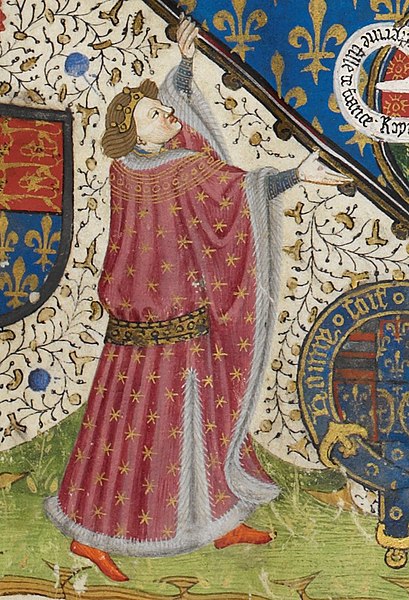
Humphrey Duke of Gloucester
A sixteenth century copy by J.Le Boucq in a manuscript at Arras

Image:luminarium.org

The youngest son of King Henry IV he received his Christian name as a tribute to the family of his mother Mary de Bohun.

I have posted previously about the Duke and the events of 1425 in particular in Stand off on London Bridge.

On Matt's History Blog

One of the recipients of Humphrey's patronage was the abbey at St Albans, and it was there that he had chosen to be buried:


Duke Humphrey sponsored by St Alban before the Blessed Sacrament and Christ as the Man of Sorrows circa 1430-40

Image:luminarium.org

https://upload.wikimedia.org/wikipedia/commons/thumb/4/47/Humphrey_%26_Eleanor.jpg/220px-Humphrey_%26_Eleanor.jpg

Duke Humphrey and his second wife Eleanor Cobham
From the Benefactor's Book of St Albans 1431

Image: Wikipedia  

Duchess Eleanor was disgraced and imprisoned after a witchcraft scandal in 1441. Her life and downfall are set out, again with skill and economy, by G.L. Harriss in the ODNB at Eleanor (c.1400–1452). Her alleged principal necromancer Roger Bolingbroke was an Oxford man, principal of St Andrew's Hall. He may well fit in with the contemorary Oxford tradition of astrology - and the risk of serious charges ensuing if politics, let alone the succession to the Crown, was addressed.  There is an account of him and the prosecution at Roger Bolingbroke and a more detailed one with extracts from a contemporary chronicle at  ExecutedToday.com » 1441: Roger Bolingbroke, “hanged, hedyd, and quartered" Eleanor herself, divorced from the Duke, and sentenced to perpetual imprisonment died at Beaumaris castle in Anglesey in 1452.

Humphrey lived in the style appropriate to the son, brother and uncle of Kings, and some hint of that can be seen not only in manuscripts he owned but also in the rare survival of a piece of plate from his collection:

 http://gutenberg.polytechnic.edu.na/4/1/4/7/41477/41477-h/images/illo090.jpg
A cup bearing the arms of Duke Humphrey and his Duchess Eleanor,
now in the possession of Christ's College Cambridge

Image: Project Gutenberg


File:Gloucester-Talbot-Shrewsbury-Book.jpeg

Duke Humphrey from the Talbot Shrewsbury Book 1443-45
BL Royal MS E VI f.2v.

Image: Wikimedia 

It was Humphrey who built the first royal residence at Greenwich in the years after 1428 and which was to be taken over by his nephew King Henry VI and his Queen Margaret. renamed the Palace of Placentia and rebuilt under King Henry VII it was to remain an important royal residence until the Civil War, and then, after the Restoration and possible plans for a new royal palace there, to become eventually the great Naval complex we see today. 

Related image

Greenwich Palace

Image: National Maritime Museum


http://s0.geograph.org.uk/photos/22/10/221072_b1992b65.jpg

St Saviour's Hospital Bury St Edmunds
The hospital built in 1184-5. This is the lower half of the west range, which was 100ft long

Image:geograph.org.uk

St Saviour's Bury St Edmund's where Humphrey died was the largest of the six hospitals in Bury
and there is the VCH Suffolk account of it here.  A small part of the buildings survive near Bury St Edmunds railway station.


http://churchmonumentssociety.org/images/M_o_t_M_Archive_Photos/Chantry-from-N.gif

The tomb of Humphrey Duke of Gloucester at St Albans, adjacent to the shrine of the saint

Image:churchmonumentssociety.org


The coffin and crypt of Humphrey Duke of Gloucester at St Albans
The painted crucifix is of great interest. Whether it still survives I do not know.

Image:churchmonumentssociety.org

Thre is an illustrated article about the Duke's tomb, and something about the circumstances of his death and burial, in the article about it as Monument of the Month in May 2010 for the Church Monuments Society here 

He has another enduring monument in Ocford - Duke Humfrey's Library, which still uses the older spelling of his name. A book collector and patron of Italian humanists Humphrey made two substantial gifts to the University of  Oxford. In 1439 he gave 129 manuscripts and in 1444 another 134. Oxford responded by adding an extra storey to the Divinity School they were building to house these and their other books and named it in the Duke's honour. The building was not completed until 1488, but it still retains his name. There is more about it, with links, at Duke Humfrey's Library.
The remainder of his library had been promised but went instead to King Henry VI's foundation in Cambridge of King's College. Humphrey's interests and importance in this reception of contemporary culture are considered in the life by Harriss in the ODNB linked to above.