Once I was a clever boy learning the arts of Oxford... is a quotation from the verses written by Bishop Richard Fleming (c.1385-1431) for his tomb in Lincoln Cathedral. Fleming, the founder of Lincoln College in Oxford, is the subject of my research for a D. Phil., and, like me, a son of the West Riding. I have remarked in the past that I have a deeply meaningful on-going relationship with a dead fifteenth century bishop... it was Fleming who, in effect, enabled me to come to Oxford and to learn its arts, and for that I am immensely grateful.


Showing posts with label Duchy of Brittany. Show all posts

Tuesday, 14 January 2014

Duke John V of Brittany


Following on from my recent post Anne of Brittany, Queen and Duchess I thought I would post apicture of this delightful statue of her relative and predecessor Duke John V. Born in 1389 he succeeded his father Duke John IV in 1399, and his mother, Joanna of Navarre, later married the widower King Henry IV of England, making Duke John and his siblings step-brothers of King Henry V - which was to prove a complication in the later stages of the Hundred Years War.

I first saw a picture of this statue at a seminar given by Michael "Brittany" Jones  in the wonderful series on Late Medieval France chaired by Peter Lewis at All Souls in my early days in Oxford, and I am delighted to find a view of it again on the internet.

 
Statue of Jean V, Duc de Bretagne (polychrome wood)

Duke John V of Brittany 1399-1442
Polychrome statue in the Chapelle Saint Fiacre at Le Faouet in Brittany
The Duke wears a state robe decorated with the erminois arms of the Duchy

Image:bridgemanart.com 


There is an online life of the Duke here, which accounts him as John VI rather than John V due to differing interpretations as to the Breton succession in the fourteenth century conflicts. However it seems more usual amongst historians to refer to him as Duke John V.

An online illustrated history of the Duchy can be viewed here  and a family tree of the Ducal house can be seen here.


Thursday, 9 January 2014

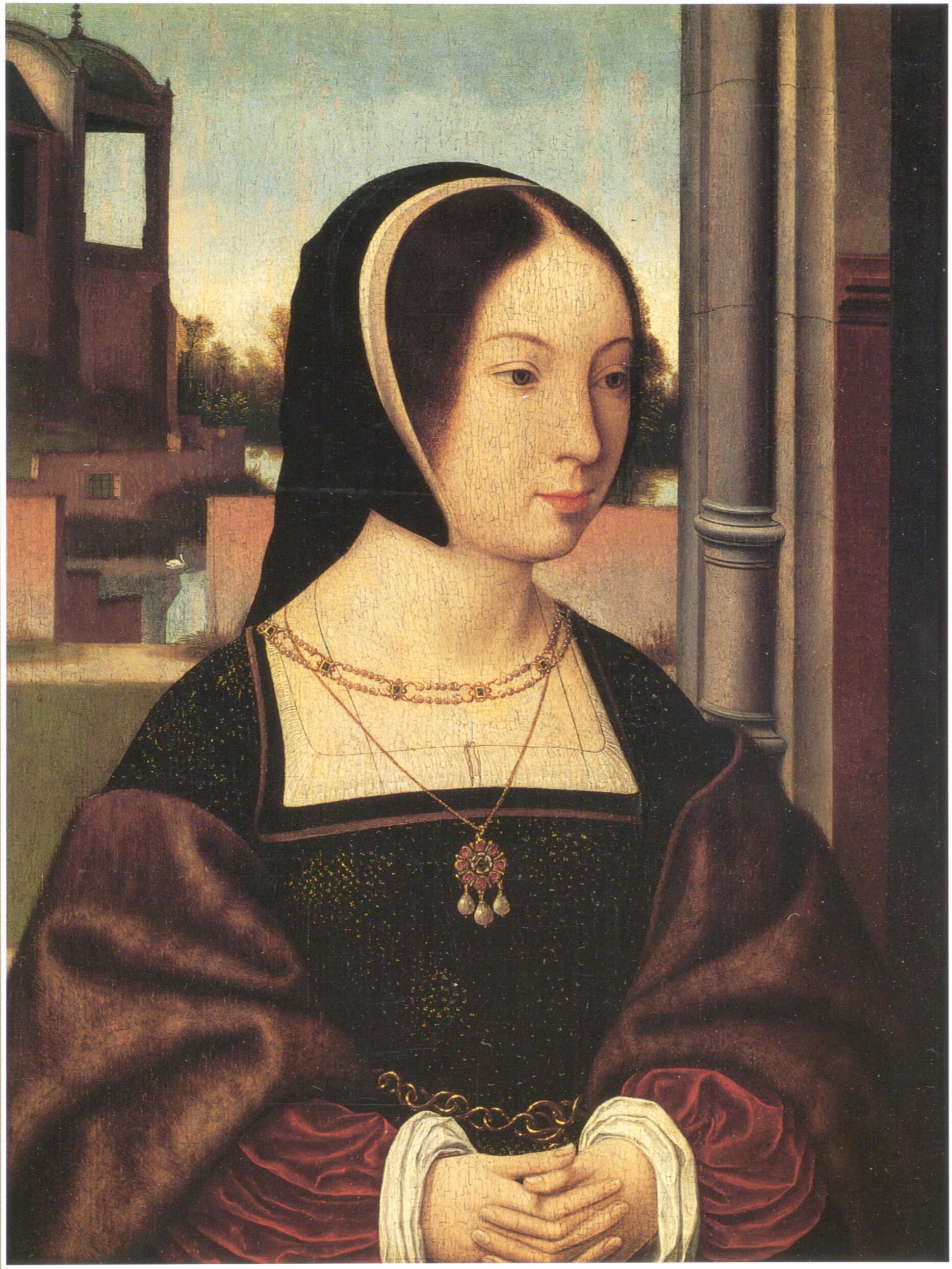
Anne of Brittany, Queen and Duchess


Today is the quincentenary of the death in 1514 of Anne of Brittany, Duchess Regnant of her patrimonial Duchy, briefly titular Queen of the Romans and twice Queen of France, and mother of a Queen of France. There is an illustrated online life of her, with links to related biographies and other articles, here.

File:Portrait of Anne of Brittany - Mostaert.jpg

A posthumous portrait of Queen Anne of circa 1520
Jan Mostaert 1475-1552/3

Image: Wikimedia

Anne was promised, betrothed, and eventually married to many eligible men because of the fact that she was heiress of Brittany. Like Eleanor of Aquitaine in the mid-twelfth century she was of strategic importance because of the territories she ruled. As a result on the death of her first real husband King Charles VIII in 1498 there was the rushed annulment of the marriage of his cousin and successor King Louis XII to Charles' sister so that the new King could marry Queen Anne. Thus she had the unusual distinction of being Queen consort in succession to two Kings of France. 

Had the Breton Ducal house of Montfort produced male heirs, or even had more political and military luck in the later years of her father Duke Francis II, it might well have survived as an autonomous entity, or even attained full independence as perhaps a sovereign Grand Duchy. This is one of those more interesting counter-factuals to speculate upon. As it was Anne was to be the last ruler to exercise independent authority as opposed to the more notional rights as Breton ruler of  her daughter Queen Claude (d.1524) - who was married to King Francis I to ensure the succession to the Duchy stayed with the French Crown -  and her sons Duke Francis III, the Dauphin who died in 1536 and his successor Duke Henri I, who finally united the Duchy to the Crown with his accession as King Henri II in 1547.


File:Anne of Brittany medal.jpg 

A bronze medal of Queen Anne from 1499
by Nicolas Leclerc and Jean de Saint-Priest
Behind the Queen can be seen the lilies of France and the ermines of Brittany

Image: Wikipedia

Her Book of Hours, the Grandes Heures of Anne of Brittany survives in the Biblioteque National in Paris, and there is an illustrated online article about this magnificent volume with its illuminations, including many of plants, here. Here is a portrait of the Queen from it, with her patron saints:

File:Duchesse Anne en prière.png

Queen Anne at prayer.
Behind her are St Anne, St Ursula, holding a banner with the arms of Brittany, and St Catherine

Image;Wikimedia