


The fury of English iconolasm came hard upon one of the most prodigious periods of church building in the history of the country. Of the parish churches which ministered to the needs of the faithful virtually none were unaffected by the fifteenth century, If not being rebuilt entirely they were being completed, or extended, or gaining new features, such as clerestories and towers, or chantries, or at very least a few new windows in the latest style. This all reflected the great prosperity of the century. Not until the nineteenth century was there to be such an outburst of church building and improvement. That link is not accidental - the fifteenth and later nineteenth centuries were the two times in English history when wages were consistently ahead of prices. People had money, and they had devotion.
Parish churches on the whole survived the reformation - the main exceptions were cities which witnessed the union of parishes such as York and Lincoln, and reflecting urban demographic changes.
For great churches - cathedrals, abbeys, collegiate foundations - the future was less certain. Here too there had been considerable building activity, and by 1500 English architects were displaying not only maturity and confidence, but a renewed inventiveness, as in King Henry VII's Chapel at Westminster. That virtuosity can also be seen in a building linked to it in style if not otherwise, the well chapel at Holywell in North Wales. I cite that both because of its architectural finesse , but also because it is in a fairly remote location, away from the south-east, although it was a popular destination for pilgrims both from the elite and the populace at large - and also because it was sufficiently remote to survive as a place of such pilgrimage through the recusant era.

St Winefride's Well at Holywell, commissioned by the Abbot of Basingwerk circa 1500
Image: Wikipedia

Model of Glastonbury Abbey.
Image:skyscrapernews.com/All rights reserved. Copyright Holder - GNU License
Monastic building was still extensive and for which we have evidence at Glastonbury, Evesham, Canterbury, Chester, Westminster and in the complete rebuilding of the cathedral priory at Bath. In my home county of Yorkshire one can still see evidence of that confidence by the Cistercians at Fountains and Kirkstall, and by the Augustinians at Bolton and Bridlington. I did once hear an archaeologist (one of those amongst that community who do not believe in anything unless they have actually dug it up) asserting that this was the monasteries spending up the money before they were dissolved...
Model of Glastonbury Abbey.
Reconstruction of how the abbey may have appeared in 1539
The easternmost Edgar chapel and that of Our Lady of Loretto west of the north transept are from the first years of the sixteenth century
The easternmost Edgar chapel and that of Our Lady of Loretto west of the north transept are from the first years of the sixteenth century
Image:skyscrapernews.com/All rights reserved. Copyright Holder - GNU License
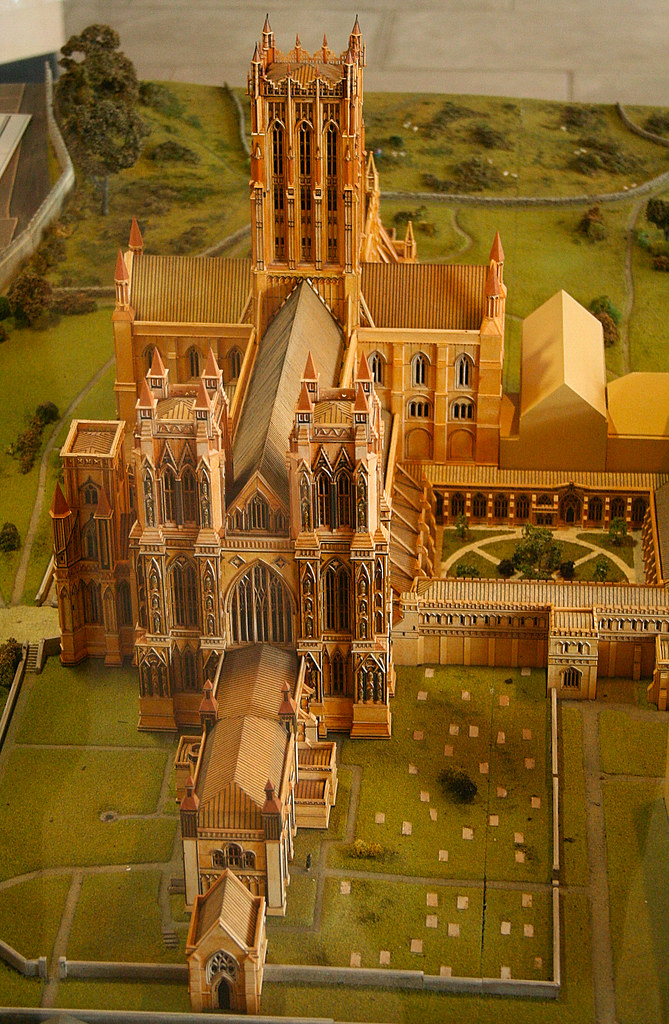
Glastonbury Abbey from the west
Today the shell of the Lady Chapel and Gallilee in the foreground survive as well as the eastern piers of the central tower and some portions of the aisle walls
Today the shell of the Lady Chapel and Gallilee in the foreground survive as well as the eastern piers of the central tower and some portions of the aisle walls
Image: Canis Major on Flickr

The view down the nave today
Image:earlybritishkingdoms.com

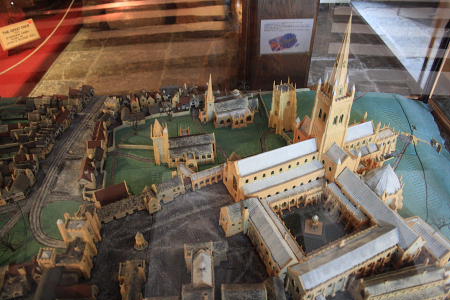
Evesham Abbey as it may have appeared in 1540
The bell tower is centre right, adjacent to the two surviving parish churches
Image:thealmonry.blogspot.co.uk

The bell tower of Evesham Abbey.
Completed on the eve of the dissolution it is, apart from the doorway of the chapter house and some very low walling all that survives above ground of the central buildings of the complex.
Image: railbus.co.uk

Image:Copyright Dave MacLeod/cisterciansshef.ac.uk

A reconstruction model of Fountains as seen from the east on the eve of the dissolution of the abbey
Image:capper-online.de

Image:Wikipedia

Image:thecolchesterarchaeologist.co.uk
The view down the nave today
Image:earlybritishkingdoms.com

Evesham Abbey as it may have appeared in 1540
The bell tower is centre right, adjacent to the two surviving parish churches
Image:thealmonry.blogspot.co.uk
The abbey from the south-west
Image:nblazydays.wordpress.com
The bell tower of Evesham Abbey.
Completed on the eve of the dissolution it is, apart from the doorway of the chapter house and some very low walling all that survives above ground of the central buildings of the complex.
Image: railbus.co.uk
Fountains Abbey
Image:Copyright Dave MacLeod/cisterciansshef.ac.uk
Image:capper-online.de
Of these great churches the cathedrals survived, with the exception of St Mary's cathedral priory in Coventry, about which there is something here. The creation of five new dioceses ensured the survival of the main structure at Bristol, Chester, Gloucester, Peterborough and Oxford, but many others listed as potential diocesan centre - the grand idea seems to have been a diocese for each county, but money constraints doubtless came intp play, leading to the loss of great buildings, including Bury St Edmunds, Colchester and Fountains.
A reconstruction of Bury St Edmunds in the later middle ages
Image:stedmundsburychronicle.co.uk


A model in the abbey grounds at Bury St Edmunds showing the abbey in its earlier phase, before the collapse of the west tower in 1431 and its subsequent rebuilding
The present cathedral is the church to the immediate north-west of the abbey in the rear centre
Image:bystargooseandhanglands.blogspot.co.uk

Bury St Edmunds abbey today
At the rear is the splendid tower from 2000 of the Anglican cathedral
Image:Wikipedia

An engraving of an early sixteenth century drawing of Colchester Abbey
Image:thecolchesterarchaeologist.co.uk
By sheer good luck, and against the odds, churches such as St Albans survived, to become a cathedral in 1877, and parishes saved all or most of Tewkesbury (bought at scrap value for £453 by the townspeople), Selby, Sherborne, Dorchester, Bridlington, Cartmel, Romsey, Wymondham, Croyland and others as well as Beverley, Ripon and Southwell collegiate churches.
For those with no potential as a cathedral or as a parish church, or where there were already large churches in a city, such as St Augustine's in Canterbury or St Mary's in York - both major buildings of cathedral size - the prospects were grim.
Overall the loss of buildings, let alone their decoration and furnishings was catastrophic. There are accounts of some being rapidly destroyed by new owners to prevent their return to their rightful possessors, and neglect, decay, casual plundering and vandalism took their inevitable toll.
For those with no potential as a cathedral or as a parish church, or where there were already large churches in a city, such as St Augustine's in Canterbury or St Mary's in York - both major buildings of cathedral size - the prospects were grim.
Overall the loss of buildings, let alone their decoration and furnishings was catastrophic. There are accounts of some being rapidly destroyed by new owners to prevent their return to their rightful possessors, and neglect, decay, casual plundering and vandalism took their inevitable toll.
To be continued


