Once I was a clever boy learning the arts of Oxford... is a quotation from the verses written by Bishop Richard Fleming (c.1385-1431) for his tomb in Lincoln Cathedral. Fleming, the founder of Lincoln College in Oxford, is the subject of my research for a D. Phil., and, like me, a son of the West Riding. I have remarked in the past that I have a deeply meaningful on-going relationship with a dead fifteenth century bishop... it was Fleming who, in effect, enabled me to come to Oxford and to learn its arts, and for that I am immensely grateful.
Visiting Oxford?
Allow me to be your guide... and discover the history of Oxford with an Oxford historian.
I offer a wide range of guided walks around the city and university. These can be a general introduction to the history and architecture or looking at specific themes and subjects.
I am a Catholic and a historian based in Oxford, where I am a member of Oriel College. My research, for a long delayed D.Phil., is a study of Richard Fleming, Bishop of Lincoln in the second decade of the fifteenth century. I also work as a freelance tutor in History and as an independent tour guide.
I was received into the Church in 2005 and am a Brother of the External Oratory of St Philip Neri at the Oxford Oratory.
The Octave of All Saints 2026: The Confessors
-
From the Breviary according to the use of the Roman Curia, 1529, the
conclusion of the sermon for the third day in the Octave of All Saints.
After the most...
Obituary of a very failed Pontificate
-
"Nun khre methusthen kai tina per bian ponen, epei de katthane
Mursilos."Such would have been the reaction of the unchristianised Greeks.
But for us, for t...
Saint Gabriel
-
The angels call for our veneration and awe as part of God’s creation. Part
of the destructive modernism of the 1970s included advice to Catholic
school t...
Prayer and Reality
-
[image: Image result for kneeling "low Mass"]
"It is not the healthy who need a physician but the sick"
Jesus is supposed to be our Saviour but most of us...
This appears to be another instance of the actions of a certain type of modern academic who, either influenced, or indeed inflamed, by their own ‘political correctness’ or, maybe worse, those who are too frightened to resist the current zeitgeist in such matters, changing things for the sake of conciliating tiny but regrettably vocal groups who go around seeing matters to offend them everywhere.
This nonsense about not calling the Anglo-Saxons ‘Anglo-Saxons’ comes indeed from the US. I first encountered it a few years ago at a meeting in Oxford when a loquacious but strangely inarticulate female US student mystified the rest of us by going on at length about the term. Amongst the most bewildered by this was a specialist in Anglo-Saxon from one of the leading colleges, who valiantly tried to point out that ‘Anglo-Saxon’ referred to the history, literature, indeed art, created by Anglo-Saxons in the period between the end of Roman Britain and the Norman Conquest. Nothing less, but also nothing more.
I have no intellectual or historical problem about using terms such as Early Medieval or Early England/English or even Early Medieval Britain - which does comprehend the Romano-British, the Vikings, and, as they emerge and engage one with another, the Welsh, the Scots, and the Picts - as a time reverence or categorisation. That can be useful and indeed neutral phraseology, and broaden historical as well as geographical horizons.
That said there is no good reason whatsoever to abandon such a very long-established term as ‘Anglo-Saxon’. If certain Generation Z US students do not understand it that it is their problem, not mine. They need to get over it. I not going to be told I cannot refer to Anglo-Saxon things as ‘Anglo-Saxon’ because someone who is following a silly fad in the US might be offended. Are we expected to change the titles of the works of Clapham, Stenton, Campbell and innumerable others to satisfy such nonsense? Perhaps we should censor Bede when he refers to Angles, Saxons and Jutes? Was he being ‘racist’ when he so denominated them?
It really tempts one to respond in choice Anglo-Saxon……
Today, were it not Holy Week, is the feast day of St Guthlac, the seventh/eighth century patron of Crowland (Croyland) Abbey in Lincolnshire, and indeed a monastic community with which in his time Bishop Richard Fleming clearly enjoyed good relations
Medieval Histories last October had the following piece about him and his cult, which I have very slightly amended. At the end are links to a whole serie sof article son the medieval Fens and on Anglo-Saxon England:
Crowland Abbey in the Fens
Image: Rex Slye/ Medieval Histories
St. Guthlac and Crowland Abbey
The
Anglo-Saxon hermit, St. Guthlac, had a career reaching from
aristocratic warrior over monastic visionary to patron saint of Crowland
Abbey
They were
ferocious in appearance, terrible in shape with great heads, long necks,
thin faces, yellow complexions, filthy beards, shaggy ears, wild
foreheads, fierce eyes, foul mouths, horses’ teeth, throats vomiting
flames, twisted jaws, thick lips, strident voices, singed hair, fat
cheeks, pigeons breasts, scabby thighs, knotty knees, crooked legs,
swollen ankles, splay feet, spreading mouths, raucous cries. For they
grew so terrible to hear with their mighty shrieking that they filled
almost the whole intervening space between earth and heaven with their
discordant bellowing.
From: Felix’s Life of Saint Guthlac ed. by Bertram Colgrave, Cambridge University Press (1985), p. 103
The historical Guthlac was born sometime
around AD 670. In his earliest Vitae we are told that he belonged to a
line of the Mercian royal stirps and this was the reason for his initial
career as an Anglo-Saxon warrior. However, at some point in his youth
he became a monk at Repton in Derbyshire. Two years later, he moved
further east where he took up the life of a hermit at Crowland on the
border of the fens finding shelter in an ancient British burial mound.
Later, in the 10th century, his hermitage became a very wealthy monastery.
Politically,
Crowland, was originally located at the border between the old Mercian
kingdom and that of the Gyrwe, situated on the western border of the
Fenland, by Bede called the “regione Girviorum”.
In the Tribal Hidage,
this region was divided into a northern and a southern part, each
assessed at 600 hides. The border was formed by the River Nene, which
ran from Peterborough just south of Crowland to the Wash. Later in 749 Mercia established a hegemony over East Anglia, but Guthlac did not
live to experience this. Nevertheless, he may have felt the encroachment
of his former life into his new world.
Geographically, the
landscape offered a fluid liminality constantly recreated through the
shifting courses of rivers and streams through the fenland and into the
Wash. In spring, when the rivers would flood, heavy sediments from the
erosions of winter would end up clotting the waterways and channel the
streams along new and constantly shifting routes.
Socially this
landscape was barely livable and although spiritual friendship was
established between Guthlac and some followers, this was initially not a
site intended for a religious community.
Here at the crossroad of
water and land, Guthlac would try to bridge the abyss between his
semi-pagan past (the burial mound), his warrior ancestry (mirrored in
his spiritual fights with Britons) and the new Christian thinking about
people and places, which was in the Mercian crucible (from
warrior-economy based on people to lordship based on land). This would
later be unpacked in detail by his early chronicler, St. Felix, who
wrote his first Vita soon after the death of the saint in 714.
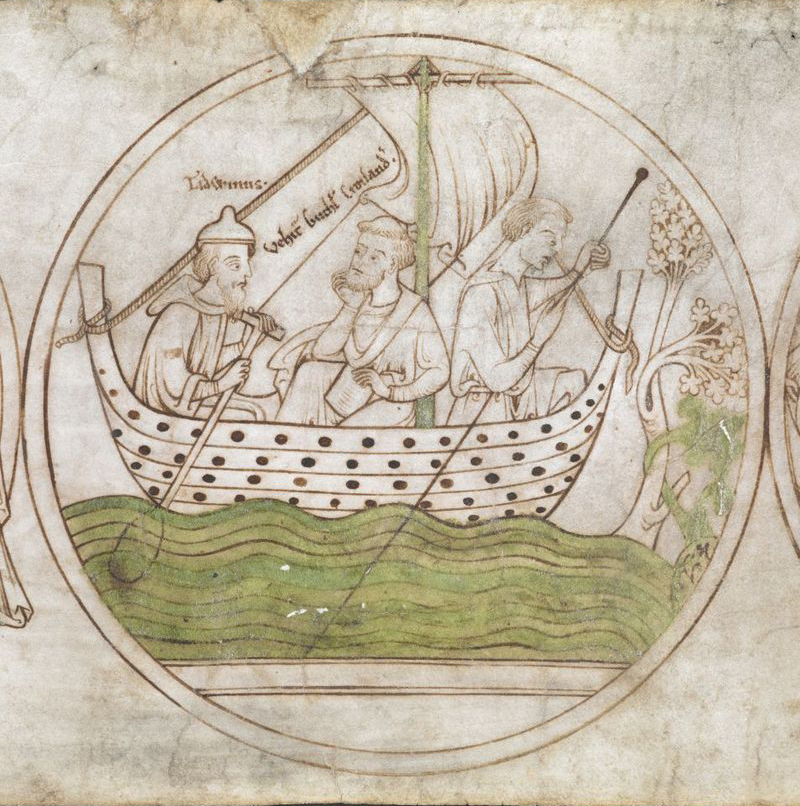
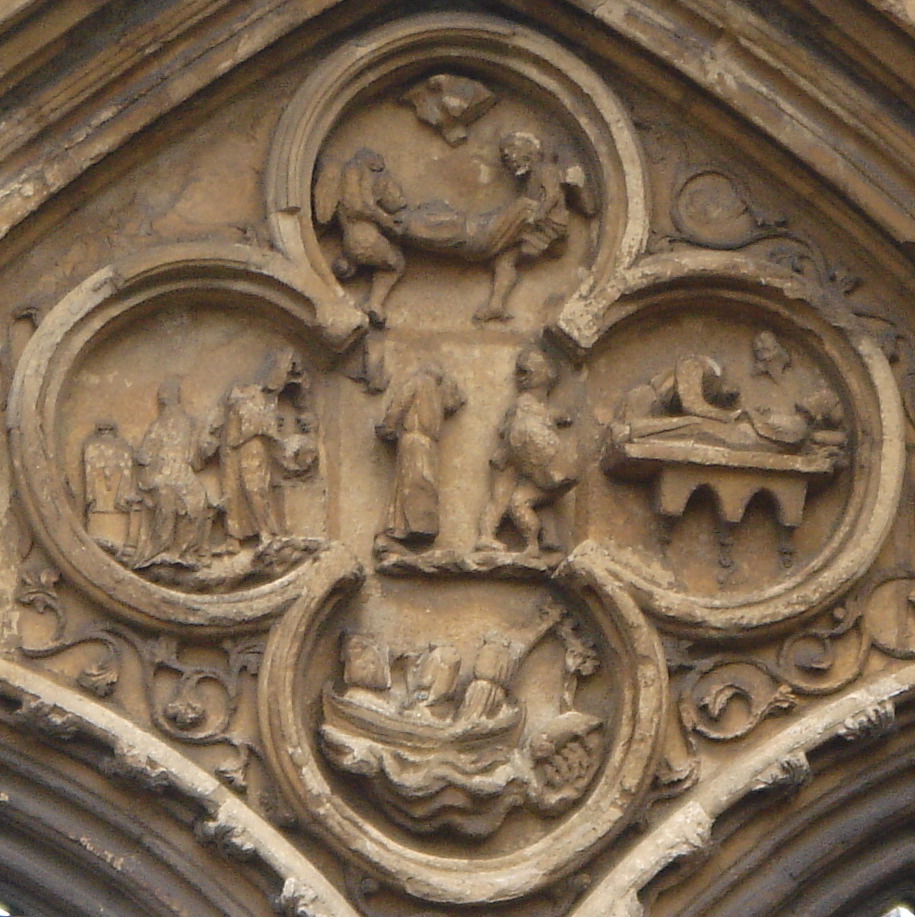
Quatrefoil with stories from the life of St. Guthlac, Crowland Abbey.Source: WikpediaAccording
to the close reading of the vita, recently carried out by Lisa M. C.
Weston, Guthlac was – in the words of Felix – constantly negotiating
models of these past and present communities and lifestyles – the old
warrior-world and the new monastic (Christian) thinking of lordship as
based on the exploitation of landed resources and the accompanying new
behavioural and cultural models and mind-sets.
Central to this
conflict was the movement between two different literary cultures – that
of the old oral warrior poetry and the new world of literacy and
liturgy.
Above all, this became framed in his Vita through a
series of nightly spiritual battles between British-speaking demons and
the newly converted hermit, throwing verses from psalms and other
scripture in their faces.
In the first night he is called to
battle the temptation to return to his former life as a warrior and
potential hero. In the second he is tempted by the demons to adopt an
extreme asceticism and immoderate fasting. Finally, the third night he
is demonised by multiple shrieking and frightening monsters trying to
drag him into the fens or devouring by setting his hermitage on fire
while raising him up on spears. However, it is at this point he
identifies the monsters as a delusion because they speak the British
tongue of his youth; and he is able to expel them in favour of a
solitary austere existence.
On the basis of this he is able to transcend the old world and wholeheartedly enter the new, playing out his role as miles Christi
and divine councillor for the future king of Mercia, Æthelbald, who
gained sanctuary with Guthlac while exiled to the east. It is Æthelbald
who according to the Vita, founded a monastery at Crowland immediately
after the death of the saint in 716. During the next 200 years, the
cult continued to grow and in the monastery was turned into a
Benedictine Abbey. The popularity of the cult is witnessed by a series
of the survived manuscripts containing the Vita of Felix as well as
later poetic rewritings of his life and deeds. It was during these
rewritings Guthlac changed his shape from solitary spiritual warrior and
into a more ordinary post-conquest saint.
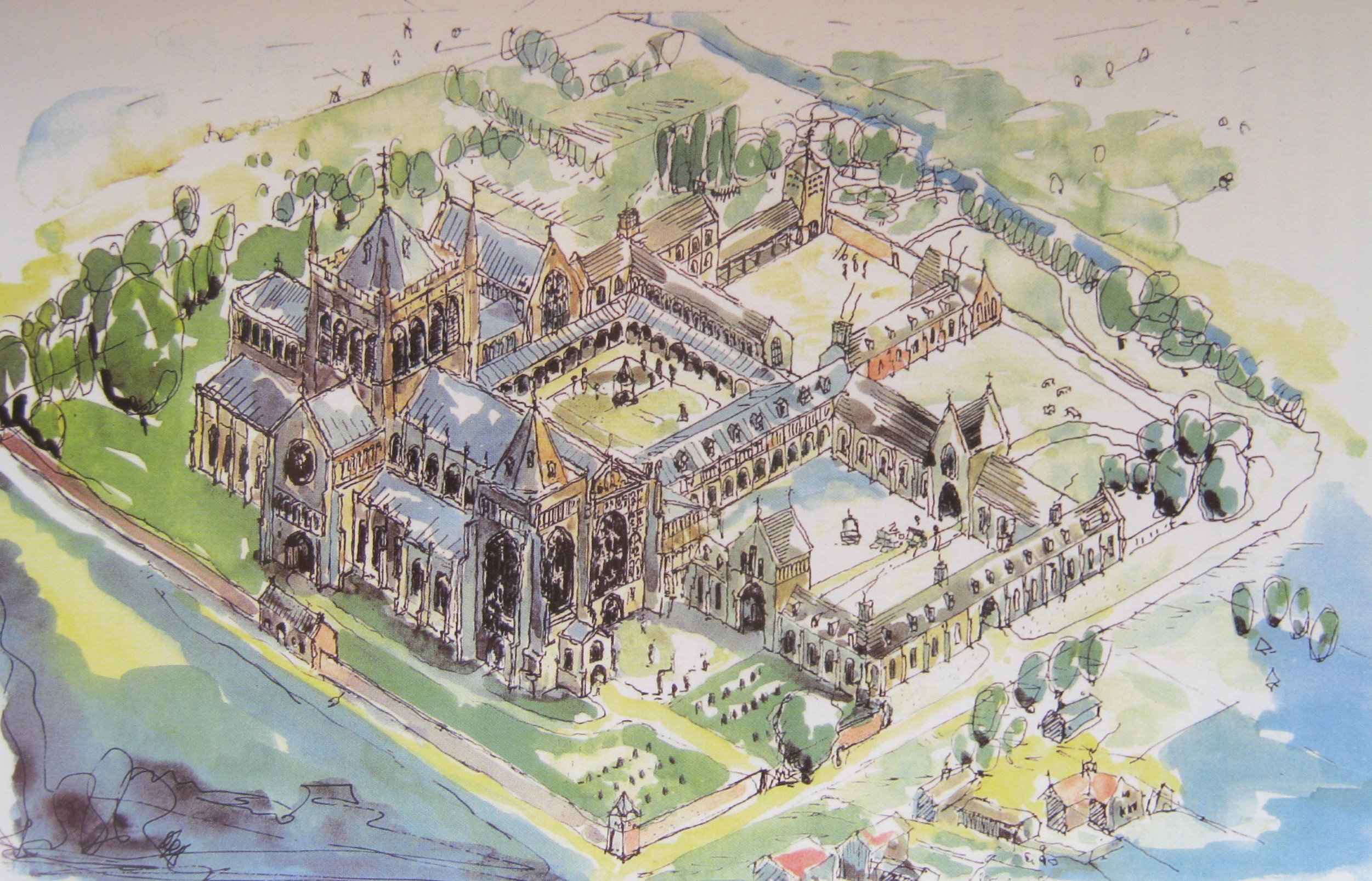
The
remains of the present building are the remains of a concerted effort
of Henry de Longchamp, the abbot of Crowland from 1191-1236 and his
successors to rebuild the church after a fire in 1179. They worked hard
to recreate Crowland as an important pilgrimage centre publishing new
variations of his legend and making the life of the saint a central
feature of the decorative scheme of the new Abbey Church. This turned it
into one of the most opulent and flamboyant of the East Anglian abbeys.
The
Abbey Church had a nave with three aisles covered by nine bays and an
apsidal choir of five bays. It measured 83 m x 27 m. As it stands today,
only the northern aisle is roofed; this is used for the modern parish
church.
However, an inkling of the decorative scheme, which used to
embellish the church can be found on the facade of the still-standing
west front. This was once brightly coloured. Right on top of the doorway
arches is a quatrefoil illustrating the high-medieval and more placid
version of Guthlac. Now the focus was on the traditional accoutrements of a
typical medieval saint: miraculous healings, books, buildings etc.
Exactly the same shift can be discerned through a careful exploration of
the so-called Guthlac roll, which stresses the saint building a chapel –
something which the early Vita does not mention at all. Instead the Vita tells us that Guthlac turned a ruined burial mound or tumulus into
his rustic ascetic cell. Thus Guthlac became – in the words of John
Black – “primarily the defender of a religious foundation in its battles
to retain holdings and power”.
Inside the church is a small museum telling the story of Guthlac and Crowland Abbey.
For a long time a number of research projects have explored the culturally fluid
landscape of the Medieval Fenlands in Eastern England. New book tells the story Read more.
New studies of the use of the fluid landscape in the
Early Medieval Fenlands point to a continuity in the settlement-structure from pre-Roman times Read more.
On the edge of the Fenlands at Oikington an Anglo-Saxon man named Hoch built a farm
sometime in the 5th century. here, his family was buried Read more.
The eel is a curious animal. Now listed on the international red list of threatened
species, it used to be the ubiquitous food for smallholders and poor peasants in the early middle ages Read more.
In the Early Middle Ages eels were abundant and served as comfort food for hungry
peasants. Later it turned into a very expensive delicatessen. Read more.
There are other articles on contemporary events inn East Anglia and Mercia at:
The BBC News website has a report on the most recent
research into the DNA of human remains from late Roman and Anglo-Saxon
Britain. This indicates that a third of the DNA of the English comes
from the Anglo-Saxons. It also gives insight into matters such as
intermarriage and the survival of the Romano-British population.
Each day Wikipedia features one of their onine articles, and yesterday they chose a very interesting one about the aetheling Aethelwold, the nephew of King Alfred, and the son of the King's elder brother and predecessor King Aethelred I. After his uncle's death he revolted against King Edward the Elder at the beginning of his reign, allied with forces in the Danelaw where he was acknowledged as King, and was killed in battle in 902 or 903.
The article is a detailed study and a fascinating insight into the dynastic and power politics of later-ninth and early to mid-tenth century England. It includes an excellent and up to date bibliography. The whole article can be read at Æthelwold ætheling
A coin issued by King Alwaldus - Æthelwold ætheling - in the Danelaw
The BBC News website has a story about modern research finding, to its not inconsiderable surprise, that a tenth century Anglo-Saxon cure for eye infections is 90% effective in combatting MRSA. The report can be seen at 1000-year-old onion and garlic eye remedy kills MRSA
This morning at the end of the Mass for the transferred Solemnity of the Ascension at the Oratory the recessional hymn was, as is usual on the feast there, Mgr Ronald Knox's translation of St Bede's hymn for the Ascension, and sung to the tune of Immortal, Invisible,God only wise. Like others of Knox's translations the text is sometimes awkward, and I realise that I am not alone in thinking that. That slightly unmusical style is perhaps surprising given Knox's felicity in producing the elegant pieces containedin Essays in Satire or Let Dons Delight :
New praises be given to Christ newly crowned, who back to his heaven a new way hath found; God’s blessedness sharing before us he goes, what mansions preparing, what endless repose!
His glory still praising on thrice-holy ground the apostles stood gazing, his mother around; with hearts that beat faster, with eyes full of love, they watched while their Master ascended above.
‘No star can disclose him’ the bright angels said; ‘Eternity knows him, your conquering head; those high habitations he leaves not again, till, judging all nations, on earth he shall reign.’
Thus spoke they and straightway, where legions defend heaven’s glittering gateway, their Lord did attend, and cry, looking thither, ‘Your portals let down for him who rides hither in peace and renown.’
They asked, who keep sentry in that blessed town, ‘Who thus claimeth entry, a king of renown?’ ‘The Lord of all valiance,’ that herald replied, ‘Who Satan’s battalions laid low in their pride.’
Grant, Lord, that out longing may follow thee there, on earth who are thronging thy temples with prayer; and unto thee gather, Redeemer, thine own, where thou with thy Father dost sit on the throne.
Source:minipilgrim.com
I found another translation online, which is by Benjamin Webb (1820-1885), and sung to "Lasst uns erfreuen":
A hymn of glory let us sing:
New songs throughout the world shall ring:
Alleluia! Alleluia!
Chirst, by a road before untrod,
Ascendeth to the throne of God.
Alleluia! Alleluia! Alleluia! Alleluia! Alleluia!
The holy apostolic band
Upon the Mount of Olives stand;
Alleluia! Alleluia!
And with his followers they see
Jesus' resplendent majesty.
Alleluia! Alleluia! Alleluia! Alleluia! Alleluia!
To whom the angels, drawing nigh,
"Why stand and gaze upon the sky?
Alleluia! Alleluia!
This is the Saviour!" thus they say;
"This is his noble triumph-day."
Alleluia! Alleluia! Alleluia! Alleluia! Alleluia!
"Again shall ye behold him so
As ye today have seen him go
Alleluia! Alleluia!
In glorious pomp ascending high,
Up to the portals of the sky."
Alleluia! Alleluia! Alleluia! Alleluia! Alleluia!
Oh, grant us thitherward to tend
And with unwearied hearts ascend
Alleluia! Alleluia!
Unto thy kingdom's throne, where thou,
As is our faith, art seated now.
Alleluia! Alleluia! Alleluia! Alleluia! Alleluia!
Be thou our Joy and strong Defence
Who art our future Recompense:
Alleluia! Alleluia!
So shall the light that springs from thee
Be ours through all eternity.
Alleluia! Alleluia! Alleluia! Alleluia! Alleluia!
O risen Christ, ascended Lord,
All praise to thee let earth accord,
Alleluia! Alleluia!
Who art, while endless ages run,
With Father and with Spirit One.
Alleluia! Alleluia! Alleluia! Alleluia! Alleluia!
Source:fministry.com
Not having Bede's Omnia Opera to hand I do not know how long is the original text - both Knox and Webb appear to have made a selection of stanzas from a lengthy original.
Two thoughts arise. Firstly what might John Mason Neale have done with the text is he had translated it, given his immense skill as a translator, or what might Edward Caswell produced?
Secondly, and assuming that Kox was not taking undue liberties with the text - and his style might very well suggest that he was in this case being very literal in his translation - what were the sights that inspired St Bede with his images of fortifications and gateways? In addition to the Apocalypse did he have in mind the undoubtedly extensive remains in his lifetime of Roman town defences and buildings in his native Northumbria? Was he thinking of Hadrian's Wall or Eboracum (York) and peopling them with the Angelic host? What also might his imagery suggest, in a reflex way, about the outward state and display about Northumbrian kingship?
My attention was drawn to an article in the Daily Mail about recent work which suggests that at least part of Offa's Dyke near Chirk can be dated to the period 430-652 with 95% certainty on the basis of radio-carbon dating.
This would suggest that the Dyke was an on-going policy by the Kings of Mercia, and that King Offa (757-796) himself may have consolidated the work of his predecessors into a complete system. The article, with some good illustrations of the earthwork can be read at Ancient Offa's Dyke between England and Wales may be renamed.
Offa's Dyke on Spring Hill in Shropshire
Image:offasdyke.demon.co.uk
What this does demonstrate is both the ability of Anglo-Saxon rulers to engage in organised projects over along period and their ability to exact labour and military services and, secondly, the fact that we are still learning about the past in ways which open up our understanding.
In the second of his
Ford Lectures Prof. Blair spoke about landscapes of power and the
siting of royal centres on influence and administration. He began
by saying that some reviewers of his book on the Anglo-Saxon church had
expressed the view that
he had over- emphasised the importance of monastic centres and their
material
wealth at the expense of royal and aristocratic centres. He was,
however, on reflection, still inclined to see the grandeur of the
Anglo-Saxon church as being different from the less splendid
surroundings of royal authority.
These
centres were more ephemeral and adaptable. He cited first the site of
Oakley in Dorset, where various sites near the Roman road and clustered
around the landmark of Wor Barrow were given as sites of charter
attestations and a record of the Provost of Chester-le-Street staying
(copying out the Mass of St Cuthbert ) in a bishop's tent nearby in the
tenth century. This was also a site with evidence of Anglo-Saxon
executions.
Such spread out sites should, he believes, be
understood as zones rather than places - a recognised meeting place
where the King could camp, meet with local leaders, give grants and
administer justice before moving on, returning as and
when
necessary, and with no permanent building, just a continuing tradition
of visits.
That
there were permanent royal residences where the King based himself
while hunting was clear - notably the site at Cheddar. Rather grandly
christened a palace by its excavator the complex had been less grand
than such a title might suggest to modern ears. Such a centre could allow
the itinerant ruler to combine the pleasures of the chase with
administration. Cheddar is of course famous for the story of King Edmund
I narrowly avoiding death in an accident whilst hunting above the gorge
at Cheddar and restoring Glastonbury to St Dunstan.
Plan of Cheddar Palace
Image:earlybritishkingdoms.com
Reconstruction of Cheddar Palace circa 1000
Image: Wikipedia
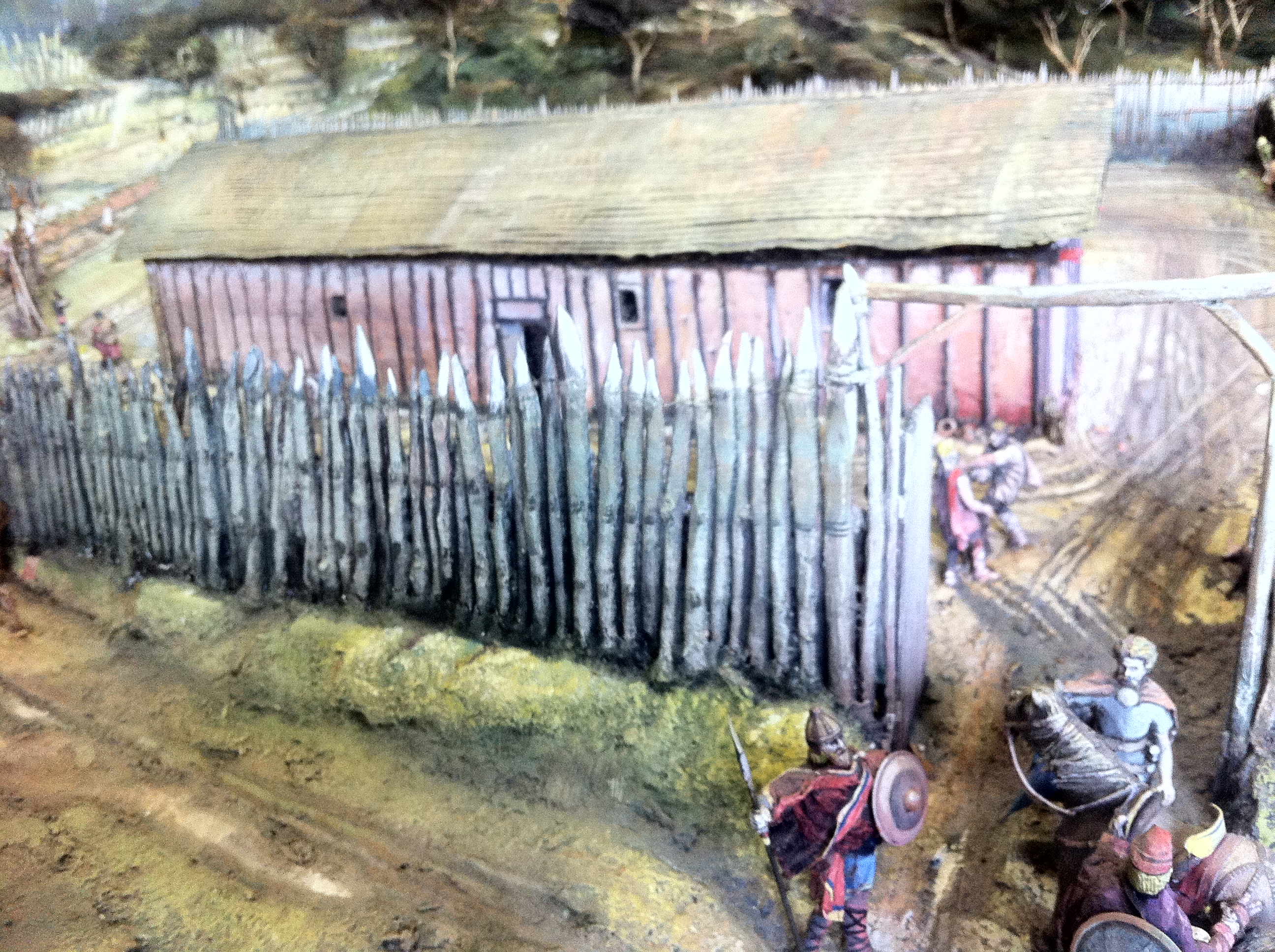
The early seventh century site at Yeavering in
Northumberland was similarly less of a permanent site than has perhaps
been understood. Bede records its dismantling and the erection of a new
royal centre at Milford nearby, and this may well have been the pattern
with such sites.
A reconstruction of Yeavering in the early seventh century
Image:pastperfect.org.uk
Sites
similar to Yeavering in their layout have been identified from
Northumberland to southern England - one indeed identified from aerial
photography had been hitherto mistakenly identified as a Roman villa.
Like
his first example there were ones with as eries of chater attestations,
chronicle references and archaeological evidence as well as indicators
in place names which suggested recognised centres of royal governance
that were flexible and physically
impermanent.
Some
of these sites had yielded valuable coins, suggesting the presence of
wealth and trade. Such evidence was not always in the trading area. Thus
Prof. Blair was inclined to see the evidence of wealthy grave goods
from burials in the Peak District as an indicator of the trade in lead
from the area - citing such examples as St Wilfrid encasing the
cathedral at York in lead in the seventh century - an d pointing to an
ever increasing number of church buildings.
There were sites
which clearly indicated a relationship of trade and commerce with
administration, and of settlements being planned as organised
settlements for commerce. This was a society where material wealth was
not just the preserve of the elites.
His examples ranged across much of lowland England, suggesting a general pattern of such social and economic
interaction.
Hilary term in Oxford means - or should mean - for Oxford Historians the Ford Lectures on British History. This year, on the trienniel cycle, we are are back to a medieval topic with Professor John Blair of The Queen's College giving his lectures on People and Places in Anglo-Saxon England 600-1100.They began last evening in the Examination Schools in the High.
Last night was an opportunity for Prof. Blair to indicate his subject matter for the coming five weeks. His aim is to provide an overview and interpretation of the archaeological evidence from excavations over recent decades into Anglo-Saxon social and economic life. To do this he has used a Leverhulme grant to study the great outpouring of archaeological reports generated by excavations since the 1970s, many of them little known by the wider body of historians. These include many sites resulting on modern development which would otherwise have never been explored but for the principle of the developer paying in advance for an archaeological survey. This follows on from earlier work on specific sites, but now enabling regional patterns to be determined as had not been possible initially.
We are promised new insights into patterns of distribution and we were given some initial examples last night, and also introduced to less tangible matters such as fashion, as well as distribution, in pottery in East Anglia in the period.
An important point he restated was that evidence of wooden buildings in the form of p[ost holes, and even more in building arrangements where the houses rested on flat surface stones, can give little idea of the actual buildings they supported. There was also the point that from an era with so many objects made of wood or leather that leave no trace in archaeological sites, and even more so perhaps in the case of textiles, probably brightly coloured, we can only too easily have an impoverished impression of the life-style of the period under review.
This series of lectures promises to be a major overhaul of our view and understanding of life between the seventh and eleventh centuries and one I hope to attend throughout. I also hope to post reports as the lectures go on, and we are promised a book by Prof. Blair with far more in it than he can cram into his lectures.