Once I was a clever boy learning the arts of Oxford... is a quotation from the verses written by Bishop Richard Fleming (c.1385-1431) for his tomb in Lincoln Cathedral. Fleming, the founder of Lincoln College in Oxford, is the subject of my research for a D. Phil., and, like me, a son of the West Riding. I have remarked in the past that I have a deeply meaningful on-going relationship with a dead fifteenth century bishop... it was Fleming who, in effect, enabled me to come to Oxford and to learn its arts, and for that I am immensely grateful.


Showing posts with label Akathistos Hymn. Show all posts

Wednesday, 29 May 2013

Listening to the Akathistos Hymn


Yesterday evening I went to Pusey House to listen to the singing of the Akathistos Hymn about which I posted in The Akathistos Hymn at Pusey House on May 28th and where there is a link to the text of the piece.

We began with an introductory talk by Bishop Kallistos of Diokleia, who is always a stimulating and interesting preacher and speaker. He outlined the historty ofg the hymn, which is dated to the first half of the sixth century, and pre-dates the fixing of the feast of the Annunciation under Justinian. It may be the work of the greatest Byzantine hymnographer St Romanus. Given its date it may have originally been intended for the feast of the  Synaxis of Our Lady on December 26th.
The current Greek use is to sing sequential parts of it on the Fridays of Lent, but the more ancient or traditional practice is preserved in the Russian use, where it is sung in its entirity on the fifth Friday5 of Lent.

In the Orthodox tradition, unlike the western one, the feast of the Annunciation is never transferred - thus if it falls on Good Friday its celebration has to follow that of the passion. This cannot happen with the modern calendar, but with the Julian calendar such a coincidence with Good Friday can sometimes occur

Bishop Kallistos drew attention to three themes in the hymn. The first was that of Joy  - the repeated call upon the Virgin, and the believer, to rejoice in all that she embodied and represented.

The second point was the Christological thought of the hymn - Mary, however exalted, is always subordinate to her Son.

The third point was the mystery and paradox described by the hymn in its account of the Incarnation and how they are integral to the life and story of the Virgin Mother of God.

The hymn is now prefaced and followed by the singing of a kontakion in which the City - that is Constantinople - gives thanks for deliverance from its assailants. this appears to originate with the 626 Persian siege, and the kontakion being the work of Patriarch Sergius after its lifting. The hymn also gives thanks for the delivery of the city from the 718 siege by the Arabs, and that of  846 by the still pagan Russians.

The hymn was sung in its entirety in English in a liturgical translation published by the Ecumenical Society of the Blessed Virgin Mary together with another by Roger Green which draws out the richness of the original Greek. Green himself describes the expereince of the hymn as being "caught up in a brilliant firework display." Copies of this translation were available for purchase.

To someone used to the western tradition the most obvious parallel is with litanies such as that of Loretto, but in the case of the Akathistos Hymn the officiant and schola divide the piece between them as a series of collects and invocations, whilst the icon of Our Lady is censed throughout the rite.

Listening to the hymn and looking at the text I was reminded of Fr Hunwicke's  point that for the most advanced expressions and forms of Marian devotion one should look to the Orthodox tradition


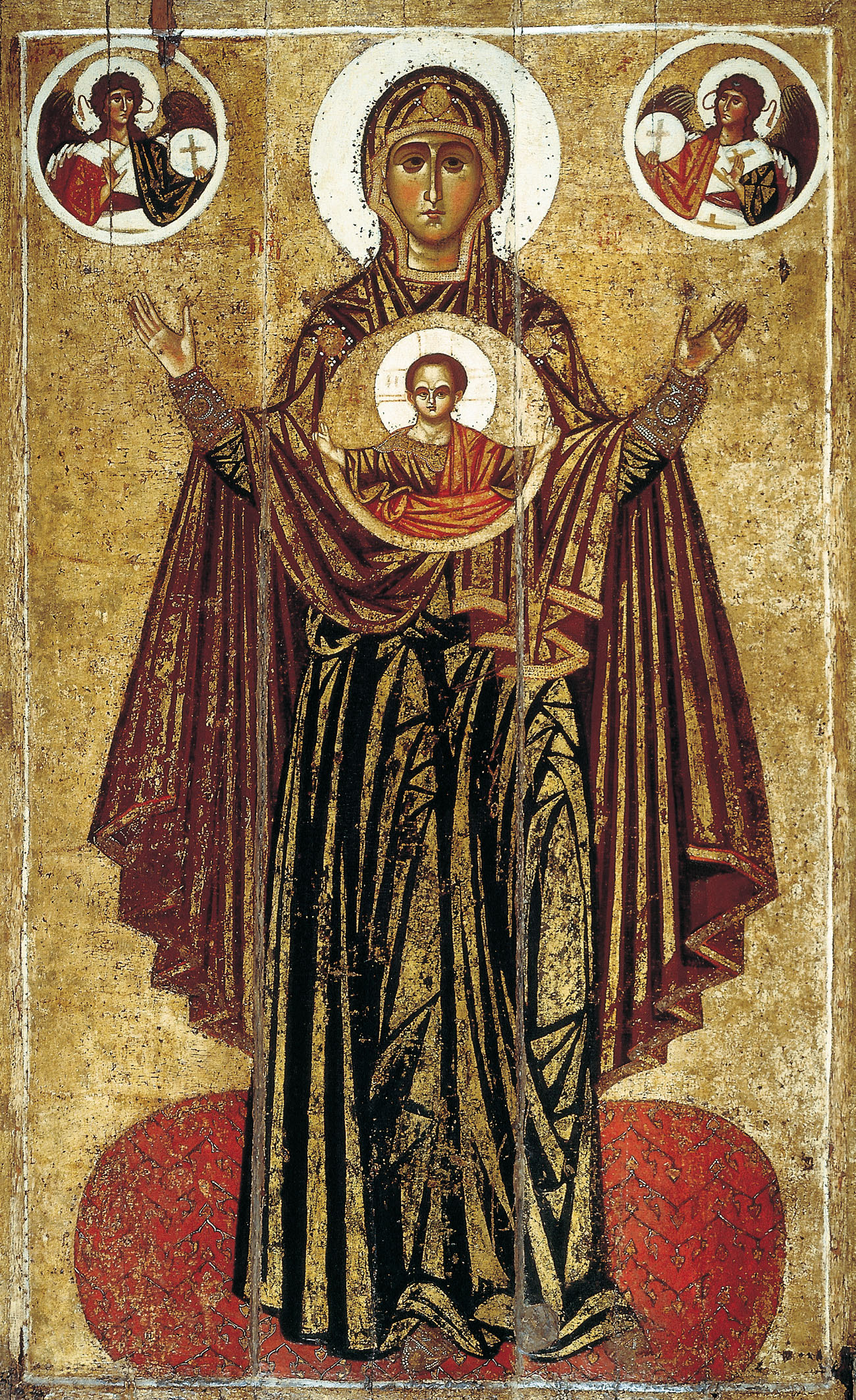
Icon of the Mother of God "of the Akathist"
Image:idlespeculations-terryprest.blog


The Vatican Directory on Popular Piety and the Liturgy (December 2001) lists many approved "popular pieties" and devotions outside the Liturgy, and includes the Akathistos Hymn. This seems to have been a particular favourite of the late Pope John Paul II.

Tuesday, 21 May 2013

The Akathistos Hymn at Pusey House on May 28th


On Tuesday next week, May 28th,  Pusey House is hosting at 5 pm a joint event by the Ecumenical Society of the Blessed Virgin Mary and the Fellowship of St Alban and St Sergius when Bishop Kallistos Ware, Bishop of Diokelia  will give an introductory talk and lead the singing of the Akathistos hymn to the Most Holy Mother of God.

The text of this great sixth century hymn to Our Lady can be read in translation here.

Literally akathist means standing - this is a devotion during which one remains on one's feet because of its solemnity.


File:Oranta.jpg
 
 
The Theotokos orans
A thirteenth century icon from the Spassky cathedral at Yaroslavl

Image: Wikipedia
 
When the word akathist is used alone, it most commonly refers to this, the original hymn known by this name. This, the sixth century Akathist to the Theotokos , is attributed to St. Romanos the Melodist. The tradition is that the Theotokos appeared to him, gave him a scroll and commanded him to eat it. The result was a miracle: Romanus received a beautiful, melodic voice and, simultaneously, the gift of poesy.

This hymn is often split into four parts and sung at the "Salutations to the Theotokos" service on the first four Friday evenings in Great Lent; the entire Akathist is then sung on the fifth Friday evening. Traditionally it is included in the Orthros (Matins) of the Fifth Saturday of Great Lent, which for this reason is known as the "Saturday of the Akathist". In monasteries of Athonite tradition, the whole Akathist is usually inserted nightly at Compline.

The four sections into which the Akathist is divided correspond to the themes of the Annunciation, Nativity, Christ and to the Theotokos  herself.

The hymn itself forms an alphabetical acrostic—that is, each oikos begins with a letter of the Greek alphabet, in order—and it consists of twelve long and twelve short oikoi. Each of the long oikoi include a seven-line stanza followed by six couplets employing rhyme, assonance and alliteration, beginning with the greeting Chaíre and ending with the refrain, "Rejoice, Bride without bridegroom!" (also translated as "Rejoice, thou Bride unwedded!") In the short oikoi, the seven-line stanza is followed by the refrain, Alleluia.

The Salutations to the Theotokos service, often known by its Greek name, the Χαιρετισμοί/Chairetismoí  (from the Χαίρε/Chaíre! so often used in the hymn), consists of Compline with the Akathist hymn inserted. It is known in Arabic as the Madayeh.

As next Tuesday is the eve of 560th anniversary of the fall of Constantinople in 1453 this seems a not inappropriate day on which to celebrtae the glories of Byzantine liturgy and culture.