Once I was a clever boy learning the arts of Oxford... is a quotation from the verses written by Bishop Richard Fleming (c.1385-1431) for his tomb in Lincoln Cathedral. Fleming, the founder of Lincoln College in Oxford, is the subject of my research for a D. Phil., and, like me, a son of the West Riding. I have remarked in the past that I have a deeply meaningful on-going relationship with a dead fifteenth century bishop... it was Fleming who, in effect, enabled me to come to Oxford and to learn its arts, and for that I am immensely grateful.


Thursday, 18 June 2015

St Vitus


John Dillon posted twice about St Vitus and his companions, Modestus and Crescentia, whose feast day it was on Monday on the Medieval Religion discussion group.

The interest of St Vitus lies perhaps in that we have all heard of St Vitus Dance, and also the way in which the saint was depicted on central Europe in the later medieval centuries, and his popularity as one of the Fourteen Holy Helpers - a devotion particularly strong in central Europe.

Here are the Dillon posts combined:

.Vitus, Modestus, and Crescentia (d. ca. 304, supposedly). We know nothing about the historical Vitus (Vito, Veit, Vid, Gui, Guy, etc.). His cult is ancient: there is evidence from the fifth century of a church in Rome dedicated to him and from the correspondence of pope St. Gregory the Great we learn that in the sixth century there were monasteries dedicated to him in Sicily and in Sardinia.

Vitus has a legendary Passio (BHL 8711-8716) whose earliest version is thought to be of the seventh century. According to this, he was a boy of seven years (in some versions, twelve years) at Lilybaeum in Sicily (today's Mazara del Vallo [TP]), a professed Christian, and a miracle-worker. His pagan father had him tortured and thrown in prison in an attempt to get him to renounce his faith. But an angel freed him together with his nurse Crescentia and his tutor Modestus (in some versions, Crescentia's husband), whereupon Vitus, together with these surrogate parent figures, removed to Lucania and continued to profess Christianity and to perform miracles. In time Vitus' fame reached the ears of the Emperor Diocletian, who called him to Rome to cure his demonically possessed son. Vitus obtained this cure but refused to sacrifice to Rome's pagan gods. Diocletian had the saints tortured anew, this time lethally. An angel brought them back to Lucania near the river Sele, where after a final prayer by Vitus they soon expired. Thus far the Passio of Vitus and his companions.

The seemingly very late seventh- or early eighth-century (pseudo-)Hieronymian Martyrology appears to be following the legend when it says of Vita only In Lucania, Viti ("In Lucania, Vitus") without naming a specific cult site. A church ancestral to the present chiesa di San Vito al Sele near Eboli (SA) in a part of southern Campania that prior to 1927 belonged to Lucania / Basilicata is first recorded from 1042. Archeological investigation in the 1970s found remains of an ancient settlement in the vicinity that has been interpreted as the home of Vitus' very early cult. From at least the ninth century until quite recently Modestus and Crescentia were celebrated jointly with Vitus in Roman Catholic liturgies of the Roman rite. Dropped from Vitus' feast in the reform of the general Roman Calendar promulgated in 1969 and excluded from the RM in the latter's revision of 2001, they continue as titulars of some churches and of a Roman cardinal deaconry and are celebrated along with Vitus in some Orthodox churches.

In Serbia Vitus is celebrated secularly on 28. June (Gregorian calendar) and liturgically on 15. June (Julian calendar) in commemoration of the Battle of Kosovo, reputed to have occurred on his day in 1389. He is also one of the late medieval and early modern Fourteen Holy Helpers, invoked as a protector of animals and in cases of epilepsy; from the same period comes his association with various saltatory disorders.

Some medieval images of Vitus (and, occasionally, of Modestus and Crescentia as well):

a) Vitus (image at left) as portrayed on a thirteenth- (or fourteenth- ?) century morse from the former women's abbey of St. Vitus in Hochelten, now in the treasury of the St. Martinikirche in nearby Emmerich am Rhein (Kr. Kleve) in Nordrhein-Westfalen:

b) Vitus' martyrdom (with Modestus and Crescentia at the lower corners) as depicted in a late thirteenth-century copy of French origin of the _Legenda aurea_ (San Marino, CA, Huntington Library, ms. HM 3027, fol. 66v; image greatly expandable):

c) The martyrdom of Vitus, Modestus, and Crescentia as depicted in an earlier fourteenth-century copy (1326-1350) of a French-language collection of saint's lives (Paris, BnF, ms. Français 185, fol. 233r):
The BnF's description of this scene with three martyrs, one of whom is surely Crescentia, simply as the martyrdom of Vitus and Modestus is at best unfortunate (if not downright sexist).

d) Vitus as depicted in the earlier fourteenth-century frescoes (1330s) in the nave of the church of the Hodegetria in the Patriarchate of Peć at Peć in, depending upon one's view of the matter, either Serbia's province of Kosovo and Metohija or the Republic of Kosovo:

e) Vitus as depicted undergoing torture in a cauldron as portrayed in a mid-fifteenth-century panel painting of German origin now in the National Museum in Warsaw:
The unhappy-looking lady and gent at the right rear center are presumably Crescentia and Modestus.

f) Vitus undergoing torture in a cauldron as portrayed in a late fifteenth-century limewood statue (ca. 1490) from the Tyrol, now in the Bode Museum in Berlin:

g) Vitus as depicted in a hand-colored woodcut in the Beloit College copy of Hartmann Schedel's _Nuremberg Chronicle_ (1493) at fol. CXXVr:

h) Vitus undergoing torture in a cauldron as portrayed in a late fifteenth- or early sixteenth-century wooden statue from southern Germany, now in the Zeppelin-Museum in Friedrichshafen:

i) Scenes from Vitus' Passio adorn the wings and predella of the early sixteenth-century altarpiece (1514 or 1517) in the now mostly neo-romanesque Evangelische Pfarrkirche St. Veit in Flein (Rems-Murr-Kreis) in Baden-Württemberg:
The predella (one scene showing Modestus and Crescentia as well):
Detail view of that scene (Vitus boiled in a cauldron)


Prague cathedral is dedicated to St Vitus,and although the building  - the nave and west front - was only completed in the twentieth century rather than being all medieval, it remains awonderful witness to the age of the Emperor Charles IV which commenced it in the mid-fourteenth century.

Herewith a few further medieval images of St. Vitus and, in one instance, his companions:

1) Vitus guiding abbot Wernher as depicted in an earlier twelfth-century pen-and-ink drawing (betw. 1143 and 1147) at the beginning of Munich, BSB, clm 536, a composite manuscript partly written at Wernher's command for the abbey of St. Vitus at Prüll (now part of Regensburg):
http://daten.digitale-sammlungen.de/~db/bsb00007208/images/index.html?seite=5&fip=193.174.98.30

2) Vitus accompanied by angels and enforcing the submission of a lion as depicted in a later twelfth-century illumination in the Weissenau Passional (ca. 1170-1200; Cologny, Bibliotheca Bodmeriana, Cod. Bodmer 127, fol. 103r):
http://tinyurl.com/ospw6pz
In the Vita, Vitus' emergence unscathed from the boiling cauldron is followed by his exposure to lions who submit themselves to him affectionately.

3) Vitus (lower register, second from right) as depicted in the later fourteenth-century votive painting of Archbishop Jan Očko of Vlašim now in the National Gallery in Prague:
http://tinyurl.com/ocwdo3z
Detail view (Vitus):
http://tinyurl.com/qjax2w5
 
4) Vitus (at center), Crescentia, and Modestus as depicted in a fifteenth-century fresco in the Pfarrkirche Hl. Maria und Leonhard in Lofer (Land Salzburg):
http://tinyurl.com/oc5jbnw

5) Vitus as depicted by Bartolomeo Vivarini in a later fifteenth-century panel painting from a polyptych (ca. 1470) in the chiesa matrice della Santissima Assunta in Polignano a Mare (BA) in Apulia:
http://www.chiesadisanvito.it/BVivarini.JPG 
 
6) Vitus in an enclosure with submissive lions as depicted on a later fifteenth-century altarpiece (ca. 1470-1480) from St. Veit an der Glan now in the Landesmuseum Kärnten in Klagenfurt:
http://tarvos.imareal.oeaw.ac.at/server/images/7001929.JPG
Detail view (Vitus and lions):
http://tarvos.imareal.oeaw.ac.at/server/images/7001932.JPG


Waterloo


Today is the bicentenary of the Battle of Waterloo. Yesterday witnessed celebrations on the site of the battle, with the Prince of Wales unveiling a memorial to the British troops, symbolised by the closing of the gates at the farm at Hougoument, which Wellington believed crucial to his victory at the "damn close run thing." Amongst those present were the present Duke of Wellington, who is married to Prussian princess, a Bonapartist prince and the currrent Prince Blücher. There meeting and mutual handshake was one of several ideal photo opportunities the day afforded.

Today there was a service of commemoration at St Paul's Cathedral in London. Amongst those in the congregation was the Special Correspondent - he has a remarkable knack of getting to such events - who tells me it was a fine service.

Not surprisigly prominent in the commemorations has been the present Duke of Wellington, who only inherited the title at the end of last year. A little while ago the Daily Telegraph had an interview with him, which can be read here.

The victory at Waterloo inaugurated almost a century of relative European peace - there were  not a few localised conflicts of the first and second order betweemn 1815 and 1914 - and the re-establishment of a stable international order. Looking back the subsequent century makes for depressing viewing - I do envy those who lived in the nineteenth century in this as in so many other respects.


Tuesday, 16 June 2015

St Richard of Chichester


Today is the feast of St Richard of Chichester. I have always had an interest in him as he was on eof the patrons, along with Our Lady and St Dominic of the Dominican friary, founded in 1256, three years after his death, in my home town of Pontefract, and that was to be the only medieval foundation dedicated to him.

Richard Wych was a Worcestershire man, born at Droitwich (then known as Wych) in about 1197. His family were yeomen farmers. His parents died while he was still at school, and the property was administered by guardians, who so mismanaged the estate that Richard and his brother and sister were left almost penniless. The elder brother was equally unable to cope, and it was Richard who got the farm back on its feet, by sheer hard manual work. His brother offered to hand over the whole inheritance to Richard, but with the proviso that he “married and settled down”, as we would say. Richard however had his mind set on being a clerk – a member of the clergy, though that did not necessarily imply priesthood. At all events, he was now free to go to Oxford, where he joined the school of Edmund Rich, the future archbishop of Canterbury and Saint. Edmund had a profound influence on Richard, and their friendship was to be lifelong. After graduating in Law from Oxford, Richard went on to study in Paris and Bologna. In 1235 he returned to Oxford, where he was elected Chancellor.
 
  By now his mentor Edmund had become Archbishop of Canterbury, and within two years he called him to be his own Chancellor. For the next three years Richard lived and worked with Edmund, and grew to revere him for his pastoral concern, his devotion to prayer, and his asceticism. In 1240 he accompanied Edmund on a visit to Rome, and was at his bedside there when he died.
 
  Up to this time there is no indication that Richard felt a call to the priesthood. But now, in his early forties, there came a change. Instead of returning home from Rome, he went to Orleans to study theology, and there after two years he was ordained priest.
 
  Returning to England, he took up the pastoral duties of a parish priest in Kent, but he was not to be left in obscurity for long.
 
  In 1244 the see of Chichester fell vacant. The King, Henry III, instructed the Chapter to elect his own nominee, a certain Robert Passelewe, which they duly did, even though it was well known that this Passelewe was a thoroughly unsuitable candidate. Archbishop Boniface of Canterbury decided to make a stand against what had become in practice royal appointment to episcopal sees, and took the brave and unprecedented step of quashing the election and nominating to Chichester Richard, his Chancellor. The King’s immediate reaction was to refuse to accept the homage of Richard, or to release to him the “temporalities” (the property and income) of the see, which were legally held by the Crown during an interregnum. Richard appealed to the Pope, who upheld his appointment and personally consecrated him bishop at Lyons on 5th March 1245.
 
  It was an unhappy beginning. When Richard came to Chichester to take possession of his see, he found the gates of the city closed against him and access to his estates barred, by order of the King. He was given lodging, in defiance of the royal will, by Simon, the Rector of Tarring, who became a lifelong friend. There and then Richard began the work of chief pastor, working from the Rectory at Tarring. He visited assiduously the parishes, monasteries and homes for the sick and poor in the diocese. After sixteen months the King relented, under threat of excommunication by the Pope, although he still refused to restore the income that had accrued to the royal treasury during the dispute. Richard took possession of his Cathedral amid great rejoicing.
 
  The Bishop could now devote himself fully to much-needed reforms. He instituted diocesan synods, at which the teaching and laws of the Church were expounded, and local statutes enacted. These statutes covered a wide range. The sacraments were to be administered without payment, Mass was to be celebrated in a dignified manner, clergy must practice celibacy, observe residence and wear clerical dress. There were instructions regarding the hearing of confessions, and clergy were reminded of their duty of hospitality and care of the poor. At the same time he made provision for their proper payment and security of tenure. The laity were obliged to attend Mass on Sundays and Holy Days, and all must know by heart the Lord’s Prayer, the Hail Mary and the Creed.
 
  He also had to face the task of fund-raising for the maintenance of the Cathedral. He revived the practice of “Pentecostals”, directing that all parishioners should visit the cathedral church once a year at Whitsuntide, there to pay their dues. Those who lived too far away could fulfill this duty at Hastings or Lewes, and those unable to attend at all must still hand in their dues.
 
  Richard set great store by hospitality, and he kept a good table; but he himself was frugal, and refused the good things he provided for his guests. He practised penance, wearing a hair shirt to the day of his death. He was a man of compassion, his biographer mentioning particularly his concern for handicapped children and convicted criminals. His early life on the farm is echoed in some of the miracle stories told about him – the out-of-season flowering of a fruit tree at Tarring, good advice to men fishing on the bridge at Lewes, resulting in an exceptional catch.
 
  In 1252 the Pope appointed Richard to preach the Crusade. The Bishop saw this not just as a means of raising money but as a call to renewal of life – much as we would see a Holy Year. He began a tour along the south coast, which eventually brought him to Dover. Here he consecrated a cemetery chapel for the poor, which he dedicated to his friend and teacher, St Edmund, who had been the chief inspiration for his own life’s work. It was his last public function. A few days later he collapsed. His last prayer has come down to us: “Thanks be to thee, my Lord Jesus Christ, for all the benefits thou hast bestowed on me, for all the pains and insults thou hast borne for me. And thou knowest, Lord, that if it should please thee I am ready to bear insults and torments and death for thee; and as thou knowest this to be the truth, have mercy upon me, for to thee do I commend my soul.” He died on 3rd April 1253. He was about 56 years of age, and had been bishop no more than eight years.
 
  His body was brought back to Chichester, where he was immediately hailed as a saint. He was canonised within the decade, and his body placed in a new shrine behind the High Altar in his cathedral, where it remained until destroyed at the Reformation. But today Richard is honoured again in that same spot, as a Saint and patron of Sussex.
 
Text: Universalis website

A Tribute to Saint Richard by John R. H. Moorman, sometime Bishop of Ripon and a noted church historian:
A great pastor, a great lover of God and man
Facetus, largus, curialis, vultu hilaris (“jolly, warm-hearted, courteous, and of cheerful countenance”); in these words Friar Ralph Bocking described his old master, St Richard of Chichester, whom he served for many years as companion and confessor. There was something big and impressive about St Richard, something large, warm, and comfortable. If the Church had not seen fit to canonize him, he would certainly have been canonized by popular opinion, for he was just the sort of man whom people loved and revered.
  Richard is remembered not as a great scholar or a great political figure, but as a great pastor – a wise, diligent and saintly bishop who administered his diocese with a perfect mixture of what St Paul calls “goodness and severity”, of discipline and love. He found himself called to the administration of a diocese sadly disorganized by neglect and by the fact that he himself was, for the first two years, a homeless vagrant. Yet he pulled it together. As early as 1246, while he was still under the royal ban, he published his Statutes which he expected all his people to observe.
  He was a strict disciplinarian – in his diocese, in his household, and in himself. Clergy who were lazy or immoral came in for severe rebuke, and he expelled one man from his living in spite of appeals from some of the highest personages in the land, including the king and queen. So also with the laity. When the people of Lewes dragged a thief out of a church, in which he had sought sanctuary, and lynched him, Richard made them dig up the body, carry it on their shoulders to the church, and give it Christian burial. In his own household he was much loved as a wise father, though here again he ruled with severity. He expected high standards of honesty and uprightness among his household and dismissed those who misbehaved. But he was above all things severe with himself. Unlike many of his fellow bishops, he hated ostentation and display, and always dressed soberly and fared simply. Meanwhile his greatest self-discipline was in the realm of his prayer life. Early visitors to his chapel sometimes found the bishop stretched on the ground, having spent all night in prayer. He used always to reproach himself if the birds were awake and singing their songs before he was at his prayers and praises before the altar of God.
  Richard was therefore a disciplinarian; but the quality for which he was so greatly loved by his people was his generosity and affection. He loved to give things away, to the great distress of his stewards and bailiffs who were trying so hard to restore the ravaged resources of the diocese. When he entered a village he would ask the priest to give him the names of any in his parish who were poor or sick, so that he could visit them himself and relieve them with gifts of food or money. Bocking records that, on many occasions, the bishop went out of his way to bury the dead “with his own hands”.
  There are many miracles connected with Richard’s life, many of them very human. Once, when celebrating Candlemas at Cake ham, he joined in a procession which vent outside the church, each member carrying a lighted candle. A gust of wind blew all the candles out. Suddenly it was noticed that the bishop’s candle was alight again. “Who lit my candle?” said Richard to one of his chaplains. “No one, my Lord”, came the reply. Richard looked again at the candle, then put his finger to his lips and said: “Not a word”. Out of a century which produced many great lights the candle of St Richard of Chichester still burns brightly, for he was a great saint, a great pastor, a great lover of God and man.
Text: Universalis - calendar for the Archdiocese of Birmingham

Monday, 15 June 2015

Magna Carta


Today is the 800th anniversary of the ceremony at Runnymede which is often misrepresented as King John sealing ( or worse, signing ) Magna Carta. As Sir James Holt argued we should rather see the day as the occasion for the nobles to renew their homage to the King in return for the agreement between them and written up in the  numerous copies of the Great Charter., which were quite possibly handed out to those present as well as sent to the various bodies such as cathedral chapters which still, in some cases, hold them.

Today at Runnymede The Queen, who is the 23x great granddaughter of King John, and the great and the good from both Britain and the United States (which these days makes more of Magna Carta than we do on this side of the Atlantic ) assembled to commemorate the events of 1215 and to celebrate the text granted by the King. What King John might have thought of it all , or even the barons or clergy, is something to speculate about.

historians these days are somewhat divided as to whether the 1215 Magna Carta was a peace treaty that failed - in the autumn Pope Innocent III annulled it as extorted by force from his vassal King John, and a civil war ensued until 1217 -  or whether, as Holt interpreted it in his standard work, it was a significant development, similar to, but in advance of European parallels. There is doubtless some truth in both arguments, but the significance of Magna Carta as something to reissue as pledge of good governance, as happened in 1216, 1217, 1225 and 1297, suggests it acquired prestige early ion which lifts it above the failed peace treaty into a statement of good principle to be appealed to and reaffirmed.a

 The Salisbury copy of Magna Carta

Image:paradoxplace.com

Thursday, 11 June 2015

A day in Hereford


Yesterday I joined a party from the Oxford Oratory for a day at Hereford Cathedral. I am very fond of it as a cathedral, and it is one which is, undeservedly, not as well known or visited as it should be. Quite a few of the party yeasterday had not been their previously. These days it offers a lot for the visitor and pilgrim.

I have adapted the  post on the Oratory website, adding to it more comments and information for this piece.


Vicars choral

The Wednesday Morning Group and others in the cloister of the Vicars Choral. 

The coach ride over to Herefordshire took us through some beautiful scenery, with lush foliage lining the roads, and sweeping views over the Cotswolds, Severn valley and Malvern Hills.

Hereford Cathedral is noted for the shrines of St Ethelbert, King of the East Anglia, who was murdered near Hereford by King Offa of Mercia in 794 AD, and St Thomas Cantilupe (sometime Chancellor of Oxford University) who died in 1282. Both of these shrines have been restored in recent years under the leadership of the Dean. 

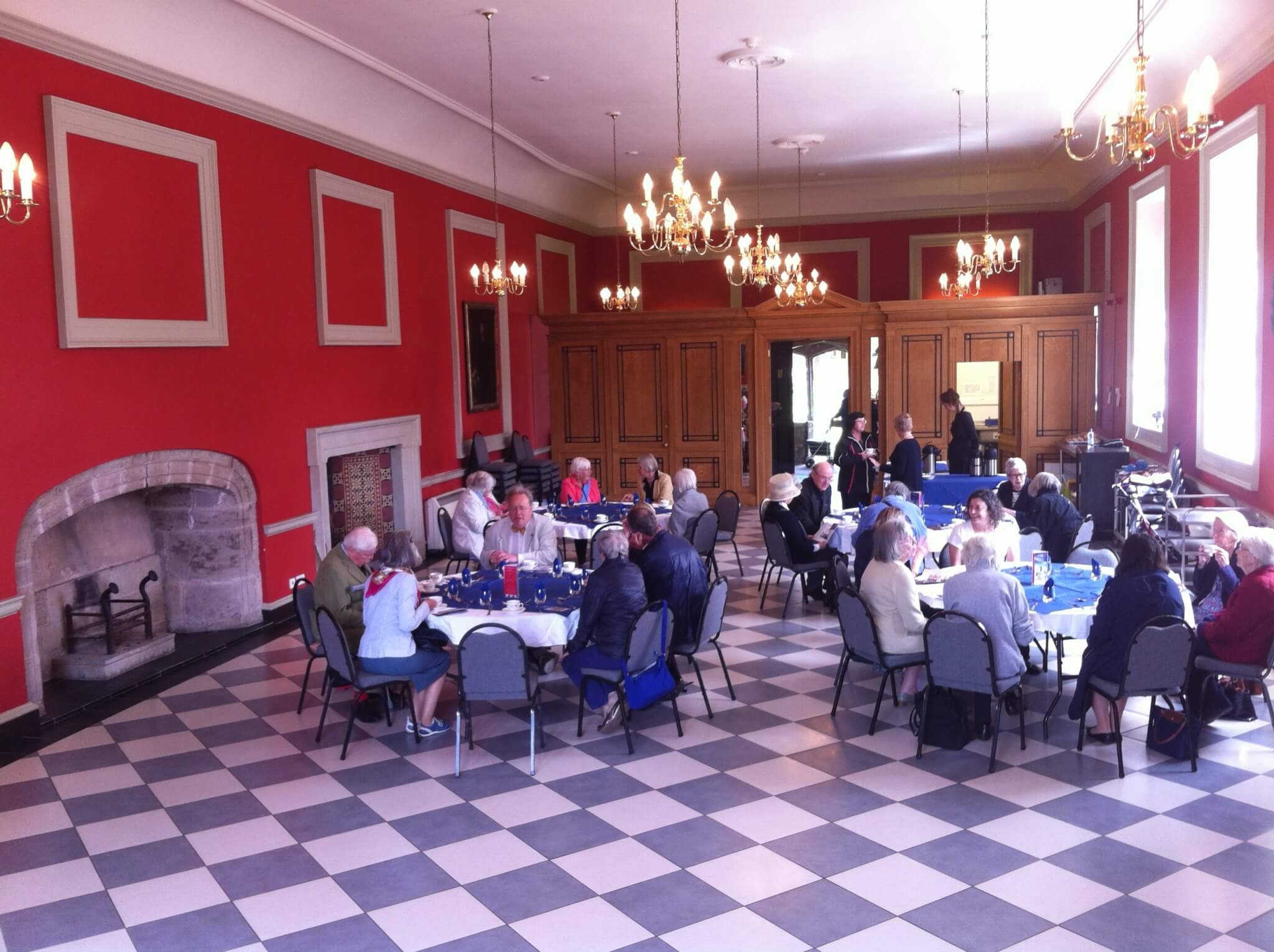
We had coffee on arrival, lunch and then afternoon tea in the Hall of the former College of the Vicars Choral - this was only dissolved as an institution in 1937 as part of the revision of the cathedral statutes. The buildings date from 1475, when the Vicars were given a residence in the Close, rather than running the hazards of walking from Castle Street late at night. The former Chapel can still be seen, as well as the Hall, whaich has been extended and modified over succeeding centuries.

hall


The Oxford pilgrims in the Hall of the Vicars Choral

We were divided into two groups so as to have a tour of the cathedral or to visit the exhibition which includes the Mappa Mundi, of circa 1300, a copy of the writ from King John accompanying the 1215 Magna Carta (the original writ is unique and onshow at the Bristish Librray exhibition this summer), a copy of the 1217 reissue of Magna Carta - considered the best surviving example - and the Chained Library, which, it was noted, houses three editions of the Annals of the Christian Church by Cardinal Baronius of the Roman Oratory. The Chained Library was installed in the late sixteenth century in the disused Lady Chapel, removed from there in the nineteenth century restoration and only finally and fully reassembled in 1996 in the new Mappa Mundi centre. It was only in those years that the original frame of the Mappa Mundi was rediscovered in a cellar - a remarkable story of survival.

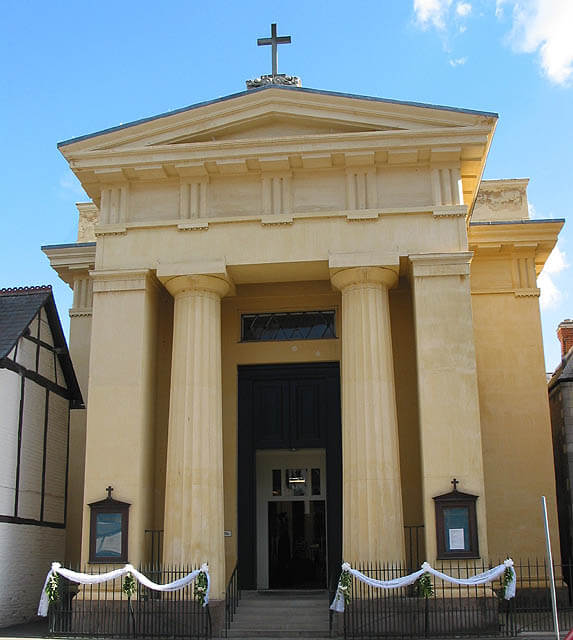
Before lunch, we were able to go to Holy Mass at the Catholic church of St Francis Xavier, in Broad Street, just next to the Cathedral.

556225_9449d1e0

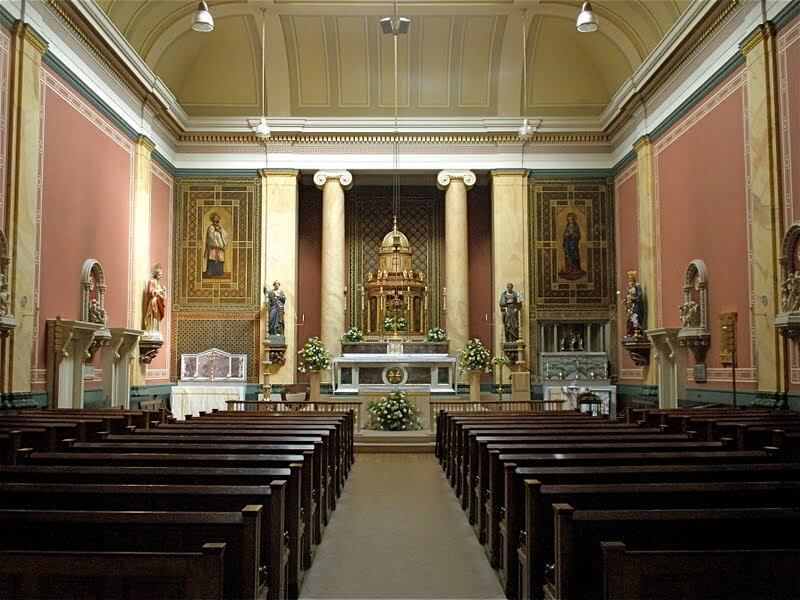
St Francis Xavier is a magnificent church, splendidly restored in recent years. Originally built by the Jesuits and opened in 1839  it has been since the 1850s in the care of the Benedictines of Belmont Abbey, which is on the western edge of the city. Dom Michael Evans, O.S.B. was most gracious in his welcome, as were his enthusiastic parishioners, who clearly have a great love for their beautiful, well-restored church. It is evident that it is open as an important act of witness in the centre of the city - they too had recently held a Corpus Christi procession through the city centre. There is more about the church at St Francis Xavier Church, Hereford

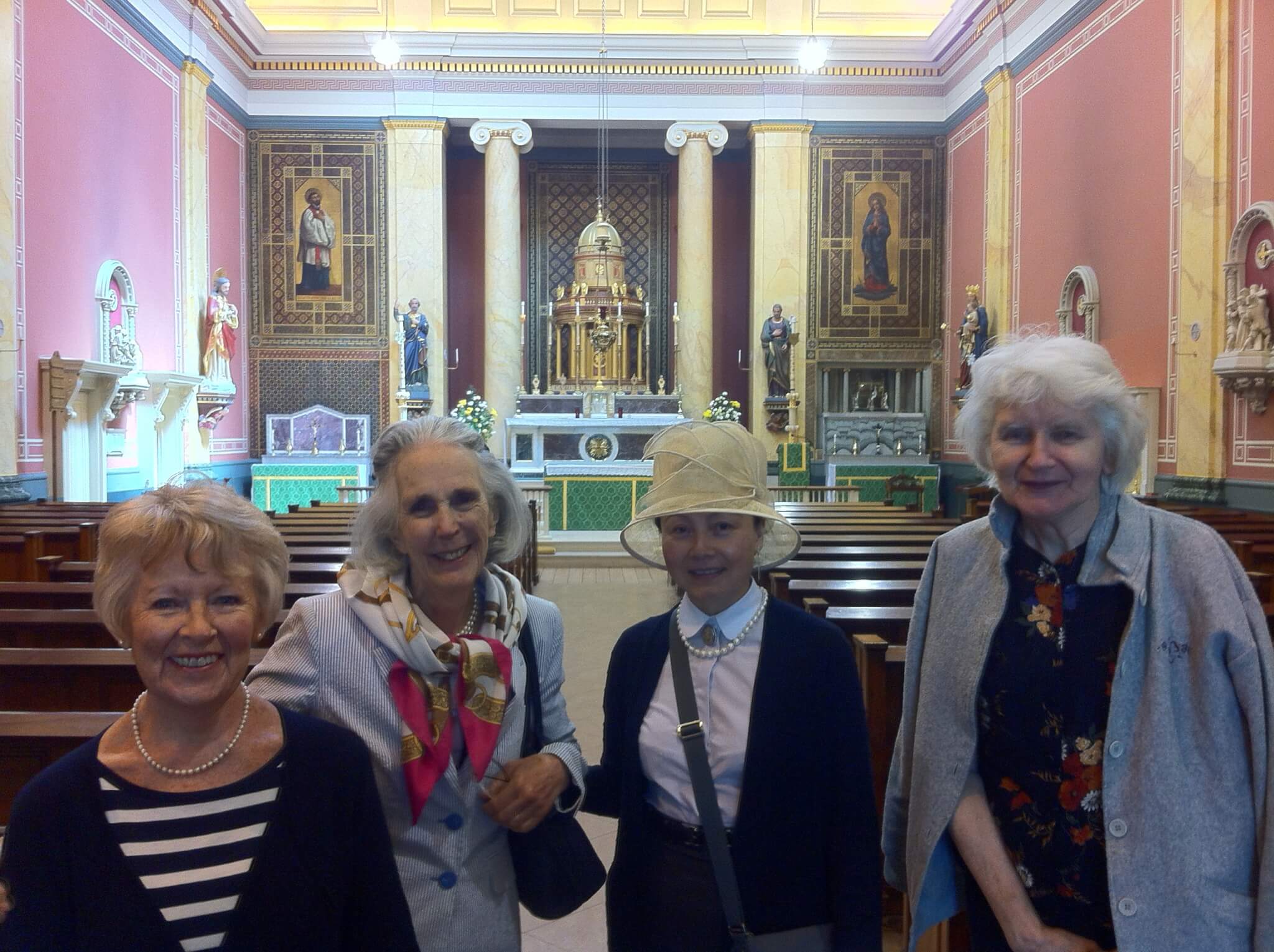
 Here are some of our group, after Mass:

sfx

To the right of the High Altar is the relic of St John Kemble, a local martyr who ministered as a priest in Herefordshire and Monmouthshire for over fifty years, before being arrested on false charges during the Popish Plot and executed on nearby Widemarsh Common on 22 August 1679. there is more about him online at  St John Kemble . A Catholic woman managed to catch his left arm as it fell from the gallows when he was quartered, and it is this relic which is preserved at St Francis Xavier. The relic is believed to have worked miracles, down to our own time.

P1010006

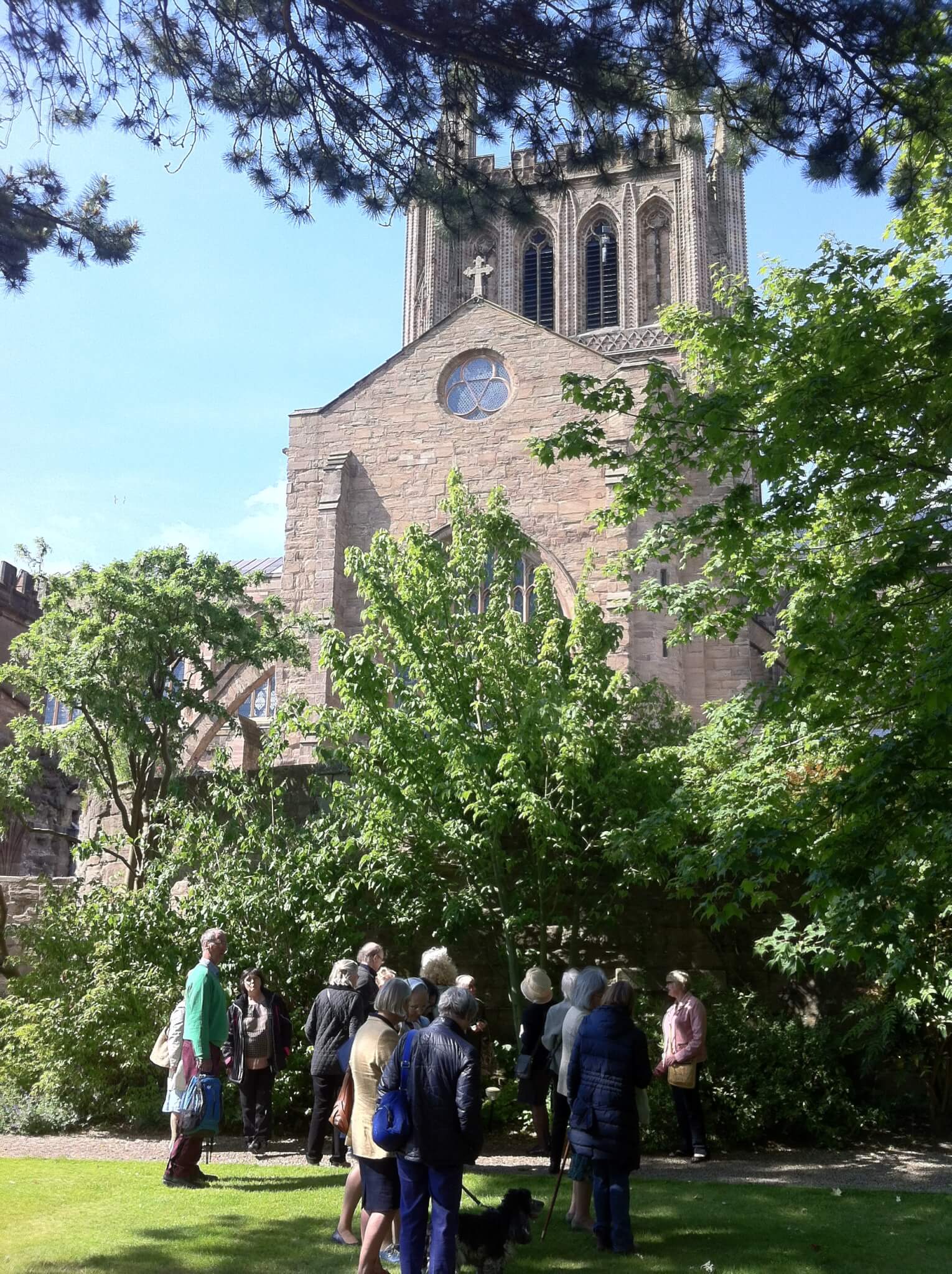
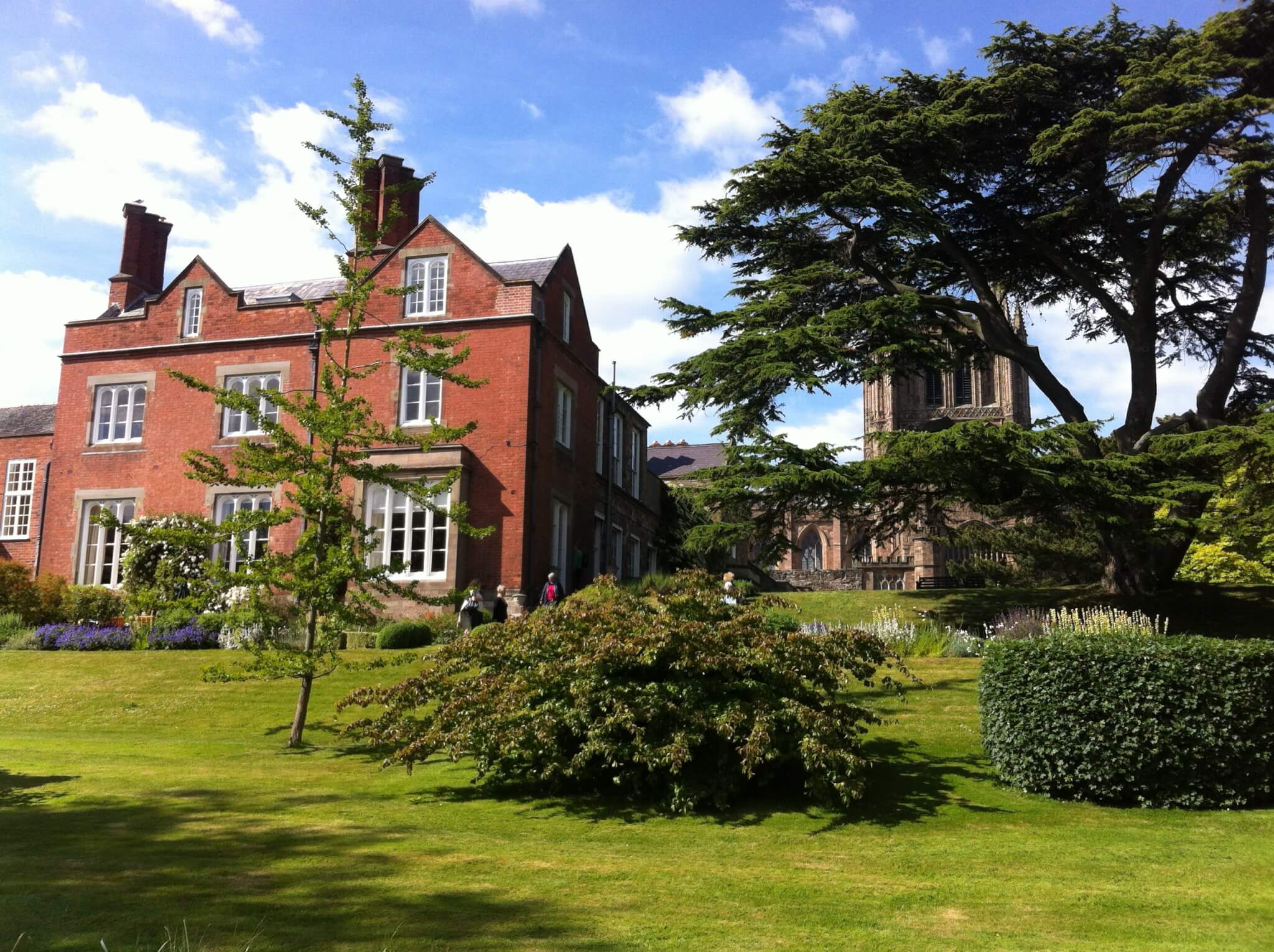
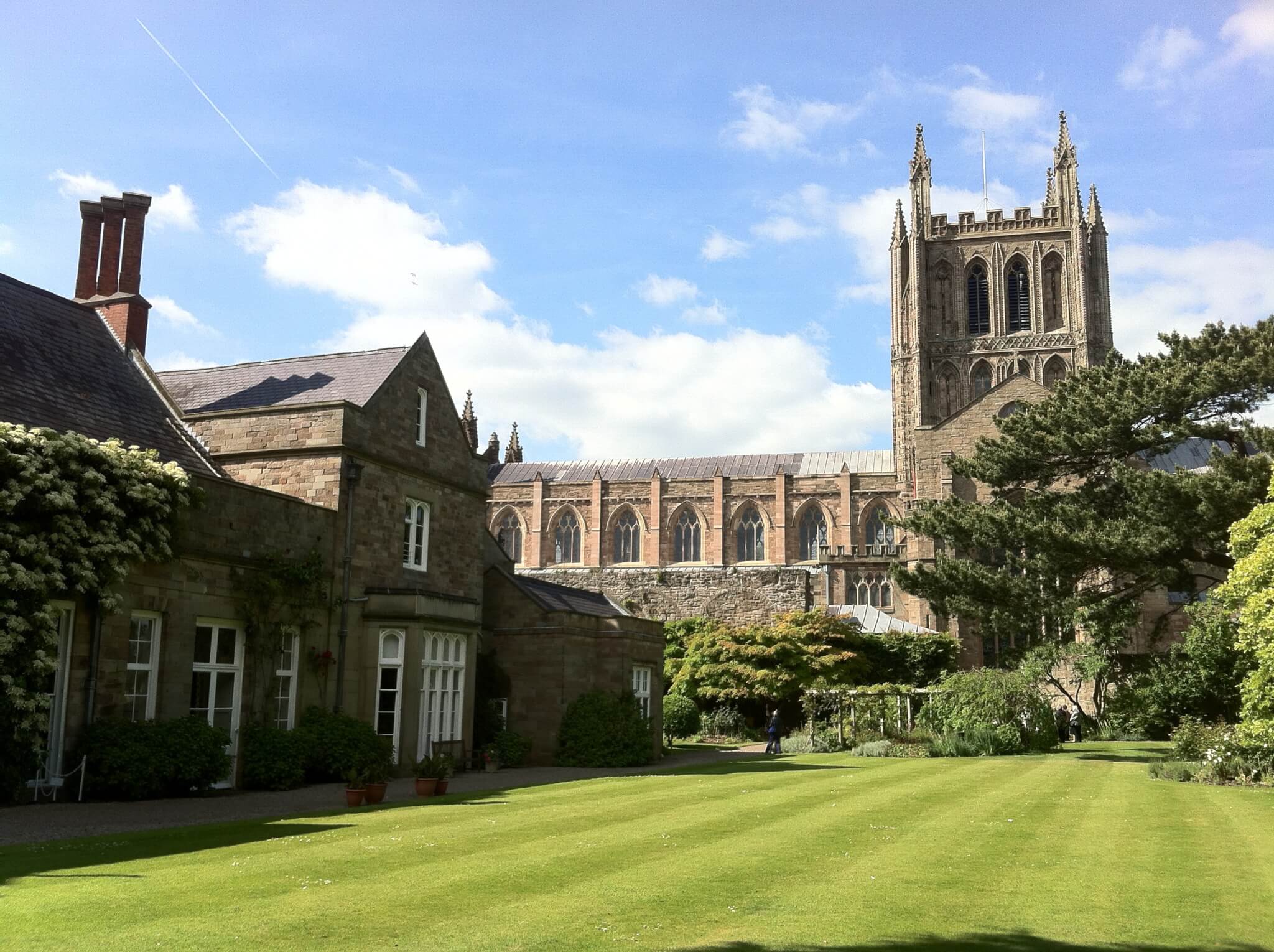
After lunch we had had the second part of our tour, either of the cathedral or the Mappa Mundi-Magna carta exhibition and then a tour of the lovely gardens, which was a great treat - especially to see the gardens of the Bishop's Palace and the Deanery.

trees

The wall behind the party is all that survives of the handsome twelfth century Bishop's chapel, "taken down" in the mid-eighteenth century - which was a bad century for the cathedral with the demolition of the remains of the late fourteenth century Chapter House in 1779, and the collapse of the west end in 1786, and the consequent disastrous "restoration" by James Wyatt, who also remocved the spire from the central tower.


Bishop garden


bishop palace

Two views in the gardens of the Bishop's Palace

After tea we attended said Evensong in the Lady Chapel. We were warmly welcomed by the Dean, The Very Reverend Michael Tavinor, and other members of the Cathedral community. Afterwards I spoke with the dean, whom i knew slightly when he was Vicar of Tewkesbury and where i spent several Christmas- New Year and summer breaks

Our journey back to Oxford was in wonderful in summer evening sunshine, which enabled one to appreciate the countryside of Herefordshire and Gloucestershire.

this was an excelelnt day out,  and quite a tonic, with plenty to see and think about historically, as well as being amongst friends. Hereford cathedral offers an excellent welcome and plenty to do, and is well worth a visit.

Images: Oxford oratory website

Monday, 8 June 2015

St William of York


June 8th is feast of St William of York, who died in 1154, and Gordon Plumb has posted the following piece, which I have slightly adapted, on the Medieval Religion discussion group:

William Fitzherbert was elected Archbishop of York by a majority of the cathedral chapter, defeating the Cistercian, Henry Murdac of Fountains Abbey. Murdac's supporters appealed to Rome on the grounds that Fitzherbert was a dissolute simoniac put into the see by King Stephen. Innocent II permitted the consecration if the charges against Fitzherbert were denied on oath. Lucian II, the next Pope but one sent him the pallium, which Fitzherbert did not bother to collect! The following Pope, the Cistercian Eugenius III suspended William on a technicality, and Murdac, now abbot of Fountains, was consecrated by Eugenius and William deposed, following the sacking of Fountains by William's supporters. William still had royal support and he went off to Winchester and lived, we are told, a saintly life. On the deaths of St Bernard, Eugenius and Murdac himself, the new Pope, Anastasius IV, reinstated William in 1153. William was reputed to have been subsequently poisoned, it is said, by the defeated party. He was canonized in 1227 by Honorius III. Miracles were reported at his tomb, including holy oil exuding from the tomb, a scene which is shown in one of the panels in the St William window in York Minster - see below.

Some images:

Oxford, Trinity College, Old Library, East windows:

York Minster, Great East window, 1f:
detail of rings embroidered on glove of St William of York:
detail, arms of St William as archbishop:

Morley, St Matthew, Derbyshire, sIII, 1c, St William with St John of Bridlington:


York Minster, nVII, St William window, in the north choir trnsept, given by Lord Ros of Helmsley castle in the fifteenth century - some details:

nVII, 22b, A man offering a leg at William's shrine:
Cripples collecting oil from William's tomb:
A released prisoner offering chains at shrine:
A woman praying at William's tomb:
Four men seeking cures at the tomb:
nVII, 1b, Robert and Richard, 4th and 5th sons of William 7th Baron Ros:
nVII, 1c, William Lord Ros and Margaret, Lady Ros:
nVII, 1e, Beatrice Dowager Lady Ros mother of William, 6th Baron Ros:
York Minster, wI, 2g-4g: St William and Sewall de Bovill:
Detail of apparel on William's alb:

York, St Michael-le-Belfrey, sVI, 2b, arms of St William in wreath:

York, St Michael-le-Belfrey, sIV, 3d-4d:
and detail:

York, Yorkshire Museum. western corner of St William's shrine, c.1471:


Oxford Corpus Christi Procession


His Grace the Archbishop of Birmingham came to Oxford to lead the Corpus Christi Procession yesterday, which attracted great crowds in a wonderful witness to our love of the Blessed Sacrament and was a tremendous sign of unity among the different parishes, religious houses and institutions of Oxford. 

I have based this post on that on the Oxford Oratory website, with afew additional comments. The occasion was indeed splendid, and , having been suffering from arthritis in one leg recently, i was delighted to be able to walk the entire procession.

The participants gather:

18547983306_9a8b554c6f_o

The marshals are briefed -n the basis of "No show without Punch" I once more donned a luminous yellow safety jacket...:

IMG_8087 (800x503)

The Franciscans prepare to carry the canopy:

18547984186_f87961d891_o

The Procession leaves the Oratory church:

18547967336_90fb587855_o

17953687193_20b6e541a7_o

 emerge
The Archbishop carries the Blessed Sacrament through St Giles':

18576414901_4a4390dfc7_o

18386580848_12db39f32e_o

IMG_8113 (800x521)

Monstrance

This year we were unable to go into Blackfriars as the church is closed for repairs, so we carried on straight to the University Chaplaincy. The Dean, Fr John Hancock, carried the Monstrance from Blackfriars to Queen Street:


Dean

blackfriars

Along St Michael's Street:

st michael


Bills

and into New Inn Hall Street:

rails


more

The Procession passes through the district of St Ebbe's - here it is crossing Queen Street:

IMG_8188 (800x521)


IMG_8196 (800x469)

Fr Dushan Croos, S.J., Chaplain to the University, carried the Blessed Sacrament for the last stage of the Procession:

croos

We had a rousing accompaniment from the Witney Town Band, conducted as is usual on this occasions by Dr Gerard Hyland, one of the the leading authorities on Pugin:

IMG_8228 (800x558)

Fr Dominic played the organ as the Blessed Sacrament was brought into the Newman Room at the Chaplaincy:

IMG_8246 (800x509)


IMG_8241 (800x533)

The Very Rev. Fr John O' Connor, O.P., Prior of Blackfriars, preached powerfully about the abiding presence of the Eucharist, and how we carried our Lord through the streets so that He might bless all the people of our city:

ser2


 ser1
His Grace gave Benediction:

Ben

 After Benediction we sang the Salve Regina and then concluded with "Faith of our Fathers":

IMG_8277 (800x568)

A welcome cup of tea at the Chaplaincy after Benediction:

IMG_8286 (800x464)

Images: courtesy of Hannah Chegwyn and Br Joseph Bailham, O.P.


King Louis XVII


Today is the 220th anniversary of the death in the Temple of King Louis XVII of France.

Louis Charles of France6.jpg 

The future King Louis XVII in 1792.

A portrait by Alexander Kucharsky

Image: Wikipedia

He was a victim of the Revolution as much as his parents - indeed more so, being  only a child. He appears as a sweet natured boy in accounts from the Constitutional period when he was known as the Prince Royal rather than as the Dauphin.

There is an online account of his life and death, and of the spurious claimants to being him here.

In recent years what was  beleived to be his heart has been shown to be genuine by DNA tests and taht has now been interred at St Denis.

As a friend of mine has opined what sort of regime is it that is based upon the systematic abuse and deathof a child as unfortunate as King Louis XVII.